Unit 1 · Topic 1.4 · about 30 minutes · 7 parts · 13 scored checks, 5 of them multiple choice
AP U.S. History 1.4: Columbian Exchange, Spanish Exploration, and Conquest
Unit 1: 4 to 6% of the multiple-choice section
What you'll be able to do
- Explain the causes of the Columbian Exchange and its effects on Europe and the Americas after 1492, and identify and describe the claim a source of the time makes.
Key vocabulary
| Term | What it means | The exam trap |
|---|---|---|
| Columbian Exchange | The movement of plants, animals and diseases between the Americas and the rest of the world that began with Columbus's voyages in 1492. | It is named for Columbus, but most of it happened after him and without anyone planning it. |
| Immunity | The protection a body builds against a disease after being exposed to it. | Immunity comes from a group's past exposure to a disease, not from strength, diet or medicine. |
| Feudalism | A system in which wealth and power rested on land, with peasants working lords' estates and owing them labor and dues. | Feudalism describes how land, labor and loyalty were tied together, not simply rule by a king. |
| Capitalism | An economic system in which private owners invest money in trade and production to earn a profit. | Europe's shift toward capitalism took centuries; do not date it to a single year or a single cause. |
| Joint-stock company | A business owned by many investors who buy shares, pool their money and share its profits and losses. | A crown could charter such a company, but the money behind it came from private investors, not the government. |
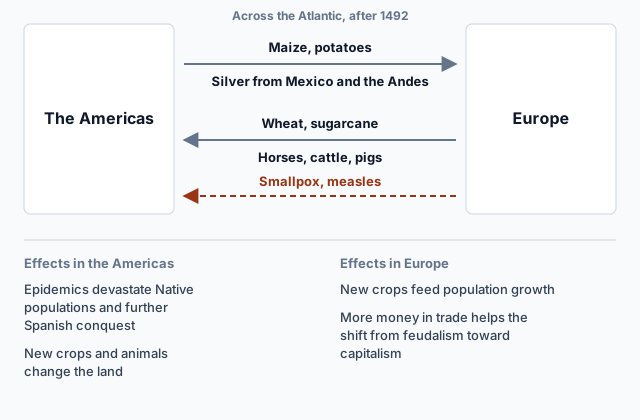 Tap to open the picture full size
Part 1 Think first What did the most damage?
Commit to a guess first. Being wrong now makes the right idea stick better.
Predict first
Before 1492 no one in Europe had grown maize or potatoes, and no one in the Americas had seen a horse or a cow. Within a few decades of Columbus's voyages, ships carried plants, animals and people back and forth across the Atlantic. Which result of this contact do you think did the most to shrink Native American populations?
In short. The Columbian Exchange was the movement of plants, animals and diseases across the Atlantic after 1492: it devastated Native populations through epidemics that helped Spanish conquest, brought new crops and animals to the Americas, and sent American crops and silver to Europe, where they fed population growth and the shift toward capitalism.
- Diseases such as smallpox, new to the Americas, killed huge numbers of Native people, and the epidemics furthered Spanish conquest; Europeans also brought wheat, sugarcane, horses, cattle and pigs.
- Crops from the Americas such as maize and potatoes helped Europe's population grow, and silver from American mines helped Europe shift from feudalism toward capitalism.
- Better ships and navigation, and joint-stock companies such as the Virginia Company of London, made long voyages possible and paid for them.
Part 2 Learn it The Columbian Exchange and its effects
2a. An exchange in both directions
The Columbian Exchange is the movement of plants, animals and diseases between the Americas and the rest of the world that began with Columbus's voyages in 1492. It ran both ways.
From the Americas, Europeans carried home new crops, among them maize (corn) and potatoes. These grew well in European fields and fed many people.
To the Americas, Europeans brought crops and animals that were not found there in 1492: wheat and sugarcane, horses, cattle and pigs. Animals that escaped or were turned loose multiplied quickly on American land.
They also brought diseases, such as smallpox and measles, that had never existed in the Americas. No one planned this part of the exchange, and it was the deadliest.
Quick check · Sort it
Tap a card, then the direction it crossed the Atlantic after 1492.
From the Americas to Europe
From Europe to the Americas
2b. Epidemics and Spanish conquest
People in the Americas had been cut off from the diseases of Europe, Africa and Asia for thousands of years. They had no immunity, the protection a body builds after exposure to a disease. When smallpox, measles and other illnesses arrived, they spread through whole communities, often ahead of the Europeans themselves. These widespread, deadly epidemics devastated Native populations.
Disease furthered Spanish conquest. Hernán Cortés reached Tenochtitlan, the Aztec capital, in 1519. Smallpox struck the city in 1520, and in 1521 the Spanish and their Native allies took it. A society losing many of its people and leaders to an epidemic was far harder to defend.
Conquest also came with the crops and animals Spain introduced. Spanish settlers planted wheat and sugarcane, and their cattle, pigs and horses spread across land that Native peoples had farmed and hunted.
Quick check · Multiple choice
Why did smallpox kill so many more Native Americans than Spaniards in the 1500s?
2c. Crops, silver and a changing Europe
In Europe, the exchange worked very differently. American crops such as maize and potatoes gave Europeans new food, and that extra food helped Europe's population grow.
The Americas also gave Europe new sources of mineral wealth. Spanish mines in Mexico and in the Andes, above all at Potosí in present-day Bolivia, produced enormous amounts of silver. It flowed to Spain and on through Europe's trade.
That silver helped change how Europe's economy worked. Under feudalism, wealth and power rested on land: lords held estates, and peasants worked them and owed the lords labor and dues. Under capitalism, private owners invest money in trade and production to earn a profit. More money moving through European markets made it easier to trade, borrow and invest, and so American silver helped Europe shift from feudalism toward capitalism. The shift took centuries, and silver was one push among several.
Quick check · Fill the statement
Complete the notes on the Columbian Exchange in Europe.
American crops such as helped Europe's population grow. Silver from American mines added to the money in European trade, helping Europe shift from , where wealth rested on land and peasants' labor, toward , where owners invest money to earn a profit.
2d. Better ships and new companies
Two other changes drove the exchange and the money it made. The first was at sea. The caravel, a small, quick ship, could sail against the wind better than older ships. Navigators used the magnetic compass for direction and the astrolabe, which measured the height of the sun or a star to find a ship's latitude. These improvements in maritime technology let Europeans cross the open ocean and come back.
The second was in how voyages were paid for. A joint-stock company sold shares to many investors, who pooled their money, split any profits and shared the losses if a venture failed. In April 1606 James I granted the First Charter of Virginia to two groups of investors. One was made up of "Knights, Gentlemen, Merchants, and other Adventurers, of our City of London and elsewhere"; the other came from Bristol, Exeter and Plymouth. An adventurer here was someone who ventured, or risked, money. The London group, the Virginia Company of London, raised its money as a joint-stock company, and its colonists founded Jamestown in 1607.
Quick check · Match
Match each term to what it was or did.
Part 3 Watch it done Identify the claim in Virginia's mines clause
Watch each step, then do the last one yourself.
The First Charter of Virginia, granted by James I on April 10, 1606, lets the colonies "dig, mine, and search for all Manner of Mines of Gold, Silver, and Copper." The colonists may keep what they find, apart from "the fifth Part only of all the same Gold and Silver" and a smaller share of the copper, owed to the king. Identify and describe the claim this clause makes about what the colony might produce.
Predict first
Before the steps: had English colonists found gold or silver in Virginia by April 1606?
Step 1 · Place it in time
The charter is dated April 10, 1606. Its colonists founded Jamestown the next year, in 1607, so no English colonist was yet living there. By then Spain had drawn silver from mines in Mexico and the Andes for decades.
Why this step?
Why does the date matter for finding the claim?
A clause written before anyone arrived cannot be reporting what was found. It can only state what its authors hoped for and how they meant to divide it, which is a different kind of claim.
Step 2 · Read the verbs and the terms
The colonies may "dig, mine, and search." Searching is what you do for something not yet found. And the king fixes his share, "the fifth Part only of all the same Gold and Silver," before a single ounce exists.
Your step · Decide and justify
Finish it. Which description of the clause's claim fits best?
Which evidence from the charter best supports your answer?
Part 4 Try it Finding a line at sea
The Treaty of Tordesillas of June 7, 1494, divided newly found lands between Spain and Portugal at a line "three hundred and seventy leagues west of the Cape Verde Islands." But no one could see a line on the ocean. So the treaty's third article says each kingdom will send ships, "two or four caravels" in all, carrying "pilots, astrologers, sailors," so that they may "jointly study and examine to better advantage the sea, courses, winds, and the degrees of the sun or of north latitude." In this old translation, astrologers means people who studied the sky; today we would say astronomers.
Try it · Multiple choice
Which claim does this article of the treaty make?
Part 5 Explain it Write it like a document-based answer
Nothing you type leaves this page. Check your answer against the model and each scoring point.
Free-response practice · Question 1 style
A short practice in the shape of the document-based question: three documents instead of seven, and a thesis with one body paragraph instead of a full essay.
Evaluate the extent to which the way European ventures in the Americas were paid for and organized changed between 1492 and 1606.
Document 1. Ferdinand and Isabella of Spain, grant to Christopher Columbus, April 30, 1492: Columbus and his men "are going by our command, with some of our vessels and men."
Document 2. Henry VII of England, letters patent to John Cabot and his sons, 1490s: they may sail "vpon their owne proper costs and charges" (spelling as printed) to find and claim lands for England.
Document 3. James I of England, First Charter of Virginia, April 10, 1606: the first of the charter's two colonies is granted to "Knights, Gentlemen, Merchants, and other Adventurers, of our City of London and elsewhere" (the second goes to investors of Bristol, Exeter and Plymouth); the colonies may "dig, mine, and search for all Manner of Mines of Gold, Silver, and Copper," owing the king "the fifth Part only of all the same Gold and Silver."
Write a thesis, one sentence of historical context, and one paragraph that uses at least two documents and explains the purpose, audience, point of view or situation of one of them.
Model answer
Thesis: Between 1492 and 1606 European ventures changed a great deal in who paid for them, moving from voyages commanded and partly equipped by a crown to colonies funded by groups of private investors in joint-stock companies, though crowns still licensed every venture and claimed a share of any precious metals.
Context: during the 1500s silver from Spain's mines in Mexico and the Andes flowed through European trade, helping Europe shift from feudalism toward capitalism and making investors eager for American profits.
In 1492 Columbus sailed "by our command, with some of our vessels and men" (Document 1), a voyage under royal command that sailed partly in the crown's vessels. Only a few years later Henry VII licensed Cabot to sail "vpon their owne proper costs and charges" (Document 2), so the king granted permission but left the cost and risk to private adventurers. By 1606 the risk was spread among many "Knights, Gentlemen, Merchants, and other Adventurers" of London and elsewhere, and of other English towns (Document 3), investors who raised money the way a joint-stock company does. Because Document 3 is a royal charter written before any colonist sailed, its mines clause shows what the crown and investors hoped to find, not what they found; the king still fixed his fifth of the gold and silver in advance. Private money grew in importance, but royal control and the hope of mineral wealth continued.
Score your own answer. This is a self-check, not a grade. Tick each point your answer makes.
Part 6 Check yourself Reading the exchange
The case questions use the table. The others mix the ideas from the whole lesson.
The table sorts what crossed the Atlantic after 1492, as this lesson describes it.
| Row | What crossed | Direction |
|---|---|---|
| 1 | Wheat, sugarcane, horses, cattle and pigs | Europe to the Americas |
| 2 | Smallpox, measles and other diseases | Europe to the Americas |
| 3 | Silver from mines in Mexico and the Andes | The Americas to Europe |
| 4 | Maize, potatoes and other crops | The Americas to Europe |
Case question 1 · Multiple choice
A historian claims that the Columbian Exchange helped Europe's population grow. Which row best supports that claim?
Case question 2 · Multiple choice
Another historian claims that Spanish conquest succeeded through more than force of arms. Which row best supports that claim?
The rest stand on their own and do not use the case.
Check yourself · Spot the error
A student writes a paragraph on the Columbian Exchange. Which line is the first to go wrong?
Check yourself · Put it in order
Put these events in the order they happened, earliest first.
Check yourself · Select all
Which two developments helped Europe's economy shift from feudalism toward capitalism? Select two.
Select 2 answers, then check.
Part 7 Keep it Bring back earlier ideas
This lesson stands on why Europeans crossed the Atlantic, from Topic 1.3, and the native societies already in North America, from Topic 1.2.
Bring it back · Multiple choice
A historian argues that European nations explored the Americas only to spread Christianity. Which evidence most weakens that argument?
Bring it back · Fill the statement
Complete the sentences about native societies before European contact.
In the Northeast, the Mississippi River Valley and along the Atlantic seaboard, some societies mixed farming with hunting and gathering, which favored . In the Northwest and present-day California, some societies developed settled communities supported by the vast resources of the .
In three lines
- The Columbian Exchange ran both ways: maize, potatoes and silver went to Europe; wheat, sugarcane, horses, cattle, pigs and deadly diseases came to the Americas.
- Epidemics to which Native peoples had no immunity devastated their populations and furthered Spanish conquest.
- American crops fed Europe's population growth, American silver helped the shift from feudalism toward capitalism, and better ships and joint-stock companies drove the trade.
Exam strategy for this topic
- Section I Part A, Multiple Choice: 55 questions in 55 minutes.
- Section I Part B, Short Answer: 3 questions in 40 minutes.
- Section II, Document-Based Question and Long Essay: 2 questions in 100 minutes.
- This lesson's Explain it is shaped like free-response question 1, Document-based.
When a question asks you to identify a claim in a source, say in your own words what the author asserts, then point to the exact words that show it; a claim is what the source argues or expects, not just a topic it mentions.
Questions students ask
What was the Columbian Exchange?
The movement of plants, animals and diseases across the Atlantic that began with Columbus's voyages in 1492. Maize and potatoes went to Europe; wheat, sugarcane, horses, cattle, pigs and diseases such as smallpox came to the Americas.
Why were European diseases so deadly in the Americas?
Native Americans had never been exposed to diseases such as smallpox and measles, so they had no immunity. Widespread epidemics devastated Native populations, often before Europeans themselves arrived in an area.
How did American silver change Europe?
Silver from Spanish mines in Mexico and the Andes flowed through European trade. More money in circulation made trading, borrowing and investing easier and helped Europe shift from feudalism toward capitalism.
What was a joint-stock company?
A business owned by many investors who pooled their money and shared the profits and losses. The Virginia Company of London, chartered in 1606, was one; its colonists founded Jamestown in 1607.
Why does the lesson quote no source on the epidemics themselves?
Every quotation on this site is checked word for word against a primary-source archive. The lesson quotes the treaties and charters it has checked, and it teaches the epidemics and the crops from the AP course framework in its own words.
Course alignment, for teachers
AP U.S. History topic 1.4, Unit 1: Period 1: 1491–1607.
- Skill 3.A: Identify and describe a claim and/or argument in a text-based or non-text-based source.
This lesson maps all 3 essential knowledge statements of the topic, and the one learning objective with none of its own, to the part that teaches each one: 4 are checked by a scored question. The map is in the lesson file.