Unit 9 · Topic 9.4 · about 30 minutes · 7 parts · 13 scored checks, 5 of them multiple choice
AP U.S. History 9.4: A Changing Economy
Unit 9: 4 to 6% of the multiple-choice section
What you'll be able to do
- Explain the causes and effects of economic and technological change in the United States after 1980, and read what presidents said about that change for its purpose and point of view.
Key vocabulary
| Term | What it means | The exam trap |
|---|---|---|
| Real wages | Pay measured after price changes are taken into account, so it shows what pay can actually buy. | A raise in dollars is not a raise in real wages if prices rose as fast. |
| Service sector | The part of the economy that sells services rather than made goods, such as retail, health care, banking, teaching and software. | Service jobs include high-paid professions as well as low-paid ones, so do not equate service with low pay. |
| Productivity | The amount of goods and services produced for each hour of work. | Rising productivity describes output per hour, not what workers are paid for that hour. |
| Economic inequality | The gap between those with the most income and wealth and everyone else. | Inequality can grow even while the economy as a whole is growing. |
| Union membership | The share of workers who belong to a labor union, an organization that bargains with employers for its members' wages and conditions. | A fall in union membership is not the same thing as a fall in factory jobs. |
 Tap to open the picture full size
Part 1 Think first From horseback to broadcast
Commit to a guess first. Being wrong now makes the right idea stick better.
Predict first
At his first inauguration, on January 20, 1993, Bill Clinton said that in George Washington's day "news traveled slowly across the land by horseback and across the ocean by boat." Now "the sights and sounds of this ceremony are broadcast instantaneously to billions around the world." As communications and business went worldwide after 1980, what do you think happened to the kinds of jobs Americans held?
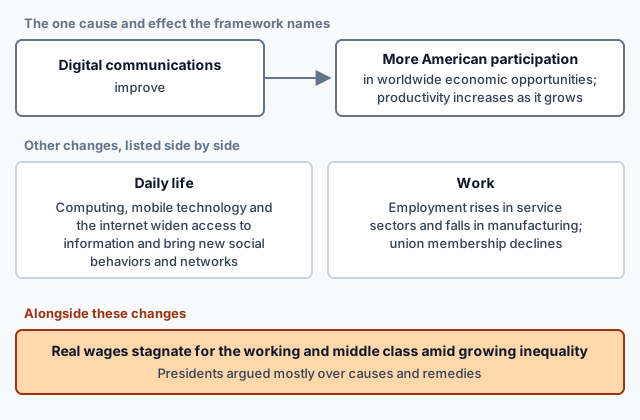
In short. After 1980, digital communications and new technology drew Americans into a worldwide economy and changed daily life, while jobs moved from manufacturing to services, union membership declined, and real wages stagnated for the working and middle class amid growing inequality, trends presidents described in different ways.
- Improvements in digital communications let Americans take part in more economic opportunities around the world, and economic productivity increased.
- Computing, mobile technology and the internet transformed daily life, widened access to information, and led to new social behaviors and networks.
- Employment grew in service sectors and fell in manufacturing, union membership declined, and real wages stagnated for the working and middle class as economic inequality grew.
Part 2 Learn it A changing economy after 1980
2a. Digital communications and a worldwide market
Clinton's 1993 address went on from the broadcast to the economy: "Communications and commerce are global; investment is mobile; technology is almost magical; and ambition for a better life is now universal. We earn our livelihood in peaceful competition with people all across the earth."
The course framework describes the same development as a process. Improvements in digital communications, ways of sending words, numbers and pictures electronically, let Americans take part in more economic opportunities around the world. Clinton's own example is money: "investment is mobile." As that participation grew, economic productivity, the amount produced for each hour of work, increased.
Read Clinton's sentence as a source, too. A new president at his inauguration speaks to the whole nation and sets out the problems he means to solve. His phrase "peaceful competition" names both sides of the change: a worldwide market was a chance to sell and a field of rivals.
Source: Clinton, First Inaugural Address, 1993 (Avalon Project).
Quick check · Multiple choice
Clinton said in 1993 that "Communications and commerce are global." According to the course framework, what did improvements in digital communications make possible after 1980?
2b. Computers, phones and the internet in daily life
Innovations in computing, digital mobile technology (phones and devices that carry the internet with them) and the internet itself transformed daily life. They increased access to information and led to new social behaviors and networks.
In his second inaugural address, on January 20, 1997, Clinton put the speed of the change in one sentence: "Ten years ago, the Internet was the mystical province of physicists; today, it is a commonplace encyclopedia for millions of schoolchildren." He called on Americans to "shape the forces of the Information Age and the global society."
He also made promises, among them that "the doors of higher education will be open to all." Notice the verb. The first sentence describes what had happened; this one says what will be. A promise in a speech is evidence of a goal, not proof that the goal was met.
Source: Clinton, Second Inaugural Address, 1997 (Avalon Project).
Quick check · Sort it
Each card is a change that came with computers, phones and the internet. Tap a card, then the effect it shows best.
Wider access to information
New social behaviors and networks
2c. Service jobs up, factory jobs and unions down
The kinds of work Americans did changed too. The course framework names three trends:
- Employment increased in service sectors, work that sells a service rather than a made good, such as retail, health care, banking, teaching and software.
- Employment decreased in manufacturing, the making of goods in factories.
- Union membership, the share of workers who belong to a labor union, declined.
Compare this with Topic 8.4. After 1945 a booming private sector, federal spending, the baby boom and new technology spurred economic growth. After 1980 the job growth the framework names came in services, while manufacturing employment fell.
The framework lists these trends side by side and does not rank their causes. So when you explain them, name the evidence for any cause you give, and do not treat a trend in jobs as proof of a trend in wages. The next section takes up wages.
Quick check · Fill the statement
Complete a student's summary of how American work changed after 1980.
Employment grew in and shrank in , and declined.
2d. Wages, inequality and a debate
Real wages are pay measured after price changes: what pay can buy. The course framework says real wages stagnated for the working and middle class amid growing economic inequality.
Presidents argued mostly over causes and remedies, amid policy debates over free trade, the safety net and financial reform.
- Ronald Reagan, January 21, 1985: "Freedom and incentives unleash the drive and entrepreneurial genius that are the core of human progress."
- Bill Clinton, January 20, 1993, taking over from President Bush: "we inherit an economy that is still the world's strongest, but is weakened by business failures, stagnant wages, increasing inequality, and deep divisions among our people." The new world, he added, "has already enriched the lives of millions of Americans who are able to compete and win in it," while "most people are working harder for less." Naming weaknesses also made the case for his own program.
- George W. Bush, January 20, 2001: "While many of our citizens prosper, others doubt the promise, even the justice, of our own country. The ambitions of some Americans are limited by failing schools and hidden prejudice and the circumstances of their birth."
- Barack Obama, January 20, 2009: the market's "power to generate wealth and expand freedom is unmatched," but "without a watchful eye, the market can spin out of control and that a nation cannot prosper long when it favors only the prosperous."
Sources: Reagan, 1985; Clinton, 1993; Bush, 2001; Obama, 2009.
Quick check · Match
Match each president's words to the claim they make about the economy.
Part 3 Watch it done Explain a change with Clinton's 1997 address
Watch each step, then do the last one yourself.
On January 20, 1997, Clinton said: "Ten years ago, the Internet was the mystical province of physicists; today, it is a commonplace encyclopedia for millions of schoolchildren." Use the sentence to explain how the internet changed Americans' access to information.
Predict first
Before the steps, what do you think the sentence shows changing?
Step 1 · State the development
The course framework says innovations in computing, mobile technology and the internet transformed daily life and increased access to information.
Why this step?
Why name the development before reading the quotation?
A quotation is evidence, not an explanation. Naming the development first tells you what the evidence has to show, so you read the words for that.
Step 2 · Read the sentence for before and after
Clinton sets two moments side by side: ten years earlier, and 1997. He is celebrating at the start of his second term, and "physicists" stands for a small group of researchers, so read the sentence as his claim about who used the internet, not as a count.
Your step · Decide and justify
Finish it. What does Clinton's sentence show about the internet's effect on access to information?
Which evidence from the same address best supports your answer?
Part 4 Try it Digital lines beside roads and bridges
Barack Obama took office on January 20, 2009, during an economic crisis. His inaugural address said the country's capacity had not shrunk: "Our workers are no less productive than when this crisis began." Then he listed what the government would build: "We will build the roads and bridges, the electric grids and digital lines that feed our commerce and bind us together."
Try it · Multiple choice
What does Obama's plan to build "digital lines" alongside roads, bridges and electric grids show about how he saw digital communications in 2009?
Try it · Spot the error
A student writes a paragraph on the excerpts from Obama's 2009 address. Which line is the first to go wrong?
Part 5 Explain it Write it like a document-based answer
Nothing you type leaves this page. Check your answer against the model and each scoring point.
Free-response practice · Question 1 style
A short practice in the shape of the document-based question: three documents instead of seven, and a thesis with one body paragraph instead of a full essay.
Evaluate the extent to which digital technology changed American economic life from 1993 to 2009.
Document 1. Bill Clinton, First Inaugural Address, January 20, 1993: "Communications and commerce are global; investment is mobile; technology is almost magical; and ambition for a better life is now universal. We earn our livelihood in peaceful competition with people all across the earth." And: "we inherit an economy that is still the world's strongest, but is weakened by business failures, stagnant wages, increasing inequality, and deep divisions among our people."
Document 2. Bill Clinton, Second Inaugural Address, January 20, 1997: "Ten years ago, the Internet was the mystical province of physicists; today, it is a commonplace encyclopedia for millions of schoolchildren."
Document 3. Barack Obama, Inaugural Address, January 20, 2009: "We will build the roads and bridges, the electric grids and digital lines that feed our commerce and bind us together." And, of the market: "Its power to generate wealth and expand freedom is unmatched, but this crisis has reminded us that without a watchful eye, the market can spin out of control and that a nation cannot prosper long when it favors only the prosperous."
Write a thesis, one sentence of historical context, and one paragraph that uses at least two documents and explains the purpose, audience, point of view or situation of one of them.
Model answer
Thesis: From 1993 to 2009 digital technology greatly changed how Americans did business and found information, making a worldwide market and the internet part of ordinary economic life, but presidents at both ends of the period still worried about who shared in the gains.
Context: in these years employment shifted from manufacturing to service sectors and union membership declined, so the economy that new technology was changing was also changing in the kinds of work people did.
In 1993 Clinton described commerce as "global" and investment as "mobile," with Americans in "peaceful competition with people all across the earth" (Document 1). By 1997 he said the internet had gone from "the mystical province of physicists" to "a commonplace encyclopedia for millions of schoolchildren" (Document 2), a fast spread of access to information. By 2009 Obama listed "digital lines" with roads and electric grids as things that "feed our commerce" (Document 3). Each document is an inaugural address, given to the whole nation by a president setting out his plans; Clinton's 1997 claim celebrates progress at the start of his second term and does not show who still lacked access. What did not change was the worry about who gained: Clinton in 1993 named "stagnant wages, increasing inequality" (Document 1), and Obama in 2009 warned that "a nation cannot prosper long when it favors only the prosperous" (Document 3).
Score your own answer. This is a self-check, not a grade. Tick each point your answer makes.
Part 6 Check yourself Three presidents on prosperity and opportunity
The case questions use the three excerpts. The others mix the ideas from the whole lesson.
Each excerpt comes from an inaugural address, spoken to the whole nation at the start of a presidential term. Sources: Reagan, 1985; Clinton, 1993; Bush, 2001 (Avalon Project).
| Address | Excerpt |
|---|---|
| Ronald Reagan, January 21, 1985 | "Freedom and incentives unleash the drive and entrepreneurial genius that are the core of human progress." |
| Bill Clinton, January 20, 1993 | "we inherit an economy that is still the world's strongest, but is weakened by business failures, stagnant wages, increasing inequality, and deep divisions among our people" |
| George W. Bush, January 20, 2001 | "While many of our citizens prosper, others doubt the promise, even the justice, of our own country. The ambitions of some Americans are limited by failing schools and hidden prejudice and the circumstances of their birth." |
Case question 1 · Multiple choice
Clinton names "stagnant wages." Which situation fits the trend the course framework describes for the real wages of the working and middle class?
Case question 2 · Multiple choice
What concern do Clinton's 1993 excerpt and Bush's 2001 excerpt most directly share?
The rest stand on their own and do not use the case.
Check yourself · Select all
Which two describe trends in American work that the course framework names for the years after 1980? Select two.
Select 2 answers, then check.
Check yourself · Decide and justify
After 1980, Americans took part in more economic opportunities around the world. What does the course framework name as making this possible?
Which evidence from this lesson best supports your answer?
Part 7 Keep it Bring back earlier ideas
This lesson stands on Reagan's conservative economic policies from Topic 9.2 and the postwar boom from Topic 8.4.
Bring it back · Multiple choice
Ronald Reagan's victory in the 1980 presidential election allowed conservatives to enact which economic policies?
Bring it back · Fill the statement
Read the situation, then complete the sentences.
A historian explains American economic growth after 1945. Along with federal spending and new technology, she points to a population change, the , and to growth outside government, in a burgeoning .
In three lines
- Digital communications drew Americans into more worldwide economic opportunities, and productivity increased.
- Computing, mobile technology and the internet changed daily life, widened access to information and created new social networks.
- Employment shifted from manufacturing to services, union membership declined, and real wages stagnated for the working and middle class amid growing inequality.
Exam strategy for this topic
- Section I Part A, Multiple Choice: 55 questions in 55 minutes.
- Section I Part B, Short Answer: 3 questions in 40 minutes.
- Section II, Document-Based Question and Long Essay: 2 questions in 100 minutes.
- This lesson's Explain it is shaped like free-response question 1, Document-based.
When you explain an economic change, state the development, then one cause and one effect, and keep each trend's direction exact: real wages stagnated; they did not simply fall.
Questions students ask
What did presidents disagree about?
The course framework states the trend: real wages stagnated for the working and middle class amid growing economic inequality. Presidents differed mainly over causes and remedies. Reagan in 1985 credited freedom and incentives with driving progress, and Bush in 2001 pledged that "we will reduce taxes, to recover the momentum of our economy and reward the effort and enterprise of working Americans." Clinton in 1993 named stagnant wages and increasing inequality, and Obama in 2009 warned that the market needs a watchful eye. The framework notes continuing policy debates over free trade, the social safety net and financial reform. Attribute each view to its speaker.
Why does this lesson print no wage, job or union figures?
Every claim here comes from the course framework or from a primary source linked beside it, and those sources describe the trends in words. If you use figures, take them from a government statistics agency and say what each one measures.
Is the service sector the same as low-paid work?
No. Service work sells a service rather than a made good, and it includes doctors, bankers and software writers as well as retail clerks. The trend the course framework names is in where people worked: more in services, fewer in manufacturing.
How is this different from the economy after 1945 in Topic 8.4?
After 1945 a burgeoning private sector, federal spending, the baby boom and new technology spurred economic growth. After 1980 employment shifted toward services, union membership declined, and real wages stagnated for the working and middle class.
Where can I read these speeches in full?
Each excerpt links to its full text at the Avalon Project at Yale Law School, the primary-source collection this lesson was checked against.
Course alignment, for teachers
AP U.S. History topic 9.4, Unit 9: Period 9: 1980–Present.
- Skill 1.B: Explain a historical concept, development, or process.
This lesson maps all 4 essential knowledge statements of the topic, and the one learning objective with none of its own, to the part that teaches each one: 5 are checked by a scored question. The map is in the lesson file.