Unit 7 · Topic 7.10 · about 30 minutes · 7 parts · 13 scored checks, 5 of them multiple choice
AP U.S. History 7.10: The New Deal
Unit 7: 10 to 17% of the multiple-choice section
What you'll be able to do
- Explain how the Great Depression and the New Deal changed American political, social and economic life over time, from relief programs and new regulation to a lasting shift in who voted Democratic.
Key vocabulary
| Term | What it means | The exam trap |
|---|---|---|
| New Deal | Franklin Roosevelt's programs, beginning in 1933, that used federal power to respond to the Great Depression. | It was a changing set of laws shaped by pressure from many sides, not one plan fixed in 1933. |
| Relief, recovery and reform | The three aims of the New Deal: help for people in need now, a restart of business and farming, and new rules to make the economy safer. | These are aims, and one program can serve more than one of them. |
| Collective bargaining | Workers negotiating wages and conditions with an employer as a group, through representatives they choose. | It is a right to negotiate as a group, not a guarantee that workers win what they ask. |
| Political realignment | A lasting shift in which groups of voters support which party. | One landslide election is not a realignment; the change has to last. |
| Populist | A politician or movement that claims to speak for ordinary people against the wealthy and powerful. | In the 1930s the word describes a style of politics, not membership in the Populist Party of the 1890s. |
 Tap to open the picture full size
Part 1 Think first What would you do first?
Commit to a guess first. Being wrong now makes the right idea stick better.
Predict first
It is March 4, 1933. Millions of Americans are out of work, banks have failed and farm prices have collapsed. The new president, Franklin Roosevelt, tells the country in his inaugural address that "the only thing we have to fear is fear itself." Which plan do you think he announced?
In short. The New Deal was Franklin Roosevelt's attempt, from 1933, to end the Great Depression by using federal power to give relief to the poor, stimulate recovery and reform the economy; it did not end the Depression, but it left lasting agencies and drew many working-class, ethnic and African American voters to the Democratic Party.
- Roosevelt's first programs aimed at relief, recovery and reform at once, from public jobs to new rules for banking and industry.
- Radical, union and populist movements pushed Roosevelt further, while conservatives in Congress and on the Supreme Court worked to limit what the New Deal could do.
- Programs such as Social Security and the National Labor Relations Board outlasted the Depression, and the coalition of voters the New Deal built lasted for decades.
Part 2 Learn it What the New Deal did, and what it left
2a. Relief, recovery and reform
Franklin Roosevelt's New Deal tried to end the Great Depression by using government power for three aims at once.
Relief was help for people in need right away: direct aid, and public jobs that paid wages to the unemployed.
Recovery meant getting farms and businesses producing and selling again. The National Industrial Recovery Act of June 1933 was written "to encourage national industrial recovery, to foster fair competition." It set up the National Recovery Administration, which supervised codes of fair competition for whole industries.
Reform meant changing the rules of the economy so a crash like 1929 would be less likely, and so ordinary people had protection the market had not given them. Roosevelt's inaugural promised supervision of banking and an end to speculation with other people's money.
One program could serve more than one aim. The Tennessee Valley Authority, created in May 1933, built dams to control flooding, improve navigation and produce cheap electric power in a poor region. The National Archives notes that the power drew industry: "Electricity also drew industries to the region, providing desperately needed jobs."
Sources: First Inaugural Address, 1933 (Avalon Project); National Industrial Recovery Act (National Archives); Tennessee Valley Authority Act (National Archives).
Quick check · Sort it
Each card is a New Deal aim or measure. Tap a card, then the aim it serves most directly.
Relief
Recovery
Reform
2b. Pushed from one side, checked from the other
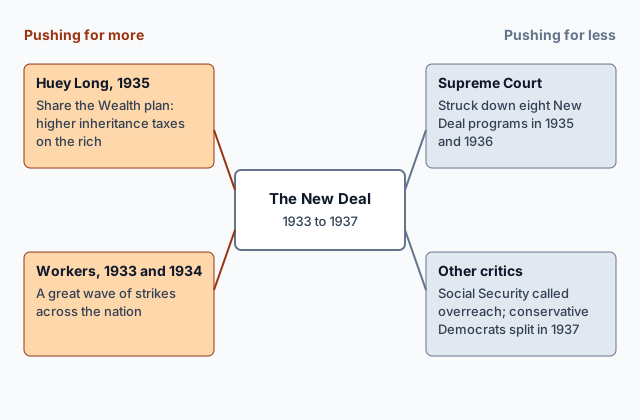
The New Deal was pushed and pulled from both sides.
Pressure for more. Huey Long, a Louisiana governor elected to the Senate in 1930, was a radical populist, in the National Archives' words. His Share the Wealth plan would raise inheritance taxes on the rich to "guarantee a family wealth of around $5,000; enough for a home and automobile, a radio, and the ordinary conveniences." In a 1935 radio speech he explained why he no longer supported Roosevelt. Workers pressed too: in 1933 and 1934 a great wave of strikes crossed the nation. In July 1935 Roosevelt signed the National Labor Relations Act, or Wagner Act, which guaranteed workers "the right to self-organization, to form, join, or assist labor organizations, to bargain collectively through representatives of their own choosing." Old-age benefits and unemployment insurance came the next month with the Social Security Act.
Pressure for less. The National Archives notes opposition to Social Security from those who considered it "governmental overreach into the private sphere." In 1935 and 1936 the Supreme Court struck down eight New Deal programs, among them the National Recovery Act and the Agricultural Adjustment Act. In 1937 Roosevelt asked Congress to add a justice for every justice over 70 who refused to retire, up to 15. Conservative Democrats joined Republicans, and the plan failed.
Sources: Huey Long recording (National Archives); National Labor Relations Act (National Archives); Social Security Act (National Archives); The 1937 Court plan (National Archives).
Quick check · Multiple choice
In 1933 and 1934 a great wave of strikes crossed the nation. In 1935 Congress passed the Wagner Act guaranteeing workers the right to organize and bargain collectively. Which statement best explains how the two developments are related?
2c. What lasted
The New Deal did not end the Depression. Some programs worked against recovery: the National Archives judges that the recovery codes "did little to help recovery, and by raising prices, they actually made the economic situation worse."
What it left was a legacy of reforms and regulatory agencies. The Social Security Act created old-age benefits and unemployment insurance. The National Labor Relations Board, created by the Wagner Act, still works to this day, the National Archives notes, and the act "made labor a force to be reckoned with both politically and economically." The Tennessee Valley Authority survived too: "Today, TVA is the largest public power company in the United States."
It also changed politics. The course framework describes a long-term political realignment: many ethnic groups, African Americans and working-class communities came to identify with the Democratic Party. A realignment is a lasting shift in which groups vote for which party, not a single election's swing.
Sources: National Industrial Recovery Act (National Archives); National Labor Relations Act (National Archives); Tennessee Valley Authority Act (National Archives).
Quick check · Select all
Which two statements describe a lasting legacy of the New Deal? Select two.
Select 2 answers, then check.
2d. Moving to the cities for work
Hard times moved people. The course framework links the economic difficulties of the 1930s, and then the demand for war production and labor in World War II, to the migration of many Americans to urban centers in search of work.
The Tennessee Valley shows hardship pushing people out. Before the TVA, the National Archives notes, the valley faced badly eroded lands, a deficient economy and a steady out-migration.
The war then pulled migrants to the cities. In early 1941, as the United States prepared for World War II, millions of jobs were being created, mostly in urban areas. Large numbers of African Americans moved to cities in the North and West to work in defense industries, and they were often met with violence and discrimination there.
The pattern is one of push and pull factors: conditions that drive people away from a place, and opportunities that draw them to another.
Sources: Tennessee Valley Authority Act (National Archives); Executive Order 8802 (National Archives).
Quick check · Fill the statement
Complete the notes on migration from 1930 to 1945.
Before the TVA, the Tennessee Valley's eroded land and weak economy were factors behind a steady out-migration. In early 1941 millions of new defense jobs, mostly in areas, were factors for migrants.
Part 3 Watch it done Connect a Court ruling to a new labor law
Watch each step, then do the last one yourself.
In May 1935, in Schechter Poultry Corp. v. United States, the Supreme Court struck down the National Industrial Recovery Act's code system. In July 1935 Roosevelt signed the National Labor Relations Act. Explain how the first development relates to the second.
Predict first
Before the steps, how do you think the ruling and the new law are connected?
Step 1 · Say what the first development did
The recovery act of 1933 set up industry codes and guaranteed workers a right to collective bargaining. In May 1935 the Court struck down the act's compulsory code system.
Why this step?
Why start with what was lost, not with the new law?
A connection between two developments runs through something they share. Here it is workers' right to bargain: the ruling removed one guarantee of it, and the second development is what came next for that right.
Step 2 · Say what the second development did
The National Labor Relations Act guaranteed workers the right to organize and bargain collectively, and created the National Labor Relations Board to enforce it. Roosevelt signed it on July 5, 1935.
Your step · Decide and justify
Finish it. How does the Court's ruling relate to the new labor law?
Which evidence best supports your answer?
Part 4 Try it Letters about the Court plan
In 1935 and 1936 the Supreme Court struck down eight New Deal programs, among them the National Recovery Act. Roosevelt had used the 1935 Schechter ruling, in the National Archives' words, as evidence that the Court was living in the "horse and buggy" era. Early in February 1937 he sent Congress his plan to add justices to the Supreme Court. Letters poured into the White House and the Justice Department. The Worker's Alliance of Kalispell, Montana, wrote in support: "We consider that Recovery has been delayed materially by the dilatory action of the Supreme Court." (Dilatory means slow, causing delay.) The newspaper publisher Frank Gannett of Rochester, New York, opposed it; the National Archives sums up the worry in letters like his: "the real issue is not judicial reform but the continued expansion of executive power." The plan failed in Congress after the Democratic chairman of the House Judiciary Committee, Hatton Sumners of Texas, came out against it. That year the Court began a reversal of its previous conservative course.
Sources: Constitutional Issues: Separation of Powers (National Archives); National Labor Relations Act (National Archives).
Try it · Multiple choice
The Kalispell letter links the Supreme Court to the slow recovery. Which development most directly explains why its writers saw that connection?
Try it · Spot the error
A student writes a paragraph on the 1937 Court plan. Which line is the first to go wrong?
Part 5 Explain it Write it like a document-based answer
Nothing you type leaves this page. Check your answer against the model and each scoring point.
Free-response practice · Question 1 style
A short practice in the shape of the document-based question: three documents instead of seven, and a thesis with one body paragraph instead of a full essay.
Evaluate the extent to which the New Deal changed the role of the federal government in the American economy from 1933 to 1937.
Document 1. Franklin D. Roosevelt, First Inaugural Address, March 4, 1933: "there must be a strict supervision of all banking and credits and investments; there must be an end to speculation with other people's money."
Document 2. National Labor Relations Act, signed July 5, 1935, which guaranteed employees "the right to self-organization, to form, join, or assist labor organizations, to bargain collectively through representatives of their own choosing."
Document 3. Telegram to President Roosevelt about his 1937 plan to add justices to the Supreme Court: "Please watch your step while attempting to curb the powers of the honorable Supreme Court of the United States."
Write a thesis, one sentence of historical context, and one paragraph that uses at least two documents and explains the purpose, audience, point of view or situation of one of them.
Model answer
Thesis: From 1933 to 1937 the New Deal greatly expanded the federal government's role in the economy, from supervising banks to guaranteeing workers' rights, though the Supreme Court and Roosevelt's own supporters set limits on how far that power could reach.
Context: after the crash of 1929 and the bank failures that followed, millions of Americans were out of work, and support for the elderly had been mostly a local, state and family concern rather than a federal one.
In his first inaugural address Roosevelt promised "a strict supervision of all banking and credits and investments" (Document 1), a new federal role over private banking. By 1935 that role reached workplaces, as the Wagner Act guaranteed workers the right "to bargain collectively through representatives of their own choosing" (Document 2), backed by a federal board. The limits show in Document 3. Its writer sent the telegram to Roosevelt himself, and the friendly tone ("watch your step") suggests a supporter of the New Deal. That point of view makes the warning stronger evidence: even people who trusted Roosevelt feared what a weakened Court might mean under a later president. The change in the federal role was large, but it stopped short of changing the Court.
Score your own answer. This is a self-check, not a grade. Tick each point your answer makes.
Part 6 Check yourself The Court and the New Deal
The case questions use the table of rulings and plans. The others mix the ideas from the whole lesson.
Each row is drawn from the National Archives' accounts of the recovery act, the labor act and the 1937 Court plan. Sources: National Industrial Recovery Act (National Archives); National Labor Relations Act (National Archives); The 1937 Court plan (National Archives).
| Date | Development |
|---|---|
| June 1933 | The National Industrial Recovery Act sets up industry codes and promises workers a right to bargain collectively |
| May 1935 | In the Schechter case the Supreme Court strikes down the compulsory code system |
| 1935 to 1936 | The Court strikes down eight New Deal programs, among them the recovery act and the Agricultural Adjustment Act |
| February 1937 | Roosevelt asks Congress to add a justice for each justice over 70 who will not retire, up to 15; the plan fails |
| 1937 | The Court upholds the National Labor Relations Act in a case about a steel company |
Case question 1 · Multiple choice
Which statement best describes the relationship between the Court's rulings of 1935 to 1936 and Roosevelt's plan of February 1937?
Case question 2 · Multiple choice
Read the first, second and last rows together. What do they suggest about the New Deal's labor policy?
The rest stand on their own and do not use the case.
Check yourself · Put it in order
Put these events in the order they happened, earliest first.
Check yourself · Match
Match each New Deal measure to what it did.
Part 7 Keep it Bring back earlier ideas
This lesson stands on the causes of the Great Depression from Topic 7.9 and the wartime migration of Topic 7.6.
Bring it back · Multiple choice
After the bank failures and stock market crash that began the Great Depression, many Americans called for a new kind of federal law. Which demand fits that response?
Bring it back · Fill the statement
Complete the sentences about migration during and after World War I.
African Americans who moved north and west in the Great Migration were escaping segregation, racial violence and in the South. In their new homes they .
In three lines
- The New Deal used federal power for relief, recovery and reform, beginning with Roosevelt's first months in 1933.
- Populists, strikers and unions pushed it further, while the Supreme Court and conservatives in Congress limited its reach.
- It did not end the Depression, but it left lasting agencies and a Democratic coalition of working-class, ethnic and African American voters.
Exam strategy for this topic
- Section I Part A, Multiple Choice: 55 questions in 55 minutes.
- Section I Part B, Short Answer: 3 questions in 40 minutes.
- Section II, Document-Based Question and Long Essay: 2 questions in 100 minutes.
- This lesson's Explain it is shaped like free-response question 1, Document-based.
When a question asks how one development relates to another, name what links them, such as a right, a group or a law, and put the two in time order before you say which caused which.
Questions students ask
Did the New Deal end the Great Depression?
No. The course framework says plainly that it did not. Its lasting effects were reforms, regulatory agencies and a long-term change in who voted Democratic.
Who pushed Roosevelt to do more?
Radical, union and populist movements. Senator Huey Long of Louisiana proposed sharing wealth through higher inheritance taxes on the rich, and a great wave of strikes in 1933 and 1934 came before the Wagner Act guaranteed the right to organize.
What was the Court plan of 1937?
In February 1937 Roosevelt asked Congress to add a justice for each justice over 70 who would not retire, up to 15 in all, after the Court had struck down eight New Deal programs. Conservative Democrats joined the opposition and the plan failed.
Which New Deal programs still exist?
Among those in this lesson, the National Archives notes that the National Labor Relations Board and the Tennessee Valley Authority still operate. The recovery act's codes did not survive the Supreme Court.
Where can I read these documents in full?
Each excerpt links to its full text or summary at the National Archives or the Avalon Project at Yale Law School, the primary-source collections this lesson was checked against.
Course alignment, for teachers
AP U.S. History topic 7.10, Unit 7: Period 7: 1890–1945.
- Skill 5.B: Explain how a historical development or process relates to another historical development or process.
This lesson maps all 4 essential knowledge statements of the topic, and the one learning objective with none of its own, to the part that teaches each one: 5 are checked by a scored question. The map is in the lesson file.