Unit 3 · Topic 3.11 · about 30 minutes · 7 parts · 13 scored checks, 4 of them multiple choice
AP U.S. History 3.11: Developing an American Identity
Unit 3: 10 to 17% of the multiple-choice section
What you'll be able to do
- Explain the continuities and changes in American culture from 1754 to 1800, including the new national culture that grew beside lasting regional differences and the ideas about national identity found in literature, art and architecture.
Key vocabulary
| Term | What it means | The exam trap |
|---|---|---|
| National identity | A people's sense of who they are as a nation, and of what they share across the whole country. | A definition of national identity can leave groups out; read whom it names before you treat it as describing everyone. |
| National culture | The ideas, habits, writing, art and symbols that people across a whole country share. | A national culture can grow without erasing local cultures; look for evidence of both. |
| Regional variation | Differences in ways of life, wealth, people and politics from one part of the country to another. | A writer praising unity may be answering regional division; check what problem the writer faced. |
| Classical orders | The standard styles of columns and their proportions in ancient Greek and Roman building, used as a measure of good architecture. | Judging buildings by classical rules is a claim about taste and standards, not a description of how most people actually built. |
 Tap to open the picture full size
Part 1 Think first Who counts as an American?
Commit to a guess first. Being wrong now makes the right idea stick better.
Predict first
In 1782 a book called Letters From an American Farmer was published in London, written for a friend in England. Its author asked: "What then is the American, this new man?" What do you think his answer was?
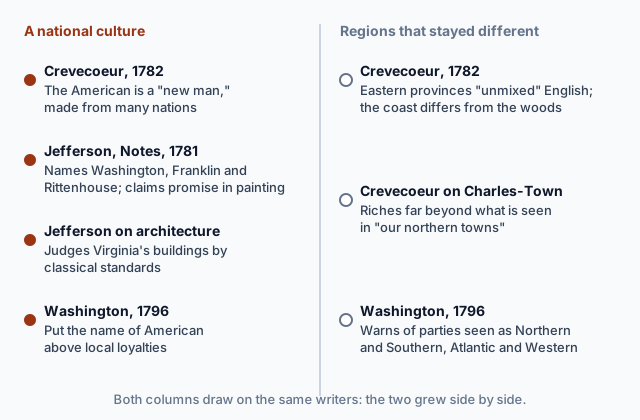
In short. From the last years of British rule through the 1790s, Americans began to describe themselves as one people with a national culture, in books about who Americans were, in claims about their own writers, scientists and artists, and in the standards they set for their buildings, while strong differences between regions lasted alongside it.
- Crevecoeur's Letters From an American Farmer, a book about the British colonies published in 1782, described the American as "this new man," made from many European nations by a new way of life.
- Ideas about national identity found expression in literature, art and architecture: Jefferson answered a European charge that America had no great poet by naming American talent, and judged Virginia's buildings by European classical standards.
- Regional differences did not fade: in 1796 Washington still had to warn against parties formed along lines of "Northern and Southern, Atlantic and Western."
Part 2 Learn it A national culture beside regional differences
2a. This new man
National identity is a people's sense of who they are as a nation. Colonists called themselves British subjects and Virginians or New Yorkers. Even before independence was won, some writers began to describe a single American people.
J. Hector St. John de Crevecoeur's Letters From an American Farmer was published in London in 1782, written for a friend in England. It describes the British colonies in North America, mostly as they were before the war. In Letter III he asked "What then is the American, this new man?" and answered:
Being American, in this telling, is something a person becomes. It comes from a way of life, not from ancestry. The government he means is the government of the colonies, which he says rests on the people and is confirmed by the crown, not the government of an independent nation.
Read his definition for who it includes. He writes that the American "is either an European, or the descendant of an European." Enslaved Africans and American Indians, who also lived in the new nation, are not in his new man at all. A national identity was taking shape, but it was drawn narrowly.
Quick check · Multiple choice
According to Crevecoeur's Letter III (1782), what makes a person an American?
2b. Regions that stayed different
A national culture is the set of ideas, habits and symbols that people across a whole country share. It grew in these years, but it grew next to regional variation: differences between parts of the country that did not go away.
Crevecoeur himself saw them. "The eastern provinces must indeed be excepted, as being the unmixed descendants of Englishmen." Describing Charles-Town in South Carolina, he found "a display of riches and luxury, inferior indeed to the former, but far superior to what are to be seen in our northern towns."
In 1796 George Washington's Farewell Address asked Americans to put their shared name first: "The name of American, which belongs to you in your national capacity, must always exalt the just pride of patriotism more than any appellation derived from local discriminations." An appellation is a name; local discriminations are local lines of division. Yet the same address warned that "it occurs as matter of serious concern that any ground should have been furnished for characterizing parties by geographical discriminations, Northern and Southern, Atlantic and Western." The sentence goes on: "whence designing men may endeavor to excite a belief that there is a real difference of local interests and views." He blames party men for exaggerating these differences, and a president urging unity had reason to play them down. Still, the warning shows parties were being identified with regions, and he feared it.
Sources: Letter III (Avalon Project); Letter IX (Avalon Project); Farewell Address (Avalon Project).
Quick check · Sort it
Each card is a phrase from Crevecoeur (1782) or Washington (1796). Tap a card, then what it points to.
A shared national culture
Lasting regional difference
2c. Literature and the arts as proof of a nation
Ideas about national identity increasingly found expression in works of art, literature and architecture. Crevecoeur's book is itself one: literature written to explain Americans to a reader in England.
Thomas Jefferson wrote his Notes on the State of Virginia in 1781 and enlarged it in 1782, answering questions from a foreigner living in America. He offered it to the public in its original form in 1787. In one passage he answers the Abbe Raynal, a European writer who applied to Europeans in America a theory that nature made living things smaller and weaker on this side of the Atlantic. Jefferson quotes the charge: "America has not yet produced one good poet."
His reply turns American talent into national pride. "In war we have produced a Washington." "In physics we have produced a Franklin." Then he widens the claim to the arts: "As in philosophy and war, so in government, in oratory, in painting, in the plastic art, we might shew that America, though but a child of yesterday, has already given hopeful proofs of genius" (spelling as printed). The plastic art means sculpture and modeling.
Notice the shape of the argument. Jefferson admits the nation is young. He claims its people can match Europe's anyway. Art and learning had become a measure of whether America counted as a nation.
Quick check · Match
Match each phrase to the work it does in the argument about American culture.
2d. Buildings for a new country
Architecture was part of the same argument. In the Notes, Jefferson judged the buildings of Virginia and found them poor: "The genius of architecture seems to have shed its maledictions over this land." (Maledictions are curses.) He complained that "the first principles of the art are unknown, and there exists scarcely a model among us sufficiently chaste to give an idea of them."
He measured buildings against the classical orders, the standard column styles of ancient Greek and Roman building. Of the Capitol at Williamsburg, the old seat of Virginia's government, he wrote that "it is the most pleasing piece of architecture we have," while faulting its columns and proportions.
He did not stop at complaint. He hoped teaching at the college might mean that "perhaps a spark may fall on some young subjects of natural taste, kindle up their genius, and produce a reformation in this elegant and useful art."
His subject here is Virginia, but his standard was Europe's classical one. Like his answer to Raynal, the passage treats buildings as a public test of a people's culture, one he wanted Americans to pass.
Quick check · Fill the statement
Complete a student's notes on Jefferson's view of architecture.
Jefferson writes that "The genius of architecture seems to have shed its maledictions over this land." That sentence is a of the buildings he saw in Virginia. He hopes teaching will "produce a reformation in this elegant and useful art," which shows he treated architecture as a .
Part 3 Watch it done Read Washington's call for unity in its situation
Watch each step, then do the last one yourself.
George Washington's Farewell Address of 1796 told Americans: "The name of American, which belongs to you in your national capacity, must always exalt the just pride of patriotism more than any appellation derived from local discriminations." Explain what the address's historical situation tells you about national and regional identity in 1796.
Predict first
Before the steps, why do you think Washington chose this moment to praise the name of American?
Step 1 · Place it in time
The address opens: "The period for a new election of a citizen to administer the executive government of the United States being not far distant." Washington is announcing that he will not serve again. By 1796 political leaders had divided into parties, the Federalists and the Democratic-Republicans.
Why this step?
Why start with when he wrote it, not with what he praised?
A plea for unity means something different from a leader who is leaving and is worried about what comes after him. The moment tells you what problem he was trying to solve.
Step 2 · Name his purpose
He wants the Union to outlast him. He warns against any attempt "to enfeeble the sacred ties which now link together the various parts." Praising the name of American is his tool for holding those parts together.
Your step · Decide and justify
Finish it. What does the address's situation suggest about regional identity in 1796?
Which evidence from the address best supports your answer?
Part 4 Try it A southern city in Crevecoeur's eyes
In Letter IX Crevecoeur describes Charles-Town, South Carolina. He begins: "Charles-town is, in the north, what Lima is in the south." Lima is a city in Peru. He writes that it shows "a display of riches and luxury, inferior indeed to the former, but far superior to what are to be seen in our northern towns." He adds: "The inhabitants are the gayest in America." Gayest here means the most cheerful and fond of pleasure.
Source: Letter IX (Avalon Project); publication note (Avalon Project).
Try it · Spot the error
A student writes a paragraph on Crevecoeur's Letters. Which line is the first to go wrong?
Try it · Fill the statement
Complete the sentence about Letter IX.
Crevecoeur calls Charles-Town's riches "far superior to what are to be seen in our northern towns." His contrast is evidence of that lasted beside the growing American identity.
Part 5 Explain it Write it like a document-based answer
Nothing you type leaves this page. Check your answer against the model and each scoring point.
Free-response practice · Question 1 style
A short practice in the shape of the document-based question: three documents instead of seven, and a thesis with one body paragraph instead of a full essay.
Evaluate the extent to which a national culture developed in the United States between the early 1780s and 1796.
Document 1. J. Hector St. John de Crevecoeur, Letters From an American Farmer, a book about the British colonies published in London in 1782 and written for a friend in England: "He is an American, who, leaving behind him all his ancient prejudices and manners, receives new ones from the new mode of life he has embraced, the new government he obeys, and the new rank he holds."
Document 2. Thomas Jefferson, Notes on the State of Virginia, written in 1781 and enlarged in 1782, answering a European writer's claim that "America has not yet produced one good poet": "As in philosophy and war, so in government, in oratory, in painting, in the plastic art, we might shew that America, though but a child of yesterday, has already given hopeful proofs of genius" (spelling as printed).
Document 3. George Washington, Farewell Address, 1796: "it occurs as matter of serious concern that any ground should have been furnished for characterizing parties by geographical discriminations, Northern and Southern, Atlantic and Western"
Write a thesis, one sentence of historical context, and one paragraph that uses at least two documents and explains the purpose, audience, point of view or situation of one of them.
Model answer
Thesis: Between the early 1780s and 1796 Americans built a real sense of national culture, defining themselves as a new people and taking pride in American talent, but it remained limited because regional divisions stayed strong enough to shape politics.
Context: the conflict with Britain and the war for independence pushed colonists to ask what, besides British rule, bound them together.
Even while describing the British colonies, Crevecoeur pictured the American as a person who leaves behind "his ancient prejudices and manners" for new ones (Document 1), an identity based on a shared way of life in America rather than on birth in Europe. Jefferson turned American achievement into national pride, claiming that America, "though but a child of yesterday," showed genius in painting and sculpture (Document 2). His purpose was to answer a European critic, so he had reason to claim as much as he could, and the passage shows pride and ambition more than proof of great art. By 1796, though, Washington named parties forming as "Northern and Southern, Atlantic and Western" as a matter of serious concern (Document 3). A national culture had grown, but it grew beside regional loyalties, not in place of them.
Score your own answer. This is a self-check, not a grade. Tick each point your answer makes.
Part 6 Check yourself One address, two claims
The case questions use the two excerpts. The others mix the ideas from the whole lesson.
Both excerpts come from George Washington's Farewell Address of 1796. Source: Farewell Address (Avalon Project).
| Passage | Excerpt |
|---|---|
| On what Americans share | "With slight shades of difference, you have the same religion, manners, habits, and political principles." |
| On how parties were forming | "it occurs as matter of serious concern that any ground should have been furnished for characterizing parties by geographical discriminations, Northern and Southern, Atlantic and Western" |
Case question 1 · Multiple choice
Taken together, what do the two excerpts suggest about American culture in 1796?
Case question 2 · Multiple choice
Which best explains why Washington stressed what Americans had in common in the first excerpt?
The rest stand on their own and do not use the case.
Check yourself · Put it in order
Put these events in the order they happened, earliest first.
Check yourself · Select all
Which two passages show ideas about national identity expressed through the arts or architecture? Select two.
Select 2 answers, then check.
Part 7 Keep it Bring back earlier ideas
This lesson stands on Washington's Farewell Address from Topic 3.10 and the Northwest Ordinance from Topic 3.7.
Bring it back · Multiple choice
Besides political factions, Washington's Farewell Address of 1796 warned Americans most directly against which of the following?
Bring it back · Fill the statement
Complete the sentences about the Northwest Ordinance of 1787.
Congress passed the Northwest Ordinance as settlers moved west. It set out a way of admitting new and banned in the Northwest Territory.
In three lines
- From the 1780s, writers described Americans as a new people, made from many nations by a shared way of life.
- Ideas about national identity found expression in literature, in pride in American talent in the arts, and in judging American buildings by European standards.
- Regional differences lasted alongside the national culture, and in 1796 Washington warned against parties being identified with regions.
Exam strategy for this topic
- Section I Part A, Multiple Choice: 55 questions in 55 minutes.
- Section I Part B, Short Answer: 3 questions in 40 minutes.
- Section II, Document-Based Question and Long Essay: 2 questions in 100 minutes.
- This lesson's Explain it is shaped like free-response question 1, Document-based.
When a question asks about change in culture, give one piece of evidence for what changed and one for what continued, and name the source of each.
Questions students ask
Who was Crevecoeur?
J. Hector St. John de Crevecoeur wrote Letters From an American Farmer, published in London in 1782 and addressed to a friend in England. It describes the British colonies, mostly before independence. Its third letter, titled What Is an American, is one of the best-known early attempts to define a national identity.
Did Americans stop thinking of themselves by region after independence?
No. A national identity grew, but regional differences stayed strong. Washington's Farewell Address of 1796 warned against parties being characterized by region, which shows regional lines still shaped politics, even though he called the differences exaggerated.
What does architecture have to do with national identity?
Leaders like Jefferson saw buildings as a sign of a people's culture. In his Notes on the State of Virginia he judged Virginia's buildings against European classical standards, found them poor, and hoped teaching would reform the art.
Why does a quotation in this lesson spell show as "shew"?
Every excerpt is copied exactly as the archive prints it, so you can check it against the source linked beside it. Shew was an older spelling of show.
Where can I read these documents in full?
Each excerpt links to its full text at the Avalon Project at Yale Law School, the primary-source collection this lesson was checked against.
Course alignment, for teachers
AP U.S. History topic 3.11, Unit 3: Period 3: 1754–1800.
- Skill 1.B: Explain a historical concept, development, or process.
This lesson maps all 2 essential knowledge statements of the topic, and the one learning objective with none of its own, to the part that teaches each one: 3 are checked by a scored question. The map is in the lesson file.