Unit 7 · Topic 7.11 · about 30 minutes · 7 parts · 13 scored checks, 5 of them multiple choice
AP U.S. History 7.11: Interwar Foreign Policy
Unit 7: 10 to 17% of the multiple-choice section
What you'll be able to do
- Explain the similarities and differences in American attitudes about the nation's proper role in the world between the two world wars, from peace treaties and isolationism to the debate over aiding nations that fought fascism.
Key vocabulary
| Term | What it means | The exam trap |
|---|---|---|
| Isolationism | The tradition of staying out of other nations' wars and alliances. | It is a refusal of military commitments, so check whether a policy is about trade or about war before you call it isolationist. |
| Unilateral | Acting on a nation's own terms and judgment, rather than through binding commitments to allies. | A unilateral nation can still sign treaties; the question is whether it keeps its freedom of action. |
| Fascism | A form of rule built on an all-powerful state, a single leader and aggressive nationalism. | Fascism and totalitarianism overlap but are not the same word for the same thing; read which one a source uses. |
| Neutrality | A nation's policy of taking neither side in a war between other nations. | Check a source's date, since what American neutrality allowed changed during this period. |
| Lend-Lease | The 1941 law that let the president lend or lease war supplies to nations whose defense he judged vital to the United States. | Read what a source says the law allowed before you say what it meant for the war. |
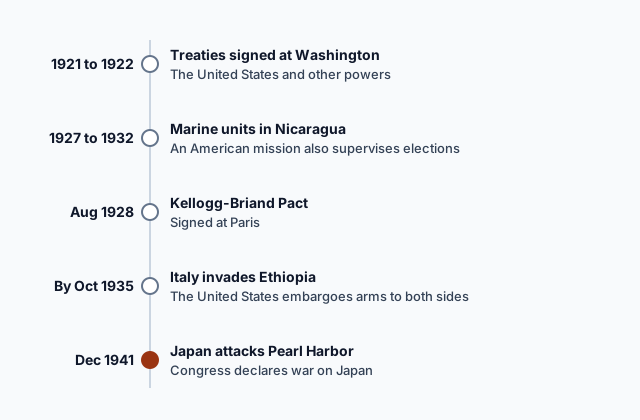 Tap to open the picture full size
Part 1 Think first A treaty against war
Commit to a guess first. Being wrong now makes the right idea stick better.
Predict first
In 1928 the United States signed a treaty in Paris with other powers in which they agreed to "condemn recourse to war for the solution of international controversies, and renounce it, as an instrument of national policy in their relations with one another." The United States never joined the League of Nations. Which phrase do you think best describes American foreign policy in the 1920s?
In short. Between the world wars the United States acted on its own terms: it signed peace treaties, invested abroad and intervened in select places, while staying out of alliances; in the 1930s many Americans worried about fascism, but most opposed military action against Germany and Japan until Japan attacked Pearl Harbor in December 1941.
- In the 1920s the United States signed treaties limiting conflict in the Pacific and renouncing war, without taking on duties to enforce them.
- As Italy, Germany and Japan turned to aggression in the 1930s, most Americans wanted to stay out of war, and the government kept arms from both sides when Italy invaded Ethiopia.
- From 1940 Roosevelt sent aid to Britain while the nation stayed officially neutral; the attack on Pearl Harbor ended the debate.
Part 2 Learn it America and the world, 1921 to 1941
2a. Peace by treaty, on American terms
After World War I the United States did not ratify the Treaty of Versailles or join the League of Nations. It still worked for peace, by treaties it chose.
At Washington in December 1921 the United States, the British Empire, France and Japan signed a treaty "With a view to the preservation of the general peace and the maintenance of their rights in relation to their insular possessions and insular dominions in the region of the Pacific Ocean." In February 1922 nine powers agreed "To respect the sovereignty, the independence, and the territorial and administrative integrity of China" and to uphold "the principle of equal opportunity for the commerce and industry of all nations throughout the territory of China," the Open Door.
In August 1928 came the Kellogg-Briand Pact, also called the Pact of Paris, which renounced war as an instrument of national policy. The Senate advised ratification in January 1929.
This is unilateral foreign policy: a nation acts on its own terms and keeps its freedom of action, rather than binding itself to allies. The United States signed promises of peace, but none of these treaties obliged it to go to war to enforce them.
Sources: Records of International Conferences (National Archives); Treaty of December 13, 1921 (Avalon Project); Nine-Power Treaty, 1922 (Avalon Project); Kellogg-Briand Pact (Avalon Project).
Quick check · Match
Match each treaty to what its signers promised.
2b. Trade, investment and limited commitments
Treaties were one tool. The course framework names the others: international investment, and military intervention in select places, all used to promote a vision of international order even while the country kept to isolationism, the tradition of staying out of other nations' wars and alliances.
Isolationism did not mean ignoring the world. The United States did not ratify the Treaty of Versailles, but it kept an unofficial delegation on the Reparations Commission, which set the payments Germany owed the Allies. In Nicaragua, Marine units sent reports home from 1927 to 1932, and an American electoral mission supervised the elections of 1928, 1930 and 1932 under an agreement between the two countries' presidents. What isolationists refused was a binding commitment that might send Americans to fight in someone else's war.
The Depression sharpened the focus on home. In his first inaugural address, on March 4, 1933, Franklin Roosevelt said: "Our international trade relations, though vastly important, are in point of time and necessity secondary to the establishment of a sound national economy." In the same speech he pledged the nation to "the policy of the good neighbor," a neighbor who respects his own obligations and the rights of others.
Sources: Records of International Conferences (National Archives); Records of the U.S. Marine Corps (National Archives); First Inaugural Address, 1933 (Avalon Project).
Quick check · Multiple choice
From 1927 to 1932 Marine units served in Nicaragua, and an American mission supervised Nicaragua's elections, yet the United States joined no alliance. Which phrase best describes this policy?
2c. Fascism abroad, and the debate at home
In the 1930s fascist and totalitarian governments turned to conquest. Many Americans were alarmed; most still opposed military action.
In October 1935, after Italy invaded Ethiopia, former Secretary of State Frank Kellogg said on the radio: "The American people have two overwhelming desires at the present time. They wish to avoid war and are willing to pay whatever price is necessary to avoid it. Secondly, they wish to see efforts for permanent peace Succeed and are willing to cooperate for the maintenance of peace provided it does not involve the country in war." (Capital as printed.) Roosevelt had "declared an arms embargo against both sides."
In July 1940 Britain, after losing 11 destroyers to the German Navy, asked Roosevelt for help, and Americans debated whether to aid Britain or keep strict neutrality. Roosevelt traded Britain 50 destroyers for leases on bases. That year he promised voters: "I have said this before, but I shall say it again and again and again; your boys are not going to be sent into any foreign wars." In January 1941 he told Congress: "Our most useful and immediate role is to act as an arsenal for them as well as for ourselves." The Lend-Lease Act of March 1941 let him lend war supplies to nations "vital to the defense of the United States," while the country stayed officially neutral.
Sources: Kellogg address, 1935 (Avalon Project); Lend-Lease Act (National Archives); Four Freedoms message (National Archives).
Quick check · Sort it
Each card is a policy or statement from 1935 to 1941. Tap a card, then the position it supports.
Keep the United States out of the conflict
Help the nations fighting the aggressors
2d. Pearl Harbor ends the debate
In August 1941 Roosevelt and British Prime Minister Winston Churchill issued the Atlantic Charter, a statement of shared aims that looked ahead to a peace "after the final destruction of the Nazi tyranny." The Charter set out shared aims, though the United States had not entered the war.
On December 7, 1941, Japan attacked the American naval base at Pearl Harbor in Hawaii. The next day Roosevelt asked Congress for a declaration of war, calling December 7 "a date which will live in infamy." He stressed that "The United States was at peace with that Nation" when the attack came. The Senate voted unanimously for war; in the House only one member, the Montana pacifist Jeannette Rankin, voted no. On December 11 Germany declared war on the United States.
The vote shows how fast opinion changed. Through the 1930s most Americans had opposed military action against Germany and Japan, even while they worried about fascism. The attack drew the United States into World War II.
Sources: Atlantic Charter (Avalon Project); Joint Address to Congress, 1941 (National Archives).
Quick check · Fill the statement
Complete the notes on American opinion before December 1941.
Many Americans were concerned about the rise of fascism, but most military action against Germany and Japan. That changed when Japan attacked ; the next day Congress declared war on Japan with only one vote against.
Part 3 Watch it done Explain how a pact against war fits isolationism
Watch each step, then do the last one yourself.
In 1928 the United States signed the Kellogg-Briand Pact, renouncing war as an instrument of national policy. Explain how signing it fit a foreign policy that stayed isolationist.
Predict first
Before the steps, what do you think the pact asked of the United States?
Step 1 · Read what it promised
In Article I the signers "condemn recourse to war for the solution of international controversies, and renounce it, as an instrument of national policy in their relations with one another." In Article II they agree that settling their disputes "shall never be sought except by pacific means."
Why this step?
Why read the articles instead of the pact's reputation?
A concept like isolationism is about commitments. Only the text says what a signer promised to do, and what it was left free not to do.
Step 2 · Read what it did not ask
Article III only covers how the treaty takes effect and how other nations may join it.
Your step · Decide and justify
Finish it. How did signing the pact fit an isolationist policy?
Which evidence best supports your answer?
Part 4 Try it A former secretary of state answers the isolationists
On October 30, 1935, Frank Kellogg, the former secretary of state whose name was on the 1928 pact, spoke on the radio after Italy invaded Ethiopia. He said: "A small but vociferous group of isolationists have created for themselves an unreal world based upon the conditions of 1914." He described their view: "There are those who would have the United States avoid war by reducing contact with other nations to a minimum and by maintaining complete isolation as to any dispute that might arise." Yet in the same address he approved the government's stand to keep the United States out of the war, including the arms embargo on both sides. He closed by saying the United States, with other countries, "can and should designate Italy as the aggressor."
Try it · Multiple choice
Kellogg attacks the isolationists but approves of keeping the United States out of the war. What does this show about American attitudes in 1935?
Try it · Spot the error
A student writes a paragraph on Kellogg's 1935 radio address. Which line is the first to go wrong?
Part 5 Explain it Write it like a document-based answer
Nothing you type leaves this page. Check your answer against the model and each scoring point.
Free-response practice · Question 1 style
A short practice in the shape of the document-based question: three documents instead of seven, and a thesis with one body paragraph instead of a full essay.
Evaluate the extent to which American attitudes about the nation's role in the world changed from 1935 to 1941.
Document 1. Frank B. Kellogg, former secretary of state, radio address, October 30, 1935: "The American people have two overwhelming desires at the present time. They wish to avoid war and are willing to pay whatever price is necessary to avoid it. Secondly, they wish to see efforts for permanent peace Succeed and are willing to cooperate for the maintenance of peace provided it does not involve the country in war." (Capital as printed.)
Document 2. Franklin D. Roosevelt, speaking during the 1940 presidential campaign: "I have said this before, but I shall say it again and again and again; your boys are not going to be sent into any foreign wars."
Document 3. Franklin D. Roosevelt, annual message to Congress, January 6, 1941: "Our most useful and immediate role is to act as an arsenal for them as well as for ourselves."
Write a thesis, one sentence of historical context, and one paragraph that uses at least two documents and explains the purpose, audience, point of view or situation of one of them.
Model answer
Thesis: From 1935 to 1941 Americans moved from refusing any part in foreign wars to supplying the nations fighting them, but until Pearl Harbor most still refused to send their own soldiers.
Context: in the 1930s Italy, Nazi Germany and Japan turned to conquest, and by early 1941 Western Europe lay under Nazi domination.
In 1935 Kellogg said Americans would pay "whatever price is necessary" to avoid war (Document 1); they would cooperate for peace only if it did not involve the country in war, and the government embargoed arms to both sides of the war in Ethiopia. By 1941 Roosevelt wanted the nation to act as "an arsenal" for the nations at war with the aggressors (Document 3), a clear change from treating both sides alike. Document 2 shows what had not changed. Roosevelt was speaking to voters during a presidential campaign, so his purpose was to win an election, and the promise that "your boys" would not fight abroad tells us what he believed most voters wanted to hear. Americans would now take sides with supplies, but not yet with soldiers.
Score your own answer. This is a self-check, not a grade. Tick each point your answer makes.
Part 6 Check yourself Three treaties of the 1920s
The case questions use the three excerpts. The others mix the ideas from the whole lesson.
All three treaties were signed by the United States between 1921 and 1928. Sources: Treaty of December 13, 1921 (Avalon Project); Nine-Power Treaty, 1922 (Avalon Project); Kellogg-Briand Pact (Avalon Project).
| Treaty | Excerpt |
|---|---|
| United States, British Empire, France and Japan, December 13, 1921 | "With a view to the preservation of the general peace and the maintenance of their rights in relation to their insular possessions and insular dominions in the region of the Pacific Ocean" |
| Nine-Power Treaty, February 6, 1922 | "To respect the sovereignty, the independence, and the territorial and administrative integrity of China"; and to uphold "the principle of equal opportunity for the commerce and industry of all nations throughout the territory of China" |
| Kellogg-Briand Pact, August 27, 1928 | "condemn recourse to war for the solution of international controversies, and renounce it, as an instrument of national policy in their relations with one another" |
Case question 1 · Multiple choice
What do the three excerpts have in common?
Case question 2 · Multiple choice
The second excerpt deals with China. Which American interest does it also protect?
The rest stand on their own and do not use the case.
Check yourself · Put it in order
Put these events in the order they happened, earliest first.
Check yourself · Select all
Which two pieces of evidence show that the United States had not entered the war before December 1941? Select two.
Select 2 answers, then check.
Part 7 Keep it Bring back earlier ideas
This lesson stands on the end of World War I from Topic 7.5 and the debate over overseas expansion from Topic 7.2.
Bring it back · Multiple choice
Woodrow Wilson took a leading part in the peace talks after World War I. What did the United States Senate then do?
Bring it back · Fill the statement
Complete the sentences about the debate over expansion around 1900.
Opponents of overseas expansion said other peoples had a right to govern themselves, the principle of . They also pointed to the nation's tradition of staying out of foreign entanglements, known as .
In three lines
- Between the wars the United States signed peace treaties, used investment and select intervention abroad, and refused alliances.
- In the 1930s many Americans feared fascism, but most opposed military action, and the government embargoed arms to both sides of the war in Ethiopia.
- Aid to Britain grew in 1940 and 1941 while the country stayed officially neutral, until the attack on Pearl Harbor brought it into the war.
Exam strategy for this topic
- Section I Part A, Multiple Choice: 55 questions in 55 minutes.
- Section I Part B, Short Answer: 3 questions in 40 minutes.
- Section II, Document-Based Question and Long Essay: 2 questions in 100 minutes.
- This lesson's Explain it is shaped like free-response question 1, Document-based.
When a question asks about American attitudes before 1941, separate what Americans feared from what they were willing to do, and name the step (embargo, aid or war) a source supports.
Questions students ask
Was the United States isolationist in the 1920s?
In its refusal of alliances, yes. But it signed the Washington treaties of 1921 and 1922 and the Kellogg-Briand Pact of 1928, kept an unofficial delegation on the Reparations Commission, and sent Marines and an election mission to Nicaragua. The course framework calls the policy unilateral and names international investment as another of its tools.
What was the Kellogg-Briand Pact?
A treaty signed at Paris on August 27, 1928, in which the signers renounced war as an instrument of national policy and agreed to settle disputes only by peaceful means. It created no way to enforce that promise.
Why did the United States help Britain before entering the war?
In January 1941 Roosevelt told Congress that "we oppose enforced isolation for ourselves or for any other part of the Americas," and argued that the nation should act as an arsenal for the countries fighting the aggressors. The destroyers deal of 1940 and the Lend-Lease Act of 1941 sent help while the country stayed officially neutral.
Did any member of Congress vote against war in December 1941?
One. The Senate voted unanimously for war against Japan, and in the House only Jeannette Rankin of Montana, a pacifist, voted no.
Where can I read these documents in full?
Each excerpt links to its full text at the National Archives or the Avalon Project at Yale Law School, the primary-source collections this lesson was checked against.
Course alignment, for teachers
AP U.S. History topic 7.11, Unit 7: Period 7: 1890–1945.
- Skill 1.B: Explain a historical concept, development, or process.
This lesson maps all 2 essential knowledge statements of the topic, and the one learning objective with none of its own, to the part that teaches each one: 3 are checked by a scored question. The map is in the lesson file.