Unit 9 · Topic 9.1 · about 30 minutes · 7 parts · 13 scored checks, 5 of them multiple choice
AP U.S. History 9.1: Contextualizing Period 9
Unit 9: 4 to 6% of the multiple-choice section
What you'll be able to do
- Explain the context in which the United States faced international and domestic challenges after 1980: the rise of the conservative movement, technological, economic and demographic change, and the redefining of its foreign policy and role in the world after the Cold War and after the attacks of September 11, 2001.
Key vocabulary
| Term | What it means | The exam trap |
|---|---|---|
| Contextualization | Placing a historical development inside the broader pattern of its time, so the pattern helps explain it. | A list of events from the same years is not context until you say how they explain the development. |
| Conservative movement | The political movement that, after 1980, advanced beliefs in traditional social values and a reduced role for government. | On the exam it names a set of beliefs about government and values, not simply one political party. |
| Interventionist foreign policy | A foreign policy ready to use American power, including military force, in affairs abroad. | Interventionism did not end with the Cold War; later administrations continued it after the Soviet rivalry ended. |
| War on terror | President George W. Bush's name, in September 2001, for the effort to defeat terrorist groups of global reach and the governments that support them. | It was aimed at a network of groups across many countries, not at a single nation or a single battle. |
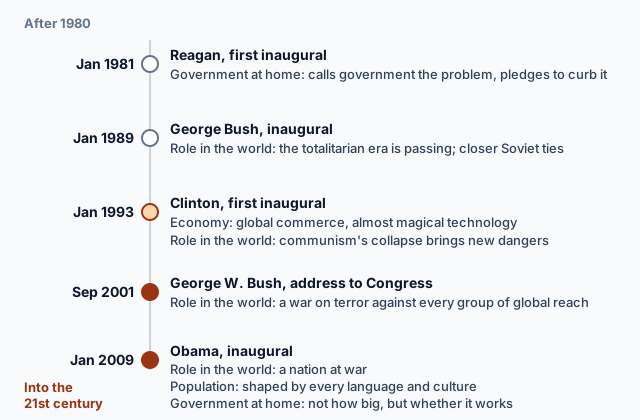 Tap to open the picture full size
Part 1 Think first After communism's collapse, what next?
Commit to a guess first. Being wrong now makes the right idea stick better.
Predict first
On January 20, 1989, President George Bush told the nation that "The totalitarian era is passing" and promised to "continue the new closeness with the Soviet Union." Four years later, with communism collapsed, what do you think had happened to U.S. military action abroad?
In short. After 1980 the United States faced its challenges inside three large patterns: a newly ascendant conservative movement, deep technological, economic and demographic change, and a redefined foreign policy and role in the world after the Cold War ended and after the attacks of September 11, 2001.
- Conservative beliefs in traditional social values and a reduced role for government advanced after 1980 and kept shaping public debate in the decades that followed.
- New science and technology strengthened the economy and transformed society while manufacturing declined, and a changing population had real cultural and political effects.
- An interventionist foreign policy begun under Reagan continued after the Cold War, and after September 11, 2001, U.S. foreign policy focused on fighting terrorism around the world.
Part 2 Learn it Three patterns of the years after 1980
2a. A conservative turn
Contextualization means placing a development inside the larger pattern of its time, so that the pattern helps explain it.
The first pattern is political. A newly ascendant conservative movement achieved several of its goals in the 1980s, and its beliefs in traditional social values and a reduced role for government kept shaping public debate for decades. Ronald Reagan stated the theme on January 20, 1981: "In this present crisis, government is not the solution to our problem; government is the problem." Four years later, at his second inaugural, he joined the two halves, looking ahead to years "when our values of faith, family, work, and neighborhood were restated for a modern age; when our economy was finally freed from government's grip."
In 1989 President George Bush said: "The old solution, the old way, was to think that public money alone could end these problems. But we have learned that is not so." He added that "our funds are low. We have a deficit to bring down," and called on volunteers and community organizations to do the work.
The debate over what government owes went on after the 1980s. In 1993 Bill Clinton asked Americans to "break the bad habit of expecting something for nothing, from our government or from each other." In the same speech he called for new public investment.
Sources: Reagan, First Inaugural, 1981 (Avalon Project); Reagan, Second Inaugural, 1985 (Avalon Project); Bush, Inaugural, 1989 (Avalon Project); Clinton, First Inaugural, 1993 (Avalon Project).
Quick check · Sort it
Each card is a line from an inaugural address, 1981 to 2009. Tap a card, then what it asks of government.
Ask less of government
Ask more of government
2b. Technology, the economy and a changing population
The second pattern is change in how Americans worked and who they were. Moving into the 21st century, new developments in science and technology strengthened the economy and transformed society, while manufacturing declined. Clinton described the new world in 1993: "Communications and commerce are global; investment is mobile; technology is almost magical; and ambition for a better life is now universal."
He saw two sides. "This new world has already enriched the lives of millions of Americans who are able to compete and win in it," he said, but change was not working "when most people are working harder for less." A good context sentence can hold both: the same change brought gains to some and strain to others.
The population kept changing too, with significant cultural and political consequences. Part of this change followed the new immigration laws of 1965 (Topic 8.9), after which immigrants came from around the world seeking opportunity. In 2009 Barack Obama said: "We are a nation of Christians and Muslims, Jews and Hindus, and non-believers. We are shaped by every language and culture, drawn from every end of this Earth." Topic 9.5 looks at these migrations and their effects. Obama also promised, "We will restore science to its rightful place," and to build "the electric grids and digital lines that feed our commerce and bind us together."
Sources: Clinton, First Inaugural, 1993 (Avalon Project); Obama, Inaugural, 2009 (Avalon Project).
Quick check · Match
Match each line from a speech to the change it describes.
2c. After the Cold War, redefining a role in the world
The third pattern is the nation's place in the world. The Reagan administration promoted an interventionist foreign policy, one ready to use American power abroad, and later administrations continued it even after the Cold War ended. In his first inaugural Reagan promised readiness: "When action is required to preserve our national security, we will act."
By January 1989 the tone had changed. President George Bush told the nation "The totalitarian era is passing" and promised to "continue the new closeness with the Soviet Union." The end of the Cold War, and new challenges to American leadership, then forced the nation to redefine its foreign policy and its role in the world.
Clinton set out the problem in 1993: "Today, as an old order passes, the new world is more free but less stable. Communism's collapse has called forth old animosities and new dangers. Clearly America must continue to lead the world we did so much to make." He promised: "When our vital interests are challenged, or the will and conscience of the international community is defied, we will act; with peaceful diplomacy when ever possible, with force when necessary" (spelling as printed). He praised the Americans then serving "in the Persian Gulf, in Somalia."
Sources: Reagan, First Inaugural, 1981 (Avalon Project); Bush, Inaugural, 1989 (Avalon Project); Clinton, First Inaugural, 1993 (Avalon Project).
Quick check · Multiple choice
In 1993 Clinton said that "Communism's collapse has called forth old animosities and new dangers" and praised the Americans then serving "in the Persian Gulf, in Somalia." What does this show about U.S. foreign policy after the Cold War?
2d. September 11 and the fight against terrorism
On September 11, 2001, terrorists attacked the United States. Nine days later President George W. Bush addressed a joint session of Congress and the American people. He said the evidence pointed to "a collection of loosely affiliated terrorist organizations known as al Qaeda," and that "There are thousands of these terrorists in more than 60 countries." His goal reached as far: "Our war on terror begins with al Qaeda, but it does not end there. It will not end until every terrorist group of global reach has been found, stopped and defeated." He warned that "Americans should not expect one battle, but a lengthy campaign."
After the attacks, U.S. foreign policy focused on fighting terrorism around the world. How to fight at home was debated. Signing the Patriot Act on October 26, 2001, Bush said: "Today, we take an essential step in defeating terrorism, while protecting the constitutional rights of all Americans." The day before, Senator Russ Feingold of Wisconsin told the Senate: "I have been troubled in the past 6 weeks by the potential loss of commitment in the Congress and the country to traditional civil liberties."
The focus outlasted the president who announced it. In 2009 Obama said: "Our nation is at war, against a far-reaching network of violence and hatred."
Sources: Bush, Address to Congress, 2001 (Avalon Project); Bush, Patriot Act signing, 2001 (Avalon Project); Senate debate on H.R. 3162, 2001 (Avalon Project); Obama, Inaugural, 2009 (Avalon Project).
Quick check · Fill the statement
Complete a student's context sentence for Bush's address of September 20, 2001.
Bush's war on terror set no regional limit because it , and he announced it nine days after .
Part 3 Watch it done Place Clinton's new world in its context
Watch each step, then do the last one yourself.
In his first inaugural address, on January 20, 1993, Bill Clinton said: "Today, a generation raised in the shadows of the Cold War assumes new responsibilities in a world warmed by the sunshine of freedom but threatened still by ancient hatreds and new plagues." Place this claim in its broader historical context.
Predict first
Before the steps, which broader development do you think this claim belongs to?
Step 1 · Name the development
Clinton says his generation faces a new world: freer than before, but with new dangers. That claim is the development you have to explain.
Why this step?
Why name the development before the context?
Context has to explain something. Until you have said what you are explaining, any fact from those years looks relevant, and a list of facts is not context.
Step 2 · Find the broader pattern
Read the rest of the speech for the change Clinton has in mind: "Today, as an old order passes, the new world is more free but less stable." Then ask which old order had just passed, and look back at Learn it for evidence from a few years earlier.
Your step · Decide and justify
Finish it. Which sentence best connects Clinton's claim to its broader context?
Which evidence best supports your answer?
Part 4 Try it One question, two inaugurals
Context works across decades as well as within them. Set two inaugural addresses side by side, 28 years apart.
Reagan, January 20, 1981: "In this present crisis, government is not the solution to our problem; government is the problem."
Obama, January 20, 2009: "The question we ask today is not whether our government is too big or too small, but whether it works." He said that "the stale political arguments that have consumed us for so long no longer apply."
Sources: Reagan, First Inaugural, 1981 (Avalon Project); Obama, Inaugural, 2009 (Avalon Project).
Try it · Multiple choice
Which broader context best explains why Obama, in 2009, framed his question as not whether government was "too big or too small"?
Now the second pattern. Recall Clinton's 1993 lines on the new economy from Learn it: "Communications and commerce are global; investment is mobile; technology is almost magical; and ambition for a better life is now universal." He also warned of a time "when most people are working harder for less."
Try it · Spot the error
A student writes a context paragraph on Clinton's 1993 lines about the new economy. Which line is the first to go wrong?
Part 5 Explain it Write it like a document-based answer
Nothing you type leaves this page. Check your answer against the model and each scoring point.
Free-response practice · Question 1 style
A short practice in the shape of the document-based question: three documents instead of seven, and a thesis with one body paragraph instead of a full essay.
Evaluate the extent to which the end of the Cold War changed how presidents described the role of the United States in the world from 1981 to 2001.
Document 1. Ronald Reagan, First Inaugural Address, January 20, 1981: "When action is required to preserve our national security, we will act." And, a few sentences later: "Above all, we must realize that no arsenal, or no weapon in the arsenals of the world, is so formidable as the will and moral courage of free men and women. It is a weapon our adversaries in today's world do not have. It is a weapon that we as Americans do have. Let that be understood by those who practice terrorism and prey upon their neighbors."
Document 2. William J. Clinton, First Inaugural Address, January 20, 1993: "Today, as an old order passes, the new world is more free but less stable. Communism's collapse has called forth old animosities and new dangers. Clearly America must continue to lead the world we did so much to make."
Document 3. George W. Bush, Address to a Joint Session of Congress and the American People, September 20, 2001: "Our war on terror begins with al Qaeda, but it does not end there. It will not end until every terrorist group of global reach has been found, stopped and defeated."
Write a thesis, one sentence of historical context, and one paragraph that uses at least two documents and explains the purpose, audience, point of view or situation of one of them.
Model answer
Thesis: The end of the Cold War changed the dangers presidents named and the reasons they gave for American power, but not their readiness to act abroad, which ran from Reagan through Clinton to George W. Bush.
Context: from 1945 to 1980 U.S. policymakers waged a cold war against the Soviet Union, seeking to contain communism, and the rivalry swung between confrontation and periods of coexistence, so a president's account of the world was built around that rival.
In 1981 Reagan promised that "When action is required to preserve our national security, we will act" (Document 1), a readiness to act while the Soviet rivalry still stood; he even named terrorism as a danger, warning terrorists that free people had the will and moral courage they lacked. By 1993 Clinton said "Communism's collapse has called forth old animosities and new dangers," yet insisted "America must continue to lead" (Document 2): the rival was gone, but the leading role stayed. Bush spoke on September 20, 2001 (Document 3), nine days after the attacks, to a nation asking what would come next; his purpose was to prepare the public for "a lengthy campaign" rather than "one battle," which is why he names a war with no clear end, until "every terrorist group of global reach" is defeated. After 2001 the danger at the center of American policy changed again, to terrorism, while the readiness to act abroad continued.
Score your own answer. This is a self-check, not a grade. Tick each point your answer makes.
Part 6 Check yourself Two speeches, twelve years apart
The case questions use the two excerpts. The others mix the ideas from the whole lesson.
The excerpts are from two different presidents named Bush, twelve years apart: George Bush in 1989 and George W. Bush in 2001. Sources: Bush, Inaugural, 1989 (Avalon Project); Bush, Address to a Joint Session of Congress, 2001 (Avalon Project).
| Document | Excerpt |
|---|---|
| George Bush, Inaugural Address, January 20, 1989 | "For a new breeze is blowing, and a world refreshed by freedom seems reborn; for in man's heart, if not in fact, the day of the dictator is over. The totalitarian era is passing, its old ideas blown away like leaves from an ancient, lifeless tree." |
| George W. Bush, Address to a Joint Session of Congress, September 20, 2001 | "Every nation, in every region, now has a decision to make. Either you are with us, or you are with the terrorists." |
Case question 1 · Multiple choice
Which broader development best explains the 1989 claim that "The totalitarian era is passing"?
Case question 2 · Multiple choice
Which broader context best explains the 2001 demand that every nation choose between the United States and the terrorists?
The rest stand on their own and do not use the case.
Check yourself · Put it in order
Put these statements in the order the presidents made them, earliest first.
Check yourself · Select all
Which two lines express the conservative beliefs that advanced after 1980, traditional social values and a reduced role for government? Select two.
Select 2 answers, then check.
Part 7 Keep it Bring back earlier ideas
This lesson stands on the Cold War from Topic 8.2 and the Great Society from Topic 8.9.
Bring it back · Multiple choice
A student reads President George Bush's 1989 promise to "continue the new closeness with the Soviet Union." Which pattern from the Cold War of 1945 to 1980 best helps place it in context?
Bring it back · Fill the statement
Complete the sentences about the 1960s background to Period 9.
Lyndon Johnson's Great Society used federal legislation and programs to try to end racial discrimination and . New immigration laws passed in opened the way for immigrants from around the world, part of the background to the nation Obama described in 2009 as drawn from every language and culture.
In three lines
- After 1980 conservative beliefs in traditional values and a reduced role for government advanced, and they shaped public debate for decades.
- New technology and a global economy brought gains and strain while manufacturing declined, and the population kept changing.
- Interventionism continued after the Cold War, and after September 11, 2001, foreign policy focused on fighting terrorism around the world.
Exam strategy for this topic
- Section I Part A, Multiple Choice: 55 questions in 55 minutes.
- Section I Part B, Short Answer: 3 questions in 40 minutes.
- Section II, Document-Based Question and Long Essay: 2 questions in 100 minutes.
- This lesson's Explain it is shaped like free-response question 1, Document-based.
When a question asks for context, name the broader development in one sentence and then say how it explains the document or event. A date, or a list of nearby events, does not earn the point by itself.
Questions students ask
What years does Period 9 cover?
The course framework dates Period 9 from 1980 to the present. This lesson's sources run from Reagan's first inaugural in 1981 to Obama's in 2009.
Is this lesson saying the conservative movement was right or wrong?
No. The course asks you to explain how conservative beliefs advanced and shaped debate, and to place them in context. Each quotation is given with its speaker so you can weigh it as one point of view. Where the lesson shows a debate, such as security and civil liberties after 2001, it quotes both sides.
Why are there two presidents named Bush?
George Bush took office in 1989, after Reagan, and served until Clinton took office in 1993. George W. Bush is a different president, who took office in 2001 and was president on September 11. The archive lists the 1989 president simply as George Bush, and this lesson does the same.
Why does this lesson use so many inaugural addresses?
On inauguration day each president states his program to the whole nation, so the addresses show how each one described the problems of his time. They are statements of a point of view, written to win support, not neutral records.
Where can I read these speeches in full?
Each excerpt links to its full text at the Avalon Project at Yale Law School, the primary-source collection this lesson was checked against.
Course alignment, for teachers
AP U.S. History topic 9.1, Unit 9: Period 9: 1980–Present.
- Skill 4.B: Explain how a specific historical development or process is situated within a broader historical context.
This lesson maps all 8 essential knowledge statements of the topic, and the one learning objective with none of its own, to the part that teaches each one: 9 are checked by a scored question. The map is in the lesson file.