Unit 8 · Topic 8.12 · about 30 minutes · 7 parts · 13 scored checks, 5 of them multiple choice
AP U.S. History 8.12: Youth Culture of the 1960s
Unit 8: 10 to 17% of the multiple-choice section
What you'll be able to do
- Explain how and why opposition to existing policies and values grew and changed in the 1960s, in the antiwar movement, the New Left and the counterculture.
Key vocabulary
| Term | What it means | The exam trap |
|---|---|---|
| Escalation | The growth of a war in size and cost, as in Vietnam from 1964 to 1968. | Escalation describes the war, not the protests; name the war and the protest separately. |
| Draft | A system for calling young men into military service; in December 1969 a lottery set their order. | The draft lottery set an order of call; it did not end the draft. |
| New Left | Young radicals of the 1960s, many from Students for a Democratic Society, who attacked liberal leaders from the left. | It criticized liberals for doing too little, not too much; conservatives made the opposite charge. |
| Counterculture | A way of living set against the main culture; in the 1960s, young people rejecting many of their parents' values. | It is about values and ways of living, so it is not the same as the antiwar movement. |
| Antiwar movement | Protest against the Vietnam War, which grew as the war escalated. | It grew over years; do not describe 1964 opposition as if it were the size of 1967. |
 Tap to open the picture full size
Part 1 Think first Two votes, seven years apart
Commit to a guess first. Being wrong now makes the right idea stick better.
Predict first
In August 1964 Congress passed the Tonkin Gulf Resolution, letting President Johnson widen the war in Vietnam, with only two senators voting no. In January 1971 Congress repealed it. What do you think did most to change Congress’s mind?
In short. In the 1960s many young Americans turned against the policies and values of their parents’ generation: antiwar protest grew as the Vietnam War escalated and sometimes met deadly force, critics on the left said liberal leaders did too little at home and wrong abroad, and the counterculture rejected older ways of living.
- Anti-communist foreign policy had faced little opposition at home, but protest against the Vietnam War grew larger as the war grew deadlier, and in May 1970 Guardsmen at Kent State and police at Jackson State shot and killed students.
- The New Left attacked liberals from the left, arguing they did too little to change racial and economic inequality and pursued immoral policies abroad.
- The counterculture rejected many of the older generation’s values, made American life more informal, and pushed for changes in sexual norms.
Part 2 Learn it Opposition in the 1960s
2a. Protest grows with the war
Since 1945, policies meant to contain communism had faced little opposition at home. Vietnam changed that. In August 1964 Congress gave Johnson authority to widen the war: "Congress approves and supports the determination of the President, as Commander in Chief, to take all necessary measures to repel any armed attack against the forces of the United States and to prevent further aggression." Only two senators voted no.
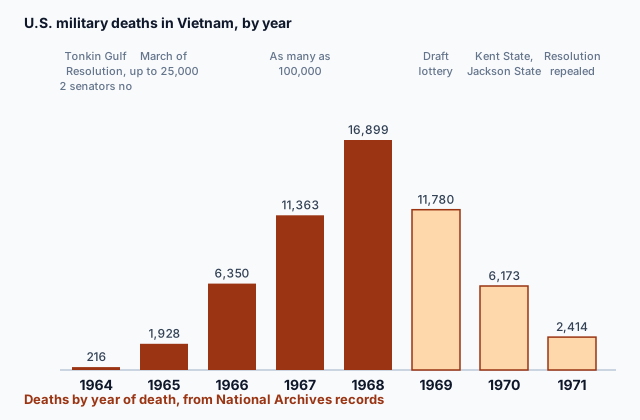
Then the war escalated, meaning it grew in size and cost. U.S. military deaths rose from 216 in 1964 to 1,928 in 1965 and 16,899 in 1968. Protest grew with them. The course framework, in one of its optional sources, notes that in April 1965 a student group, Students for a Democratic Society, led a march on Washington of up to 25,000 people, the largest peace protest in the country to that point. It puts the October 1967 march at as many as 100,000, half of whom went on to the Pentagon; estimates of that crowd varied. The National Archives calls 1968, the year of the Tet Offensive, a year of heightened social unrest over the war, values and race.
The draft made the war personal for young men. On December 1, 1969, the Selective Service held a lottery to set the order in which they would be called.
Sources: Tonkin Gulf Resolution; casualty statistics; 1968; Selective Service records (all National Archives).
Quick check · Fill the statement
Complete the notes on opposition to the war.
Before Vietnam, anti-communist foreign policy faced opposition at home. As the war , antiwar protests became .
2b. When protest met force
Antiwar protest sometimes led to violence. In 1970, after President Nixon announced that American and allied troops had been sent into Cambodia, the Ohio National Guard was sent to Kent State University to put down unrest. On May 4, 1970, Guardsmen fired on students there, killing four and wounding nine. Days later, at Jackson State College, a historically Black college in Mississippi, city and state police fired on a dormitory, killing two young Black men. The unrest at Jackson State mixed protest against the war with anger over racism.
On June 13, 1970, an executive order created the President's Commission on Campus Unrest, chaired by former Pennsylvania governor William Scranton, to identify the main causes of campus disorder. The National Archives describes the rest of its charge as "suggesting nonviolent means of resolving grievances while protecting the right to dissent." The charge named the right to dissent as something to protect, and asked how grievances could be settled without violence.
Sources: Records of the President's Commission on Campus Unrest (National Archives); the AP U.S. History course framework, for the Cambodia announcement and the Guard's mission.
Quick check · Multiple choice
The Commission on Campus Unrest was created in June 1970. How does it relate to the events on campuses that spring?
2c. Critics on the left
Opposition did not come only from the right. Some groups on the left rejected liberal policies too. They argued that liberal leaders did too little to change the racial and economic order at home, and pursued immoral policies abroad.
The course framework points to the New Left, a movement of young radicals. In June 1962, about 60 college students from Students for a Democratic Society met at Port Huron, Michigan, and, led by Tom Hayden of the University of Michigan, wrote the Port Huron Statement, a document closely tied to the New Left. In 1965 the same group organized the march against the war.
Notice who the target was. The war these students marched against was being fought by a liberal president, Johnson, the same man who signed the civil rights and antipoverty laws. In his 1965 inaugural he had accepted that American lives might be spent "in countries we barely know." To his critics on the left, the Great Society at home did not excuse the war abroad, and it did not go far enough. Martin Luther King Jr. became one such critic: the National Archives notes that in the later 1960s he "turned his attention to poverty, capitalism, and the war in Vietnam."
Sources: the AP U.S. History course framework; Johnson's inaugural address (Avalon Project); Martin Luther King, Jr. (National Archives).
Quick check · Sort it
Each card is a position from the 1960s. Tap a card, then whose position it is.
Liberal leaders
Critics on the left
2d. The counterculture
A counterculture is a way of living set against the main culture of its time. In the 1960s young people in the counterculture rejected many of the social, economic and political values of their parents' generation. They brought greater informality into American culture: jeans and long hair at school and at work, first names where titles had been the rule. In August 1969 hundreds of thousands gathered for the Woodstock music festival in New York. With the birth control pill, sold since 1960, many pushed for changes in sexual norms. It grew out of the challenges to postwar conformity that artists, intellectuals and rebellious youth had already raised in the 1950s.
The counterculture and the antiwar movement were different things, but they met. The course framework describes a 1967 photograph from the Pentagon in which a protester places a flower in a soldier's rifle barrel.
Nixon's first inaugural, in January 1969, shows how an older American could see both sides of the young. He praised them: "We see the hope of tomorrow in the youth of today." He called them "more passionately driven by conscience than any generation in our history." In the same speech he warned, "We cannot learn from one another until we stop shouting at one another."
Sources: the AP U.S. History course framework; Nixon's first inaugural address (Avalon Project).
Quick check · Match
Match each term to its description.
Part 3 Watch it done Connect the escalation and the protests
Watch each step, then do the last one yourself.
U.S. military deaths in Vietnam, by National Archives records: 216 in 1964, 1,928 in 1965, 6,350 in 1966, 11,363 in 1967, 16,899 in 1968. Explain how antiwar protest related to the escalation of the war.
Predict first
Before the steps, what do you expect to find?
Step 1 · Read the trend
Deaths rose every year from 1964 to 1968, from a few hundred to almost seventeen thousand. That is escalation: more troops, more fighting, more loss.
Why this step?
Why read the war first and the protests second?
To connect two developments, you need each one clearly on its own first. Then you can ask whether one moved with, or because of, the other.
Step 2 · Lay the protests beside it
In 1964 only two senators opposed the resolution that widened the war. In April 1965, the course framework notes, up to 25,000 people marched on Washington, and it puts the October 1967 march at as many as 100,000. The National Archives describes 1968 as a year of heightened unrest over the war.
Your step · Decide and justify
Finish it. How did protest relate to the escalation?
Which evidence best supports your answer?
Part 4 Try it A new president speaks to a divided country
Richard Nixon gave his first inaugural address on January 20, 1969, after a year of heightened unrest over the war, values and race. Inaugural addresses speak to the whole nation, and a new president uses one to set the tone he wants. Nixon described the country this way: "We are caught in war, wanting peace. We are torn by division, wanting unity." He praised the young, and he asked Americans to lower their voices.
Sources: Nixon's first inaugural address (Avalon Project); 1968: A Year of Turmoil and Change (National Archives).
Try it · Multiple choice
What does Nixon’s address most reveal about the historical situation in January 1969?
Try it · Spot the error
A student writes a sourcing paragraph on Nixon’s 1969 address. Which line is the first to go wrong?
Part 5 Explain it Write it like a document-based answer
Nothing you type leaves this page. Check your answer against the model and each scoring point.
Free-response practice · Question 1 style
A short practice in the shape of the document-based question: three documents instead of seven, and a thesis with one body paragraph instead of a full essay.
Evaluate the extent to which opposition to the Vietnam War changed from 1964 to 1971.
Document 1. Tonkin Gulf Resolution, passed by Congress August 7, 1964, with two senators opposed: "Congress approves and supports the determination of the President, as Commander in Chief, to take all necessary measures to repel any armed attack against the forces of the United States and to prevent further aggression."
Document 2. National Archives research page on Martin Luther King Jr.: "In the later 1960s, Martin Luther King Jr. turned his attention to poverty, capitalism, and the war in Vietnam."
Document 3. Richard Nixon, first inaugural address, January 20, 1969: "We are caught in war, wanting peace. We are torn by division, wanting unity."
Write a thesis, one sentence of historical context, and one paragraph that uses at least two documents and explains the purpose, audience, point of view or situation of one of them.
Model answer
Thesis: Opposition to the Vietnam War changed greatly between 1964 and 1971, from two senators in Congress to a broad movement of students, civil rights leaders and finally Congress itself, though a backlash grew beside it and the war went on.
Context: since 1945 the policy of containing communism had faced little opposition at home, and both parties had supported it.
In 1964 Congress gave the president power to "take all necessary measures" in Vietnam with only two senators opposed (Document 1), so opposition in government was nearly absent. As U.S. deaths rose from 216 in 1964 to 16,899 in 1968, opposition spread beyond students: in the later 1960s King joined the war to his criticism of poverty at home (Document 2). By 1969 a new president described a nation "torn by division" (Document 3). Nixon spoke to the whole country at the start of his term, and his purpose was to calm it, so he describes the split without saying who was right, which makes the speech good evidence of how deep it ran. The change had limits. In November 1969 Nixon appealed to what he called the silent majority, Americans who backed him against the protesters, and after Congress repealed the resolution in January 1971, American troops fought on for two more years.
Score your own answer. This is a self-check, not a grade. Tick each point your answer makes.
Part 6 Check yourself The war in numbers
The case questions use the table. The others mix the ideas from the whole lesson.
Deaths are counted by year of death or incident; a few more were recorded after 1971, such as 62 in 1975. Note: in May 1970, after President Nixon announced that troops had entered Cambodia, Ohio National Guardsmen killed four students at Kent State, and days later police killed two young Black men at Jackson State College. Source: Vietnam War U.S. Military Fatal Casualty Statistics (National Archives).
| Year | Deaths |
|---|---|
| 1964 | 216 |
| 1965 | 1,928 |
| 1966 | 6,350 |
| 1967 | 11,363 |
| 1968 | 16,899 |
| 1969 | 11,780 |
| 1970 | 6,173 |
| 1971 | 2,414 |
Case question 1 · Multiple choice
Which statement does the table best support?
Case question 2 · Multiple choice
Deaths fell after 1968. Which conclusion about protest do the table and the note above it support?
The rest stand on their own and do not use the case.
Check yourself · Put it in order
Put these events in the order they happened, earliest first.
Check yourself · Select all
Which two were criticisms that groups on the left made of liberal leaders? Select two.
Select 2 answers, then check.
Part 7 Keep it Bring back earlier ideas
This lesson stands on the African American civil rights movement of Topic 8.10 and the movements for equality in Topic 8.11.
Bring it back · Multiple choice
Which change took place among civil rights activists after 1965?
Bring it back · Fill the statement
Read the situation, then complete the sentences.
Suppose a group of activists in the early 1970s demands equal pay for equal work and an end to laws that treat people differently by sex. They are activists, and their demands are mainly for equality.
In three lines
- Antiwar protest grew as the Vietnam War escalated and sometimes met deadly force, as when Guardsmen at Kent State and police at Jackson State fired on students in 1970.
- The New Left attacked liberal leaders from the left, for doing too little at home and for an immoral war abroad.
- The counterculture rejected many of the older generation’s values, made American life more informal and pushed for changes in sexual norms.
Exam strategy for this topic
- Section I Part A, Multiple Choice: 55 questions in 55 minutes.
- Section I Part B, Short Answer: 3 questions in 40 minutes.
- Section II, Document-Based Question and Long Essay: 2 questions in 100 minutes.
- This lesson's Explain it is shaped like free-response question 1, Document-based.
When a question asks how two developments relate, give each one with a date or a number, then name the link, as in deaths rising from 1,928 to 11,363 while marches grew from up to 25,000 to as many as 100,000, by the course framework’s count.
Questions students ask
Did the protests end the Vietnam War?
The lesson does not claim that. Congress repealed the Tonkin Gulf Resolution in January 1971 to limit the president’s power to continue the war, after opposition had mounted, but the war went on after that.
What happened at Kent State and Jackson State?
In May 1970, after President Nixon announced that troops had been sent into Cambodia, the Ohio National Guard was sent to Kent State to put down unrest. On May 4 Guardsmen fired on students, killing four and wounding nine. Days later, police fired on a dormitory at Jackson State College in Mississippi, a historically Black college, killing two young Black men. A federal commission on campus unrest was created that June.
Was everyone in the counterculture against the war?
They overlapped but were not the same. The counterculture rejected a way of life, and the antiwar movement opposed a policy, though they met at events like the 1967 march on the Pentagon.
Why is the Port Huron Statement not quoted here?
Every quotation in this lesson is checked word for word against an archive copy, and no text of the statement could be checked that way, so the lesson describes it from the course framework.
Where can I read these documents in full?
Each excerpt links to its full text at the National Archives or the Avalon Project at Yale Law School, the primary-source collections this lesson was checked against.
Course alignment, for teachers
AP U.S. History topic 8.12, Unit 8: Period 8: 1945–1980.
- Skill 5.B: Explain how a historical development or process relates to another historical development or process.
This lesson maps all 3 essential knowledge statements of the topic, and the one learning objective with none of its own, to the part that teaches each one: 4 are checked by a scored question. The map is in the lesson file.