Unit 5 · Topic 5.3 · about 30 minutes · 7 parts · 13 scored checks, 5 of them multiple choice
AP U.S. History 5.3: The Mexican–American War
Unit 5: 10 to 17% of the multiple-choice section
What you'll be able to do
- Explain the causes and effects of the Mexican-American War: the dispute over Texas and its border, the lands the United States gained by war and by negotiation, and the questions those lands raised about slavery, Mexicans and American Indians, comparing the arguments of the sources that record them.
Key vocabulary
| Term | What it means | The exam trap |
|---|---|---|
| Annexation of Texas | The joining of the independent Republic of Texas to the United States, which Congress assented to by early 1845. | Polk called annexation a reunion; read a word like that as part of a source's argument, not as a neutral label. |
| Cession | Land one country gives up to another, usually by treaty, as Mexico did in 1848. | Ceded land usually had people living on it; the word names a change of rulers, not a transfer of empty land. |
| Treaty of Guadalupe Hidalgo | The treaty, signed February 2, 1848, that ended the war between the United States and Mexico. | Signing and approval are separate steps: the Senate approved it on March 10, 1848, more than a month after it was signed. |
| Gadsden Purchase | A treaty with Mexico, dated December 30, 1853, that completed what is now the southern border of the United States. | It was a purchase of land, not a change to how the Rio Grande border was drawn in 1848. |
| Free state | A state where slavery was banned. | A free state could still contain people who opposed abolition; the term names the law, not public opinion. |
 Tap to open the picture full size
Part 1 Think first Whose soil?
Commit to a guess first. Being wrong now makes the right idea stick better.
Predict first
On May 11, 1846, President James K. Polk told Congress that Mexico had shed blood on American soil. The fighting had happened on land between the Nueces River and the Rio Grande. Texas had claimed the Rio Grande as its border since 1836, and Texas had just joined the United States. What do you think Mexico said about that land?
In short. The Mexican-American War began in 1846 after the United States annexed Texas and sent troops into land both nations claimed, and the Treaty of Guadalupe Hidalgo of 1848 added vast western lands that raised hard questions about slavery and about the Mexicans and American Indians already living there.
- By Polk's own report Mexico still claimed Texas, and the land between the Nueces River and the Rio Grande was claimed by both sides when fighting began there in 1846.
- Through the war and through negotiation (the Oregon treaty of 1846 and the Gadsden Purchase of 1853) the United States added large territories reaching to the Pacific.
- The new lands raised the question of slavery's spread; the treaty left Mexican Americans' land and full rights to U.S. decisions, and U.S. treaties with American Indian nations reshaped how those nations made a living.
Part 2 Learn it The war with Mexico and the lands it added
2a. Texas and a disputed border
In his inaugural address of March 4, 1845, Polk announced that "the assent of this Government has been given to the reunion" with Texas, his word for annexing it. A year later he told Congress Mexico's view in his own words: "she has affected to believe that we have severed her rightful territory." To say she affected to believe is to say she only pretended: Polk is dismissing the claim.
The border was disputed too. Polk wrote: "The Congress of Texas, by its act of December 19, 1836, had declared the Rio del Norte to be the boundary of that Republic." The Rio del Norte is the Rio Grande. Land between the Nueces River and the Rio Grande was claimed by both sides.
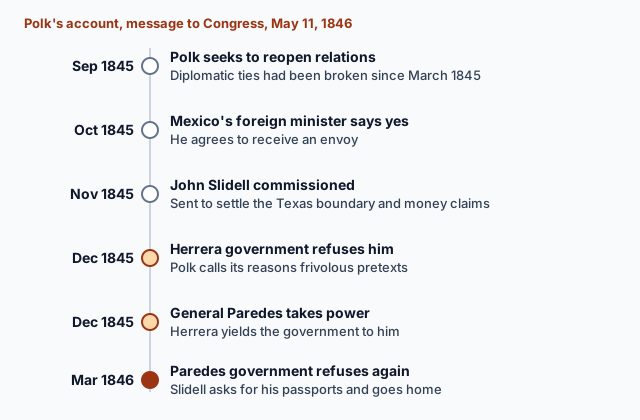
The rest of the story also comes from Polk's message of May 11, 1846, a president's case for war. He reported that Mexico's government refused to receive his envoy, John Slidell, and that he ordered the army to "occupy the left bank of the Del Norte." On April 12, he wrote, the Mexican commander, General Ampudia, told the Americans "to retire beyond the Nueces River," Mexico's claim put in one order. Then, by Polk's account, Mexican troops attacked a party of American dragoons. His conclusion: "Mexico has passed the boundary of the United States, has invaded our territory and shed American blood upon the American soil."
Sources: Polk's inaugural address (Avalon Project); Polk's message of May 11, 1846 (Avalon Project).
Quick check · Multiple choice
Polk's war message says that "Mexico has passed the boundary of the United States, has invaded our territory and shed American blood upon the American soil." Which claim, made in the same message, did he rest that on?
2b. What war and diplomacy added
American forces took Mexico City in September 1847. The Treaty of Guadalupe Hidalgo, signed February 2, 1848, ended the war. Mexico gave up all claims to Texas and accepted the Rio Grande as the border. It also ceded the lands of present-day California, Nevada, Utah and New Mexico, most of Arizona and Colorado, and parts of Oklahoma, Kansas and Wyoming. In return the United States agreed to pay "the sum of fifteen million of dollars." The Senate approved the treaty on March 10, 1848, by a vote of 34 to 14. More than 525,000 square miles were added, carrying the southwestern border to the Pacific.
War was not the only way the United States grew in these years. Diplomacy did part of the work.
- In June 1846, weeks after the war began, a treaty with Great Britain set the Oregon border along the forty-ninth parallel, with no fighting between the two.
- On December 30, 1853, the Gadsden Purchase, a treaty with Mexico in peacetime, completed what is now the southern border of the United States.
Sources: Treaty of Guadalupe Hidalgo (National Archives); Treaty with Great Britain, 1846 (Avalon Project); Avalon Project index, for the Gadsden Purchase date.
Quick check · Sort it
Each card is a gain for the United States between 1846 and 1853. Tap a card, then how it was gained.
Gained through the war with Mexico
Gained by negotiation, with no war fought over it
2c. Would slavery follow the flag?
The new lands brought an old question back to the center of politics: would slavery be allowed there? The treaty itself says nothing about slavery, so Congress had to decide. The National Archives puts it plainly: sectional tensions became especially critical when Congress began to consider whether western lands acquired after the Mexican-American War would permit slavery.
California made the question urgent. In 1849 it asked to enter the Union as a free state. Admitting it would upset the balance between slave and free states in the Senate, a balance that had held since the Missouri Compromise of 1820. Each new state brought two senators, so every territory that became a state could tip that balance one way or the other.
Topic 5.4 follows how Congress tried to settle the question in 1850.
Quick check · Fill the statement
Complete the notes on the slavery question after the war.
In 1849 California asked to enter the Union as a state. Admitting it would upset the balance between slave and free states in the .
2d. People already living in the ceded lands
The ceded lands were not empty. The treaty made promises to the Mexicans living there. Under Article VIII they "shall be free to continue where they now reside, or to remove at any time to the Mexican Republic, retaining the property which they possess in the said territories." Within a year they had to choose a citizenship. Under Article IX, those who became Americans would "be admitted at the proper time (to be judged of by the Congress of the United States) to the enjoyment of all the rights of citizens of the United States." Congress, not the treaty, would decide when. And before approving the treaty, the Senate struck Article X, which had guaranteed protection of Mexican land grants.
American Indians lived there too. Article XI says that much of the land "is now occupied by savage tribes, who will hereafter be under the exclusive control of the Government of the United States." The word savage shows how both governments saw these nations, and the United States promised to stop their raids into Mexico.
Governing the region brought more contact and more conflict between the U.S. government, Mexican Americans and American Indians. For Mexican Americans, the treaty's own terms left their land and their full rights to American decisions. For three American Indian nations, the treaty of 1853 in Check yourself shows what the new contact looked like.
Quick check · Match
Match each part of the Treaty of Guadalupe Hidalgo, or the change made to it, with what it meant for people in the ceded lands.
Part 3 Watch it done Compare two statements by Polk
Watch each step, then do the last one yourself.
Compare the arguments of two statements by President Polk. In his inaugural address of March 4, 1845, he said: "Foreign powers should therefore look on the annexation of Texas to the United States not as the conquest of a nation seeking to extend her dominions by arms and violence, but as the peaceful acquisition of a territory once her own." On May 11, 1846, he told Congress: "As war exists, and, notwithstanding all our efforts to avoid it, exists by the act of Mexico herself."
Predict first
Before the steps, do you expect the two statements to agree or disagree about whether the United States was the aggressor?
Step 1 · State each main idea
1845: annexing Texas is a peaceful act between two independent nations, not a conquest. Polk adds, "I regard the question of annexation as belonging exclusively to the United States and Texas." 1846: the war was started by Mexico, which Polk says has crossed the boundary and invaded American territory.
Why this step?
Why state each source's main idea before comparing them?
A comparison needs two clear claims to set side by side. Put each one in your own words first, or you end up comparing details instead of arguments.
Step 2 · Set each in its situation
In 1845 Polk was speaking at his inauguration, partly to foreign powers, and asking nothing of anyone. In 1846 he was asking Congress to recognize a war and to call a large body of volunteers into service. The situations differ: one statement heads off objections, the other asks for the means to fight.
Your step · Decide and justify
Finish it. Which comparison of the two arguments is better supported?
Which evidence best supports your answer?
Part 4 Try it Read the treaty's promises to Mexicans
Articles VIII and IX of the Treaty of Guadalupe Hidalgo set out what happened to Mexicans living in the ceded lands. Those who stayed had a year to declare that they would remain Mexican citizens. Anyone who stayed past that year without declaring it "shall be considered to have elected to become citizens of the United States." The Mexicans who did not keep Mexican citizenship were promised the free enjoyment of their liberty and property, and to be "secured in the free exercise of their religion without restriction."
The treaty the Senate approved was not quite the treaty that was signed. The Senate removed Article X, which had guaranteed protection of Mexican land grants.
Try it · Multiple choice
A Mexican rancher lives near Santa Fe, in the ceded lands, when the treaty takes effect. He stays, and in the following year he makes no declaration at all. Under the treaty, what is his status?
Try it · Spot the error
A student writes a paragraph on what the treaty meant for Mexicans in the ceded lands. Which line is the first to go wrong?
Part 5 Explain it Write it like a document-based answer
Nothing you type leaves this page. Check your answer against the model and each scoring point.
Free-response practice · Question 1 style
A short practice in the shape of the document-based question: three documents instead of seven, and a thesis with one body paragraph instead of a full essay.
Evaluate the extent to which the Mexican-American War changed life for the people already living in the lands the United States gained from Mexico, including Texas.
Document 1. Treaty of Guadalupe Hidalgo, February 2, 1848, Article VIII: "Those who shall prefer to remain in the said territories may either retain the title and rights of Mexican citizens or acquire those of citizens of the United States."
Document 2. Treaty of Guadalupe Hidalgo, Article XI: much of the ceded land "is now occupied by savage tribes, who will hereafter be under the exclusive control of the Government of the United States."
Document 3. Treaty between the United States and the Comanche, Kiowa and Apache, nations the treaty places south of the Arkansas River, Fort Atkinson, July 27, 1853. The tribes accept the right of the United States "to establish military and other posts within the territories inhabited by the said tribes." Article 10 adds: "should it at any time hereafter be considered by the United States as a proper policy to establish farms among and for the benefit of said Indians," the President, with the Senate's consent, may turn the tribes' yearly payments into a fund for that purpose.
Write a thesis, one sentence of historical context, and one paragraph that uses at least two documents and explains the purpose, audience, point of view or situation of one of them.
Model answer
Thesis: The war changed life in the lands taken from Mexico a great deal, because it placed Mexicans and American Indians under a government that decided their rights and their land, even though the treaty promised Mexicans continuity in property and religion.
Context: the war began in 1846 over the annexation of Texas and a disputed border, and it ended with Mexico giving up land from Texas to California.
Article VIII let Mexicans stay and choose a citizenship (Document 1), which sounds like little changed. But the treaty was written by two governments, and its point of view shows in Article XI, which calls the tribes "savage" and places them under the "exclusive control" of the United States (Document 2). The tribes themselves had no say in that article. Five years later, at Fort Atkinson, leaders of the Comanche, Kiowa and Apache, nations whose raids reached into Mexico, accepted American military posts in their lands, and the treaty raised the idea of farms set up for them by the United States (Document 3). Their land and their way of making a living were now subject to a government in Washington.
Score your own answer. This is a self-check, not a grade. Tick each point your answer makes.
Part 6 Check yourself Two treaties on raids into Mexico
The case questions use the excerpts. The others mix the ideas from the whole lesson.
The first excerpt is from the treaty that ended the war. The others are from a treaty signed five years later at Fort Atkinson between a United States agent and leaders of the Comanche, Kiowa and Apache, nations the treaty describes as "inhabiting the said territory south of the Arkansas River." Sources: Treaty of Guadalupe Hidalgo (National Archives); Treaty with the Comanche, Kiowa, and Apache, 1853 (Avalon Project).
| Document | Excerpt |
|---|---|
| Treaty of Guadalupe Hidalgo, Article XI, 1848, on raids into Mexico | "it is solemnly agreed that all such incursions shall be forcibly restrained by the Government of the United States" |
| Treaty at Fort Atkinson, Article 5, July 27, 1853 | The tribes agree "to refrain in future from warlike incursions into the Mexican provinces" |
| Treaty at Fort Atkinson, Article 6 | Yearly payments from the United States, "the same to be given to them in goods, merchandise, provisions, or agricultural implements" |
| Treaty at Fort Atkinson, Article 6, the stated purpose of the payments | Among other reasons, "the improvement of the social condition of the said tribes" |
| Treaty at Fort Atkinson, Article 8 | If a tribe breaks the treaty, "then the United States may withhold the whole part or a part of the annuities" |
| Treaty at Fort Atkinson, Article 10 | The President may change the payments into a fund for farms, "should it at any time hereafter be considered by the United States as a proper policy to establish farms among and for the benefit of said Indians" |
Case question 1 · Multiple choice
What do the 1848 excerpt and the 1853 Article 5 excerpt together show about the U.S. government after the war?
Case question 2 · Multiple choice
How do Articles 6, 8 and 10 of the 1853 treaty point to changes in the tribes' self-sufficiency and way of life?
The rest stand on their own and do not use the case.
Check yourself · Put it in order
Put these events in the order they happened, earliest first.
Check yourself · Select all
Which two questions did the lands won from Mexico raise for the United States? Select two.
Select 2 answers, then check.
Part 7 Keep it Bring back earlier ideas
This lesson stands on the big picture of Period 5 from Topic 5.1 and on Manifest Destiny from Topic 5.2.
Bring it back · Multiple choice
In the 1840s and 1850s, newspapers and legislatures argue over who should be able to vote and hold rights in the United States: newcomers from abroad, free African Americans, women. Which broad development of Period 5 does this argument show?
Bring it back · Match
Match each development of westward expansion to what it was or how it turned out.
In three lines
- War came in 1846 after the United States annexed Texas, which Mexico still claimed, and sent troops into land both nations claimed.
- The Treaty of Guadalupe Hidalgo, with the Oregon treaty and the Gadsden Purchase, added territory reaching to the Pacific and raised the question of slavery there.
- The treaty left Mexican Americans' land and rights to U.S. decisions, and U.S. contact with American Indian nations brought payments in goods and pressure to farm.
Exam strategy for this topic
- Section I Part A, Multiple Choice: 55 questions in 55 minutes.
- Section I Part B, Short Answer: 3 questions in 40 minutes.
- Section II, Document-Based Question and Long Essay: 2 questions in 100 minutes.
- This lesson's Explain it is shaped like free-response question 1, Document-based.
When a question asks you to compare two sources, state each one's main argument in a sentence first, then name one way they agree and one way they differ, and tie the difference to each source's situation.
Questions students ask
Where exactly did the war begin?
Near the Rio Grande, which Polk calls the Del Norte. His army had been ordered to its left bank, in land Texas claimed and Mexico also claimed, and by his account Mexican troops attacked a party of American dragoons there.
How much land did the United States gain from Mexico?
The National Archives puts it at more than 525,000 square miles in the 1848 treaty, including present-day California, Nevada and Utah, and the Gadsden Purchase of 1853 completed the southern border.
Did the treaty say anything about slavery?
No. It left the question to Congress, which is why the lands acquired after the war became the center of the slavery debate that Topic 5.4 takes up.
Why does the treaty call American Indians savage tribes?
That is the language of the two governments that wrote it. The excerpt is copied exactly as the archive prints it, and the word shows how those governments saw the tribes, not what the tribes were.
Where can I read these documents in full?
Each excerpt links to its full text at the National Archives or the Avalon Project at Yale Law School, the primary-source collections this lesson was checked against.
Course alignment, for teachers
AP U.S. History topic 5.3, Unit 5: Period 5: 1844–1877.
- Skill 3.C: Compare the arguments or main ideas of two sources.
This lesson maps all 2 essential knowledge statements of the topic, and the one learning objective with none of its own, to the part that teaches each one: 3 are checked by a scored question. The map is in the lesson file.