Unit 4 · Topic 4.9 · about 30 minutes · 7 parts · 13 scored checks, 5 of them multiple choice
AP U.S. History 4.9: The Development of an American Culture
Unit 4: 10 to 17% of the multiple-choice section
What you'll be able to do
- Explain how and why a new national culture developed from 1800 to 1848, and place a work of that culture within the broader developments of its time.
Key vocabulary
| Term | What it means | The exam trap |
|---|---|---|
| National culture | The art, writing, ideas and buildings a people come to see as their own. | No law or government created it; look at what people made and valued. |
| Neoclassical | A style of building and art modeled on ancient Greece and Rome. | The word names a style, not a date; a neoclassical building can be brand new. |
| Romanticism | A movement in art and writing that prized feeling, nature and the individual. | In history the word has nothing to do with love stories; it names a way of seeing nature and the self. |
| Human perfectibility | The belief that people and society can be improved, perhaps without limit. | Perfectibility is a belief about what people can become, not a claim that anyone already is perfect. |
| Transcendentalism | A philosophical and literary movement centered in New England, with Emerson among its leaders. | It was a movement of ideas, not a church or a political party. |
| Contextualization | One of the reasoning skills of AP history: explaining a development by its setting in time. | A context sentence that could be pasted into any essay on the period explains nothing about this work. |
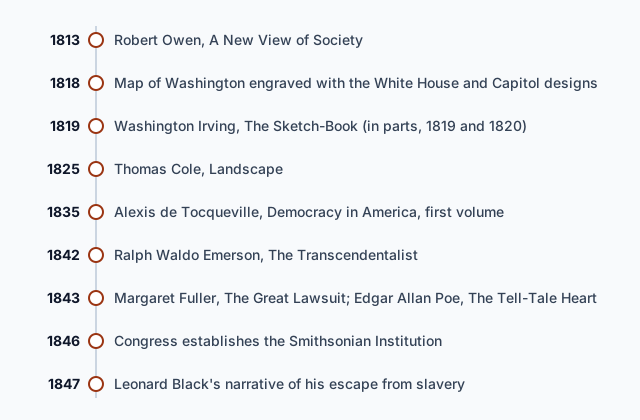 Tap to open the picture full size
Part 1 Think first Why a culture of their own?
Commit to a guess first. Being wrong now makes the right idea stick better.
Predict first
In 1825 Thomas Cole painted Landscape, a scene of American wilderness, and in the same decades American writers set their stories in American places. A generation earlier, most books and paintings Americans prized came from Britain. Why do you think so many Americans after 1800 wanted art and writing of their own?
In short. From 1800 to 1848 Americans built a national culture of their own, painting and writing about American places and people while borrowing forms and ideas from Europe, including Romantic beliefs that people and society could be made better.
- The new culture combined American subjects, such as the Hudson River landscape, with European influences, such as neoclassical buildings and Romanticism.
- It was national and regional at once: Boston's Transcendentalists, New York's painters and the narratives of people who escaped slavery each added a region's or a group's experience.
- Liberal social ideas from abroad and Romantic beliefs in human perfectibility shaped American literature, art, philosophy and architecture, though Romantics on the darker side, like Poe, did not share that hope.
Part 2 Learn it A national culture takes shape
2a. American subjects, European forms
A national culture is the art, writing, ideas and buildings a people come to see as theirs. After 1800, a generation past independence, many Americans wanted one that showed their republic had a character of its own.
Writers and painters turned to American places. Washington Irving's The Sketch-Book, published in parts in 1819 and 1820, held The Legend of Sleepy Hollow and Rip Van Winkle, tales of Dutch villagers in New York's Hudson River valley. The Hudson River School of painters made the American landscape its subject, and Thomas Cole painted Landscape in 1825.
The forms often came from Europe. An 1818 map of Washington, D.C., carried engravings of the original designs for the White House, by James Hoban, and the Capitol, by William Thornton. Both are neoclassical, modeled on the buildings of ancient Greece and Rome, a style European builders also favored; Thornton's Capitol was crowned with a dome. The way Cole's generation saw wild nature, as a source of awe and deep feeling, owed much to Romanticism, a European movement.
The new culture was a blend: American subjects, often in European forms.
Source: Dates and makers of the works named here are from the AP U.S. History course framework's examples for this topic; other details are general background.
Quick check · Sort it
Each card is one feature of American culture from 1800 to 1848. Tap a card, then where that feature came from.
An American element
A European influence
2b. Regional and group voices
The new culture had regional accents. Boston and its neighbors became a center of Transcendentalism, a philosophy holding that truth can be found within each person and in nature, beyond what the senses show. Ralph Waldo Emerson, one of its leaders, read his lecture The Transcendentalist at Boston's Masonic Temple in 1842. Margaret Fuller's essay The Great Lawsuit, printed in the Transcendentalist journal The Dial in July 1843, set American ideals of liberty and equality against the real status of women. New York gave the culture its Hudson River painters and Irving's valley tales.
African Americans shaped it too. Narratives by people who had escaped slavery were a common form of literature. Leonard Black, born enslaved in Maryland around 1820, escaped in 1837 and published his narrative at New Bedford in 1847. Robert S. Duncanson, an African American artist active from the 1840s, was known, like many painters of his time, for landscapes such as Hunting in the Woods (1846).
So the culture joined national themes to regional and group experience, from a Boston philosophy to a story of Southern slavery published in the North.
Source: Dates and makers of the works named here are from the AP U.S. History course framework's examples for this topic; other details are general background.
Quick check · Multiple choice
A historian argues that American culture from 1800 to 1848 was national and regional at the same time. Which evidence best supports that claim?
2c. Romantic faith in human perfectibility
Two currents from abroad ran through this culture. Romanticism, begun in Europe, prized feeling, nature and the individual, and many Romantics believed in human perfectibility: people and society could be made far better. Liberal social ideas about reforming society crossed the Atlantic too. In 1813 the British reformer Robert Owen opened the first essay of A New View of Society, dedicated to William Wilberforce, a member of Parliament, this way:
If training and surroundings can form any character, then better schools, work and towns can make better people.
That hope shaped American literature, art and philosophy: Emerson's Transcendentalists looked inward and to nature for truth, and Fuller held the nation to its ideals of equality. It reached architecture too: by the 1840s some American churches were built in the Gothic Revival style, a Romantic return to the medieval that came from Britain.
Romanticism had a darker side. Poe's The Tell-Tale Heart (1843) belongs to an American Gothic strain that explored anger and madness, not human improvement.
Sources: Owen's dedications (Avalon Project); Dates and makers of the works named here are from the AP U.S. History course framework's examples for this topic; other details are general background.
Quick check · Match
Match each work to the idea it carries.
2d. Putting a work in context
Contextualization means placing a development inside a broader one, so you can explain why it happened when and where it did. It takes three moves: name a broader development, give specific evidence of it, and link the two.
The years 1800 to 1848 offer several broader developments to choose from: the market revolution, migration west, Romanticism and Transcendentalism. Take the Hudson River School. Its painters celebrated wild American scenery in the same decades that canals, mills and new farms were changing that land. A strong context sentence links them: as the market revolution cut into the wilderness, painters such as Cole made the wild itself a subject worth painting.
Influence also ran the other way. Europeans studied the new nation. Alexis de Tocqueville, a French political philosopher, assessed American democracy in Democracy in America, whose first volume appeared in 1835.
Source: Dates and makers of the works named here are from the AP U.S. History course framework's examples for this topic; other details are general background.
Quick check · Fill the statement
Complete the steps for putting Cole's Landscape (1825) in context.
First, name a , such as the market revolution. Next, give , such as canals and mills changing the land of New York. Last, explain the between that development and the painting.
Part 3 Watch it done Put Owen's idea in context
Watch each step, then do the last one yourself.
In 1813 the British reformer Robert Owen wrote that "the poor and working classes of Great Britain and Ireland have been found to exceed fifteen millions of persons, or nearly three-fourths of the population of the British Islands." He argued that the right means could form the character of any community, and he dedicated the essay to William Wilberforce, a member of Parliament, hoping he would "lend your aid to introduce its influence into legislative practice." Explain the context that made an idea like Owen's relevant to Americans by the 1830s and 1840s.
Predict first
Before the steps, what do you think could make an idea about Britain's working poor matter in the United States?
Step 1 · Read the source's own situation
Owen wrote about Britain's poor and working classes, which he counted at nearly three-fourths of its people, and he asked a member of Parliament to carry his ideas into law. His claim that proper means could form any character was a plan for British lawmakers to act on.
Why this step?
Why begin with Owen's own situation instead of America's?
A source answers a problem in its own place and time. Knowing the problem Owen was trying to solve tells you which American problem his idea could be carried to.
Step 2 · Find the broader American development
In the United States the market revolution brought factories to Northern towns. Manufacturing raised living standards for some, producing a larger middle class and a small wealthy business elite, but also a large and growing population of laboring poor.
Your step · Decide and justify
Finish it. Which context best explains why an idea like Owen's was relevant to Americans by the 1830s and 1840s?
Which evidence best supports your answer?
Part 4 Try it A Londoner's will and a national institution
Congress set up the Smithsonian Institution by an act of August 10, 1846, as an independent agency for the "increase and diffusion of knowledge among men." It did so under the terms of the 1829 will of James Smithson of London. Today the Smithsonian maintains museums and exhibits of the arts, American history and natural history, among others.
Source: Records of the Smithsonian Institution (National Archives).
Try it · Multiple choice
What does the founding of the Smithsonian best show about the national culture by 1846?
Context works for a single story, too. Here a student places a tale from 1843 among the developments of its time.
Try it · Spot the error
A student writes a context paragraph on Edgar Allan Poe's The Tell-Tale Heart (1843). Which line is the first to go wrong?
Part 5 Explain it Write it like a document-based answer
Nothing you type leaves this page. Check your answer against the model and each scoring point.
Free-response practice · Question 1 style
A short practice in the shape of the document-based question: three documents instead of seven, and a thesis with one body paragraph instead of a full essay.
Evaluate the extent to which European influences shaped American culture from 1800 to 1848.
Document 1. Robert Owen, a British reformer, A New View of Society, 1813, the opening of the first essay, which Owen dedicated to William Wilberforce, a member of Parliament: "Any general character, from the best to the worst, from the most ignorant to the most enlightened, may be given to any community, even to the world at large, by the application of proper means."
Document 2. Thomas Cole, Landscape, 1825. A painting of American wilderness by a painter of the Hudson River School, an artistic movement that focused on the American landscape. (Described, not shown.)
Document 3. The National Archives' summary of the act of Congress of August 10, 1846, establishing the Smithsonian Institution as an independent agency for the "increase and diffusion of knowledge among men," under the terms of the 1829 will of James Smithson of London.
Write a thesis, one sentence of historical context, and one paragraph that uses at least two documents and explains the purpose, audience, point of view or situation of one of them.
Model answer
Thesis: European influences shaped American culture from 1800 to 1848 to a large extent in its ideas and forms, but Americans turned those borrowings to American subjects and national purposes, so the result was a blend rather than a copy.
Context: a generation after independence, many Americans wanted art and institutions that showed the young republic had a character of its own, so they took what Europe offered and turned it to American purposes.
Owen's claim that any character can be formed "by the application of proper means" (Document 1) is a liberal social idea from abroad, and its belief that people can be made better runs through the Romantic culture of the period. Because Owen wrote about Britain's working poor and dedicated the essay to a member of Parliament, his purpose was to move British lawmakers, so the document shows where the idea came from, not how Americans received it. Cole's Landscape (Document 2) applies a Romantic way of seeing nature to an American subject, the wilderness the Hudson River School made its own. The Smithsonian (Document 3) shows the same blend in an institution: a Londoner's will, turned by Congress into a national agency for the "increase and diffusion of knowledge among men." European influence was strong, but in each case Americans put it to American uses.
Score your own answer. This is a self-check, not a grade. Tick each point your answer makes.
Part 6 Check yourself Six works, 1819 to 1847
The case questions use the table. The others mix the ideas from the whole lesson.
Works the course framework offers as examples of American culture in these years. Dates and makers of the works named here are from the AP U.S. History course framework's examples for this topic; other details are general background.
| Year | Work | What it is |
|---|---|---|
| 1819 and 1820 | Washington Irving, The Sketch-Book | Tales including The Legend of Sleepy Hollow, set among Dutch villagers in New York's Hudson River valley |
| 1825 | Thomas Cole, Landscape | A painting of American wilderness, from the Hudson River School |
| 1842 | Ralph Waldo Emerson, The Transcendentalist | A lecture read at Boston's Masonic Temple by a leader of the Transcendentalist movement |
| 1843 | Margaret Fuller, The Great Lawsuit | An essay in The Dial setting American ideals of liberty and equality against the status of women |
| 1843 | Edgar Allan Poe, The Tell-Tale Heart | A tale of the American Gothic, exploring anger and madness |
| 1847 | Leonard Black, The Life and Sufferings of Leonard Black | The narrative of a man born enslaved in Maryland who escaped to the North |
Case question 1 · Multiple choice
A student uses the table to argue that every American writer of the 1840s shared the Romantic hope that people could be improved. Which work in the table most weakens that argument?
Case question 2 · Multiple choice
Use the table's date and place for Emerson's lecture. Which broader development is the best context for The Transcendentalist?
The rest stand on their own and do not use the case.
Check yourself · Select all
Which two show European influence on American culture from 1800 to 1848? Select two.
Select 2 answers, then check.
Check yourself · Fill the statement
Complete the sentence about Romantic influence on American architecture.
By the 1840s some American churches were built in the style, a Romantic return to the that came from Britain.
Part 7 Keep it Bring back earlier ideas
This lesson stands on the expansion of democracy from Topic 4.7 and on the first expressions of national identity from Topic 3.11.
Bring it back · Multiple choice
In the early 1800s, state after state changed who could vote. Which change best describes the move to a more participatory democracy?
Bring it back · Fill the statement
Read the situation, then complete the sentences.
In the 1790s an American painter finishes a large canvas of a Revolutionary War battle, to hang in a new state house. The painting shows ideas about finding expression in .
In three lines
- A new national culture combined American subjects, European forms and ideas, and regional voices.
- Liberal social ideas from abroad and Romantic beliefs in human perfectibility shaped American literature, art, philosophy and architecture.
- To contextualize a work, name a broader development, give evidence of it, and link it to the work.
Exam strategy for this topic
- Section I Part A, Multiple Choice: 55 questions in 55 minutes.
- Section I Part B, Short Answer: 3 questions in 40 minutes.
- Section II, Document-Based Question and Long Essay: 2 questions in 100 minutes.
- This lesson's Explain it is shaped like free-response question 1, Document-based.
For context, pick one broader development, give one specific piece of evidence for it, and write a sentence that says how it shaped the work. A list of events from the same years earns nothing on its own.
Questions students ask
Was American culture in these years just copied from Europe?
No. Forms and ideas often came from Europe, such as neoclassical buildings and Romanticism, but Americans put them to American subjects, such as the Hudson River landscape, and to national purposes, such as the Smithsonian.
What is the difference between Romanticism and Transcendentalism?
Romanticism was a broad European movement that prized feeling, nature and the individual. Transcendentalism was an American philosophy, centered in New England with Emerson among its leaders, that grew from that soil and held truth could be found within each person and in nature.
Why does a British reformer appear in a lesson on American culture?
The course names liberal social ideas from abroad as an influence on American literature, art, philosophy and architecture. Robert Owen's 1813 claim that proper means can form any character is one such idea; he dedicated the essay to a member of Parliament, hoping to move British lawmakers.
Where does Poe fit if the period was so hopeful?
Poe was a Romantic too, on its darker side. The Tell-Tale Heart belongs to an American Gothic strain that explored anger and madness, so he shows that the hope of perfectibility was not shared by every Romantic.
Can I read these sources myself?
Owen's essay is at the Avalon Project at Yale Law School and the Smithsonian's founding is in the National Archives' guide to its records, both linked beside the excerpts. The paintings and books are described, not quoted, from the course framework's examples.
Course alignment, for teachers
AP U.S. History topic 4.9, Unit 4: Period 4: 1800–1848.
- Skill 4.B: Explain how a specific historical development or process is situated within a broader historical context.
This lesson maps all 2 essential knowledge statements of the topic, and the one learning objective with none of its own, to the part that teaches each one: 3 are checked by a scored question. The map is in the lesson file.