Unit 1 · Topic 1.5 · about 30 minutes · 7 parts · 12 scored checks, 4 of them multiple choice
AP U.S. History 1.5: Labor, Slavery, and Caste in the Spanish Colonial System
Unit 1: 4 to 6% of the multiple-choice section
What you'll be able to do
- Explain how the growth of the Spanish Empire in North America shaped its social and economic structures over time, and connect the developments that built them: forced Native labor, the import of enslaved Africans, and a caste system that ranked every group.
Key vocabulary
| Term | What it means | The exam trap |
|---|---|---|
| Encomienda | A Spanish grant that gave a colonist the labor or tribute of a group of Native people, in return for protecting them and having them taught Christianity. | Read what the grant gave the colonist before calling it the same thing as slavery. |
| Atlantic slave trade | The forced shipment of captive Africans across the Atlantic to work in the Americas. | Ask who took part on each side of the ocean; an answer that names only one side is incomplete. |
| Caste system | The Spanish system that defined the status of every group in the colonies by birthplace and ancestry. | Check what a person's rank rested on before assuming money could change it. |
| Peninsulares | People born in Spain who lived in Spain's American colonies. | The word names where a person was born, not where they lived or what they owned. |
| Mestizo | In Spain's colonies, a person of mixed Spanish and Native American ancestry. | Mestizo is one of several mixed categories; do not use it for every person of mixed ancestry. |
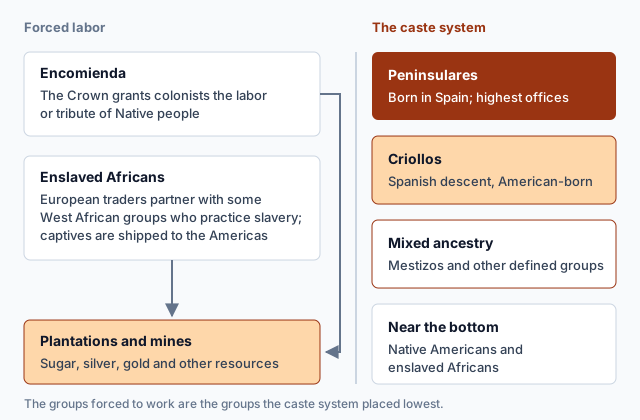 Tap to open the picture full size
Part 1 Think first When the workers were gone
Commit to a guess first. Being wrong now makes the right idea stick better.
Predict first
In the early 1500s Spanish colonists on the Caribbean islands forced Native people to dig for gold and work their fields. Within a few decades, epidemics and overwork had devastated the Native population of the islands. The colonists still wanted gold, sugar and food. Where do you think they turned for workers?
In short. As Spain's empire grew in the Americas, it forced Native people to work under the encomienda, imported enslaved Africans when Native populations collapsed, and sorted everyone in its colonies into a caste system by birthplace and ancestry.
- Under the encomienda, the Crown granted Spanish colonists the labor or tribute of Native people, who were forced to work on plantations and in mines.
- European traders partnered with some West African groups who practiced slavery to take captives to the Americas, where the Spanish forced enslaved Africans to work on plantations and in mines.
- The Spanish caste system took in Europeans, Africans, Native Americans and people of mixed ancestry, and carefully defined each group's status.
Part 2 Learn it Labor, slavery and caste
2a. The encomienda: forced Native labor
Spain claimed most of the Americas early. In the Treaty of Tordesillas, signed June 7, 1494, Spain and Portugal agreed on a line drawn "three hundred and seventy leagues west of the Cape Verde Islands." Lands "on the western side of the said bound" went to the monarchs of Castile, and lands to the east went to Portugal. No Native nation had a say in it.
The encomienda was how Spanish colonists put that claim to work. The Crown granted a colonist, called an encomendero, a group of Native people who owed him labor or tribute. In return he was supposed to protect them and see that they were taught Christianity. In practice it was forced labor. Spanish colonial economies used it to marshal Native workers for plantation agriculture and to extract silver, gold and other resources from the land.
The Native people in an encomienda were not bought and sold the way enslaved people were. The colonist held a claim on their work, not on their bodies as property. For the people forced to work, the difference often meant little. Some Native people were also enslaved outright, taken as captives in raids and wars, until the Crown banned their enslavement in 1542.
Quick check · Multiple choice
A Spanish colonist in New Spain receives a grant from the Crown. The Native people of several nearby villages must now work in his fields and in a mine, and he is responsible for their instruction in Christianity. Which system does the grant describe?
2b. Enslaved Africans for plantations and mines
The encomienda depended on Native workers, and Native populations were collapsing. Epidemics of diseases Europeans brought, such as smallpox, devastated them, and forced labor added to the deaths. Spanish colonists looked across the Atlantic for workers.
European traders, the Portuguese first, partnered with some West African groups who practiced slavery. Those groups sold people captured in wars and raids to European traders on the coast in exchange for goods. The captives were forced onto ships bound for the Americas. The Spanish imported enslaved Africans to labor in plantation agriculture, especially on sugar plantations, and in mining.
Two things are true at once here. European demand drove the trade across the ocean, and every captive suffered the violence of capture and the voyage. Some West African rulers and traders also took part and profited. An accurate account names both partners in the trade.
Quick check · Fill the statement
Complete the notes on how enslaved Africans came to Spain's colonies.
European traders obtained captives by partnering with . In Spain's colonies, enslaved Africans were forced to work in mines and on .
2c. A caste system for a mixed population
Spain's colonies now held Europeans, Native Americans, Africans, and a growing number of people of mixed ancestry. The Spanish developed a caste system that took in all of them and carefully defined each group's status by birthplace and ancestry.
At the top were peninsulares, people born in Spain, who held the highest offices in the colonial government and the church. Next came criollos, people of Spanish descent born in the Americas. Below them were people of mixed ancestry, such as mestizos, of Spanish and Native ancestry, and people of Spanish and African ancestry. Native Americans and enslaved Africans were placed near the bottom.
Read the system as a connection, not just a list. The groups placed near the bottom were the ones whose forced work the encomienda and the slave trade supplied, and the system recorded that order and made it look natural. A criollo family could be rich and still rank below a newcomer from Spain, because the system rested on birth, not on wealth alone.
Quick check · Match
Match each term from Spain's American empire to the person it describes.
Part 3 Watch it done Connect two developments
Watch each step, then do the last one yourself.
In the 1500s the Spanish forced Native people to work under the encomienda, and they also imported growing numbers of enslaved Africans. Identify the connection between the two developments.
Predict first
Before the steps, how do you think the two developments are connected?
Step 1 · Describe the first development
Under the encomienda, Native people were forced to work on plantations and in mines. Epidemics of European diseases, along with overwork, devastated their numbers.
Why this step?
Why start with what happened to the first group of workers?
A connection runs from one development to the next. Say what the first one was and what changed in it before you explain what followed.
Step 2 · Describe the second development
The Spanish imported enslaved Africans, bought from European traders who partnered with some West African groups, to labor in plantation agriculture and mining.
Your step · Decide and justify
Finish it. Which connection best links the two developments?
Which evidence best supports your answer?
Part 4 Try it Build the chain
Historians connect developments into chains, where each one helps bring about the next. Put this chain for Spain's empire in order.
Try it · Put it in order
Put these developments in Spain's American empire in the order in which each one builds on the developments before it.
Try it · Spot the error
A student connects developments in Spain's empire. Which line is the first to go wrong?
Part 5 Explain it Write it like a document-based answer
Nothing you type leaves this page. Check your answer against the model and each scoring point.
Free-response practice · Question 1 style
A short practice in the shape of the document-based question: three documents instead of seven, and a thesis with one body paragraph instead of a full essay.
Evaluate the extent to which forced labor shaped the society of Spain's American empire between 1492 and 1607.
Document 1. Treaty Between Spain and Portugal, concluded at Tordesillas, June 7, 1494, between the monarchs of Castile and the king of Portugal: lands "on the western side of the said bound," a line "three hundred and seventy leagues west of the Cape Verde Islands," are to go to the monarchs of Castile.
Document 2. Described, not quoted. Bartolomé de las Casas, a Spanish friar who had once held an encomienda himself, published A Short Account of the Destruction of the Indies in 1552. He described Spanish colonists killing and overworking Native people and urged the Spanish Crown to protect them.
Document 3. Described, not quoted. The New Laws issued by the Spanish Crown in 1542 forbade the enslavement of Native people and limited the encomienda, ordering that no new grants be made.
Write a thesis, one sentence of historical context, and one paragraph that uses at least two documents and explains the purpose, audience, point of view or situation of one of them.
Model answer
Thesis: Forced labor shaped Spanish colonial society to a great extent, because the empire's mines and plantations ran on Native and then African workers, and the caste system ranked people in a way that matched who was forced to work, though Crown reformers tried to limit the worst abuses.
Context: in the decades after 1492, epidemics of European diseases devastated Native populations, and the Spanish imported enslaved Africans to replace the Native labor they were losing.
Spain's claim to the lands "on the western side of the said bound" (Document 1) was made by two European monarchs with no Native nation consulted, and the encomienda turned that claim into a claim on Native people's work. Las Casas described colonists killing and overworking the Native people under them (Document 2). As a friar trying to persuade the Crown to act, he had reason to stress the cruelty, so his account shows the abuses he wanted ended more than a full picture of colonial life; but the Crown's own New Laws of 1542 (Document 3) banned Native enslavement and limited the encomienda, which suggests the abuses were serious enough to worry the Crown. Reform targeted Native labor, while the import of enslaved Africans for plantations and mines went on, and the caste system placed the peoples forced to work, Native Americans and enslaved Africans, near the bottom.
Score your own answer. This is a self-check, not a grade. Tick each point your answer makes.
Part 6 Check yourself Two labor systems, one empire
The case questions use the table. The others mix the ideas from the whole lesson.
The table summarizes the two systems of forced labor this lesson described in Spain's American empire in the 1500s.
| System | Whose labor | How the workers were obtained | Work they were forced to do |
|---|---|---|---|
| Encomienda | Native Americans | The Crown granted colonists the labor or tribute of Native communities | Plantation agriculture, and mining for silver, gold and other resources |
| Slavery of Africans | Enslaved Africans | European traders bought captives from some West African groups who practiced slavery | Plantation agriculture and mining |
Case question 1 · Multiple choice
Which conclusion connects the table to the Spanish caste system?
Case question 2 · Multiple choice
Which development best explains why the second row of the table grew in importance during the 1500s?
The rest stand on their own and do not use the case.
Check yourself · Sort it
Each card describes a scene from Spain's American empire. Tap a card, then the system it belongs to.
Encomienda
Atlantic slave trade
Caste system
Check yourself · Select all
Which two statements describe how the Spanish caste system worked? Select two.
Select 2 answers, then check.
Part 7 Keep it Bring back earlier ideas
This lesson stands on Spanish conquest and the Columbian Exchange from Topic 1.4 and the causes of European exploration from Topic 1.3.
Bring it back · Fill the statement
Complete the sentence about Spanish exploration and conquest.
Spanish conquest of the Americas was accompanied by that devastated Native populations, and it introduced crops and animals not found in the Americas, such as .
Bring it back · Multiple choice
A historian lists reasons European nations explored and conquered lands in the Americas. Which list matches the main causes?
In three lines
- Under the encomienda, the Spanish Crown granted colonists the labor or tribute of Native people, who were forced to work on plantations and in mines.
- As Native populations collapsed, the Spanish imported enslaved Africans, supplied through European traders who partnered with some West African groups who practiced slavery.
- The caste system defined the status of every group by birthplace and ancestry, and placed the peoples forced to work near the bottom.
Exam strategy for this topic
- Section I Part A, Multiple Choice: 55 questions in 55 minutes.
- Section I Part B, Short Answer: 3 questions in 40 minutes.
- Section II, Document-Based Question and Long Essay: 2 questions in 100 minutes.
- This lesson's Explain it is shaped like free-response question 1, Document-based.
When a question asks you to connect developments, name both, then say how one led to or resembled the other, for example the collapse of Native populations and the turn to enslaved African labor for the same work.
Questions students ask
Was the encomienda the same as slavery?
Not in law. The Native people in an encomienda were not bought and sold as property; the grant gave a colonist a claim on their labor or tribute. In practice it was forced labor, and it fell hard on the people forced into it. Separately, some Native people were enslaved outright as captives of raids and wars until the Crown banned it in 1542.
Why did the Spanish turn to enslaved Africans?
Epidemics of European diseases and forced labor devastated the Native populations the encomienda depended on. The Spanish imported enslaved Africans to work on plantations and in mines, the same work Native people had been forced to do.
Did Africans take part in the slave trade?
Some did. European traders partnered with some West African groups who practiced slavery, and those groups sold captives to the Europeans on the coast. European demand drove the trade across the Atlantic, and the captives themselves had no choice in any of it.
Why did Spain claim most of the Americas?
In the Treaty of Tordesillas of June 7, 1494, Spain and Portugal divided newly found lands along a line in the Atlantic. Lands west of the line went to the monarchs of Castile, which put most of the Americas in Spain's share. Native peoples had no part in the agreement.
Where can I read the Treaty of Tordesillas?
The full English translation is at the Avalon Project at Yale Law School, linked beside each quotation in this lesson.
Course alignment, for teachers
AP U.S. History topic 1.5, Unit 1: Period 1: 1491–1607.
- Skill 5.A: Identify patterns among or connections between historical developments and processes.
This lesson maps all 3 essential knowledge statements of the topic, and the one learning objective with none of its own, to the part that teaches each one: 4 are checked by a scored question. The map is in the lesson file.