Unit 8 · Topic 8.7 · about 30 minutes · 7 parts · 13 scored checks, 4 of them multiple choice
AP U.S. History 8.7: America as a World Power
Unit 8: 10 to 17% of the multiple-choice section
What you'll be able to do
- Explain the various military and diplomatic responses of the United States to international developments from the 1950s to the early 1960s, and compare the arguments of two sources about American military power.
Key vocabulary
| Term | What it means | The exam trap |
|---|---|---|
| Decolonization | The breakup of European empires after World War II, as colonies in Asia, Africa and the Middle East became independent nations. | Decolonization describes empires ending, not the Cold War itself; a new nation could be independent and still courted by both sides. |
| Nonaligned nation | A country, often newly independent, that refused to join either the American or the Soviet bloc. | Nonaligned does not mean neutral in every quarrel or cut off from both powers; many traded with or took aid from each. |
| Military-industrial complex | Eisenhower's name for the partnership of a large permanent military and the arms industry that supplied it. | Eisenhower used the term to warn about its political influence, not to argue that the military should be abolished. |
| Arms control | Agreements between rival powers to limit the testing, building or spread of weapons, such as the 1963 test ban treaty. | Arms control limits weapons; it is not disarmament, and the 1963 treaty still allowed tests underground. |
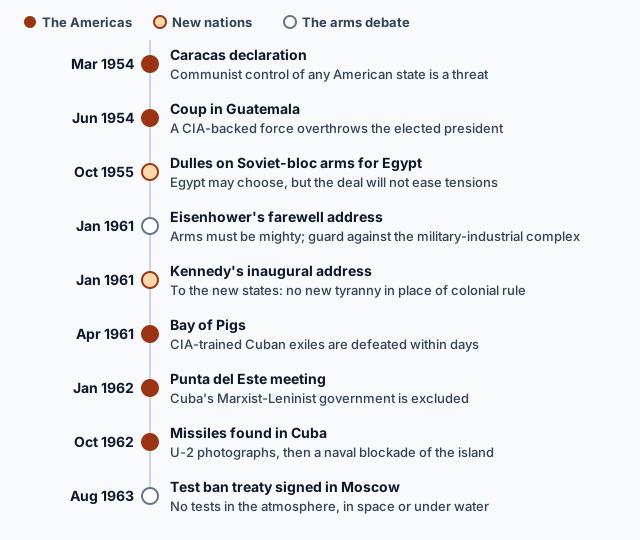 Tap to open the picture full size
Part 1 Think first What did the old general warn about?
Commit to a guess first. Being wrong now makes the right idea stick better.
Predict first
On January 17, 1961, three days before he left office, President Dwight Eisenhower, the military leader and hero of World War II, gave a farewell address on national television from the Oval Office. What do you think he warned Americans about?
In short. As empires broke apart and the arms race grew, the United States competed with the Soviet Union for new nations, drew a hard line against communism in Latin America, and argued at home over how much military power it needed and what that power cost.
- Decolonization in Africa and the Middle East created new nations that both Cold War sides courted, and many of them stayed nonaligned.
- In Latin America the United States backed non-Communist governments, democratic or not, and helped overthrow Guatemala's elected government in 1954.
- Americans debated a large nuclear arsenal and the military-industrial complex, and in 1963 the United States signed a treaty ending nuclear tests in the atmosphere, in space and under water.
Part 2 Learn it American power in a changing world
2a. New nations, and the contest for them
After World War II, European empires in Asia, Africa and the Middle East broke apart. This decolonization, often driven by powerful nationalist movements, created new nations. In Africa, Ghana won independence from Britain in 1957, and seventeen African colonies became independent in 1960 alone; in the Congo, free that year, the United States and the Soviet Union soon backed rival leaders. Both Cold War sides looked for allies among the new nations, and many chose to stay nonaligned, joining neither bloc.
In the Middle East, Egypt shows how the contest worked. In 1955 its government, led by Colonel Nasser, arranged to buy arms from the Soviet bloc. On October 4, Secretary of State Dulles declined to criticize: "It is difficult to be critical of countries which, feeling themselves endangered, seek the arms which they sincerely believe they need for defense." But he added that "from the standpoint of U.S. relations with the Soviet Union, such delivery of arms would not contribute to relaxing tensions."
In January 1961 Kennedy told the new nations: "To those new states whom we welcome to the ranks of the free, we pledge our word that one form of colonial control shall not have passed away merely to be replaced by a far more iron tyranny." He meant Soviet communism. Then: "We shall not always expect to find them supporting our view."
Sources: Dulles news conference, 1955 (Avalon Project); Kennedy's inaugural address (National Archives).
Quick check · Fill the statement
Complete the notes on Dulles in 1955 and Kennedy in 1961.
Kennedy told the new states he would not always expect them to support the American view, which accepted that many would stay . Dulles accepted Egypt's right to buy Soviet-bloc arms but said the deal would not ease Cold War .
2b. Latin America: what the republics declared
Cold War competition reached Latin America too, and the United States pressed its neighbors to take a stand. On March 28, 1954, the Tenth Inter-American Conference, meeting at Caracas, declared that "the domination or control of the political institutions of any American State by the international communist movement extending to this Hemisphere the political system of an extra continental power, would constitute a threat to the sovereignty and political independence of the American States." It was not unanimous: 17 voted in favor, Mexico and Argentina abstained, and Guatemala voted against.
In January 1962 the foreign ministers met at Punta del Este, Uruguay. They warned that communism aimed at "the destruction of democratic institutions and the establishment of totalitarian dictatorships," and resolved that "adherence by any member of the Organization of American States to Marxism-Leninism is incompatible with the inter-American system." The vote to exclude Cuba's government was 14 to 1, with six abstentions, among them Argentina, Brazil, Chile and Mexico.
The republics presented anti-communism as a defense of democracy; Caracas restated faith in "the effective exercise of representative democracy." Notice the test they applied, though: a government lost its place for being communist, not for failing to hold free elections.
Sources: Caracas Declaration, 1954; Punta del Este resolutions, 1962 (Avalon Project).
Quick check · Multiple choice
In 1962 the American foreign ministers at Punta del Este excluded Cuba's government from the inter-American system. According to their resolution, what made a member government incompatible with that system?
2c. Latin America: what Washington did
Declarations show the hemisphere's line. American actions show Washington's own, and they went further.
Guatemala had voted against the Caracas declaration. Three months later, in June 1954, a force trained and supplied by the CIA overthrew Guatemala's elected president, Jacobo Arbenz, whose land reform had taken unused land from the American-owned United Fruit Company and who accepted communists in his government. In Cuba, Fidel Castro's revolution of 1959 overthrew Fulgencio Batista, a dictator the United States had long accepted. In April 1961 Cuban exiles trained by the CIA landed at the Bay of Pigs to overthrow Castro and were defeated within days.
Kennedy also offered aid. In 1961 he promised "To our sister republics south of our border, we offer a special pledge," a "new alliance for progress" against poverty, and in the same breath: "Let all our neighbors know that we shall join with them to oppose aggression or subversion anywhere in the Americas."
The pattern is what the course framework describes: the United States supported non-Communist regimes that had varying levels of commitment to democracy. It backed dictators such as the Somoza family in Nicaragua, and it helped remove an elected government it judged too close to communism.
Sources: Kennedy's inaugural address (National Archives). Guatemala, Batista, the Bay of Pigs and the Somozas are well established but not printed on the archive pages used here.
Quick check · Multiple choice
Which American action best shows that the United States judged Latin American governments by their stance on communism more than by how democratic they were?
2d. Debating the arsenal
By 1961, Eisenhower said, the military bore little relation to any the country had known in peacetime. Americans argued over it and over a growing nuclear arsenal.
Eisenhower, leaving office, said "we have been compelled to create a permanent armaments industry of vast proportions." He called the partnership of that industry with the armed forces the military-industrial complex. He wanted it strong, and he also said "We must never let the weight of this combination endanger our liberties or democratic processes."
Kennedy, three days later, defended strength as the way to prevent war: "For only when our arms are sufficient beyond doubt can we be certain beyond doubt that they will never be employed." Yet he described both sides as "both rightly alarmed by the steady spread of the deadly atom," and asked them to work on the "inspection and control of arms."
Fallout from nuclear tests drew wide public attention, and citizens' groups such as SANE and Women Strike for Peace campaigned against testing. On August 5, 1963, the United States, Britain and the Soviet Union signed a treaty in Moscow banning tests in the atmosphere, in outer space and under water, though not underground. Its preamble speaks of "desiring to put an end to the contamination of mans environment by radioactive substances" (spelling as printed).
Sources (the citizens' groups are well established but not named on these pages): Eisenhower's farewell address; Kennedy's inaugural address; Test Ban Treaty (National Archives).
Quick check · Sort it
Each card is a phrase from 1961 or 1963. Tap a card, then the argument it makes.
Argues for strong arms
Warns of the costs or dangers of arms
Part 3 Watch it done Compare Eisenhower and Kennedy
Watch each step, then do the last one yourself.
Eisenhower gave his farewell address on January 17, 1961. Kennedy gave his inaugural address on January 20. Compare their main arguments about American military strength.
Predict first
Before the steps, how do you think the two speeches relate on military strength?
Step 1 · State each claim
Eisenhower: "Our arms must be mighty, ready for instant action," but the country must guard against the influence of the military-industrial complex "In the councils of government." Kennedy: "only when our arms are sufficient beyond doubt" can the country be sure they will not be used, and both sides should work on the "inspection and control of arms."
Why this step?
Why write out both claims before comparing them?
A comparison is about how two arguments relate. Summarizing one source tells you only what it says. With both claims side by side you can see where they meet and where they part.
Step 2 · Find where they meet
Both men accept a strong military as a way to keep an enemy from attacking.
Your step · Decide and justify
Finish it. Where do the two arguments part?
Which evidence best supports your answer?
Part 4 Try it Thirteen days and a treaty
Cuba brought the Latin American front and the arms race together. On Sunday, October 14, 1962, an American U-2 spy plane photographed Soviet missile sites being built in Cuba. On October 22 Kennedy told the nation in a televised address, and the United States put a naval blockade around the island. "Kennedy's speech drew wide support in Latin America and among U.S. allies." On October 28 the Soviets agreed to remove the missiles. In return the United States agreed never to take part in an invasion of Cuba, and Kennedy ordered several obsolete American bases in Turkey dismantled. Less than a year later the United States, Britain and the Soviet Union signed the test ban treaty.
Sources: Aerial Photograph of Missiles in Cuba; Test Ban Treaty (National Archives).
Try it · Spot the error
A student writes a paragraph on the Cuban missile crisis. Which line is the first to go wrong?
Try it · Put it in order
Put these events in the order they happened, earliest first.
Part 5 Explain it Write it like a document-based answer
Nothing you type leaves this page. Check your answer against the model and each scoring point.
Free-response practice · Question 1 style
A short practice in the shape of the document-based question: three documents instead of seven, and a thesis with one body paragraph instead of a full essay.
Evaluate the extent to which the United States relied on military strength in responding to international developments from 1954 to 1963.
Document 1. Caracas Declaration of Solidarity, adopted by the Tenth Inter-American Conference at American urging, March 28, 1954: "the domination or control of the political institutions of any American State by the international communist movement extending to this Hemisphere the political system of an extra continental power, would constitute a threat to the sovereignty and political independence of the American States."
Document 2. President Dwight Eisenhower, farewell address on national television, January 17, 1961: "Our arms must be mighty, ready for instant action, so that no potential aggressor may be tempted to risk his own destruction." And: "In the councils of government, we must guard against the acquisition of unwarranted influence, whether sought or unsought, by the military-industrial complex."
Document 3. Treaty signed by the United States, Britain and the Soviet Union, Moscow, August 5, 1963, banning nuclear tests in the atmosphere, in outer space and under water, its preamble "desiring to put an end to the contamination of mans environment by radioactive substances" (spelling as printed).
Write a thesis, one sentence of historical context, and one paragraph that uses at least two documents and explains the purpose, audience, point of view or situation of one of them.
Model answer
Thesis: From 1954 to 1963 the United States relied heavily on military strength to contain communism, but it paired force with diplomacy and, by 1963, with limits on the arms race.
Context: after World War II the United States committed itself to containing Soviet communism around the world, and by the 1950s both powers held growing nuclear arsenals.
Some responses were diplomatic and collective. In 1954 the American republics declared that communist control of any American state would threaten them all (Document 1), though the declaration itself called only for a meeting to consider action. Force was close behind: three months later a CIA-backed force overthrew Guatemala's government. In 1961 Eisenhower still insisted that American arms be "mighty, ready for instant action" (Document 2), yet warned against the "unwarranted influence" of the military-industrial complex. His point of view gives that warning weight: he was the military leader and hero of World War II, speaking as he left office with no election to win. In 1962 Kennedy answered Soviet missiles in Cuba with a naval blockade but ended the crisis with a bargain, a pledge never to invade Cuba and the removal of American missiles from Turkey. By 1963 the United States had agreed to stop testing in the atmosphere, in space and under water (Document 3). Strength stayed the foundation, but by 1963 it came with bargains and treaties.
Score your own answer. This is a self-check, not a grade. Tick each point your answer makes.
Part 6 Check yourself Two declarations on the Americas
The case questions use the two excerpts. The others mix the ideas from the whole lesson.
Both excerpts come from meetings of the American republics, eight years apart, held with strong American backing. Neither vote was unanimous: at Caracas, Guatemala voted no and two republics abstained; at Punta del Este, six abstained on excluding Cuba. Sources: Caracas Declaration, 1954; Punta del Este resolutions, 1962 (Avalon Project).
| Document | Excerpt |
|---|---|
| Caracas Declaration of Solidarity, March 28, 1954 | "the domination or control of the political institutions of any American State by the international communist movement extending to this Hemisphere the political system of an extra continental power, would constitute a threat to the sovereignty and political independence of the American States" |
| Resolutions of the foreign ministers at Punta del Este, January 1962 | "the present Government of Cuba, which has officially identified itself as a Marxist-Leninist government, is incompatible with the principles and objectives of the inter-American system" |
Case question 1 · Multiple choice
Which best describes the main difference between the two excerpts?
Case question 2 · Select all
Which two conclusions do the two excerpts together support? Select two.
Select 2 answers, then check.
The rest stand on their own and do not use the case.
Check yourself · Match
Match each situation to the idea it shows.
Check yourself · Fill the statement
Complete the summary of Eisenhower's farewell address.
Eisenhower told Americans their arms must be strong enough that no would dare to attack. In the same speech he warned that the partnership of the armed forces and the arms industry could gain too much .
Part 7 Keep it Bring back earlier ideas
This lesson stands on the containment policies of Topic 8.2 and the Red Scare of Topic 8.3.
Bring it back · Multiple choice
As the wartime alliance with the Soviet Union broke down after 1945, which approach did United States foreign policy take?
Bring it back · Fill the statement
Complete the sentences about the years after World War II.
Both major parties supported abroad. What Americans argued over were the methods used to at home.
In three lines
- Decolonization created new nations that both Cold War powers courted, and many stayed nonaligned.
- In Latin America the United States drew its line against communism, backing non-Communist governments with varying commitments to democracy and acting against governments it saw as communist.
- Americans debated the nuclear arsenal and the military-industrial complex, and strength came to be paired with arms control.
Exam strategy for this topic
- Section I Part A, Multiple Choice: 55 questions in 55 minutes.
- Section I Part B, Short Answer: 3 questions in 40 minutes.
- Section II, Document-Based Question and Long Essay: 2 questions in 100 minutes.
- This lesson's Explain it is shaped like free-response question 1, Document-based.
When you compare two sources, write one sentence that says where they agree and one that says where they differ, and quote a phrase from each source in the second sentence.
Questions students ask
Did Eisenhower want to cut the military?
Not in the sense of disarming. He said American arms "must be mighty, ready for instant action," and that the country had been "compelled" to build a permanent arms industry. His warning was that the industry and the military together must not gain unwarranted influence over government.
Why did the United States back governments in Latin America that were not democracies?
Because the test it applied was communism. In 1954 it helped overthrow Guatemala's elected president, whom it judged too close to communism, and it backed anti-Communist dictators such as the Somoza family in Nicaragua. The American republics excluded Cuba's government in 1962 for adherence to Marxism-Leninism, not for its election record.
What does nonaligned mean?
A nonaligned nation joined neither the American nor the Soviet bloc. Many of the new nations of Africa, Asia and the Middle East took that position, which is why Kennedy said the United States would not always find them supporting its view.
Did the 1963 treaty end nuclear testing?
No. It banned tests in the atmosphere, in outer space and under water, but not underground. It limited the arms race rather than ending it.
Why does a quotation in this lesson print "mans environment" without an apostrophe?
Every excerpt is copied exactly as the archive prints it, so you can check it against the source linked beside it.
Course alignment, for teachers
AP U.S. History topic 8.7, Unit 8: Period 8: 1945–1980.
- Skill 3.C: Compare the arguments or main ideas of two sources.
This lesson maps all 3 essential knowledge statements of the topic, and the one learning objective with none of its own, to the part that teaches each one: 4 are checked by a scored question. The map is in the lesson file.