Unit 8 · Topic 8.6 · about 30 minutes · 7 parts · 13 scored checks, 4 of them multiple choice
AP U.S. History 8.6: Early Steps in the Civil Rights Movement (1940s and 1950s)
Unit 8: 10 to 17% of the multiple-choice section
What you'll be able to do
- Explain how and why the civil rights movements developed and expanded from 1945 to 1960, and identify the patterns that connect the federal government's measures of those years.
Key vocabulary
| Term | What it means | The exam trap |
|---|---|---|
| Equal protection | The 14th Amendment's guarantee that no state may deny any person the equal protection of the laws. | The clause limits what states do; Brown used it against state laws that required or permitted school segregation. |
| Executive order | A directive from the president to the executive branch, including the armed forces, issued without a new law from Congress. | An executive order can only direct what the president already controls; it is not a law passed by Congress. |
| Filibuster | Endless debate in the Senate that keeps a bill from coming to a vote. | A filibuster blocks a vote; it is not a vote against a bill. |
| Desegregation | Ending the separation of people by race in a place or an institution, such as a school or the armed services. | A ruling or order calling for desegregation is not the same as desegregation done; ask what happened next. |
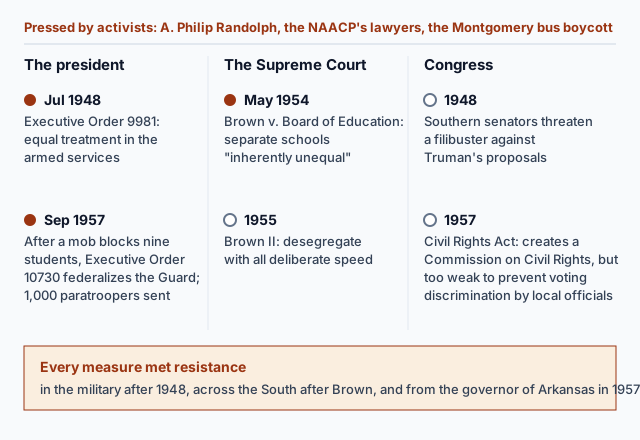 Tap to open the picture full size
Part 1 Think first Which branch moved first?
Commit to a guess first. Being wrong now makes the right idea stick better.
Predict first
In February 1948 President Harry S. Truman asked Congress to pass a set of civil rights laws. Which branch of the federal government do you think was first to take a major step against segregation after World War II?
In short. Seeking to fulfill the 14th Amendment's promise of equal protection, activists such as A. Philip Randolph, the NAACP's lawyers and the Montgomery bus boycotters pressed the federal government, and from 1948 to 1957 the president, the Supreme Court and Congress each took real steps against segregation, but resistance kept progress toward racial equality slow.
- Activist pressure came first: Randolph's threatened march won a wartime order in 1941, and in 1948, with Southern senators blocking civil rights laws, Truman ordered equality of treatment in the armed services.
- In Brown v. Board of Education (1954) the Supreme Court ruled that "Separate educational facilities are inherently unequal."
- Resistance followed each step: Brown II asked the states to move only "with all deliberate speed," and in 1957 Eisenhower had to send troops to enforce court orders in Little Rock.
Part 2 Learn it First federal steps against segregation
2a. A promise from Reconstruction
After the Civil War, Congress proposed the 14th Amendment, ratified in 1868. Its first section ends with the words "nor deny to any person within its jurisdiction the equal protection of the laws." Equal protection means a state must apply its laws to all people alike. In 1896, in Plessy v. Ferguson, the Supreme Court accepted the doctrine of "separate but equal," and the promise went unkept for decades.
Activists kept pressing. In 1941 A. Philip Randolph, a labor leader, threatened a mass march on Washington against discrimination in defense jobs, and President Franklin Roosevelt answered with Executive Order 8802, which forbade discrimination by defense contractors. During the war more than one million African American men were inducted into the armed forces, and Black newspapers called for a double victory, over fascism abroad and racism at home. The National Archives puts the long fight this way: "A legacy of Reconstruction was the determined struggle of Black and White citizens to make the promise of the 14th Amendment a reality."
Sources: 14th Amendment; Brown v. Board of Education; Executive Order 9981 (all National Archives).
Quick check · Fill the statement
Complete a student's notes on where the civil rights struggle of the 1940s and 1950s began.
The 14th Amendment, ratified during Reconstruction, promised every person . In 1896 the Supreme Court let states keep the races apart under the doctrine of , so activists after 1945 were trying to fulfill a promise made about eighty years earlier.
2b. The president and the armed forces
Truman's record before 1948 was mixed: he let Congress end the wartime Fair Employment Practices Commission. But in December 1946 he appointed the President's Commission on Civil Rights, whose 1947 report, To Secure These Rights, proposed laws against lynching and the poll tax. In February 1948 he asked Congress to pass them. Southern senators at once threatened a filibuster, endless debate that keeps a bill from coming to a vote.
Pressure kept building. Randolph campaigned against segregation in the armed services, and Truman, running for election that year, needed the votes of Black citizens in Northern cities. An executive order, a directive from the president to the executive branch, let him act without Congress. On July 26, 1948, he signed Executive Order 9981:
The National Archives notes considerable resistance to the order from the military; almost all of it was integrated only by the end of the Korean conflict.
Quick check · Multiple choice
Activists such as A. Philip Randolph pressed Truman in 1948 to end segregation in the armed services. Why did he do it by executive order rather than through a law passed by Congress?
2c. The Court and the schools
Brown v. Board of Education was the work of a long legal campaign. Lawyers for the NAACP, led by Thurgood Marshall, first won cases against segregated graduate and law schools, then asked the Court to overturn Plessy itself. The Brown cases came from Kansas, South Carolina, Virginia and Delaware, where Black children had been denied admission to white schools. On May 17, 1954, Chief Justice Earl Warren read the Court's unanimous opinion. Separating children by race, it said, "generates a feeling of inferiority as to their status in the community that may affect their hearts and minds in a way unlikely ever to be undone." Its conclusion was short:
Desegregation means ending the separation of people by race in a place or an institution. Brown overruled Plessy's doctrine in public education, and the National Archives calls it a catalyst for the expanding civil rights movement of the 1950s.
Quick check · Match
Match each federal measure to what it did.
2d. Montgomery, Little Rock and slow progress
Activists kept up the pressure. In December 1955 Rosa Parks was arrested in Montgomery, Alabama, for refusing to give up her bus seat to a white man. Black residents boycotted the buses for more than a year, led by Martin Luther King Jr., until a 1956 Supreme Court ruling ended segregation on the city's buses. In 1957 King and other ministers founded the Southern Christian Leadership Conference.
Brown met considerable resistance, and in 1955 the Court had asked the states to desegregate only "with all deliberate speed." In September 1957 Arkansas's governor, Orval Faubus, used the National Guard to keep nine Black students out of Little Rock's Central High School. He then withdrew the Guard, and when the students entered, a segregationist mob rioted. Local leaders asked for federal help, and President Dwight D. Eisenhower signed Executive Order 10730, putting the Guard under federal control and sending 1,000 Army paratroopers.
Congress acted too. Its Civil Rights Act of 1957 created a Commission on Civil Rights, but as the Center for Legislative Archives notes, "Congress passed Civil Rights Acts in 1957, 1960, and 1964, but none of these laws were strong enough to prevent voting discrimination by local officials."
Sources: King; Executive Order 10730; Congress and the Voting Rights Act (all National Archives).
Quick check · Sort it
Each card is an event from 1948 to 1957. Tap a card, then say whether it moved desegregation forward or held it back.
Moved desegregation forward
Held desegregation back
Part 3 Watch it done Find the pattern in three federal measures
Watch each step, then do the last one yourself.
Executive Order 9981 (1948), Brown v. Board of Education (1954) and Executive Order 10730 (1957) came from different presidents and different branches of the federal government. Identify a pattern that connects them.
Predict first
Before the steps, which pattern do you think fits all three?
Step 1 · Name who acted, and how
Truman acted by executive order, on the armed services he commanded. The Supreme Court acted by deciding cases the NAACP brought from four states. Eisenhower acted by executive order, to enforce federal court orders at a school in Little Rock.
Why this step?
Why sort the measures by who acted?
A pattern is something that repeats. Lining up who acted, and who did not, shows what the three share that a list of dates would hide.
Step 2 · Look at what followed each one
Truman's order met resistance in the military for years. Brown met considerable resistance across the South. In Little Rock the governor first used the National Guard to block nine students, then withdrew it, and a segregationist mob took its place until Eisenhower sent troops.
Your step · Decide and justify
Finish it. Which pattern connects the three measures?
Which evidence best supports your answer?
Part 4 Try it Read the Little Rock order
In September 1957 President Eisenhower signed Executive Order 10730. It explains why he acted: the command in his earlier proclamation to stop obstructing the court's orders had not been obeyed, and "willful obstruction of enforcement of said court orders still exists and threatens to continue." The order also repeats his finding that "such obstruction of justice constitutes a denial of the equal protection of the laws secured by the Constitution of the United States." The National Archives adds that Eisenhower was required to uphold the Constitution and the laws, but also wanted to avoid a bloody confrontation in Arkansas.
Try it · Spot the error
A student writes a paragraph on Executive Order 10730. Which line is the first to go wrong?
Try it · Multiple choice
What does the Little Rock crisis show about the connection between Brown v. Board of Education and the executive branch?
Part 5 Explain it Write it like a document-based answer
Nothing you type leaves this page. Check your answer against the model and each scoring point.
Free-response practice · Question 1 style
A short practice in the shape of the document-based question: three documents instead of seven, and a thesis with one body paragraph instead of a full essay.
Evaluate the extent to which the federal government advanced racial equality between 1948 and 1957.
Document 1. Executive Order 9981, signed by President Harry S. Truman, July 26, 1948: "there shall be equality of treatment and opportunity for all persons in the armed services without regard to race, color, religion or national origin." The order continues: "This policy shall be put into effect as rapidly as possible, having due regard to the time required to effectuate any necessary changes without impairing efficiency or morale."
Document 2. Brown v. Board of Education, opinion of the Supreme Court read by Chief Justice Earl Warren, May 17, 1954: "Separate educational facilities are inherently unequal."
Document 3. Executive Order 10730, signed by President Dwight D. Eisenhower, September 1957, on the schools of Little Rock, Arkansas: "willful obstruction of enforcement of said court orders still exists and threatens to continue."
Write a thesis, one sentence of historical context, and one paragraph that uses at least two documents and explains the purpose, audience, point of view or situation of one of them.
Model answer
Thesis: Between 1948 and 1957 the federal government advanced racial equality a great deal in law, making equal treatment the policy of the armed services and the public schools, but far less in practice, because each measure depended on enforcement that met resistance.
Context: after World War II, in which more than one million African American men served, activists such as A. Philip Randolph and the NAACP's lawyers pressed the government to fulfill the 14th Amendment's promise of equal protection, while Southern senators blocked civil rights laws in Congress.
Truman's order made equality of treatment the policy of the armed services (Document 1), but it came from a commander in chief who could not get laws through Congress, and its own words promise change only as fast as the services could make it "without impairing efficiency or morale." That caution helps explain why the military was almost entirely integrated only by the end of the Korean conflict. Brown went further, declaring separate schools "inherently unequal" (Document 2), yet a year later the Court asked the states to act only "with all deliberate speed." By 1957 a president had to say that obstruction of court orders "still exists and threatens to continue" (Document 3) before federal troops opened one high school. Even Congress's own measure of these years, the Civil Rights Act of 1957, was too weak to stop local officials from keeping Black citizens from voting.
Score your own answer. This is a self-check, not a grade. Tick each point your answer makes.
Part 6 Check yourself Three branches, four measures
The case questions use the table. The others mix the ideas from the whole lesson.
The table sets the federal government's main measures of these years beside what followed each. Sources: Executive Order 9981; Brown v. Board of Education; Congress and the Voting Rights Act; Executive Order 10730 (all National Archives).
| Measure | Branch | What followed |
|---|---|---|
| Executive Order 9981, July 1948 | President | Resistance in the military; almost all of it integrated by the end of the Korean conflict |
| Brown v. Board of Education, May 1954 | Supreme Court | Brown II (1955) asks for desegregation with all deliberate speed; considerable resistance |
| Civil Rights Act of 1957 | Congress | Created a Commission on Civil Rights, but was not strong enough to prevent voting discrimination by local officials |
| Executive Order 10730, September 1957 | President | Came after a segregationist mob blocked court-ordered integration; paratroopers needed to restore order at one school |
Case question 1 · Multiple choice
What does the table suggest about progress toward racial equality in these years?
Case question 2 · Select all
Which two statements does the table support? Select two.
Select 2 answers, then check.
The rest stand on their own and do not use the case.
Check yourself · Put it in order
Put these events in the order they happened, earliest first.
Check yourself · Fill the statement
Complete a historian's notes connecting Brown to what came before and after it.
Brown overruled, in public education, the doctrine the Court had accepted in . A year later the Court asked for desegregation with all deliberate speed, vague wording that met considerable resistance, and in a president sent troops to enforce a court's orders in Little Rock.
Part 7 Keep it Bring back earlier ideas
This lesson stands on the debates at home over communism from Topic 8.3 and the postwar economy from Topic 8.4.
Bring it back · Multiple choice
In the late 1940s and early 1950s, loyalty checks and congressional hearings tried to expose suspected communists inside the United States. Which statement best describes the response?
Bring it back · Fill the statement
Read the situation, then complete the sentences.
A family in 1955 is doing well: private business is booming, the government is spending heavily on defense and highways, babies are being born so fast that new schools go up everywhere, and new machines fill the home. Together these forces drove postwar . The father's college degree gets him a better job, and the family leaves the city for , while many other Americans head for the South and West.
In three lines
- Civil rights activists and federal leaders after 1945 sought to fulfill the 14th Amendment's Reconstruction promise of equal protection.
- The president desegregated the armed services in 1948, the Supreme Court ruled school segregation unconstitutional in 1954, and Congress passed only a weak law in 1957.
- Each measure met resistance, so progress toward racial equality was real in law but slow in practice.
Exam strategy for this topic
- Section I Part A, Multiple Choice: 55 questions in 55 minutes.
- Section I Part B, Short Answer: 3 questions in 40 minutes.
- Section II, Document-Based Question and Long Essay: 2 questions in 100 minutes.
- This lesson's Explain it is shaped like free-response question 1, Document-based.
When a question asks for a pattern, name what repeats across the developments, such as who acted and what followed, rather than describing each one on its own.
Questions students ask
Why did the armed services desegregate before the schools?
The president commands the armed services, so Truman could change their policy by executive order once Southern senators blocked his proposed laws in 1948. Public schools were run by states and local districts, and changing them took a Supreme Court ruling in 1954.
Who pushed the federal government to act?
Activists did. A. Philip Randolph's threatened march in 1941 won Executive Order 8802, and his 1948 campaign pressed Truman on the armed services. Thurgood Marshall and the NAACP's lawyers built the cases that became Brown. In Montgomery, Rosa Parks's arrest in 1955 began a bus boycott led by Martin Luther King Jr., who in 1957 helped found the Southern Christian Leadership Conference.
Did Brown v. Board of Education end school segregation right away?
No. The Court ruled in 1954, then in 1955 asked the states to begin desegregation plans "with all deliberate speed." The ruling met considerable resistance. In 1957 Arkansas's governor used the National Guard to block nine students at Little Rock's Central High School, then withdrew it, and a mob took its place until President Eisenhower sent paratroopers.
What did Congress do about civil rights in the 1950s?
It passed the Civil Rights Act of 1957, the first of several, which created a Commission on Civil Rights. The Center for Legislative Archives notes that none of the acts of 1957, 1960 and 1964 was strong enough to prevent voting discrimination by local officials. Stronger federal laws came in the 1960s, the subject of Topic 8.10.
Why does this lesson start with an amendment from 1868?
Because the civil rights activists of the 1940s and 1950s saw themselves as finishing work Reconstruction began. Brown itself rested on the 14th Amendment's promise of equal protection of the laws.
Where can I read these documents in full?
Each excerpt links to its full text at the National Archives, which holds the original executive orders and the Supreme Court's opinion in Brown.
Course alignment, for teachers
AP U.S. History topic 8.6, Unit 8: Period 8: 1945–1980.
- Skill 5.A: Identify patterns among or connections between historical developments and processes.
This lesson maps all 2 essential knowledge statements of the topic, and the one learning objective with none of its own, to the part that teaches each one: 3 are checked by a scored question. The map is in the lesson file.