Unit 4 · Topic 4.7 · about 30 minutes · 7 parts · 10 scored checks, 3 of them multiple choice, plus 2 from earlier lessons
AP U.S. History 4.7: Expanding Democracy
Unit 4: 10 to 17% of the multiple-choice section
What you'll be able to do
- Explain the causes and effects of the expansion of participatory democracy from 1800 to 1848, using state constitutions, presidents' inaugural addresses and the National Archives' history of the new parties.
Key vocabulary
| Term | What it means | The exam trap |
|---|---|---|
| Suffrage | The right to vote. | Suffrage is about who may vote, not about who wins or how many actually turn out. |
| Property qualification | A rule that a man own land or other property, or pay taxes, before he may vote. | Owning land and paying taxes were separate tests in some states; read which one a document names. |
| Qualified elector | In a state constitution, a person who meets the tests to vote. | Elector here means a voter, not a member of the Electoral College. |
| Participatory democracy | Government in which many citizens take part, by voting, holding office and joining in campaigns. | Being allowed to vote is not the same as voting; turnout is a separate measure. |
| Political party | An organization that runs candidates and works to bring voters to the polls for them. | A party is more than its candidate: newspapers, local organizers and rallies did much of the work. |
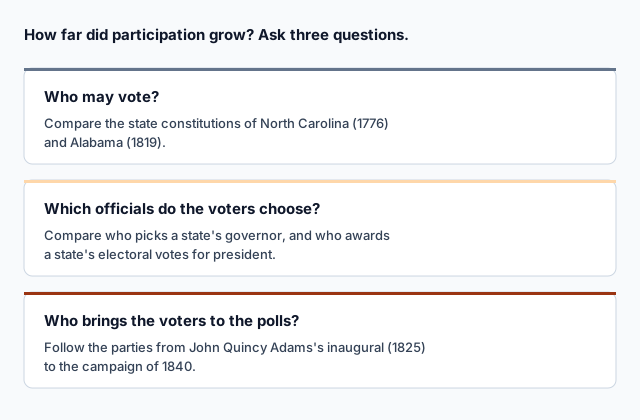 Tap to open the picture full size
Part 1 Think first Who gets a vote?
Commit to a guess first. Being wrong now makes the right idea stick better.
Predict first
In 1776 North Carolina let a man vote for its state Senate only if he owned fifty acres of land in his county. In 1819 Alabama wrote its first constitution. A white man of 30 who works for wages, owns no land, and has lived in the same Alabama county for two years wants to vote for governor. What do you think Alabama's constitution said?
In short. Between 1800 and 1848 the United States became a more participatory democracy: states replaced voting rules based on owning property with voting by all adult white men, and new political parties grew up to organize the new voters.
- In 1776 North Carolina let a man vote for its state Senate only if he owned fifty acres; Alabama's 1819 constitution asked only that a voter be a white male citizen of 21 who met a residence rule.
- Voters also chose more officials: Alabama's voters elected the governor and county sheriffs, and by 1828 the popular vote decided most states' electoral votes for president.
- Parties organized the new voters. The Democrats used newspapers and rallies to elect Jackson in 1828, and in 1840 the Whigs won with the same methods.
Part 2 Learn it How democracy widened, and for whom
2a. From owning property to being an adult white man
Many of the first state constitutions kept a property test for voting. In 1776 North Carolina let a man of 21 vote for its state Senate only if he was "possessed of a freehold within the same county of fifty acres of land." A freehold is land a man owns outright. To vote for the lower house he had to have "paid public taxes."
Alabama's first constitution, written in 1819 so the territory could enter the Union, dropped land and taxes. A qualified elector was "Every white male person of the age of twenty-one years, or upwards, who shall be a citizen of the United States" with a year in the state and three months in his county. The vote moved from owning property to being an adult white man.
The National Archives sets the change in a growing country. As Americans moved west, new states were set up in newly settled regions with no established economic elite, while long-settled states eliminated property restrictions on voting for white males. By 1828 most adult white males could vote.
Read the 1819 rule for whom it leaves out. Women could not vote, and the word white shut out free Black men and American Indians. Alabama also barred regular soldiers and sailors.
Sources: Constitution of North Carolina, 1776 (Avalon Project); Constitution of Alabama, 1819 (Avalon Project); The Two-Party System (National Archives).
Quick check · Sort it
Alabama's 1819 constitution made a voter of "Every white male person of the age of twenty-one years, or upwards, who shall be a citizen of the United States" who had lived a year in the state and three months in his county, and it barred regular soldiers and sailors. Tap each person, then the bin the rule puts them in.
Could vote under the 1819 rule
Could not vote under the 1819 rule
2b. More offices in the voters' hands
Voters also came to choose more of their officials.
North Carolina's 1776 constitution had the two houses of the legislature, meeting together, "by ballot elect a Governor for one year." Voters chose legislators, and the legislators chose the governor. Alabama's 1819 constitution says "The Governor shall be elected by the qualified electors," and "A sheriff shall be elected in each county by the qualified electors thereof." The voter now reached the governor's office and the county sheriff directly.
The presidency moved the same way. Before 1824, the National Archives explains, state legislatures commonly awarded a state's electoral votes for president. By 1828 popular vote totals decided them in most states, so a candidate for president had to appeal to the common voter, not only to an alliance of state leaders.
Sources: Constitution of North Carolina, 1776 (Avalon Project); Constitution of Alabama, 1819 (Avalon Project); The Two-Party System (National Archives).
Quick check · Select all
Compared with North Carolina's 1776 constitution and with presidential elections before 1824, which two changes put a choice that legislators had made into the hands of the voters? Select two.
Select 2 answers, then check.
2c. Parties for a mass electorate
More voters choosing more officials needed organizing, and parties did it. On March 4, 1825, John Quincy Adams said in his inaugural address that, after the wars of the French Revolution ended, "this baneful weed of party strife was uprooted." He also admitted he was "Less possessed of your confidence in advance than any of my predecessors." He had reason to. In 1824 Jackson won the most popular and electoral votes but no candidate won an Electoral College majority, so the House of Representatives chose Adams. Jackson's supporters called it a "corrupt bargain" between Adams and Henry Clay.
Those supporters built the Democratic Party. In 1828, the National Archives explains, it became the first party to use the press effectively in a national campaign and held big public rallies, and participation reached a new level of excitement. Jackson's first inaugural said he served by "the choice of a free people."
Jackson's opponents formed the Whigs, who won the presidency in 1840 with William Henry Harrison by using the Democrats' own methods. Harrison still distrusted parties: "the spirit of party, assuming to be that of liberty, is harsh, vindictive, and intolerant."
Sources: Inaugural Address of John Quincy Adams (Avalon Project); The Two-Party System (National Archives); First Inaugural Address of Andrew Jackson (Avalon Project); Inaugural Address of William Henry Harrison (Avalon Project).
Quick check · Multiple choice
In 1825 Adams said party strife had been "uprooted." In 1841 Harrison warned against "the spirit of party." Which development best explains the difference between the two speeches?
Part 3 Watch it done Explain what the new voters meant for a president
Watch each step, then do the last one yourself.
Andrew Jackson's first inaugural address, March 4, 1829: "The recent demonstration of public sentiment inscribes on the list of Executive duties, in characters too legible to be overlooked, the task of reform." Explain how the expansion of voting shaped the authority Jackson claimed in this sentence.
Predict first
Before the steps, where do you think Jackson says his duty to reform comes from?
Step 1 · Name the development
By 1828, the National Archives notes, most adult white males could vote, and a candidate for president had to appeal to the common voter to win.
Why this step?
Why start with the change in voting instead of with Jackson's words?
A claim to authority rests on where the authority comes from. Knowing who chose the president tells you whom Jackson could say he answered to.
Step 2 · Read the claim
Jackson calls his election a "demonstration of public sentiment" and says it writes reform onto the list of a president's duties. Earlier in the same address he says he serves by "the choice of a free people."
Your step · Decide and justify
Finish it. How did the expansion of voting shape the authority Jackson claimed?
Which evidence best supports your answer?
Part 4 Try it Why it happened state by state
The Constitution of 1787 did not set its own rule for voters. Article I says the voters for the House of Representatives in each state "shall have the Qualifications requisite for Electors of the most numerous Branch of the State Legislature." Whoever a state let vote for its own lower house could vote for Congress.
Source: Constitution of the United States (National Archives).
Try it · Fill the statement
Complete the explanation.
Because the Constitution let each state's own voting rules decide who voted for the House, the move away from property tests came . A newly settled state like Alabama, without , wrote no property test into its first constitution.
Try it · Spot the error
A student explains the expansion of voting. Which line is the first to go wrong?
Part 5 Explain it Write it like a document-based answer
Nothing you type leaves this page. Check your answer against the model and each scoring point.
Free-response practice · Question 1 style
A short practice in the shape of the document-based question: three documents instead of seven, and a thesis with one body paragraph instead of a full essay.
Evaluate the extent to which political participation in the United States expanded between 1776 and 1841.
Document 1. Constitution of North Carolina, December 18, 1776: a voter for the state Senate must be "possessed of a freehold within the same county of fifty acres of land"; a voter for the lower house must have "paid public taxes"; the two houses together "by ballot elect a Governor for one year."
Document 2. Constitution of Alabama, December 6, 1819: "Every white male person of the age of twenty-one years, or upwards, who shall be a citizen of the United States" who has lived in the state a year is a qualified elector, and "The Governor shall be elected by the qualified electors."
Document 3. Inaugural address of John Quincy Adams, March 4, 1825: after the wars of the French Revolution ended, "this baneful weed of party strife was uprooted." Later in the address he calls himself "Less possessed of your confidence in advance than any of my predecessors."
Write a thesis, one sentence of historical context, and one paragraph that uses at least two documents and explains the purpose, audience, point of view or situation of one of them.
Model answer
Thesis: Between 1776 and 1841 political participation expanded a great deal for white men, who gained the vote without owning property, chose more of their officials and were drawn in by mass parties, but the same change wrote women and men who were not white out of the electorate by name.
Context: As the country expanded west, new states were set up in newly settled regions without an established economic elite, and older states eliminated property restrictions on voting for white men.
In 1776 North Carolina tied the vote for its Senate to owning fifty acres and let the legislature "elect a Governor" (Document 1). By 1819 Alabama asked for no land at all, and its voters elected the governor themselves (Document 2), so both the electorate and the offices it reached grew. Yet Alabama's rule opens with "Every white male person," which names who was excluded as clearly as who was included. Adams's claim in 1825 that party strife was "uprooted" (Document 3) shows that the parties that would organize these voters had not yet formed. Adams calls himself "Less possessed of your confidence in advance than any of my predecessors": he had been chosen by the House after the disputed election of 1824, so he had reason to hope party conflict was over, and his speech records a wish more than a fact. By 1828 the Democrats were rallying voters for Jackson, and by 1840 the Whigs used the same methods.
Score your own answer. This is a self-check, not a grade. Tick each point your answer makes.
Part 6 Check yourself Two constitutions, 43 years apart
The case questions use the two excerpts. The others mix the ideas from the whole lesson.
Both excerpts set the rules for voters in a state. Sources: Constitution of North Carolina, 1776 (Avalon Project); Constitution of Alabama, 1819 (Avalon Project).
| Document | Excerpt |
|---|---|
| Constitution of North Carolina, December 18, 1776 | "all freemen, of the age of twenty-one years, who have been inhabitants of any one county within the State twelve months immediately preceding the day of any election and possessed of a freehold within the same county of fifty acres of land for six months next before, and at the day of election, shall be entitled to vote for a member of the Senate" |
| Constitution of Alabama, December 6, 1819 | "Every white male person of the age of twenty-one years, or upwards, who shall be a citizen of the United States" and has lived in the state a year is a qualified elector, but "no soldier, seaman, or marine, in the regular army or navy of the United States, shall be entitled to vote" |
Case question 1 · Multiple choice
Which statement best describes the change in the basis of voting between the two excerpts?
Case question 2 · Multiple choice
A historian claims that the right to vote simply widened in this period. Which detail from the excerpts most complicates that claim?
The rest stand on their own and do not use the case.
Check yourself · Put it in order
Put these events in the order they happened, earliest first.
Check yourself · Match
Match each phrase to what it shows about participation in this period.
Part 7 Keep it Bring back earlier ideas
This lesson stands on the market revolution's changes to work and family from Topic 4.6 and the sectional politics of Topic 4.3.
From 4.6 Market Revolution: Society and Culture · Sort it
Under the domestic ideals of the period, which sphere was each activity assigned to? Tap a card, then its sphere.
Public sphere
Private sphere
From 4.3 Politics and Regional Interests · Match
Match each part of the Missouri debate to what it did or would have done.
In three lines
- States replaced voting based on owning property with voting by all adult white men, one state at a time.
- Voters also chose more officials, from governors and sheriffs to presidential electors.
- New mass parties, the Democrats and then the Whigs, grew up to organize the wider electorate.
Exam strategy for this topic
- Section I Part A, Multiple Choice: 55 questions in 55 minutes.
- Section I Part B, Short Answer: 3 questions in 40 minutes.
- Section II, Document-Based Question and Long Essay: 2 questions in 100 minutes.
- This lesson's Explain it is shaped like free-response question 1, Document-based.
When a question asks for a cause or effect of expanding democracy, name the specific change (who could vote, which offices voters chose, how parties drew voters in) and tie it to a document or a date.
Questions students ask
Did the U.S. Constitution say who could vote?
Not directly. Article I says voters for the House "shall have the Qualifications requisite for Electors of the most numerous Branch of the State Legislature," so each state's own rules decided. That is why the vote widened state by state.
When did most white men gain the vote?
Gradually, state by state. The National Archives notes that by 1828 most adult white males could vote. Alabama, which wrote its constitution in 1819 to enter the Union, is an example of a new state whose first constitution had no property test.
Were women or free Black men part of the expansion?
No. Alabama's rule covered only white males, and no state in this lesson let women vote. The course framework adds that even as emancipation spread in the North, many state governments restricted African Americans' rights.
Who were the Democrats and the Whigs?
The two national parties of the 1830s and 1840s. The Democrats grew out of the alliance of Jackson's supporters; Jackson's opponents formed the Whigs, led by Henry Clay. Topic 4.8 covers what they fought about.
Where can I read these documents in full?
Each excerpt links to its full text at the Avalon Project at Yale Law School or the National Archives, the collections this lesson was checked against.
Course alignment, for teachers
AP U.S. History topic 4.7, Unit 4: Period 4: 1800–1848.
- Skill 1.B: Explain a historical concept, development, or process.
This lesson maps the one essential knowledge statement of the topic, and the one learning objective with none of its own, to the part that teaches each one: 2 are checked by a scored question. The map is in the lesson file.