Unit 8 · Topic 8.5 · about 30 minutes · 7 parts · 13 scored checks, 4 of them multiple choice
AP U.S. History 8.5: Culture after 1945
Unit 8: 10 to 17% of the multiple-choice section
What you'll be able to do
- Explain how mass culture has been maintained or challenged over time, from the shared culture of television and the suburbs after 1945 to the challenges to conformity by artists, intellectuals and rebellious youth, and place each development in its broader historical context.
Key vocabulary
| Term | What it means | The exam trap |
|---|---|---|
| Mass culture | Entertainment, news and goods produced for a whole nation at once, such as network television shows. | Mass culture is about reach, not about quality; a show can be mass culture and still be good. |
| Homogeneous | Made up of parts that are alike; in this topic, a culture becoming more similar from region to region. | A culture can grow more homogeneous overall while groups inside it push back; the word describes a trend, not every person. |
| Conformity | Fitting in by behaving, dressing and thinking the way the people around you expect. | Conformity is a pressure people feel, not a law; most challenges to it were about values, not breaking laws. |
| Beat movement | A group of 1950s writers and poets, among them Jack Kerouac and Lawrence Ferlinghetti, who rejected settled middle-class life. | The Beats are a 1950s challenge to conformity. Later writers call Kerouac a counterculture hero because the 1960s counterculture took up the Beats, but the two are not the same movement. |
| Contextualization | Placing a development within the broader events and processes of its time to help explain it. | Context must connect to the development; a true fact from the same decade that explains nothing is not context. |
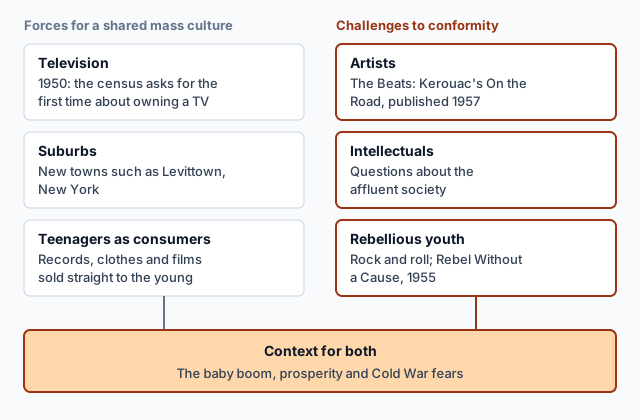 Tap to open the picture full size
Part 1 Think first What does a TV in every house do?
Commit to a guess first. Being wrong now makes the right idea stick better.
Predict first
In 1950 the United States had fewer than 100 commercial television stations, and the census of that year was the first to ask Americans whether they owned a TV. During the 1950s television spread quickly, and by 1960 its effect on children was widely discussed. What do you think it did to American culture?
In short. In the postwar years television, the new suburbs and a national market of buyers made American mass culture increasingly alike, and that sameness inspired challenges to conformity from artists, intellectuals and rebellious young people.
- Television spread fast after 1950, and the baby boom children were, in one historian's words, the first television generation.
- Adults worried about delinquency and blamed new media from comic books to rock and roll, and a Senate subcommittee investigated comic books in 1954.
- Beat writers such as Jack Kerouac, intellectuals, and performers who drew young fans challenged the pressure to conform, and their challenge grew out of the same prosperity and Cold War fears.
Part 2 Learn it A shared culture, and the people who resisted it
2a. One culture on one screen
Mass culture is entertainment, news and goods made for a whole nation at once. After 1945 it became increasingly homogeneous, more alike from place to place.
Television did more than anything to make it so. The 1950 census was the first to ask whether people owned a TV, and in that year the country had fewer than 100 commercial stations. Its influence came suddenly, and by 1960 it was widely discussed. Families in different regions now watched the same network programs. The course framework names two well-known examples, the comedy I Love Lucy and the family show Leave It to Beaver: the same episode reached viewers in every region on the same night.
The suburbs pushed the same way. Families in new towns such as Levittown, New York, bought the same kinds of houses, cars and appliances. Young people became buyers too, in what Holt calls "a culture that increasingly regarded teenagers as consumers rather than economic contributors." Companies sold records, clothes and films straight to them.
Sources: 1950 Census Fact Sheet (National Archives); Marilyn Irvin Holt, Children as Topic No. 1 (Prologue, 2010). The television examples are from the AP U.S. History course framework.
Quick check · Fill the statement
Complete the sentences.
After 1945, millions of families in different regions watched the same programs, so mass culture became more . Companies began to sell records, clothes and films directly to young people, who were now treated as .
2b. Rebellious youth and the delinquency scare
Many adults feared that the new youth culture was pulling teenagers away from their parents' values. "In the late 1940s and throughout the 1950s, juvenile delinquency found middle America," writes the historian Marilyn Irvin Holt. The number of young people brought before juvenile judges more than doubled between 1948 and 1956. The popular press and Hollywood fed the fear; the 1955 film Rebel Without a Cause showed troubled teenagers who were white and suburban.
Holt sums up what social commentators, community leaders, police experts and welfare workers blamed: "parents, television, movies, rock and roll, bad neighborhoods, gangs, inadequate teachers, lack of community leadership." On April 27, 1953, the Senate Judiciary Committee created a Special Subcommittee on Juvenile Delinquency, and the National Archives notes that "it drew the most attention when it investigated the allegation that comic books contributed to the rise in juvenile crime."
Some of what worried adults was what young people loved. The course framework points to Elvis Presley singing Hound Dog on The Ed Sullivan Show on October 28, 1956, a sign of shifting social standards and of young people's growing pull on the media.
Sources: Marilyn Irvin Holt, Children as Topic No. 1 (Prologue, 2010); Congress Investigates: Comic Books (National Archives).
Quick check · Match
Match each development of the 1950s to what it shows about youth culture and the response to it.
2c. Artists and intellectuals against conformity
Conformity means fitting in by thinking, dressing and living the way everyone around you does. Writers, musicians and thinkers of the 1950s questioned it.
The Beat movement was a group of writers who rejected the steady job and the tidy suburb for travel, jazz and experiment. Miriam Kleiman, writing in the National Archives magazine Prologue, calls Jack Kerouac "American counterculture hero, king of the Beats, and author of On the Road." The novel, published in 1957, follows young men drifting back and forth across the country. The course framework also names the Beat poet Lawrence Ferlinghetti.
The course framework lists other challengers. The economist John Kenneth Galbraith's The Affluent Society questioned the nature of the new affluence instead of simply celebrating it. Chuck Berry's rock and roll won young fans while race shaped how his music was heard. And the Mattachine Society's 1951 statement of purpose took on the prejudice and discrimination that gay Americans faced, in a decade that expected everyone to fit one pattern.
Source: Miriam Kleiman, Hit the Road, Jack! (Prologue, 2011). The other examples are from the AP U.S. History course framework.
Quick check · Sort it
Each card is a development of the postwar years. Tap a card, then the side it belongs on.
Spread a shared mass culture
Challenged conformity
2d. Putting the culture in context
Contextualization means placing a development inside the larger events of its time. Both the push for conformity and the pushback grew out of the same setting.
One part of that setting was the baby boom. About 59.4 million children were born in the United States between 1946 and 1960, so by the mid-1950s there were more children and teenagers than ever, with more money to spend.
Another part was the Cold War. Children were taught what to do in the event of a nuclear attack. When the 1950 White House Conference on Children and Youth met, American troops were fighting in Korea, and, as Holt quotes him, President Truman told the delegates that "the single most important thing our young people will need to meet this critical challenge in the years ahead is moral strength." To many adults, a young person who rebelled seemed to weaken the nation in a dangerous time.
So the conformity of the 1950s was not only about taste. Prosperity paid for the shared culture, and Cold War fear made fitting in feel like a duty.
Source: Marilyn Irvin Holt, Children as Topic No. 1 (Prologue, 2010).
Quick check · Select all
Which two parts of the broader context best explain why many adults in the 1950s saw rebellious youth as a serious problem? Select two.
Select 2 answers, then check.
Part 3 Watch it done Put the comic book hearings in context
Watch each step, then do the last one yourself.
On April 27, 1953, the Senate Judiciary Committee created a Special Subcommittee on Juvenile Delinquency, which drew the most attention for its investigation of whether comic books contributed to the rise in juvenile crime. Explain the broader context that helps account for this investigation.
Predict first
Before the steps, what kind of context do you think will explain it best?
Step 1 · State the development exactly
The subcommittee was created to investigate the causes of juvenile delinquency. Its April 21, 1954 session took testimony from Dr. Frederic Wertham, a medical expert on children, and from William Gaines, publisher of Entertaining Comics.
Why this step?
Why state the development before looking for context?
Context has to fit something specific. Knowing that this was an inquiry into the causes of youth crime, aimed at a medium children read, tells you which larger developments to look for.
Step 2 · Find the larger developments
The baby boom was producing millions more children, and a new national youth culture of comics, films, records and television was being sold straight to them.
Your step · Decide and justify
Finish it. Which broader context best explains why a Senate subcommittee looked into comic books?
Which evidence best supports your answer?
Part 4 Try it A youth culture with national reach
In the 1950s rebellious styles spread fast. Elvis Presley's 1956 appearance on The Ed Sullivan Show is one the course framework treats as a sign of young people's growing influence on the media. A year later, Kerouac's On the Road gave restless young readers a hero who rejected the settled life of job and suburb.
Sources: Miriam Kleiman, Hit the Road, Jack! (Prologue, 2011). The Elvis example is from the AP U.S. History course framework.
Try it · Multiple choice
Which broader context best explains why rebellious youth culture in the 1950s could spread across the whole country so quickly?
Try it · Spot the error
A student writes a contextualization paragraph on Kerouac's On the Road (1957). Which line is the first to go wrong?
Part 5 Explain it Write it like a document-based answer
Nothing you type leaves this page. Check your answer against the model and each scoring point.
Free-response practice · Question 1 style
A short practice in the shape of the document-based question: three documents instead of seven, and a thesis with one body paragraph instead of a full essay.
Evaluate the extent to which American culture became more uniform between 1945 and 1960.
Document 1. The 1950 census, which counted 151 million people, was the first to ask Americans whether they owned a TV. In 1950 the country had fewer than 100 commercial television stations. Of the children born after the war, the historian Marilyn Irvin Holt writes: "This was the first television generation."
Document 2. On April 27, 1953, the Senate Judiciary Committee created a Special Subcommittee on Juvenile Delinquency. According to the National Archives, "it drew the most attention when it investigated the allegation that comic books contributed to the rise in juvenile crime." On April 21, 1954 it took testimony from a medical expert on children and from a comic book publisher.
Document 3. Jack Kerouac, On the Road, a novel published in 1957, which follows young men drifting back and forth across the country, away from steady jobs and settled homes.
Write a thesis, one sentence of historical context, and one paragraph that uses at least two documents and explains the purpose, audience, point of view or situation of one of them.
Model answer
Thesis: American culture became considerably more uniform between 1945 and 1960, as television, suburbs and a national market reached millions of families, but the pressure to conform produced its own challengers among artists, intellectuals and young people, so the uniformity was never complete.
Context: the baby boom, with about 59.4 million children born from 1946 to 1960, and Cold War fears, which made unity seem a matter of national safety, created both a huge young audience and pressure on it to fit in.
In 1950 television was just arriving, with the census asking about TV sets for the first time, and the children of the baby boom grew up as "the first television generation" (Document 1), watching the same programs in every region. That shared screen made culture more alike. Yet by 1953 a Senate subcommittee was investigating the causes of juvenile delinquency, and it drew the most attention for asking whether comic books caused youth crime (Document 2). The subcommittee's purpose was to find causes and propose measures, so its focus on comics shows how much adults feared the new youth media more than it proves that comics caused crime. And in 1957 Kerouac published a novel of young men who refused the settled life (Document 3). Culture grew more alike, but the very worry about rebels, and the rebels themselves, show that it was not uniform.
Score your own answer. This is a self-check, not a grade. Tick each point your answer makes.
Part 6 Check yourself Growing up in the first television generation
The case questions use the table. The others mix the ideas from the whole lesson.
These figures are from the National Archives' 1950 census fact sheet and the historian Marilyn Irvin Holt's 2010 article on postwar childhood in the National Archives magazine Prologue. Sources: 1950 Census Fact Sheet (National Archives); Marilyn Irvin Holt, Children as Topic No. 1 (Prologue, 2010).
| Measure | Figure |
|---|---|
| Children born in the United States, 1946 to 1960 | 59.4 million |
| Commercial television stations in the country, 1950 | Fewer than 100 |
| Census question on owning a TV | Asked for the first time in 1950 |
| Young people brought before juvenile judges, 1948 to 1956 | More than doubled |
Case question 1 · Multiple choice
Which conclusion do the first three rows best support?
Case question 2 · Multiple choice
How does the last row help put the 1953 Senate inquiry into juvenile delinquency in context?
The rest stand on their own and do not use the case.
Check yourself · Put it in order
Put these events in the order they happened, earliest first.
Check yourself · Fill the statement
Complete the sentences.
Writers such as Jack Kerouac, who rejected the settled life of job and suburb, belonged to the . Together with intellectuals and rebellious youth, they challenged the pressure toward .
Part 7 Keep it Bring back earlier ideas
This lesson stands on the postwar boom of Topic 8.4 and the Red Scare of Topic 8.3.
Bring it back · Multiple choice
An economist lists the causes of U.S. economic growth after 1945. Which list fits best?
Bring it back · Select all
In the years after 1945, which two statements describe how Americans responded to the threat of communism at home and abroad? Select two.
Select 2 answers, then check.
In three lines
- Television, suburbs and a national market made postwar mass culture increasingly homogeneous.
- Fear of delinquency led adults and a Senate subcommittee to look hard at what young people read, watched and heard.
- Artists, intellectuals and rebellious youth challenged conformity, and both the sameness and the challenge grew out of the baby boom, prosperity and the Cold War.
Exam strategy for this topic
- Section I Part A, Multiple Choice: 55 questions in 55 minutes.
- Section I Part B, Short Answer: 3 questions in 40 minutes.
- Section II, Document-Based Question and Long Essay: 2 questions in 100 minutes.
- This lesson's Explain it is shaped like free-response question 1, Document-based.
When a question asks you to contextualize, name a broader development from the same years or just before, such as the baby boom or the Cold War, and then say in one sentence how it shaped the development in the question.
Questions students ask
Was everyone in the 1950s a conformist?
No. Mass culture grew more alike, but Beat writers, intellectuals, rock and roll performers and their young fans all challenged the pressure to conform, and the Mattachine Society spoke up for gay Americans.
Why did a Senate subcommittee investigate comic books?
The subcommittee was created in 1953 to investigate the causes of juvenile delinquency. Juvenile court cases had risen sharply, and comic books were one of the new kinds of media made for young people, so they came under suspicion.
Who were the Beats?
A group of writers and poets of the 1950s who rejected the settled life of job and suburb. Jack Kerouac, author of On the Road (1957), was called the king of the Beats, and the poet Lawrence Ferlinghetti was another.
How does the Cold War connect to culture?
Cold War fear made unity and moral strength seem like matters of national safety. In 1950, with troops fighting in Korea, Truman told a conference on children that young people would need moral strength above all.
Where can I read these sources?
Each quotation links to the National Archives page it was checked against. The course framework's examples, such as I Love Lucy and Elvis on The Ed Sullivan Show, can be found in many libraries and archives.
Course alignment, for teachers
AP U.S. History topic 8.5, Unit 8: Period 8: 1945–1980.
- Skill 4.B: Explain how a specific historical development or process is situated within a broader historical context.
This lesson maps the one essential knowledge statement of the topic, and the one learning objective with none of its own, to the part that teaches each one: 2 are checked by a scored question. The map is in the lesson file.