Unit 5 · Topic 5.8 · about 30 minutes · 7 parts · 13 scored checks, 5 of them multiple choice
AP U.S. History 5.8: Military Conflict in the Civil War
Unit 5: 10 to 17% of the multiple-choice section
What you'll be able to do
- Explain the factors that led to the Union's victory in the Civil War: how both sides mobilized their economies and societies while facing opposition at home, and how better leadership and strategy, key victories, greater resources and the destruction of the South's infrastructure overcame the Confederacy's early initiative.
Key vocabulary
| Term | What it means | The exam trap |
|---|---|---|
| Mobilization | Turning a society's people, money and industry toward fighting a war. | Mobilization covers factories, money and labor as well as soldiers; do not limit it to raising armies. |
| Draft | A law that requires men to serve in the military, also called conscription. | A draft law and the reaction to it are two different things; keep the policy and the response apart, and remember which side drafted first. |
| Home front | Life in a country at war away from the battlefields: its farms, cities, politics and families. | The home front is not one opinion; ask which group a source speaks for. |
| Infrastructure | The railroads, roads, factories and farms that let a society move goods and supply its armies. | Infrastructure is what supplies armies, not the armies themselves; read which one a source is describing. |
| Strategy | The overall plan that links a war's goals, as distinct from the fighting of any one battle. | A strategy is judged over a whole war, so a single battle rarely proves it worked. |
| Blockade | Using warships to stop ships from entering or leaving an enemy's ports. | A blockade works on trade and supply, not on armies in the field. |
 Tap to open the picture full size
Part 1 Think first Why did a stronger side need four years?
Commit to a guess first. Being wrong now makes the right idea stick better.
Predict first
In 1861 the North had several times the South's population, most of the factories that made war materials, and better roads, canals and railroads. Yet the war went on for four years. What do you think did most to turn the North's advantages into victory?
In short. The Union won the Civil War because better leadership and strategy, key victories such as Vicksburg and Gettysburg, and the North's greater resources wore down a Confederacy that had shown real daring early, while the destruction of the South's railroads and supplies left its armies unable to fight on.
- Both sides raised armies and money for a long war, each in the end with a draft and new taxes, and both faced opposition and division among their own people.
- The Confederacy did not have to conquer the North, only outlast it, and its able commanders and early victories made that a real hope.
- Once Lincoln found a general in Ulysses S. Grant and a strategy aimed at the South's armies and its means of supplying them, the North's population, factories, railroads and navy told.
Part 2 Learn it How the Union won
2a. Mobilizing people and money
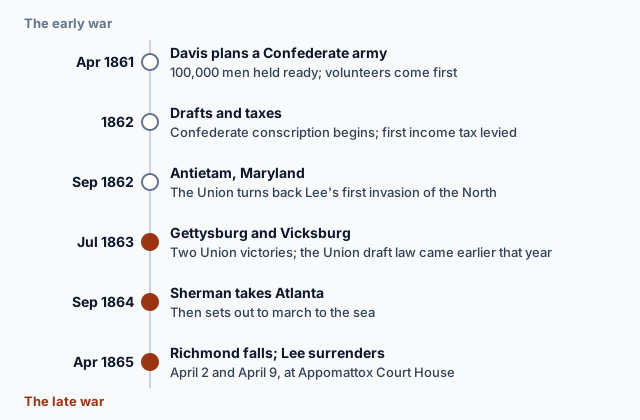
Mobilization means turning a society's people, money and industry toward war, and neither side was ready for a long one in 1861. On April 29, 1861, Jefferson Davis, president of the Confederacy, told its Congress at Montgomery: "It is proposed to organize and hold in readiness for instant action, in view of the present exigencies of the country, an army of 100,000 men." At first, volunteers filled the ranks on both sides.
Volunteers were not enough for a long war, and both sides turned to a draft. The Confederacy went first: its War Department's records on conscription and exemptions begin in 1862. The Union followed with the Enrollment Act of 1863, which made men from twenty to forty-five subject to the draft.
Wars cost money as well as men. An act of Congress of July 1, 1862, levied the first income tax Americans actually paid, an emergency measure to finance the Union cause. The Confederacy, with far less industry to tax, collected a tax in kind, paid in goods such as crops rather than cash, and in 1864 and 1865 it impressed enslaved people, forcing them into war labor.
Sources: Jefferson Davis, Message to Congress, April 29, 1861 (Avalon Project); Guide to the War Department Collection of Confederate Records (National Archives); Civil War Draft Records (Prologue, National Archives); Income Tax Records of the Civil War Years (Prologue, National Archives).
Quick check · Sort it
Each card is a step a government took to wage the war. Tap a card, then the side that took it.
The Union
The Confederacy
2b. Opposition and division at home
The home front, life away from the battlefields, was divided on both sides.
In the North, a drafted man could buy his way out of service, usually by hiring a substitute to serve in his place. Grover Cleveland, a future president enrolled in June 1863, paid a substitute. In 1864 the New York lawyer George Templeton Strong paid a "big 'Dutch' boy of about twenty" $1,100 to serve for him. Michael T. Meier, writing in the National Archives' Prologue magazine, calls the Enrollment Act "this unpopular law." By the summer of 1862, the historian Daniel E. Sutherland writes, Lincoln also faced a rising tide of public criticism of how the war was going in the East, with midterm elections ahead. In the slave state of Maryland, where a crowd had attacked Union troops in Baltimore in the war's first week, Lincoln suspended habeas corpus and arrested disloyal citizens, including members of the state legislature.
The Confederacy was divided too. Across the South, Sutherland writes, Unionist and Confederate neighbors who had taken rival sides fought each other for control of their communities. And enslaved people inside the Confederacy were never behind its war; a National Archives teaching guide notes that the South had to fear them as a threat of rebellion and of help to the Union.
Sources: Civil War Draft Records (Prologue, National Archives); Abraham Lincoln and the Guerrillas (Prologue, National Archives); Factors that Affected the Civil War (National Archives teaching guide).
Quick check · Multiple choice
A Northern lawyer pays a substitute to take his place in the army, and in the South, Unionist and Confederate neighbors fight each other. What do the two cases show together?
2c. Confederate daring, Union leadership and key victories
The Confederacy did not have to conquer the North, only outlast it. It had able commanders, among them Robert E. Lee, Joseph Johnston and Stonewall Jackson, and Lee took the war north. In September 1862 the Union army turned back his first invasion of the North at Antietam, Maryland.
The turning came in July 1863, with two Union victories: the Battle of Gettysburg, in Pennsylvania, and the fall of Vicksburg to Grant's army in the West. On July 7 Lincoln telegraphed General Henry Halleck: "We have certain information that Vicksburg surrendered to Gen. Grant on the 4th of July." But General George Meade hung back, and Lee's beaten army escaped into Virginia.
Lincoln found the general he wanted in Ulysses S. Grant, whose victories had secured parts of the Mississippi River basin, and nominated him to be Lieutenant General of the Army. A strategy is the plan that links a war's goals. The teaching guide lists four: control the Mississippi River; cut the South off from foreign traders and smugglers, the job of Lincoln's naval blockade; defeat the Confederate army in the field; and curtail the South's ability to produce goods and war materials.
Sources: Factors that Affected the Civil War (National Archives teaching guide); War Department General Order 143 (National Archives); Emancipation Proclamation (National Archives); Lincoln's telegram to Halleck, July 7, 1863 (Prologue, National Archives); The Union Navy in the Civil War (Prologue, National Archives).
Quick check · Match
Match each Union goal to what reaching it did in the war.
2d. Resources, and the destruction of the South's infrastructure
The North's resources were greater in almost every way. Its population was several times the South's, which meant more soldiers and more workers. It had most of the factories that made war materials, a network of roads, canals and railroads that could resupply armies in the field, and a far stronger navy.
Resources win faster when the enemy's are destroyed. Infrastructure is the railroads, roads, factories and farms that let a society feed and supply its armies. In 1863 the Union army's General Orders No. 100, rules of war prepared by Francis Lieber, permitted such destruction when the war required it. Article 17 says: "War is not carried on by arms alone. It is lawful to starve the hostile belligerent, armed or unarmed, so that it leads to the speedier subjection of the enemy."
In the war's last year the Union put this to work. General William T. Sherman captured Atlanta on September 2, 1864, and then set out to march from Atlanta to the sea; he later telegraphed Lincoln that Savannah, Georgia, had surrendered, as a Christmas present to the President. In the war's last year, Union armies destroyed much of the South's infrastructure.
Sources: Factors that Affected the Civil War (National Archives teaching guide); General Orders No. 100 (Avalon Project); The Union Navy in the Civil War (Prologue, National Archives).
Quick check · Fill the statement
Complete a student's notes on the Union's material advantages.
The North's meant it could replace losses the South could not. Its carried supplies to armies in the field. Destroying the South's railroads, farms and factories attacked the Confederacy's ability to .
Part 3 Watch it done Connect a rule of war to the Union's victory
Watch each step, then do the last one yourself.
Article 15 of General Orders No. 100, issued to the Union army on April 24, 1863, says that military necessity "allows of all destruction of property, and obstruction of the ways and channels of traffic, travel, or communication, and of all withholding of sustenance or means of life from the enemy." Identify the pattern in how the Union fought that this rule belongs to.
Predict first
Before the steps, what do you think this rule is mostly about?
Step 1 · List what the rule names
Property. The ways and channels of traffic, travel and communication, which in 1863 meant roads, railroads, rivers and telegraph lines. Sustenance, which is food.
Why this step?
Why check the rule's limits before naming a pattern?
A pattern has to fit the whole source. Article 16 says military necessity does not allow cruelty, "nor of the wanton devastation of a district," so the rule permits destruction with a military purpose, not destruction for its own sake.
Step 2 · Set it beside the Union's goals
One goal the North had to reach was to curtail the South's ability to produce goods and war materials. Compare what Article 15 names with what that goal needs. The rule permits; it does not by itself order any army to act.
Your step · Decide and justify
Finish it. Which pattern in the Union's war does Article 15 belong to?
Which evidence best supports your answer?
Part 4 Try it The end of the war
Test what you know on the war's last weeks. Near the war's end, Lee struggled to defend both Petersburg and Richmond against Grant, whose army the Union navy kept supplied. On April 2, 1865, Richmond, the Confederate capital, fell, and Confederate officials including President Jefferson Davis fled. A week later, on April 9, Grant and Lee met at Appomattox Court House, Virginia. The agreement signed there on April 10 had Lee's troops march to a set point, "stack their Arms, deposit their flags," and go home. Not until August 20, 1866, did the President formally declare the war over.
Sources: The Union Navy in the Civil War (Prologue, National Archives); Articles of Agreement of Surrender (National Archives).
Try it · Spot the error
A student writes five sentences on how the war ended. Which line is the first to go wrong?
Try it · Multiple choice
Which pattern best connects the fall of Richmond and Lee's surrender at Appomattox to the Union's goals?
Part 5 Explain it Write it like a document-based answer
Nothing you type leaves this page. Check your answer against the model and each scoring point.
Free-response practice · Question 1 style
A short practice in the shape of the document-based question: three documents instead of seven, and a thesis with one body paragraph instead of a full essay.
Evaluate the extent to which the North's greater resources explain the Union's victory in the Civil War.
Document 1. Jefferson Davis, president of the Confederacy, message to the Confederate Congress at Montgomery, April 29, 1861: "It is proposed to organize and hold in readiness for instant action, in view of the present exigencies of the country, an army of 100,000 men."
Document 2. General Orders No. 100, rules of war prepared by Francis Lieber and issued to the Union army, April 24, 1863, Article 17: "War is not carried on by arms alone. It is lawful to starve the hostile belligerent, armed or unarmed, so that it leads to the speedier subjection of the enemy."
Document 3. Abraham Lincoln, Second Inaugural Address, March 4, 1865: "The progress of our arms, upon which all else chiefly depends, is as well known to the public as to myself, and it is, I trust, reasonably satisfactory and encouraging to all."
Write a thesis, one sentence of historical context, and one paragraph that uses at least two documents and explains the purpose, audience, point of view or situation of one of them.
Model answer
Thesis: The North's greater resources explain the Union's victory only in part, because they decided the war only after the Union found leaders and a strategy that used them and set out to destroy the South's own means of supply.
Context: Lincoln's election in 1860 without any Southern electoral votes was followed by the secession of most slave states, and by 1865 Lincoln could say that neither side had expected so long a war.
In 1861 the Confederacy mobilized fast: Davis planned an army of 100,000 men held ready "for instant action" (Document 1). Davis was speaking to his own Congress weeks after the war began, so his purpose was likely to win support for a larger army; the proposal shows how quickly the South set out to mobilize. That start did not last because the war grew long, and a long war favored the side with more people and factories. But resources were joined to a strategy: by 1863 the Union army's own rules said "War is not carried on by arms alone" and allowed starving the enemy (Document 2), aiming at the South's supplies as well as its soldiers. By March 1865 Lincoln could call "the progress of our arms" satisfactory (Document 3), after Sherman had taken Atlanta and Savannah and Grant had Lee pinned between Petersburg and Richmond.
Score your own answer. This is a self-check, not a grade. Tick each point your answer makes.
Part 6 Check yourself Two presidents, four years apart
The case questions use the two excerpts. The others mix the ideas from the whole lesson.
The first excerpt is the Confederate president in the war's first weeks; the second is the Union president a month before Lee's surrender. Sources: Jefferson Davis, Message to Congress, April 29, 1861 (Avalon Project); Lincoln's Second Inaugural Address (Avalon Project).
| Document | Excerpt |
|---|---|
| Jefferson Davis, message to the Confederate Congress, April 29, 1861 | "Requisitions for troops have been met with such alacrity that the numbers tendering their services have in every instance greatly exceeded the demand." |
| Abraham Lincoln, Second Inaugural Address, March 4, 1865 | "Neither party expected for the war the magnitude or the duration which it has already attained." |
Case question 1 · Multiple choice
Read together, what change do the two excerpts point to most directly?
Case question 2 · Multiple choice
Lincoln says neither side expected the war to last so long. Which factor in the Union's victory gained the most from the war's length?
The rest stand on their own and do not use the case.
Check yourself · Put it in order
Put these events in the order they happened, earliest first.
Check yourself · Select all
Which two explain how the Union turned its greater resources into victory? Select two.
Select 2 answers, then check.
Part 7 Keep it Bring back earlier ideas
This lesson stands on the failure of compromise from Topic 5.6 and Lincoln's election and secession from Topic 5.7.
Bring it back · Multiple choice
The Kansas-Nebraska Act and the Supreme Court's Dred Scott decision both dealt with slavery in the territories. What did they have in common?
Bring it back · Fill the statement
Read the situation, then complete the sentences.
Suppose a Southern editor in the winter of 1860 complains that the new president owes nothing to the South. The complaint rests on a real fact: Lincoln won on the Republicans' platform without .
In three lines
- Both sides raised armies and money, each in the end with a draft, while facing opposition and division at home.
- The Confederacy showed daring early, and only had to outlast the North to win.
- Better leadership and strategy, key victories, greater resources and the destruction of the South's infrastructure won the war for the Union.
Exam strategy for this topic
- Section I Part A, Multiple Choice: 55 questions in 55 minutes.
- Section I Part B, Short Answer: 3 questions in 40 minutes.
- Section II, Document-Based Question and Long Essay: 2 questions in 100 minutes.
- This lesson's Explain it is shaped like free-response question 1, Document-based.
When a question asks why the Union won, name more than one factor and say how they connect: resources counted because leaders and a strategy put them to work over a long war.
Questions students ask
Did the North win just because it was bigger?
Not on its own. The North had several times the South's population and most of its factories from the start, yet the war lasted four years. Its advantages counted once Lincoln found Grant, the Union followed a strategy aimed at the South's armies and supplies, and the war ran long enough for numbers and factories to tell.
Did everyone in the North support the war?
No. A drafted Northerner could buy his way out, usually by hiring a substitute, and George Templeton Strong paid $1,100 for his in 1864. Lincoln faced public criticism of the war in 1862, and in Maryland he suspended habeas corpus and arrested disloyal citizens. The Confederacy was divided too: Unionist and Confederate neighbors fought each other across the South.
What was General Orders No. 100?
Rules of war for the Union army, prepared by Francis Lieber and issued in 1863. They permitted the destruction of an enemy's property and supply routes when war required it, while ruling out cruelty and destruction for its own sake.
Which battles turned the war?
Antietam in September 1862 turned back Lee's first invasion of the North. In July 1863 the Union won at Gettysburg, and Vicksburg surrendered to Grant on July 4. In September 1864 Sherman took Atlanta and set out for the sea, and in April 1865 Richmond fell and Lee surrendered.
When did the Civil War end?
Lee surrendered his army to Grant at Appomattox Court House on April 9, 1865, a week after Richmond fell. Other Confederate forces surrendered over the following months, and the President formally declared the war over on August 20, 1866.
Where can I read these documents in full?
Each excerpt links to its full text at the National Archives or the Avalon Project at Yale Law School, the collections this lesson was checked against.
Course alignment, for teachers
AP U.S. History topic 5.8, Unit 5: Period 5: 1844–1877.
- Skill 5.A: Identify patterns among or connections between historical developments and processes.
This lesson maps all 2 essential knowledge statements of the topic, and the one learning objective with none of its own, to the part that teaches each one: 3 are checked by a scored question. The map is in the lesson file.