Unit 7 · Topic 7.2 · about 30 minutes · 7 parts · 13 scored checks, 5 of them multiple choice
AP U.S. History 7.2: Imperialism: Debates
Unit 7: 10 to 17% of the multiple-choice section
What you'll be able to do
- Explain the similarities and differences in attitudes about the nation's proper role in the world, comparing the arguments of imperialists and anti-imperialists and reading their sources for point of view, purpose, situation and audience.
Key vocabulary
| Term | What it means | The exam trap |
|---|---|---|
| Imperialism | A nation's extension of its power over other lands and peoples, by taking territory or by controlling their affairs. | Imperialists did not all want the same thing; markets, naval bases and colonies are different aims, so name which one a source wants. |
| Isolationism | Washington's rule for foreign policy as later Americans invoked it: trade abroad, but as few political ties as possible. | Before you call a source isolationist, check which ties abroad it rejects and which it welcomes. |
| Self-determination | The principle that a people should choose its own government. | It names a principle about who decides, not any particular form of government. |
| Annexation | The formal addition of a territory to a nation, as Congress did with Hawaii in 1898. | Annexation is a legal act; it can follow a treaty or a vote of Congress, so check how a territory was taken before you compare cases. |
| Protectorate | A country that keeps its own government but accepts another nation's power over parts of its affairs. | Do not confuse protectorate with protectionism, a policy of taxing imports to shield home industry. |
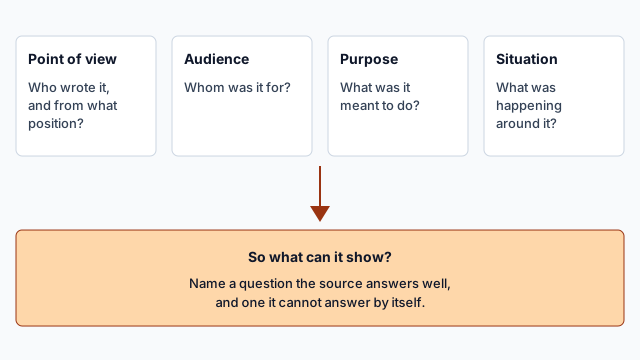 Tap to open the picture full size
Part 1 Think first What changed for Hawaii in 1898?
Commit to a guess first. Being wrong now makes the right idea stick better.
Predict first
In the fall of 1897, 21,269 native Hawaiians signed a petition against annexing Hawaii to the United States, and by February 1898 the annexation treaty had failed in the Senate. On July 7, 1898, President McKinley signed a resolution of Congress annexing Hawaii anyway. What do you think changed between February and July?
In short. In the 1890s and after, imperialists argued that Americans were destined to spread their culture and institutions overseas, while anti-imperialists argued that the United States should not extend its territory beyond its shores.
- Imperialists cited economic opportunity, racial theories, competition with European empires, and the belief that the western frontier had closed.
- Anti-imperialists cited self-determination, the foreign policy tradition of isolationism, and racial theories of their own.
- Both sides claimed to speak for American ideals, so reading who wrote a source, for whom and why is the key to using it.
Part 2 Learn it Imperialists and anti-imperialists
2a. A tradition of staying apart
Americans who argued about expansion in the 1890s shared a starting point. In his Farewell Address of 1796, George Washington wrote: "The great rule of conduct for us in regard to foreign nations is in extending our commercial relations, to have with them as little political connection as possible." He added: "It is our true policy to steer clear of permanent alliances with any portion of the foreign world." Trade abroad was welcome; political ties were to be few. This habit of staying out of other nations' politics and wars is called isolationism.
A century later, President William McKinley claimed the same tradition in his first inaugural address, on March 4, 1897: "We have cherished the policy of non-interference with affairs of foreign governments wisely inaugurated by Washington, keeping ourselves free from entanglement, either as allies or foes." He went on: "We want no wars of conquest; we must avoid the temptation of territorial aggression."
Within two years the country had annexed Hawaii and taken islands from Spain. Opponents of expansion would use the old tradition against it.
Sources: Washington's Farewell Address (Avalon Project); McKinley's first inaugural address (Avalon Project).
Quick check · Multiple choice
Washington in 1796 wrote of having "as little political connection as possible" with foreign nations. McKinley in 1897 praised "non-interference with affairs of foreign governments." Which statement fits both?
2b. The case for expansion
Imperialists argued that Americans were destined to spread their culture and institutions to peoples around the globe. Their reasons came in four kinds.
Economic opportunity. In 1901 McKinley said American products were "increasing in such unprecedented volume as to admonish us of the necessity of still further enlarging our foreign markets by broader commercial relations." Next he named the means: "For this purpose reciprocal trade arrangements with other nations should in liberal spirit be carefully cultivated and promoted." Trade treaties fit Washington's own rule of "extending our commercial relations." Imperialists went further and joined markets to territory. In Hawaii, the U.S. businessmen with sugar interests who overthrew the queen in 1893 feared a U.S. tariff on sugar, and in 1894 their leader, Sanford Dole, sent a delegation to Washington seeking annexation.
Competition with European empires. In 1902 European gunboats blockaded Venezuela's ports over unpaid debts, and many Americans worried that European intervention would undermine U.S. dominance in Latin America.
Racial theories. Many imperialists ranked nations as civilized or not, a ranking rooted in the racial thinking of the time. Roosevelt told Congress in 1904: "Chronic wrongdoing, or an impotence which results in a general loosening of the ties of civilized society, may in America, as elsewhere, ultimately require intervention by some civilized nation."
A closed frontier. The course framework adds that in the 1890s many Americans perceived the western frontier as closed.
Sources: McKinley's second inaugural (Avalon Project); Annexing Hawaii and Roosevelt Corollary (National Archives).
Quick check · Match
Match each piece of evidence to the kind of imperialist argument it supports.
2c. The case against
Anti-imperialists argued that the United States should not extend its territory overseas. Their reasons came in three kinds.
Self-determination, the principle that a people should choose its own government. In Hawaii, a committee of non-native U.S. businessmen and politicians, supported by the U.S. minister and a contingent of Marines, overthrew Queen Lili'uokalani in 1893, against the will of the native Hawaiians. On June 16, 1897, McKinley and representatives of the new Republic of Hawaii signed a treaty of annexation, and he sent it to the Senate. That fall, 21,269 native Hawaiians signed a Petition Against Annexation, and their delegates and the queen met with senators. The treaty failed. After annexation passed in 1898 by a different route, the queen protested to the House that her throne had been taken illegally.
The isolationist tradition. If Washington's rule was "as little political connection as possible" with foreign nations, ruling distant islands broke it.
Racial theories, turned against expansion. The course framework notes that anti-imperialists also invoked racial theories: some argued that taking islands would bring in peoples they considered unfit to be citizens.
Both sides could argue from race, and both claimed to speak for American ideals.
Source: Annexing Hawaii (National Archives).
Quick check · Sort it
Each card is an argument from the debate over expansion. Tap a card, then the side that made it.
Imperialist
Anti-imperialist
2d. Reading a source from the debate
Every source in this debate was written by someone trying to win it. To use one well, ask four questions: who wrote it and from what position (point of view), whom it was for (audience), what it was meant to do (purpose), and what was happening around it (historical situation). Then ask what those answers do to the source's use: what it can show well, and what it cannot.
Roosevelt's 1904 words come from his annual message to Congress, written after European gunboats had blockaded Venezuela. He argued for "the exercise of an international police power" by the United States in the hemisphere, and he tied his policy to the Monroe Doctrine. He also wrote: "It is not true that the United States feels any land hunger or entertains any projects as regards the other nations of the Western Hemisphere save such as are for their welfare."
That denial is strong evidence of how a president justified intervention to lawmakers and the public. It is weaker evidence of why the United States intervened. The National Archives names other aims: to keep other powers out and to ensure financial solvency.
Quick check · Fill the statement
Complete a historian's notes on Roosevelt's 1904 message.
The message was sent to Congress, which is its . Roosevelt wrote it to win support for "the exercise of an international police power," which is its . So it is better evidence of how the policy was than of every reason behind it.
Part 3 Watch it done Source McKinley's pledge of 1897
Watch each step, then do the last one yourself.
On March 4, 1897, in his first inaugural address, President McKinley said: "We want no wars of conquest; we must avoid the temptation of territorial aggression." Explain how the speech's audience and purpose limit what it can show about McKinley's own aims.
Predict first
Before the steps, what kind of statement do you think this is?
Step 1 · Name the audience and purpose
An inaugural address speaks to the whole nation on the day a president takes office. Its purpose is to reassure and to state principles, so it speaks in broad terms. McKinley tied his words to the policy "wisely inaugurated by Washington," a tradition most of his listeners already honored.
Why this step?
Why ask about the audience before judging the claim?
A speech meant for a large audience tells you what the speaker wanted that audience to hear. Before using it as evidence of a plan, you need other evidence of what he actually did.
Step 2 · Check it against his actions
Ask what McKinley did in the months after the speech. You met it in the story of Hawaii: look for a step of his own that bears on new territory.
Your step · Decide and justify
Finish it. How far can the 1897 statement be used as evidence of McKinley's own aims toward new territory?
Which evidence best supports your answer?
Part 4 Try it Two promises about Cuba
When Congress moved toward war with Spain in April 1898, Senator Henry M. Teller of Colorado proposed an amendment by which the United States promised to "leave the government and control of the island to its people" once Cuba was pacified. U.S. troops still occupied Cuba for several years after the war. In 1901 Congress enacted conditions for ending the occupation, drafted by Secretary of War Elihu Root and presented by Senator Orville Platt. Cubans reluctantly wrote this Platt Amendment into their constitution; a treaty approved on May 22, 1903 repeated them. Its third article reads: "the government of Cuba consents that the United States may exercise the right to intervene for the preservation of Cuban independence, the maintenance of a government adequate for the protection of life, property, and individual liberty." The National Archives says the amendment virtually made Cuba a U.S. protectorate.
Source: Platt Amendment (National Archives).
Try it · Multiple choice
What does the change from the Teller Amendment to the Platt Amendment best show about American attitudes toward Cuba?
Try it · Spot the error
A student writes a sourcing paragraph on the Platt Amendment. Which line is the first to go wrong?
Part 5 Explain it Write it like a document-based answer
Nothing you type leaves this page. Check your answer against the model and each scoring point.
Free-response practice · Question 1 style
A short practice in the shape of the document-based question: three documents instead of seven, and a thesis with one body paragraph instead of a full essay.
Evaluate the extent to which American leaders' views of the nation's proper role in the world changed between 1897 and 1904.
Document 1. President William McKinley, first inaugural address, March 4, 1897: "We have cherished the policy of non-interference with affairs of foreign governments wisely inaugurated by Washington, keeping ourselves free from entanglement, either as allies or foes." And: "We want no wars of conquest; we must avoid the temptation of territorial aggression."
Document 2. President William McKinley, second inaugural address, March 4, 1901: "Our diversified productions, however, are increasing in such unprecedented volume as to admonish us of the necessity of still further enlarging our foreign markets by broader commercial relations." And: "For this purpose reciprocal trade arrangements with other nations should in liberal spirit be carefully cultivated and promoted."
Document 3. President Theodore Roosevelt, annual message to Congress, December 6, 1904: "Chronic wrongdoing, or an impotence which results in a general loosening of the ties of civilized society, may in America, as elsewhere, ultimately require intervention by some civilized nation." He calls for "the exercise of an international police power" by the United States.
Write a thesis, one sentence of historical context, and one paragraph that uses at least two documents and explains the purpose, audience, point of view or situation of one of them.
Model answer
Thesis: Between 1897 and 1904 leaders' views of power abroad changed more than their views of trade: the search for markets carried on Washington's rule of commerce, while Roosevelt's claimed right to police the hemisphere broke with non-interference.
Context: in 1898 the war with Spain and the annexation of Hawaii gave the United States islands in the Caribbean and the Pacific, and a public debate over expansion followed.
In 1897 McKinley praised "non-interference with affairs of foreign governments" and rejected "wars of conquest" (Document 1). As an inaugural address to the whole nation, it states a principle meant to reassure, and McKinley signed a treaty to annex Hawaii that same June, so it is weak evidence of his own aims. In 1901 he sought larger foreign markets through "reciprocal trade arrangements" (Document 2), trade treaties that fit Washington's call for "extending our commercial relations." The sharp change came in 1904, when Roosevelt claimed a right of intervention by a "civilized nation" (Document 3), a ranking of nations rooted in the racial thinking of the time, joined to an international police power. Even so, he tied it to the Monroe Doctrine and described it as continuity.
Score your own answer. This is a self-check, not a grade. Tick each point your answer makes.
Part 6 Check yourself Two presidents, a century apart
The case questions use the two excerpts. The others mix the ideas from the whole lesson.
Washington wrote his Farewell Address in 1796; Roosevelt sent his annual message to Congress on December 6, 1904. Sources: Farewell Address (Avalon Project); Roosevelt's 1904 message (National Archives).
| Document | Excerpt |
|---|---|
| George Washington, Farewell Address, 1796 | "The great rule of conduct for us in regard to foreign nations is in extending our commercial relations, to have with them as little political connection as possible." |
| Theodore Roosevelt, annual message to Congress, 1904 | "It is not true that the United States feels any land hunger or entertains any projects as regards the other nations of the Western Hemisphere save such as are for their welfare." The United States may be forced into "the exercise of an international police power." |
Case question 1 · Multiple choice
How does Roosevelt's position depart from Washington's?
Case question 2 · Multiple choice
Roosevelt's denial of any land hunger comes from his annual message to Congress. How does that limit its use as evidence?
The rest stand on their own and do not use the case.
Check yourself · Put it in order
Put these events in the order they happened, earliest first.
Check yourself · Select all
Which two were arguments made by imperialists? Select two.
Select 2 answers, then check.
Part 7 Keep it Bring back earlier ideas
This debate stands on the forces of Period 7 from Topic 7.1 and the Gilded Age ideas of Topic 6.9.
Bring it back · Fill the statement
Complete the sentence about Period 7.
The United States grew into a world power through a series of , and each one renewed the debate at home over the nation's .
Bring it back · Multiple choice
Gilded Age social commentators advocated theories later described as Social Darwinism. What did these theories mainly do?
In three lines
- Imperialists cited markets, competition with European empires, racial theories and a closed frontier to argue that Americans were destined to expand.
- Anti-imperialists cited self-determination, the isolationist tradition and racial theories of their own to argue against taking territory overseas.
- Each side's sources were written to win the argument, so their audience and purpose limit what they can show.
Exam strategy for this topic
- Section I Part A, Multiple Choice: 55 questions in 55 minutes.
- Section I Part B, Short Answer: 3 questions in 40 minutes.
- Section II, Document-Based Question and Long Essay: 2 questions in 100 minutes.
- This lesson's Explain it is shaped like free-response question 1, Document-based.
When a question asks how a source's purpose or audience limits its use, name a question the source answers well and one it answers badly, and say why.
Questions students ask
Who were the anti-imperialists?
Americans who argued that the United States should not extend its territory overseas. They cited self-determination, the tradition of staying out of foreign politics, and in some cases racial theories.
Did both sides really use racial ideas?
Yes. Some imperialists ranked peoples as civilized or not to justify ruling them, and some anti-imperialists used the same kind of ranking to argue that islands would bring in peoples they considered unfit for citizenship.
What happened to the Hawaiian petition against annexation?
In the fall of 1897, 21,269 native Hawaiians signed it, and the treaty of annexation failed in the Senate. In July 1898, during the war with Spain, Congress annexed Hawaii by joint resolution, which needed only a simple majority in each house.
Why did McKinley mention Washington in 1897?
He was claiming the tradition of non-interference that Washington's Farewell Address had set out, a tradition most Americans honored. Opponents of expansion would soon use the same tradition against his policies.
Where can I read these documents in full?
Each excerpt links to its full text at the National Archives or the Avalon Project at Yale Law School, the primary-source collections this lesson was checked against.
Course alignment, for teachers
AP U.S. History topic 7.2, Unit 7: Period 7: 1890–1945.
- Skill 2.C: Explain the significance of a source’s point of view, purpose, historical situation, and/or audience, including how these might limit the use(s) of a source.
This lesson maps all 2 essential knowledge statements of the topic, and the one learning objective with none of its own, to the part that teaches each one: 3 are checked by a scored question. The map is in the lesson file.