Unit 7 · Topic 7.7 · about 30 minutes · 7 parts · 13 scored checks, 5 of them multiple choice
AP U.S. History 7.7: 1920s: Innovations in Communication and Technology
Unit 7: 10 to 17% of the multiple-choice section
What you'll be able to do
- Explain the causes and effects of the new technologies of communication and manufacturing in the 1920s, and connect mass production to the mass media that spread a national culture and made Americans more aware of regional cultures.
Key vocabulary
| Term | What it means | The exam trap |
|---|---|---|
| Mass production | Making large numbers of identical goods quickly, often by machine and on an assembly line. | Mass production describes how goods are made, not who buys them; keep the two ideas apart when you explain a cause. |
| Assembly line | A way of building a product in which it moves past workers who each do one task. | An assembly line is a method of work, not a single invention or a single company. |
| Consumer goods | Products made to be bought and used by households, such as cars, radios and appliances. | A good can be a consumer good and a communications technology at the same time. |
| Mass media | Means of communication, such as radio and film, that reach a very large audience at once. | Mass media are defined by how many people they reach at once, not by whether they carry news, music or advertising. |
| National culture | Songs, news, styles and brand names shared by Americans across regions. | A national culture can grow while regional cultures remain; one does not require the end of the other. |
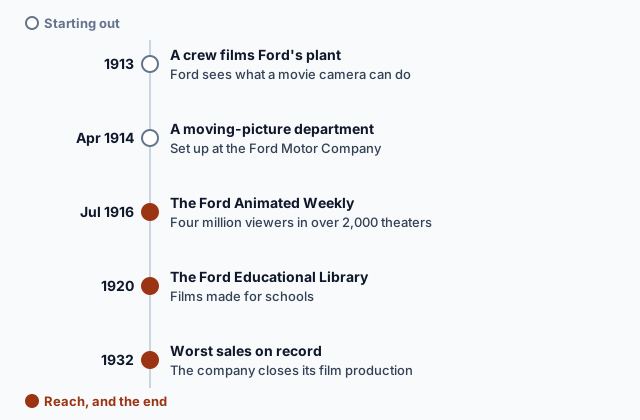 Tap to open the picture full size
Part 1 Think first A new question for the census
Commit to a guess first. Being wrong now makes the right idea stick better.
Predict first
A National Archives history of the census says: "Commercial radio broadcasting had been in its infancy in 1920." The census of April 1930 asked every household a new question: did the family own a radio set? What share of households do you think said yes?
In short. In the 1920s new manufacturing techniques such as the assembly line turned the economy toward consumer goods, and new mass media, radio and film above all, carried the same news, programs and advertising to millions of homes while also showing Americans regional cultures far from their own.
- Mass production made cars and other consumer goods available to more families, raising standards of living, giving people greater mobility and building better communications.
- Commercial radio was in its infancy in 1920; by April 1930 about 40 percent of households had at least one radio, and business leaders valued it for advertising mass-produced goods.
- Radio and cinema spread a shared national culture and also made Americans more aware of regional cultures.
Part 2 Learn it Machines, media and a national culture
2a. Mass production and consumer goods
Mass production is making large numbers of identical goods quickly. Its best known tool was the assembly line, where the product moves past workers who each do one task. A National Archives history notes that Henry Ford's company was the first to use the assembly line in automobile production.
Behind the change lay decades of industrial growth: since the late 1800s businesses had used new technology and greater access to natural resources to increase production dramatically. In the 1920s new technologies and manufacturing techniques helped focus the economy of the 1920s on consumer goods, things made to be bought by ordinary households: cars, radios, appliances. The course framework names three results. Standards of living improved. People gained greater personal mobility, because a family with a car could go where and when it chose. And communications systems got better.
Leaders of the time saw it. In his inaugural address of March 4, 1929, President Herbert Hoover said Americans had reached "a higher degree of comfort and security than ever existed before in the history of the world," and he spoke of a nation whose life "expands with science and invention." A new president was celebrating, so read the claim as a view from the top. It shows the confidence a growing consumer economy gave the nation's leaders.
Sources: Henry Ford: Movie Mogul? (National Archives); Hoover's Inaugural Address, 1929 (Avalon Project).
Quick check · Multiple choice
A carmaker of the 1920s moves from building each car by hand to building cars on an assembly line. Which outcome fits the pattern historians describe for that decade?
2b. Radio: one broadcast, millions of homes
Radio is a mass medium: one broadcast reaches a huge audience at the same moment. It grew fast. "Commercial radio broadcasting had been in its infancy in 1920." Ten years later, "In April 1930, approximately 40 percent of households had at least one radio." Notice what that number also says: in 1930 most households still had no radio.
Radio tied two developments together. Factories were mass-producing goods, and someone had to persuade millions of people to buy them. Historian Roland Marchand has argued that business and political leaders of the early twentieth century saw radio partly as a source of cultural uplift and partly as "a valuable medium for advertisement of mass-produced goods." The same program, and the same advertisement, could be heard in a Kansas farmhouse and a New York apartment on the same night.
That is how mass media helped spread a national culture: songs, news, jokes and brand names that Americans in every region came to share.
Sources: Preparing for the 1930 Census (National Archives); The 1930 Census in Perspective (National Archives).
Quick check · Fill the statement
Complete the notes on radio in the 1920s.
In 1920 commercial radio broadcasting was . By April 1930 about of households had at least one radio. Business and political leaders valued radio partly as a way to .
2c. Film: a national audience and regional pictures
Cinema reached a mass audience even before radio did. Ford's company was a surprising part of it. Between 1915 and the mid-1920s, a National Archives history says, Henry Ford was "overseeing the largest motion picture production and distribution operation on the planet." His weekly series of short educational films reached theaters nationwide: "By the end of 1919, the series appeared on over 5,200 movie screens every week." In some rural areas, Ford's films were the first motion pictures farm families had ever seen.
Film did two things at once. It gave Americans everywhere the same pictures, which built a national culture. It also showed them places unlike their own. Ford's films for schools included a 1921 film on "the regional geography, people, and businesses of the city of San Jose, California," and a 1924 film, The Hawaiian Islands, that "documents life in Honolulu, local Hawaiian and Japanese cultures, sugar cane production, and the making of poi."
The course framework states both effects: mass media spread national culture and also brought greater awareness of regional cultures.
Quick check · Sort it
Each card describes mass media in the 1910s to 1920s. Tap a card, then the effect it shows best.
Spreading a shared national culture
Building awareness of regional cultures
2d. Connecting the two developments
A good AP answer does not stop at listing changes. It explains how one development relates to another. Mass production and mass media are a strong pair, because each needed the other.
Factories that could make millions of cars or radios needed millions of buyers. Mass media could reach them. When Henry Ford first saw a crew filming his plant in 1913, he thought film might be "a way to communicate the news of the day to the public, to educate them about the world in which they lived, and of course, to illustrate the wonders of Ford automobiles." The largest share of the footage his company later shot was edited into sales films for its dealers. They were shown wherever buyers gathered: "dealership showrooms, fraternal lodges, schools, recreation halls, county fairs."
The link runs the other way too. Radios were themselves mass-produced consumer goods, and each one sold enlarged the audience for advertising.
Sources: Henry Ford: Movie Mogul? (National Archives); The 1930 Census in Perspective (National Archives).
Quick check · Match
Match each development of the 1910s and 1920s to the way it connects with another development.
Part 3 Watch it done Connect Ford's films to Ford's cars
Watch each step, then do the last one yourself.
In 1913 Henry Ford watched a movie crew film his Highland Park, Michigan, plant. A National Archives history says he thought film might be "a way to communicate the news of the day to the public, to educate them about the world in which they lived, and of course, to illustrate the wonders of Ford automobiles." Explain how Ford's film business related to his car business.
Predict first
Before the steps, how do you think the two businesses were related?
Step 1 · Name each development
First development: Ford's factories built cars in huge numbers on the assembly line. Second development: Ford's film department, set up in April 1914, which between 1915 and the mid-1920s ran the largest film production and distribution operation in the world.
Why this step?
Why name both developments before linking them?
A connection needs two things. Stating each one first stops you from describing a single development in detail and calling that a link.
Step 2 · Find evidence of what the films did
The largest share of the company's footage was edited into sales films for Ford dealers. They were shown in "dealership showrooms, fraternal lodges, schools, recreation halls, county fairs," and the company's own estimate, by the mid-1920s, was 2,500,000 viewers a month.
Your step · Decide and justify
Finish it. Which statement best explains how the two developments were related?
Which evidence best supports your answer?
Part 4 Try it Radio enters politics
The radio boom of the 1920s kept going. "During the 1930s almost every home had a radio, and families typically spent several hours a day gathered together, listening to their favorite programs." Presidents learned to use it, some better than others. A National Archives history of Herbert Hoover notes: "Herbert Hoover's inability to use the radio as an effective communication tool contributed to his election loss in 1932." His successor, Franklin Roosevelt, spoke to the nation in radio talks he called fireside chats, including one on July 24, 1933. "Informal and relaxed, the talks made Americans feel as if President Roosevelt was talking directly to them."
Sources: FDR's Fireside Chat lesson (National Archives); The Ordeal of Herbert Hoover (National Archives).
Try it · Multiple choice
How does the presidents' use of radio in the early 1930s relate to the communications changes of the 1920s?
Try it · Spot the error
A student writes a paragraph on radio's effects. Which line is the first to go wrong?
Part 5 Explain it Write it like a document-based answer
Nothing you type leaves this page. Check your answer against the model and each scoring point.
Free-response practice · Question 1 style
A short practice in the shape of the document-based question: three documents instead of seven, and a thesis with one body paragraph instead of a full essay.
Evaluate the extent to which new technologies changed American life between the 1910s and 1930.
Document 1. The Ford Man, the Ford Motor Company's in-house newspaper, September 20, 1917, as quoted in a National Archives history: Ford films were shown "in more than 3,500 theaters in the United States alone," and the paper called its count of four to five million weekly viewers "a conservative estimate."
Document 2. President Herbert Hoover, inaugural address, March 4, 1929: Americans had reached "a higher degree of comfort and security than ever existed before in the history of the world."
Document 3. A National Archives history of the 1930 census (2002): "In April 1930, approximately 40 percent of households had at least one radio."
Write a thesis, one sentence of historical context, and one paragraph that uses at least two documents and explains the purpose, audience, point of view or situation of one of them.
Model answer
Thesis: New technologies changed American life a great deal between the 1910s and 1930, bringing mass-produced comforts and a shared film and radio culture to millions, but the change was uneven, since in 1930 most households still had no radio.
Context: since the late 1800s businesses had used new technology and greater access to natural resources to increase production dramatically, and by the 1920s factories were turning out consumer goods for ordinary households.
As early as 1917 Ford's films played "in more than 3,500 theaters in the United States alone" (Document 1). The Ford Man was the company's own newspaper, written for Ford people and meant to celebrate the company, so its count of viewers, which it called "a conservative estimate," may run high. By 1929 a new president could claim Americans had reached "a higher degree of comfort and security than ever existed before in the history of the world" (Document 2), the confidence of a consumer economy at its peak. Yet only about 40 percent of households had a radio in April 1930 (Document 3). The new technologies reached millions, but not yet most homes.
Score your own answer. This is a self-check, not a grade. Tick each point your answer makes.
Part 6 Check yourself Radio and film, 1919 to 1930
The case questions use the excerpts. The others mix the ideas from the whole lesson.
Three excerpts from National Archives histories of the period. Sources: Henry Ford: Movie Mogul?; Preparing for the 1930 Census; The 1930 Census in Perspective.
| Topic | Excerpt |
|---|---|
| Ford's weekly film series, 1919 | "By the end of 1919, the series appeared on over 5,200 movie screens every week." |
| Radio in 1920 and 1930 | "Commercial radio broadcasting had been in its infancy in 1920." "In April 1930, approximately 40 percent of households had at least one radio." |
| Why the 1930 census asked about radios | "The inclusion of a question on radio ownership reflected this new interest in the possibilities of consumer items and methods of mass communication." |
Case question 1 · Multiple choice
Which conclusion do the excerpts best support?
Case question 2 · Multiple choice
The 1930 census question about radio ownership is best explained by which connection between developments?
The rest stand on their own and do not use the case.
Check yourself · Put it in order
Put these events in the order they happened, earliest first.
Check yourself · Select all
Which two are effects the course framework links to the new technologies and manufacturing techniques of the period? Select two.
Select 2 answers, then check.
Part 7 Keep it Bring back earlier ideas
This lesson stands on the industrial growth of Topic 6.5 and the wartime migration to cities in Topic 7.6.
Bring it back · Multiple choice
In the late 1800s, American businesses dramatically increased the production of goods. Which explanation fits what historians describe?
Bring it back · Fill the statement
Complete the sentence about the World War I home front.
When World War I raised the demand for and for workers, many Americans moved to looking for jobs.
In three lines
- Mass production focused the economy on consumer goods, raising living standards and giving families new mobility.
- Radio grew from its infancy in 1920 to about 40 percent of households by 1930, and leaders valued it for advertising.
- Radio and film spread a national culture and also made Americans more aware of regional cultures.
Exam strategy for this topic
- Section I Part A, Multiple Choice: 55 questions in 55 minutes.
- Section I Part B, Short Answer: 3 questions in 40 minutes.
- Section II, Document-Based Question and Long Essay: 2 questions in 100 minutes.
- This lesson's Explain it is shaped like free-response question 1, Document-based.
When a question asks how two developments relate, name both, then say what one made possible or necessary for the other, with one piece of evidence for the link.
Questions students ask
Did Henry Ford invent the car or the assembly line?
The lesson does not say he invented either. A National Archives history notes that Ford's company was the first to use the assembly line in automobile production, which is a claim about applying the method to cars.
How many Americans had a radio in the 1920s?
Commercial radio was in its infancy in 1920. The 1930 census, the first to ask, found that about 40 percent of households had at least one radio in April 1930.
Why does a lesson on technology talk so much about Ford's films?
Because they show the connection the topic is about. Ford's company mass-produced cars and also ran, for a few years, one of the largest film operations in the world, much of it used to sell those cars.
Did mass media make every region the same?
No. The course framework says mass media spread a national culture and also made Americans more aware of regional cultures. Ford's school films on Honolulu and San Jose are examples of the second.
Where can I read these sources in full?
Each excerpt links to its full text at the National Archives or the Avalon Project at Yale Law School, the collections this lesson was checked against.
Course alignment, for teachers
AP U.S. History topic 7.7, Unit 7: Period 7: 1890–1945.
- Skill 5.B: Explain how a historical development or process relates to another historical development or process.
This lesson maps all 2 essential knowledge statements of the topic, and the one learning objective with none of its own, to the part that teaches each one: 3 are checked by a scored question. The map is in the lesson file.