Unit 6 · Topic 6.8 · about 30 minutes · 7 parts · 13 scored checks, 5 of them multiple choice
AP U.S. History 6.8: Immigration and Migration in the Gilded Age
Unit 6: 10 to 17% of the multiple-choice section
What you'll be able to do
- Explain how cultural and economic factors affected migration patterns over time, and compare the main ideas of two sources about who came to American cities and who was kept out.
Key vocabulary
| Term | What it means | The exam trap |
|---|---|---|
| Push factor | A condition that drives people to leave home, such as poverty, religious persecution or blocked chances to rise. | A push factor is about the place people leave; a job waiting in a city is a pull, not a push. |
| Pull factor | A condition that draws people to a new place, such as work in a growing city or family already settled there. | A pull factor explains where people went, not why they left; a good answer names both. |
| Internal migration | Movement within a country, such as African Americans moving within the South or out of it. | Moving out of the South to another region is still internal migration, because no national border is crossed. |
| Ethnic neighborhood | A city neighborhood where people of one ethnicity cluster, such as San Francisco's Chinatown or Polish Downtown in Chicago. | These neighborhoods are evidence of community and cultural life, not only of poverty or separation. |
| Chinese Exclusion Act | The 1882 law that suspended the coming of Chinese laborers for ten years, the first significant law restricting immigration into the United States. | It suspended laborers, skilled and unskilled; it did not bar every Chinese person; diplomats, for example, were exempt. |
 Tap to open the picture full size
Part 1 Think first What pulled people to the cities?
Commit to a guess first. Being wrong now makes the right idea stick better.
Predict first
Between 1865 and 1898, newcomers from Asia, from southern and eastern Europe, and from the American South settled in the nation's growing cities. What do you think drew most of them there?
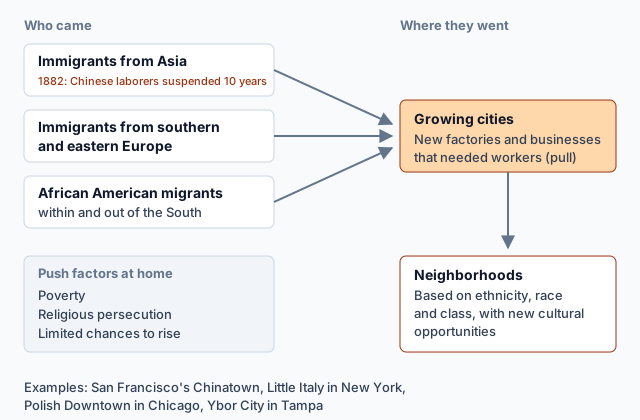
In short. Between 1865 and 1898, growing cities full of new factories and businesses drew immigrants from Asia and southern and eastern Europe and African American migrants from within and out of the South, many of them escaping poverty, religious persecution or limited chances to rise, and they built neighborhoods that gave city life new cultural opportunities.
- Internal and international migration made the industrial workforce larger and more diverse.
- Economic pull (city jobs) and push factors at home (poverty, persecution, blocked chances to rise) shaped who moved, while laws such as the 1882 Chinese Exclusion Act shaped who could come.
- Neighborhoods based on ethnicity, race and class, from San Francisco's Chinatown to Polish Downtown in Chicago, gave city dwellers new cultural opportunities.
Part 2 Learn it New people in the growing cities
8a. Why people moved
After the Civil War, cities became centers of economic growth. New factories and businesses needed workers, and the cities drew them from three directions: immigrants from Asia, immigrants from southern and eastern Europe, and African American migrants who moved within the South or left it.
Historians sort the reasons into push factors, conditions that drive people from home, and pull factors, conditions that draw them to a new place. Many migrants were pushed by poverty, by religious persecution, and by limited chances for social mobility, the chance to rise, in their home countries or regions. The cities pulled them with work.
Some families moved in steps. The AP U.S. History course framework uses Rose Cohen as an example. She was born in Russia in 1880. Her father went to New York City first, then sent for her and her aunt in 1892.
Quick check · Sort it
Tap a card, then the kind of factor it describes.
Push: drives people from home
Pull: draws people to a new place
8b. A workforce from many places
Internal migration is movement within a country; international migration is movement between countries. Both made the industrial workforce larger and more diverse.
One stream met a law meant to stop it. The Chinese Exclusion Act, approved on May 6, 1882, opened by declaring that "the coming of Chinese laborers to this country endangers the good order of certain localities within the territory thereof." It suspended the coming of Chinese laborers for ten years, and it defined them as "both skilled and unskilled laborers and Chinese employed in mining." The National Archives calls it the first significant law restricting immigration into the United States.
Read the Act as evidence of what Congress believed and wanted, not as a fair picture of Chinese workers. Its definition is part of its purpose. By counting skilled workers and miners as laborers, Congress made the ban reach as far as it could. The National Archives explains the result: "Thus very few Chinese could enter the country under the 1882 law."
Whole families joined the workforce. The National Archives notes that immigrants and rural migrants often sent their children to work, or worked beside them.
Sources: Chinese Exclusion Act (National Archives); Photographs of Lewis Hine (National Archives).
Quick check · Multiple choice
The 1882 Act defines Chinese laborers as "both skilled and unskilled laborers and Chinese employed in mining." Why would Congress write the definition that broadly?
8c. Neighborhoods, and comparing two sources
In the cities, urban neighborhoods formed around particular ethnicities, races and classes, and they gave city dwellers new cultural opportunities. The course framework's examples include San Francisco's Chinatown, Japantown in Tacoma, Little Italy in New York, Polish Downtown in Chicago, and Ybor City in Tampa, where Spaniards, Italians and Cubans shared a neighborhood. An 1890 photograph from Polish Chicago shows an inn whose sign named it a meeting place of the Kosciuszko Guards, a Polish immigrant organization named for a Polish soldier who fought for the Patriots in the American Revolution.
To compare two sources, state each one's main idea first. Then ask where they agree, where they differ, and why. Two sources can agree on a fact and still say very different things about it. The inn's sign shows immigrants building something of their own. The 1882 Act shows lawmakers treating one group of immigrants as a danger, yet its Section 3 exempts "Chinese laborers who were in the United States on the seventeenth day of November, eighteen hundred and eighty." Both sources show immigrants already present, and they say very different things about them.
Quick check · Fill the statement
Complete a student's comparison of two sources.
Source A is an 1890 photograph of an inn in Chicago's Polish neighborhood, marked as the meeting place of a Polish immigrant club. Source B is the 1882 Chinese Exclusion Act, whose Section 3 exempts Chinese laborers who were in the United States on November 17, 1880. Both are evidence that immigrants were in American life by the 1880s. Their main ideas differ: Source A shows immigrants , while Source B treats Chinese laborers as a danger to good order.
Part 3 Watch it done Compare two sources on who should come
Watch each step, then do the last one yourself.
Source 1, the Chinese Exclusion Act, May 6, 1882: "the coming of Chinese laborers to this country endangers the good order of certain localities within the territory thereof." Source 2, President Benjamin Harrison's inaugural address, March 4, 1889: "We should not cease to be hospitable to immigration, but we should cease to be careless as to the character of it." And: "There are men of all races, even the best, whose coming is necessarily a burden upon our public revenues or a threat to social order. These should be identified and excluded." Compare the main ideas of the two sources.
Step 1 · State each main idea
Source 1: Chinese laborers, as a group, endanger good order in some places, so their coming is suspended. Source 2: the country should stay hospitable to immigration, but should care about the character of the people who come.
Why this step?
Why state each main idea before comparing details?
A comparison is only as good as the summaries under it. If you match details first, you can miss that two sources share a worry but answer it in different ways.
Step 2 · Find the agreement
Both treat some newcomers as a danger to order. The Act speaks of "good order"; Harrison speaks of a "threat to social order." Both come from the national government, seven years apart.
Your step · Decide and justify
Finish it. What is the main difference between the two sources?
Which evidence best supports your answer?
Part 4 Try it Moving within the country
Not every migrant crossed an ocean. African Americans moved within the South and out of it, and limited chances for social mobility were among the reasons people migrated. In 1890 Louisiana's legislature took up a bill, which the Black community of New Orleans protested vigorously, requiring railways to provide "equal but separate accommodations for the white, and colored races." It passed. In 1896, in Plessy v. Ferguson, the Supreme Court upheld it. Justice John Marshall Harlan, the lone dissenter, wrote: "Our constitution is color-blind, and neither knows nor tolerates classes among citizens."
Try it · Multiple choice
How does Louisiana's 1890 railway law relate to the migration of African Americans in this period?
Try it · Spot the error
A student writes a paragraph about Louisiana's 1890 law. Which line is the first to go wrong?
Part 5 Explain it Write it like a document-based answer
Nothing you type leaves this page. Check your answer against the model and each scoring point.
Free-response practice · Question 1 style
A short practice in the shape of the document-based question: three documents instead of seven, and a thesis with one body paragraph instead of a full essay.
Evaluate the extent to which economic factors shaped migration to and within the United States from 1865 to 1898.
Document 1. Chinese Exclusion Act, approved May 6, 1882: "the coming of Chinese laborers to this country endangers the good order of certain localities within the territory thereof." The Act defines Chinese laborers as "both skilled and unskilled laborers and Chinese employed in mining."
Document 2. Benjamin Harrison, inaugural address, March 4, 1889: "We should not cease to be hospitable to immigration, but we should cease to be careless as to the character of it."
Document 3. Louisiana law of 1890, upheld by the Supreme Court in Plessy v. Ferguson, 1896: railways must provide "equal but separate accommodations for the white, and colored races."
Write a thesis, one sentence of historical context, and one paragraph that uses at least two documents and explains the purpose, audience, point of view or situation of one of them.
Model answer
Thesis: Economic factors, above all the jobs in growing industrial cities, drew most migrants between 1865 and 1898, but cultural and legal factors such as religious persecution abroad, segregation in the South and laws aimed at one nationality shaped who moved and where they could go.
Context: after the Civil War, large-scale industrial production turned cities into centers of new factories and businesses that needed a growing labor force.
The Chinese Exclusion Act shows the economic pull at work: its definition of laborers as "both skilled and unskilled laborers and Chinese employed in mining" (Document 1) shows lawmakers expected Chinese immigrants in trades and mines, and wrote the ban broadly enough to reach them. The Act also shows that law, not jobs, decided whether more could come. As a law, its claim that Chinese laborers endanger "good order" is Congress's own point of view, written to justify suspending one group, so it is evidence of lawmakers' fears more than of how Chinese workers lived. For African Americans, Louisiana's demand for "equal but separate accommodations" (Document 3) is evidence of the limits on social mobility in the South, a push that mixed economics with race. Economics explains the size of the movement; culture and law shaped its pattern.
Score your own answer. This is a self-check, not a grade. Tick each point your answer makes.
Part 6 Check yourself One law, read as evidence
The case questions use the three sections of the 1882 Act. The others mix ideas from the whole lesson.
Three passages from the Chinese Exclusion Act, approved May 6, 1882. Source: Chinese Exclusion Act (National Archives).
| Part of the Act | Text |
|---|---|
| Opening | "the coming of Chinese laborers to this country endangers the good order of certain localities within the territory thereof" |
| Section 3 (who the ban does not cover) | "Chinese laborers who were in the United States on the seventeenth day of November, eighteen hundred and eighty" |
| Section 15 (definition) | "both skilled and unskilled laborers and Chinese employed in mining" |
Case question 1 · Multiple choice
Section 3 says the ban does not cover Chinese laborers already in the country on November 17, 1880, the date of a treaty with China. What does that tell a historian?
Case question 2 · Select all
Compare the opening with Section 15. Which two conclusions does the table support? Select two.
Select 2 answers, then check.
The rest stand on their own and do not use the case.
Check yourself · Put it in order
Put these events in the order they happened, earliest first.
Check yourself · Match
Match each move to the kind of migration it is.
Check yourself · Fill the statement
Read the situation, then complete the sentences.
In Polish Downtown in Chicago, an inn served as the meeting place of a Polish immigrant organization. A neighborhood like this was based on a shared , and it gave city dwellers new opportunities.
Part 7 Keep it Bring back earlier ideas
This lesson stands on labor's fights with management from Topic 6.7 and the rise of big business from Topic 6.6.
Bring it back · Multiple choice
In the 1880s, the owners of a factory cut workers' wages. Which response fits how Gilded Age workers fought over wages and working conditions?
Bring it back · Multiple choice
Which business strategy did many Gilded Age leaders use to raise profits, and with what effect on wealth?
In three lines
- Growing industrial cities drew immigrants from Asia and southern and eastern Europe and African American migrants within and out of the South.
- Many migrants were pushed by poverty, religious persecution and limited chances to rise, and pulled by city jobs; laws such as the 1882 Chinese Exclusion Act shaped who could come.
- Neighborhoods based on ethnicity, race and class gave city dwellers new cultural opportunities.
Exam strategy for this topic
- Section I Part A, Multiple Choice: 55 questions in 55 minutes.
- Section I Part B, Short Answer: 3 questions in 40 minutes.
- Section II, Document-Based Question and Long Essay: 2 questions in 100 minutes.
- This lesson's Explain it is shaped like free-response question 1, Document-based.
When a question asks you to compare two sources, write each main idea in one sentence first, then give one similarity and one difference, and explain why the difference exists.
Questions students ask
Where did Gilded Age immigrants come from?
Growing cities drew immigrants from Asia and from southern and eastern Europe. African American migrants also moved within the South and out of it.
Why did they come?
Cities had new factories and businesses that needed workers. Many migrants were also escaping poverty, religious persecution and limited chances to rise in their home countries or regions.
Why does this lesson quote a law that tried to keep immigrants out?
The Chinese Exclusion Act is evidence of what Congress believed about Chinese laborers and how far it meant the ban to reach: its broad definition of laborers meant, in the National Archives' words, that very few Chinese could enter. Its claims about danger are Congress's view, not a description of Chinese workers.
What did ethnic neighborhoods offer?
Neighborhoods based on ethnicity, race and class gave city dwellers new cultural opportunities, such as the clubs and meeting places of Polish Downtown in Chicago.
Where can I read these documents in full?
Each excerpt links to its full text at the National Archives or the Avalon Project at Yale Law School, the primary-source collections this lesson was checked against.
Course alignment, for teachers
AP U.S. History topic 6.8, Unit 6: Period 6: 1865–1898.
- Skill 3.C: Compare the arguments or main ideas of two sources.
This lesson maps all 3 essential knowledge statements of the topic, and the one learning objective with none of its own, to the part that teaches each one: 4 are checked by a scored question. The map is in the lesson file.