Unit 3 · Topic 3.6 · about 30 minutes · 7 parts · 12 scored checks, 4 of them multiple choice, plus 1 from earlier lessons
AP U.S. History 3.6: The Influence of Revolutionary Ideals
Unit 3: 10 to 17% of the multiple-choice section
What you'll be able to do
- Explain the various ways the American Revolution affected society, and identify and describe the claims that the period's laws and declarations make.
- Describe the global impact of the American Revolution, and identify the claims about rights that France's declaration of 1789 shares with the Declaration of Independence.
Key vocabulary
| Term | What it means | The exam trap |
|---|---|---|
| Abolition | The legal end of slavery. | Calls for abolition are not abolition itself; check whether a law actually passed, and where. |
| Gradual abolition | Ending slavery over time, as Pennsylvania's 1780 act did by freeing children born after it once they reached age 28. | Gradual abolition did not free people at once; under Pennsylvania's act, people already enslaved stayed enslaved if their owners registered them. |
| Greater political democracy | More people taking part in choosing their government, for example through a wider right to vote. | A wider vote is not universal suffrage; Pennsylvania's still went only to freemen. |
| Elector | In the documents of this period, a person with the right to vote. | Here it does not mean a member of the Electoral College, which came later with the Constitution. |
| Republican motherhood | The ideal that women should teach republican values within the family, which gave women a new importance in American political culture. | It describes a role in the home, not a right to vote or hold office. |
 Tap to open the picture full size
Part 1 Think first Freedom for whom?
Commit to a guess first. Being wrong now makes the right idea stick better.
Predict first
In March 1780, with the war against Britain still going on, Pennsylvania's lawmakers passed a law about slavery. Its first lines recall "the arms and tyranny of Great Britain." Guess before you read on: what did the law do?
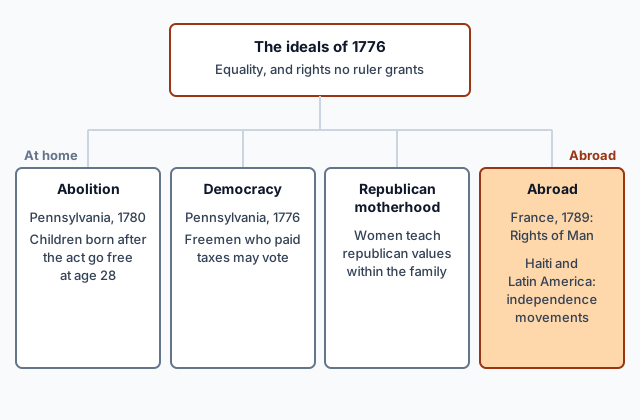
In short. The Revolution's ideals made inequality harder to ignore, so some Americans called for ending slavery and for greater political democracy, republican motherhood gave women a new place in political culture, and the ideals of 1776 reverberated in France, Haiti and Latin America.
- Pennsylvania's 1780 act ended slavery gradually: children born after it served until age 28 and then went free, while people already enslaved stayed enslaved if their owners registered them.
- Pennsylvania's 1776 constitution gave the vote to freemen who paid taxes, and republican motherhood called on women to teach republican values within the family.
- France's 1789 declaration that "Men are born and remain free and equal in rights" echoes the claim of 1776, and the Revolution also inspired independence movements in Haiti and Latin America.
Part 2 Learn it Revolutionary ideals at home and abroad
2a. Calls to end slavery
The Revolution's own words made inequality harder to ignore. If "all men are created equal," as the Declaration of Independence said, what about the people held in slavery? During and after the war, an increased awareness of inequalities in society moved some individuals and groups to call for the abolition of slavery, its legal end.
Pennsylvania passed An Act for the Gradual Abolition of Slavery on March 1, 1780. Gradual abolition ends slavery over time instead of all at once. Under the act, children born in the state after it passed would not be slaves for life. Each would serve the person who would otherwise have owned them until age 28, and then go free. People already enslaved stayed enslaved if their owners registered them by the coming November. And the act still let owners from other states reclaim enslaved people who escaped into Pennsylvania.
So the act is evidence of two things at once: that revolutionary ideals moved lawmakers to act against slavery, and that they acted slowly and with limits.
Sources: Declaration of Independence (National Archives); Pennsylvania gradual abolition act, 1780 (Avalon Project).
Quick check · Multiple choice
A child was born in Pennsylvania in 1781 to an enslaved mother. Under the 1780 act, what was the child's status?
2b. Calls for greater political democracy
The same awareness of inequality led some Americans to call for greater political democracy: more people taking part in choosing their government. Pennsylvania's constitution of September 28, 1776 is one example. Section 6 reads:
An elector is a voter. Under this section a free man who paid taxes could vote, with no land required, and sons of landowners could vote without paying taxes. Members of the assembly were "chosen annually by ballot," and none could serve "more than four years in seven," so offices would change hands often.
Read the limits too. The vote was for freemen of twenty-one and older who had lived in the state a full year. A wider vote was still not a vote for everyone.
Quick check · Sort it
Each card is a rule from Pennsylvania's 1776 constitution. Tap a card, then what it does.
Widens who takes part
Limits who takes part
2c. Republican motherhood
Women took part in the Revolution. Topic 3.3 showed women mobilizing in large numbers to give financial and material support to the Patriot movement. That participation, Enlightenment ideas, and women's own appeals for wider roles all fed a new ideal.
Republican motherhood called on women to teach republican values within the family. A republic needs citizens raised to value it, and mothers would raise them. The ideal gained popularity and granted women a new importance in American political culture.
Notice where that importance sat. The ideal gave women a political task inside the home, raising good citizens, rather than a place in government. It is a change in how Americans thought about women's role, not a change in who held office.
Quick check · Fill the statement
Complete the definition.
The ideal of republican motherhood called on women to teach within the , and it granted women a new importance in American .
2d. Echoes abroad
The American Revolution and the ideals of the Declaration of Independence reverberated in France, Haiti and Latin America, inspiring later independence movements.
France's National Assembly approved the Declaration of the Rights of Man on August 26, 1789. Read it beside 1776. The Declaration of Independence says "all men are created equal" and that people are "endowed by their Creator with certain unalienable Rights." The French declaration's first article says "Men are born and remain free and equal in rights." Its opening speaks of "the natural, unalienable, and sacred rights of man." Where 1776 rests government on "the consent of the governed," 1789 says "The principle of all sovereignty resides essentially in the nation." Sovereignty is the final authority to govern.
An echo is not a copy. The French wrote their own declaration for their own revolution, and its wording differs. What the two share are claims: people are equal in rights, those rights come before any government, and power comes from the people.
In Haiti and across Latin America, the American example also helped inspire later movements for independence from European empires.
Sources: Declaration of Independence (National Archives); Declaration of the Rights of Man, 1789 (Avalon Project).
Quick check · Match
Match each claim from France's 1789 declaration to the American text of 1776 that makes a similar claim.
Part 3 Watch it done Find the claim in Pennsylvania's 1780 act
Watch each step, then do the last one yourself.
Section 1 of Pennsylvania's 1780 act opens: "WHEN we contemplate our abhorrence of that condition to which the arms and tyranny of Great Britain were exerted to reduce us" and goes on to say that "we conceive that it is our duty, and we rejoice that it is in our power to extend a portion of that freedom to others, which hath been extended to us." Identify the act's claim and describe the argument it makes for it.
Predict first
Before the steps, what do you think the act claims?
Step 1 · Find the claim
A claim is the point a source argues for. In a law it is usually the action the law justifies. Here the lawmakers say what they must do: it is "our duty" to extend freedom to others.
Why this step?
Why start with what the authors say they should do?
Everything else in the passage is there to support that point. Once you have the claim, you can sort the rest into reasons, and describing an argument means saying how those reasons support the claim.
Step 2 · Find the reasons
The lawmakers begin with their own experience: "the arms and tyranny of Great Britain" had tried to reduce them to a condition they hated, and they had been freed from it. That experience is where the argument starts; the last step is to say how it leads to the duty.
Your step · Decide and justify
Finish it. Which best describes the argument Section 1 makes for its claim?
Which words from the act best support your answer?
Part 4 Try it Equal in rights, in 1776 and after
In July 1776 the Declaration of Independence said "all men are created equal." Claims like that were made for all men while slavery stood and voting was limited. Later Americans and others abroad picked these claims up and used them: Pennsylvania's lawmakers in 1780, and France's National Assembly in 1789.
Sources: Virginia Declaration of Rights (Avalon Project); Declaration of Independence (National Archives); Declaration of the Rights of Man (Avalon Project).
Try it · Select all
Which two passages make a claim about equality among people? Select two.
Select 2 answers, then check.
Try it · Spot the error
A student describes the argument of France's 1789 declaration. Which line is the first to go wrong?
Part 5 Explain it Write it like a document-based answer
Nothing you type leaves this page. Check your answer against the model and each scoring point.
Free-response practice · Question 1 style
A short practice in the shape of the document-based question: three documents instead of seven, and a thesis with one body paragraph instead of a full essay.
Evaluate the extent to which the ideals of the American Revolution changed American society between 1776 and 1780.
Document 1. Declaration of Independence, July 4, 1776: "all men are created equal" and governments derive "their just powers from the consent of the governed."
Document 2. Constitution of Pennsylvania, September 28, 1776, Section 6: "Every freemen of the full age of twenty-one Years, having resided in this state for the space of one whole Year next before the day of election for representatives, and paid public taxes during that time, shall enjoy the right of an elector" (spelling as printed)
Document 3. Pennsylvania, An Act for the Gradual Abolition of Slavery, March 1, 1780: "we conceive that it is our duty, and we rejoice that it is in our power to extend a portion of that freedom to others, which hath been extended to us"
Write a thesis, one sentence of historical context, and one paragraph that uses at least two documents and explains the purpose, audience, point of view or situation of one of them.
Model answer
Thesis: The Revolution's ideals changed American society in real but limited ways between 1776 and 1780, widening the vote and starting the end of slavery in some places while leaving most inequalities in place.
Context: Enlightenment ideas about natural rights and the war against Britain led Americans to claim equality for "all men," which made the gap between that claim and slavery and limited voting harder to ignore.
In 1776 the Declaration claimed that "all men are created equal" (Document 1), and the same year Pennsylvania gave the vote to any freeman who "paid public taxes" (Document 2), so a man did not need land to vote there. In 1780 Pennsylvania's lawmakers said it was "our duty" to extend freedom to others (Document 3). They wrote while still at war with Britain, to justify the law to Pennsylvanians by tying it to their own fight against tyranny, which explains why the act speaks of freedom "extended to us." Yet the act made children born after it wait until age 28 for freedom, it left registered slaves enslaved, and the vote stayed with freemen. The ideals started change; they did not finish it.
Score your own answer. This is a self-check, not a grade. Tick each point your answer makes.
Part 6 Check yourself Two declarations
The case questions use the two excerpts. The others mix the ideas from the whole lesson.
One declaration from Philadelphia in 1776 and one from Paris in 1789. Sources: Declaration of Independence (National Archives); Declaration of the Rights of Man (Avalon Project).
| Document | Excerpt |
|---|---|
| Declaration of Independence, July 4, 1776 | "all men are created equal" and they are "endowed by their Creator with certain unalienable Rights" |
| Declaration of the Rights of Man, August 26, 1789 | "Men are born and remain free and equal in rights." The declaration sets out "the natural, unalienable, and sacred rights of man" |
Case question 1 · Multiple choice
Which claim do the two excerpts share?
Case question 2 · Multiple choice
What do the two excerpts, read together, best show about the American Revolution?
The rest stand on their own and do not use the case.
Check yourself · Put it in order
Put these documents in the order they were made, earliest first.
Check yourself · Decide and justify
A writer in the 1780s argues that a mother who teaches her sons to love liberty serves the new republic. Is this an example of the ideal of republican motherhood?
Which reason best supports your answer?
Part 7 Keep it Bring back earlier ideas
This lesson stands on how the Patriots won the war, from Topic 3.5, and the ideals of 1776 from Topic 3.4.
Bring it back · Multiple choice
Which statement best explains how the Patriot cause succeeded despite Britain's apparently overwhelming military and financial advantages?
From 3.4 Philosophical Foundations of the American Revolution · Select all
Which two phrases from the Declaration of Independence call on God to stand behind the signers' cause, rather than saying where rights come from? Select two.
Select 2 answers, then check.
In three lines
- Revolutionary ideals moved some Americans to call for abolition; Pennsylvania's 1780 act ended slavery gradually and with limits.
- Calls for greater democracy widened the vote in places, and republican motherhood gave women a new role in political culture through the family.
- The ideals of 1776 reverberated in France, Haiti and Latin America, inspiring later independence movements.
Exam strategy for this topic
- Section I Part A, Multiple Choice: 55 questions in 55 minutes.
- Section I Part B, Short Answer: 3 questions in 40 minutes.
- Section II, Document-Based Question and Long Essay: 2 questions in 100 minutes.
- This lesson's Explain it is shaped like free-response question 1, Document-based.
When a question asks how the Revolution affected society, name a change and its limit in the same breath, such as gradual abolition in Pennsylvania or a vote widened only to taxpaying freemen.
Questions students ask
Did the American Revolution end slavery?
No. It moved some Americans to call for abolition, and Pennsylvania passed a gradual abolition act in 1780, but that act freed children born after it only at age 28, and people already enslaved stayed enslaved if their owners registered them by the coming November.
What was republican motherhood?
An ideal that called on women to teach republican values within the family. It grew out of women's part in the Revolution, Enlightenment ideas and women's own appeals, and it granted women a new importance in political culture.
Did the Revolution affect other countries?
Yes. Its ideals reverberated in France, Haiti and Latin America and inspired later independence movements. France's Declaration of the Rights of Man of 1789 makes similar claims about equal and unalienable rights.
Why does one quotation say "Every freemen"?
Every excerpt is copied exactly as the archive prints it, mistakes included, so you can check it against the source linked beside it.
Where can I read these documents in full?
Each excerpt links to its full text at the Avalon Project at Yale Law School or the National Archives, the primary-source collections this lesson was checked against.
Course alignment, for teachers
AP U.S. History topic 3.6, Unit 3: Period 3: 1754–1800.
- Skill 3.A: Identify and describe a claim and/or argument in a text-based or non-text-based source.
This lesson maps all 3 essential knowledge statements of the topic, and the 2 learning objectives with none of their own, to the part that teaches each one: 5 are checked by a scored question. The map is in the lesson file.