Unit 3 · Topic 3.7 · about 30 minutes · 7 parts · 12 scored checks, 4 of them multiple choice, plus 1 from earlier lessons
AP U.S. History 3.7: The Articles of Confederation
Unit 3: 10 to 17% of the multiple-choice section
What you'll be able to do
- Explain how different forms of government developed and changed as a result of the Revolutionary Period, and identify the evidence the period's constitutions, reports and resolutions use to support their arguments.
Key vocabulary
| Term | What it means | The exam trap |
|---|---|---|
| Property qualification | A rule that a person must own a set amount of property to vote or hold office. | It measures wealth, not where a person lived or how long; a residence rule is a different test. |
| Legislative branch | The part of a government that makes laws, the elected assembly or assemblies. | In New Jersey the legislature chose the governor, so do not assume voters elected every executive. |
| Articles of Confederation | The first plan of government for the United States, agreed to in 1777 and in force from 1781, uniting sovereign states under a limited Congress. | It is not the Constitution of 1787, which replaced it. |
| Confederation | A union of states that each keep their own sovereignty and grant only limited powers to a central government. | The central government in a confederation depends on the states, not the other way around. |
| Northwest Ordinance | The 1787 law of the Confederation Congress that organized the territory northwest of the Ohio River, set a path to statehood and banned slavery there. | It applied to the Northwest Territory only, not to lands south of the Ohio River. |
 Tap to open the picture full size
Part 1 Think first One state, one vote?
Commit to a guess first. Being wrong now makes the right idea stick better.
Predict first
In November 1777 Congress agreed to the Articles of Confederation, the first plan to unite the independent states under one government. Some states had far more people than others. Guess before you read on: how did the Articles decide each state's votes in Congress?
In short. After independence, many state constitutions gave most power to the legislature and kept property qualifications, and the Articles of Confederation united the states under a central government too limited to handle trade, money and disputes, which led to calls for a stronger one, though its Congress did pass the Northwest Ordinance.
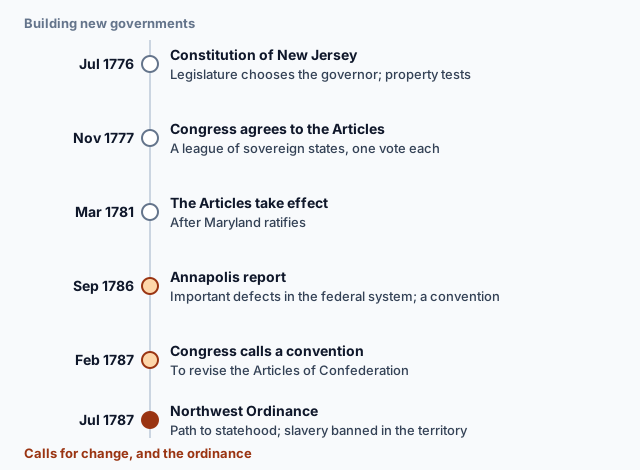
- New Jersey's 1776 constitution had the legislature choose the governor and required voters to be worth fifty pounds.
- Under the Articles each state kept its sovereignty and had one vote, the states laid the taxes, and changing the Articles needed every state.
- The Northwest Ordinance of 1787 set a path to statehood, encouraged schools, protected property and banned slavery in the Northwest Territory.
Part 2 Learn it New governments after independence
2a. State constitutions
After declaring independence the states wrote new constitutions. Many placed most power in the legislative branch, the elected lawmakers, and kept property qualifications, rules that a person must own a certain amount to vote or hold office. Together these limited both concentrated power and what leaders saw as too much popular influence.
New Jersey's constitution of July 2, 1776 shows both. Its lawmakers chose the governor: "That the Council and Assembly jointly, at their first meeting after each annual election, shall, by a majority of votes, elect some fit person within the Colony, to be Governor for one year." The vote went to "all inhabitants of this Colony, of full age, who are worth fifty pounds proclamation money, clear estate in the same." A member of the Assembly had to be "worth five hundred pounds proclamation money, in real and personal estate," and a member of the Council "worth at least one thousand pounds proclamation money, of real and personal estate." The richer the office, the higher the test.
Pennsylvania's constitution of September 28, 1776, whose voting rule Topic 3.6 read, states the principle directly: "The supreme legislative power shall be vested in a house of representatives of the freemen of the commonwealth or state of Pennsylvania."
Sources: Constitution of New Jersey, 1776 (Avalon Project); Constitution of Pennsylvania, 1776 (Avalon Project).
Quick check · Sort it
Each card is a rule from a 1776 state constitution. Tap a card, then the bin for what it shows.
Power placed in the legislature
A property qualification
2b. The Articles: a league of states
Congress adopted the Articles of Confederation on November 15, 1777, and they took effect on March 1, 1781, when Maryland ratified them. They unified the newly independent states under a central government with limited power.
Article II sets the terms: "Each state retains its sovereignty, freedom, and independence, and every power, jurisdiction, and right, which is not by this Confederation expressly delegated to the United States, in Congress assembled." Article III calls the union "a firm league of friendship." A confederation is a union of states that keep their own sovereignty.
The government was one house, a Congress, where "each State shall have one vote." The biggest decisions, such as war, treaties, coining or borrowing money and raising forces, could not be made "unless nine States assent to the same." Changing the Articles was harder still: an amendment had to be agreed in Congress and "be afterwards confirmed by the legislatures of every State."
Sources: Articles of Confederation (National Archives); Articles of Confederation (Avalon Project).
Quick check · Multiple choice
Under the Articles, a proposed change passes Congress and is approved by twelve of the thirteen state legislatures. The thirteenth votes no. What happens?
2c. Troubles, and calls for a stronger government
Limited power soon meant trouble. Congress could decide what the common treasury needed, but under Article VIII "The taxes for paying that proportion shall be laid and levied by the authority and direction of the legislatures of the several States." The National Archives sums up the result: the central government could not tax, had too little power to regulate commerce, worked with a depleted treasury, and had little power to settle quarrels between states.
After the Revolution, difficulties over international trade, finances, interstate commerce, foreign relations and internal unrest led to calls for a stronger central government. In September 1786 commissioners from five states met at Annapolis, Maryland, sent "to take into consideration the trade and Commerce of the United States." They went further. Pointing to "the embarrassments which characterize the present State of our national affairs, foreign and domestic," they asked the states to send delegates to Philadelphia the next May to find ways "to render the constitution of the Federal Government adequate to the exigencies of the Union." Exigencies are urgent needs.
Sources: Articles of Confederation (Avalon Project); Articles of Confederation (National Archives); Annapolis report, 1786 (Avalon Project).
Quick check · Match
Match each feature of the Articles of Confederation to the problem it caused.
2d. The Northwest Ordinance
Not everything failed. As settlers moved west in the 1780s, the Confederation Congress, the one-house legislature under the Articles, adopted the Northwest Ordinance on July 13, 1787. It created a government for the territory northwest of the Ohio River and a method for admitting new states. The territory would form "not less than three nor more than five States." Once one had sixty thousand free inhabitants, it would join "on an equal footing with the original States in all respects whatever." New states would be equals, not colonies.
The ordinance also set out rights and rules. On education: "Religion, morality, and knowledge, being necessary to good government and the happiness of mankind, schools and the means of education shall forever be encouraged." On property: "No man shall be deprived of his liberty or property, but by the judgment of his peers or the law of the land." On slavery: "There shall be neither slavery nor involuntary servitude in the said territory." The same article let owners in the original states reclaim people who escaped into the territory.
Sources: Northwest Ordinance (National Archives); Northwest Ordinance (Avalon Project).
Quick check · Fill the statement
Complete the notes on the Northwest Ordinance of 1787.
The ordinance set out a way to from the territory, said that schools shall forever be , and banned in the territory.
Part 3 Watch it done Find the evidence in the Annapolis report
Watch each step, then do the last one yourself.
On September 14, 1786, commissioners at Annapolis reported to their state legislatures: "That there are important defects in the system of the Federal Government is acknowledged by the Acts of all those States, which have concurred in the present Meeting." Identify the evidence the report uses to support its claim that the federal system has defects.
Predict first
Before the steps, what kind of evidence do you expect a report like this to give?
Step 1 · Separate the claim from the support
The claim is what the report wants readers to accept: there are "important defects in the system of the Federal Government." The rest of the sentence says why readers should accept it.
Why this step?
Why not take a report's claim as proof on its own?
A claim is only what a source wants you to believe. The evidence is what it offers so that you will, and naming the evidence is how you judge whether the claim is well supported.
Step 2 · Check what the report leaves out
Later in the report the commissioners write: "Your Commissioners decline an enumeration of those national circumstances" behind their opinion. An enumeration is a list. They say the facts had often been in public discussion, so they do not set them out.
Your step · Decide and justify
Finish the last step yourself. What evidence does the report use to support its claim of defects?
Which words from the report name the evidence it uses?
Part 4 Try it Congress answers
Congress answered on February 21, 1787. Its resolution says that "experience hath evinced that there are defects in the present Confederation." Evinced means shown. It notes that several states, "particularly the State of New York by express instructions to their delegates in Congress," had suggested a convention. Congress then called one to meet at Philadelphia in May "for the sole and express purpose of revising the Articles of Confederation." That convention is Topic 3.8.
Source: Report of Proceedings in Congress, 1787 (Avalon Project).
Try it · Multiple choice
What evidence does Congress's resolution of February 21, 1787 give for calling a convention?
Now read a student's paragraph that uses the Articles of Confederation as evidence. Check each line against the articles quoted in this lesson.
Try it · Spot the error
A student uses the Articles of Confederation as evidence that the central government had limited power. Which line is the first to go wrong?
Part 5 Explain it Write it like a document-based answer
Nothing you type leaves this page. Check your answer against the model and each scoring point.
Free-response practice · Question 1 style
A short practice in the shape of the document-based question: three documents instead of seven, and a thesis with one body paragraph instead of a full essay.
Evaluate the extent to which the Articles of Confederation created an effective national government between 1781 and 1787.
Document 1. Articles of Confederation, agreed to by Congress in 1777 and in force from March 1, 1781, Article II: "Each state retains its sovereignty, freedom, and independence, and every power, jurisdiction, and right, which is not by this Confederation expressly delegated to the United States, in Congress assembled."
Document 2. Report of the commissioners at Annapolis to their state legislatures, September 14, 1786: "That there are important defects in the system of the Federal Government is acknowledged by the Acts of all those States, which have concurred in the present Meeting"
Document 3. Northwest Ordinance, adopted by the Confederation Congress, July 13, 1787: new states would join "on an equal footing with the original States in all respects whatever," and "There shall be neither slavery nor involuntary servitude in the said territory."
Write a thesis, one sentence of historical context, and one paragraph that uses at least two documents and explains the purpose, audience, point of view or situation of one of them.
Model answer
Thesis: The Articles created a national government that was largely ineffective at raising money and managing trade, but it was effective in organizing the western lands.
Context: Having just fought a war against a distant, powerful government, the states built a central government with limited power and kept most authority for themselves.
Article II left each state its sovereignty and every power not "expressly delegated" (Document 1), so Congress had to rely on the states for taxes and could do little about commerce. By 1786 commissioners from five states reported "important defects in the system of the Federal Government" (Document 2). They were writing to their own legislatures to justify going beyond their trade mission and calling a convention, so they had reason to stress the defects, but the states that sent them had already admitted the problem. Yet in 1787 the same Congress passed the Northwest Ordinance, which promised new states an "equal footing" and banned slavery in the territory (Document 3). The Articles failed at money and trade but worked in the West.
Score your own answer. This is a self-check, not a grade. Tick each point your answer makes.
Part 6 Check yourself New Jersey's constitution of 1776
The case questions use the two sections. The others mix the ideas from the whole lesson.
Two sections of New Jersey's constitution of July 2, 1776. Source: Constitution of New Jersey (Avalon Project).
| Section | Text |
|---|---|
| Section IV | The vote goes to "all inhabitants of this Colony, of full age, who are worth fifty pounds proclamation money, clear estate in the same" |
| Section VII | "That the Council and Assembly jointly, at their first meeting after each annual election, shall, by a majority of votes, elect some fit person within the Colony, to be Governor for one year" |
Case question 1 · Multiple choice
Section IV is evidence for which feature of many new state constitutions?
Case question 2 · Multiple choice
What does Section VII show about where New Jersey placed power?
The rest stand on their own and do not use the case.
Check yourself · Put it in order
Put these events in the order they happened, earliest first.
Check yourself · Select all
Which two were provisions of the Northwest Ordinance? Select two.
Select 2 answers, then check.
Part 7 Keep it Bring back earlier ideas
This lesson stands on the ideals of Topic 3.4 and their effect on society in Topic 3.6.
Bring it back · Fill the statement
Complete the notes on Pennsylvania's 1780 act.
Under Pennsylvania's 1780 act, a child born after it to an enslaved mother would serve until age and then go free, while people already enslaved whose owners registered them .
From 3.4 Philosophical Foundations of the American Revolution · Match
Match each phrase from the documents of 1775 and 1776 to the work it does in the colonists' argument.
In three lines
- Many new state constitutions placed power in the legislature and kept property qualifications for voting and office.
- The Articles of Confederation created a league of sovereign states with a limited central government that could not tax.
- Troubles over trade, money and disputes led to calls for a stronger government, while the Northwest Ordinance organized the West and banned slavery there.
Exam strategy for this topic
- Section I Part A, Multiple Choice: 55 questions in 55 minutes.
- Section I Part B, Short Answer: 3 questions in 40 minutes.
- Section II, Document-Based Question and Long Essay: 2 questions in 100 minutes.
- This lesson's Explain it is shaped like free-response question 1, Document-based.
When a question asks about the Articles of Confederation, quote what they let Congress do and what they left to the states, and pair a weakness with the Northwest Ordinance as a success.
Questions students ask
Why was the central government under the Articles so weak?
The Articles left each state its sovereignty and every power not expressly delegated, gave each state one vote, left taxes to the state legislatures and needed every state to change them.
Did the new state constitutions let everyone vote?
No. Many kept property qualifications. New Jersey's 1776 constitution gave the vote to inhabitants worth fifty pounds, and set higher property tests for members of its Assembly and Council.
What did the Northwest Ordinance do?
It set up a government for the territory northwest of the Ohio River, a method for admitting three to five new states on an equal footing with the original ones, and rules that encouraged schools, protected property and banned slavery there.
Why does a quotation say "experience hath evinced"?
Every excerpt is copied exactly as the archive prints it. Hath is an old form of has, and evinced means shown.
Where can I read these documents in full?
Each excerpt links to its full text at the Avalon Project at Yale Law School or the National Archives, the primary-source collections this lesson was checked against.
Course alignment, for teachers
AP U.S. History topic 3.7, Unit 3: Period 3: 1754–1800.
- Skill 3.B: Identify the evidence used in a source to support an argument.
This lesson maps all 3 essential knowledge statements of the topic, and the one learning objective with none of its own, to the part that teaches each one: 4 are checked by a scored question. The map is in the lesson file.