Unit 7 · Topic 7.13 · about 30 minutes · 7 parts · 13 scored checks, 5 of them multiple choice
AP U.S. History 7.13: World War II: Military
Unit 7: 10 to 17% of the multiple-choice section
What you'll be able to do
- Explain the causes and effects of the victory of the United States and its allies over the Axis powers, and explain how pieces of evidence from the war relate to one another.
Key vocabulary
| Term | What it means | The exam trap |
|---|---|---|
| Fascism | A system of rule by a dictator over a nation organized for conquest, as in Nazi Germany. | Fascism names a kind of government, not a country; check which Axis power a document is describing. |
| Militarism | Government run by and for the armed forces, in which military goals come first. | A country with a large army is not militarist by that fact alone; ask who holds power. |
| D-Day | The Allied landing on the coast of Normandy, in German-occupied France, on June 6, 1944. | D-Day was in Europe; do not place it in the war against Japan. |
| Island-hopping | The American strategy in the Pacific of taking one island after another, each a step closer to Japan. | Island-hopping names a series of battles over years, not one battle; do not date it to a single landing. |
| Manhattan Project | The secret federal effort during World War II to build an atomic bomb. | The project's work began years before the bombs were used; keep its first steps and its last ones apart in time. |
| Holocaust | The Nazi persecution and mass murder of Europe's Jews. | When Americans learned the full extent of it matters; check the date of a document before you use it. |
 Tap to open the picture full size
Part 1 Think first What turned the tide?
Commit to a guess first. Being wrong now makes the right idea stick better.
Predict first
On June 6, 1944, the day of the D-Day invasion, General Dwight D. Eisenhower's order to the Allied troops declared: "The tide has turned!" The first atomic bomb would not be tested for more than a year. What do you think Eisenhower named as the reason the tide had turned?
In short. The United States and its allies defeated the Axis powers through Allied cooperation, scientific and technological advances, the work of servicemen and women, and campaigns such as D-Day and Pacific island-hopping, and the atomic bombs dropped on Japan in August 1945 hastened the war's end while starting a lasting debate about their morality.
- Americans saw the war as a fight for freedom and democracy against fascism and militarism, a view the revelations about Japanese atrocities, the Nazi camps and the Holocaust later reinforced.
- Military service opened opportunities to women and minorities for the war's duration, and it fed a debate over racial segregation in the armed forces that went on after 1945.
- Germany surrendered on May 7, 1945, before the first atomic test; Japan surrendered in September, weeks after the bombs fell on Hiroshima and Nagasaki.
Part 2 Learn it How the Allies won, and what it cost
2a. A fight for freedom against fascism
Americans viewed the war as a fight for the survival of freedom and democracy against fascism, rule by a dictator over a nation organized for conquest, and militarism, a government run by and for its armed forces. Eisenhower called the D-Day invasion "the Great Crusade, toward which we have striven these many months," and promised his troops "the elimination of Nazi tyranny over the oppressed peoples of Europe, and security for ourselves in a free world."
What Americans learned as the war ended reinforced that view. In April 1945 U.S. troops entered the Buchenwald concentration camp, where an Army photograph shows slave laborers of whom "many had died from malnutrition when U.S. troops of the 80th Division entered the camp." In July 1945 the Allies warned Japan that "stern justice shall be meted out to all war criminals, including those who have visited cruelties upon our prisoners." In November 1945, at the Nuremberg trial of Nazi leaders, Justice Jackson, the chief prosecutor for the United States, said the Nazi persecution of the Jews "moved rapidly to organized mass violence against them, physical isolation in ghettos, deportation, forced labor, mass starvation, and extermination." That murder of Europe's Jews is the Holocaust.
Sources: Eisenhower's Order of the Day (National Archives); Pictures of World War II (National Archives); Potsdam Conference documents (Avalon Project); Nuremberg Trial Proceedings, November 21, 1945 (Avalon Project).
Quick check · Sort it
Each card is a phrase from a document of 1944 or 1945. Tap a card, then say whether it names what the Allies fought for or what they fought against.
What they fought for
What they fought against
2b. Who served, and the fight over segregation
Military service gave women and minorities chances to improve their positions, mostly for the war's duration, and it raised hard questions about racial segregation. The National Archives notes that during the war the Army became the nation's largest minority employer. More than one million African American men were inducted, and with thousands of Black women they served in all branches and every theater. Women served in uniform: the Women's Auxiliary Army Corps became the Women's Army Corps in July 1943, and Army nurses served overseas. Service could bring training, as for a Black member of the Women's Army Corps photographed in 1944 as a "laboratory technician trainee."
They served in a military that kept Black and white troops in separate units, where, the National Archives says, they "experienced continuing discrimination and segregation." How could a military fighting for democracy segregate its own people? The debate outlasted the war. On July 26, 1948, President Harry Truman ordered that "there shall be equality of treatment and opportunity for all persons in the armed services without regard to race, color, religion or national origin." The military resisted the order, and almost all of it was integrated only by the end of the Korean War.
Sources: Executive Order 9981 (National Archives); Pictures of African Americans During World War II (National Archives).
Quick check · Decide and justify
Did service in World War II settle the debate over racial segregation in the armed forces?
Which evidence best supports your answer?
2c. Cooperation, science and campaigns
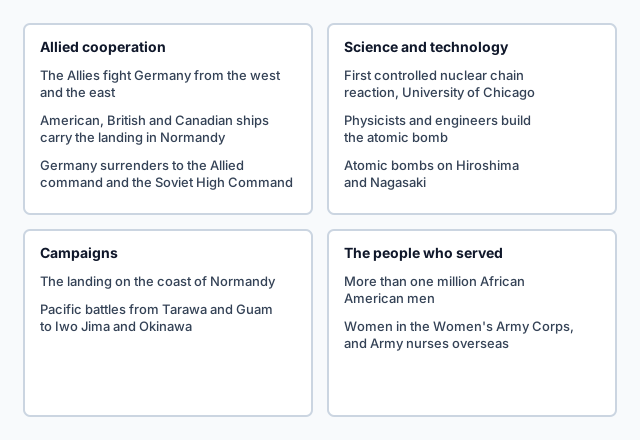
The Allies won through Allied cooperation, scientific and technological advances, the contributions of servicemen and women, and campaigns such as Pacific island-hopping and the D-Day invasion.
Cooperation was formal from early on. On January 1, 1942, 26 nations joined in the Declaration by the United Nations, pledging to continue their joint war effort and not to make peace separately. Eisenhower, an American general, commanded the D-Day landing on the coast of Normandy on June 6, 1944, carried by more than 4,000 American, British and Canadian ships. The Soviet Union fought Germany from the east, and on May 7, 1945, Germany surrendered to Eisenhower's command "and simultaneously to the Soviet High Command."
Science mattered as much. On December 2, 1942, physicists led by Enrico Fermi at the University of Chicago produced the first controlled, self-sustaining nuclear chain reaction. It was a step in the Manhattan Project, the government's secret effort to build an atomic bomb.
In the Pacific, American forces used island-hopping, taking one island after another, each a step closer to Japan. Photographs in the National Archives trace the path: Marines storming Tarawa in the Gilbert Islands in November 1943, troops landing on Guam in July 1944, Marines on Iwo Jima on February 19, 1945, and the fighting on Okinawa in 1945.
Sources: United Nations Charter (National Archives); Eisenhower's Order of the Day (National Archives); Surrender of Germany (National Archives); Manhattan Project Notebook (National Archives); Pictures of World War II (National Archives).
Quick check · Put it in order
Put these events in the order they happened, earliest first.
2d. The atomic bombs
The first atomic bomb was tested in New Mexico on July 16, 1945. Ten days later the United States, Britain and China called on Japan to surrender and warned: "The alternative for Japan is prompt and utter destruction." On August 6 and 9 the United States dropped atomic bombs on Hiroshima and Nagasaki. Within days Japan surrendered, and its envoys signed the formal surrender aboard the USS Missouri in Tokyo Bay on September 2, 1945.
The bombs hastened the end of the war. The Manhattan Engineer District, the Army command in charge of the bomb project, listed in 1946 the considerations behind its choice of targets. One was "to produce the greatest military effect on the Japanese people and thereby most effectively shorten the war." The same report counted more than 100,000 dead in the two cities.
The bombs also sparked a debate about the morality of using atomic weapons. One side argues that ending the war quickly justified them. The other argues that killing so many civilians with a single new weapon could not be justified, whatever it ended.
Sources: Manhattan Project Notebook (National Archives); Potsdam Conference documents (Avalon Project); Surrender of Japan (National Archives); Manhattan Engineer District report, 1946 (Avalon Project).
Quick check · Multiple choice
Which statement best describes the effects of the atomic bombs on the war?
Part 3 Watch it done Connect two documents from the summer of 1945
Watch each step, then do the last one yourself.
Document A is the warning the leaders of the United States, China and Great Britain issued to Japan on July 26, 1945: "The alternative for Japan is prompt and utter destruction." Document B is the Instrument of Surrender of September 2, 1945, in which Japan's envoys "hereby accept the provisions set forth in the declaration issued by the heads of the Governments of the United States, China, and Great Britain on 26 July 1945 at Potsdam." Explain the relationship between the two documents.
Predict first
Before the steps, what do you think connects the two documents?
Step 1 · Place each in time
Document A came on July 26, ten days after the first atomic test in New Mexico. Document B was signed aboard the USS Missouri in Tokyo Bay on September 2.
Why this step?
Why look at what happened between the two dates?
Two documents are often linked by the events between them. Here the atomic bombs fell on Hiroshima and Nagasaki on August 6 and 9, and Japan surrendered within days.
Step 2 · Name the authors and the audience
Document A comes from the leaders of three Allied governments and speaks to Japan. Document B is signed by Japan's envoys and accepted for the Allied Powers.
Your step · Decide and justify
Finish it. Which best describes the relationship between Document A and Document B?
Which evidence best supports your answer?
Part 4 Try it A wartime ideal after the war
In 1944 Eisenhower promised his troops "security for ourselves in a free world." Four years later, Truman's order on the armed forces opened with these words: "WHEREAS it is essential that there be maintained in the armed services of the United States the highest standards of democracy, with equality of treatment and opportunity for all those who serve in our country's defense" (capitals as printed). Read the two side by side.
Sources: Eisenhower's Order of the Day (National Archives); Executive Order 9981 (National Archives).
Try it · Multiple choice
How does the opening of the 1948 order relate to the war's stated aims?
Try it · Spot the error
A student writes a paragraph on why the Allies won. Which line is the first to go wrong?
Part 5 Explain it Write it like a document-based answer
Nothing you type leaves this page. Check your answer against the model and each scoring point.
Free-response practice · Question 1 style
A short practice in the shape of the document-based question: three documents instead of seven, and a thesis with one body paragraph instead of a full essay.
Evaluate the extent to which cooperation among the Allies was responsible for the victory over the Axis powers.
Document 1. General Dwight D. Eisenhower, Order of the Day to the Allied invasion force, June 6, 1944: "In company with our brave Allies and brothers-in-arms on other Fronts, you will bring about the destruction of the German war machine, the elimination of Nazi tyranny over the oppressed peoples of Europe, and security for ourselves in a free world." And: "Our Home Fronts have given us an overwhelming superiority in weapons and munitions of war, and placed at our disposal great reserves of trained fighting men."
Document 2. Manhattan Engineer District, the Army's atomic bomb command, report of 1946, listing one of the considerations behind its choice of targets in Japan: "to produce the greatest military effect on the Japanese people and thereby most effectively shorten the war."
Document 3. Instrument of Surrender, signed in Tokyo Bay, September 2, 1945, accepted by General Douglas MacArthur "for the United States, Republic of China, United Kingdom, and the Union of Soviet Socialist Republics, and in the interests of the other United Nations at war with Japan."
Write a thesis, one sentence of historical context, and one paragraph that uses at least two documents and explains the purpose, audience, point of view or situation of one of them.
Model answer
Thesis: Allied cooperation was responsible for the victory to a large extent, since the war in Europe was won by many nations fighting together, but in the war against Japan American science and industry also played a decisive part.
Context: after the attack on Pearl Harbor drew the United States into the war, 26 nations pledged in the Declaration by the United Nations of January 1942 to keep fighting together and not to make a separate peace.
Eisenhower told the D-Day troops they fought "In company with our brave Allies and brothers-in-arms on other Fronts" (Document 1). As the commander of the invasion writing to inspire his soldiers on its eve, he had every reason to stress unity, but the force itself, carried by American, British and Canadian ships, shows the cooperation was real. Even Eisenhower, though, credits the "Home Fronts" for "an overwhelming superiority in weapons," a sign that production mattered as much as alliance. Against Japan, the atomic bombs came from an American-led project, and one consideration in choosing their targets was to "most effectively shorten the war" (Document 2). Yet the surrender was accepted for four nations and "the other United Nations" (Document 3), so victory over Japan was still framed as an Allied victory.
Score your own answer. This is a self-check, not a grade. Tick each point your answer makes.
Part 6 Check yourself Counting the dead at Hiroshima and Nagasaki
The case questions use the table and the note under it. The others mix the ideas from the whole lesson.
In 1946 the Manhattan Engineer District, the Army command in charge of the atomic bomb project, published a study of their effects. Its chapter on casualties gives the District's best available figures, shown below. The same chapter warns: "The number of total casualties has been estimated at various times since the bombings with wide discrepancies." Among the reasons it gives, Japanese census records were incomplete, and "the great fires that raged in each city totally consumed many bodies." Sources: Manhattan Engineer District, Total Casualties, 1946 (Avalon Project); Avalon Project 20th century index.
| Estimate | Hiroshima | Nagasaki |
|---|---|---|
| Population before the raid | 255,000 | 195,000 |
| Dead | 66,000 | 39,000 |
| Injured | 69,000 | 25,000 |
| Total casualties | 135,000 | 64,000 |
Case question 1 · Multiple choice
Which conclusion does the table best support?
Case question 2 · Multiple choice
A National Archives page today says the two bombs led to "hundreds of thousands of deaths." The 1946 table counts 105,000 dead. Which explanation does the 1946 report itself best support?
The rest stand on their own and do not use the case.
Check yourself · Fill the statement
Complete the notes on who served.
More than one million African American men served, and women served in units such as the . Most of these openings lasted . The armed forces were still , and Truman's order for equal treatment in them came in .
Check yourself · Match
Match each part of the Allied war effort to what it was.
Part 7 Keep it Bring back earlier ideas
This lesson stands on the home front's mobilization from Topic 7.12 and the road to war from Topic 7.11.
Bring it back · Multiple choice
Which statement best describes the part the American economy played in World War II?
Bring it back · Fill the statement
Complete the sentences about the years before the United States entered the war.
In the 1930s many Americans worried about the rise of in Europe and Asia. Most still opposed taking military action against Germany and Japan until the attack on drew the United States into the war.
In three lines
- Americans fought the war as a fight for freedom and democracy, a view the revelations of Japanese atrocities, the Nazi camps and the Holocaust reinforced.
- Service opened opportunities to women and minorities for the war's duration and fed a debate over segregation that lasted past 1945.
- Cooperation, science, the people who served, D-Day and island-hopping won the war; the atomic bombs hastened its end and started a debate about their morality.
Exam strategy for this topic
- Section I Part A, Multiple Choice: 55 questions in 55 minutes.
- Section I Part B, Short Answer: 3 questions in 40 minutes.
- Section II, Document-Based Question and Long Essay: 2 questions in 100 minutes.
- This lesson's Explain it is shaped like free-response question 1, Document-based.
When a question pairs two documents, say what links them (a date, an event between them, or words in one that point to the other) before you say what either one proves.
Questions students ask
Did the atomic bomb win World War II?
No. Germany surrendered on May 7, 1945, before the first atomic test on July 16. The bombs dropped on Hiroshima and Nagasaki in August hastened Japan's surrender, which came within days.
What was island-hopping?
The American strategy in the Pacific of taking one island after another, each a step closer to Japan, from Tarawa in November 1943 to Iwo Jima and Okinawa in 1945.
Were the armed forces segregated in World War II?
Yes. More than one million African American men and thousands of Black women served, in every branch, but in a segregated military. Truman ordered equal treatment in the armed services in 1948, and the order met resistance from the military.
Why do counts of the dead at Hiroshima and Nagasaki differ?
The Army's own 1946 report said estimates had been made at various times with wide discrepancies, and it named reasons, among them incomplete census records and fires that consumed many bodies.
Where can I read these documents in full?
Each excerpt links to its full text at the National Archives or the Avalon Project at Yale Law School, the primary-source collections this lesson was checked against.
Course alignment, for teachers
AP U.S. History topic 7.13, Unit 7: Period 7: 1890–1945.
- Skill 6.C: Use historical reasoning to explain relationships among pieces of historical evidence.
This lesson maps all 3 essential knowledge statements of the topic, and the one learning objective with none of its own, to the part that teaches each one: 4 are checked by a scored question. The map is in the lesson file.