Unit 8 · Topic 8.8 · about 30 minutes · 7 parts · 13 scored checks, 4 of them multiple choice
AP U.S. History 8.8: The Vietnam War
Unit 8: 10 to 17% of the multiple-choice section
What you'll be able to do
- Explain the causes and effects of the Vietnam War: a nationalist war against French rule led by communists, the American commitment to contain communism and the war it became, and the debate over a president's power to wage war that it set off.
Key vocabulary
| Term | What it means | The exam trap |
|---|---|---|
| Containment | The American policy of stopping the spread of communism, by aid, alliances and, in Korea and Vietnam, war. | Containment's stated aim was to stop communism from spreading, not to roll it back where it already ruled, though some American actions, such as the Bay of Pigs, went further. |
| Viet Minh | The Vietnamese independence movement led by Ho Chi Minh, a communist, that fought France until 1954 and then governed the north. | The Viet Minh were both nationalist and communist-led; an answer that calls them only one of the two misses how the war began. |
| Geneva settlement | The 1954 agreements that ended France's war in Indochina, divided Vietnam at a provisional line and set elections for July 1956. | The line was meant to be temporary; the declaration said it was not a political or territorial boundary. |
| Tonkin Gulf Resolution | The 1964 resolution in which Congress approved the president's taking all necessary measures to repel attacks and prevent further aggression in Southeast Asia. | It was not a declaration of war, which is why the war in Vietnam is called undeclared. |
| War Powers Resolution | The 1973 law, passed over Nixon's veto, that requires a president to consult Congress, report within 48 hours of sending troops into hostilities, and end their use within sixty days (ninety to withdraw safely) without approval. | It sets deadlines after troops are sent; it does not forbid a president from sending them first. |
| Vietnamization | Nixon's policy of withdrawing American troops while South Vietnam's army took over the fighting. | Vietnamization reduced American troops; it did not end the war, which Nixon also widened into Cambodia. |
 Tap to open the picture full size
Part 1 Think first One resolution, two votes against
Commit to a guess first. Being wrong now makes the right idea stick better.
Predict first
In August 1964, after reports that North Vietnamese boats had attacked American destroyers in the Gulf of Tonkin, Congress passed a resolution backing the president. It let him, "as the President determines, to take all necessary steps, including the use of armed force" in Southeast Asia. How do you think Congress voted?
In short. The United States stepped into Vietnam as French rule ended, to keep a nationalist movement led by communists from winning, fought a long undeclared war there, and came out of it with new limits on a president's power to send troops into combat.
- Ho Chi Minh's Viet Minh fought France for independence; Washington paid much of France's cost, and the 1954 Geneva settlement divided Vietnam at a provisional line.
- Eisenhower backed Diem's South Vietnam, Kennedy sent advisers and aid, and Johnson sent ground troops in 1965; after Tet in 1968, Nixon withdrew troops while widening the war into Cambodia.
- The Paris Peace Agreement of 1973 brought American troops home, Saigon fell in 1975, and Congress passed the War Powers Resolution over Nixon's veto in 1973.
Part 2 Learn it How the United States went to war in Vietnam
2a. A nationalist war against France
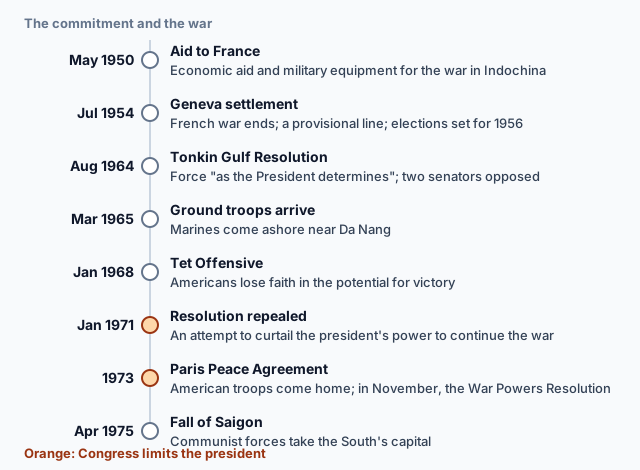
Vietnam was part of France's empire. Its strongest independence movement was the Viet Minh, led by Ho Chi Minh, a communist. That one fact is where decolonization and the Cold War met in Vietnam. On February 28, 1946, Ho Chi Minh telegraphed President Truman for support. His appeals went unanswered, and France returned to fight for its colony.
Once the Cold War hardened, Washington read the Viet Minh as communist first and nationalist second. On May 8, 1950, the Secretary of State announced that the United States "considers the situation to be such as to warrant its according economic aid and military equipment to the Associated States of Indochina and to France." By 1954 the United States was paying much of the cost of France's war, though not with troops.
In July 1954 a conference at Geneva, with China and the Soviet Union taking part, ended the war. Its final declaration said "the military demarcation line is provisional and should not in any way be interpreted as constituting a political or territorial boundary," and that "general elections shall be held in July 1956." Eisenhower's own framing was that "The United States has not been a belligerent in the war." Across Asia, both Cold War sides courted the new nations, and some, such as India and Indonesia, stayed nonaligned.
Sources: Remembering Vietnam (Prologue, National Archives); aid statement, 1950; Geneva final declaration; Eisenhower's statement (Avalon Project).
Quick check · Fill the statement
Complete the notes on Vietnam's war against France.
The Viet Minh, who fought France, were led by communists, but their war to end French rule was driven by . The Geneva declaration called the line dividing Vietnam , and it set elections to unite the country for July 1956.
2b. Containment in South Vietnam, 1954 to 1964
After Geneva, Eisenhower committed American support to the new anti-Communist government of South Vietnam under Ngo Dinh Diem. In 1956 Diem's government refused to hold the elections Geneva had called for, with American backing; American officials expected Ho Chi Minh to win them. A Southeast Asia Collective Defense Treaty, approved by the Senate in February 1955, pledged its members to meet Communist aggression in the region.
Kennedy escalated American financial and military aid, sending thousands of military advisers to train and support South Vietnam's army. Johnson took office in November 1963 and kept the commitment.
On August 5, 1964, Johnson explained the policy to Congress: "Our commitments in that area are well known to the Congress. They were first made in 1954 by President Eisenhower." He went on: "A threat to any nation in that region is a threat to all, and a threat to us." If one nation fell to communism, the reasoning ran, its neighbors would fall next, an idea often called the domino theory. Concern about expansionist Communist ideology, not a wish for a colony, drew the United States deeper in.
Sources: Remembering Vietnam (Prologue); Remembering Vietnam exhibit (National Archives); Johnson's message to Congress (Avalon Project).
Quick check · Multiple choice
Johnson told Congress in 1964 that "A threat to any nation in that region is a threat to all, and a threat to us." Which reasoning does that sentence express?
2c. The war, 1965 to 1975
In 1965 Johnson ordered an air campaign against North Vietnam and sent the first American ground troops. On March 8, 1965, Marines came ashore near Da Nang. "I am not going to lose Vietnam," Johnson said. "I am not going to be the President who saw Southeast Asia go the way China went." By 1968 more than half a million American troops were in Vietnam.
In January 1968 Communist forces attacked across South Vietnam in the Tet Offensive. They did not win, but Americans lost faith in the potential for victory, and the Johnson administration began to question its strategy. Richard Nixon, elected that year, pursued Vietnamization: withdrawing American troops while South Vietnam's army took over the fighting. He also widened the war. On April 30, 1970, he announced American involvement in Cambodia, which fanned antiwar protest at home.
The Paris Peace Agreement of 1973 brought American troops home. In the National Archives' words, "Peace is declared but not achieved." In April 1975 Communist forces took Saigon. More than 58,000 Americans died in the war, and approximately four million Vietnamese, Laotians and Cambodians were killed.
Sources: Remembering Vietnam exhibit; Remembering Vietnam (Prologue); Vietnam War: Diplomacy; casualty statistics (National Archives).
| Year | Deaths |
|---|---|
| 1964 | 216 |
| 1965 | 1,928 |
| 1966 | 6,350 |
| 1967 | 11,363 |
| 1968 | 16,899 |
| 1969 | 11,780 |
| 1970 | 6,173 |
| 1971 | 2,414 |
| 1972 | 759 |
| 1973 | 68 |
Quick check · Multiple choice
In the table, American deaths peak in 1968 and fall every year after 1969. Which development best explains the fall after 1969?
2d. Who decides on war?
The Constitution gives Congress the power to declare war and makes the president commander in chief. Vietnam tested that balance from the start.
On August 2, 1964, North Vietnamese torpedo boats attacked the destroyer USS Maddox in the Gulf of Tonkin. It was not publicly known then that the Maddox was gathering intelligence to assist South Vietnamese commando raids on the North. A second attack was reported on August 4, though the captain soon doubted it, and Defense Secretary McNamara did not pass his doubts to Johnson. Johnson presented the clashes to Congress as unprovoked aggression. On August 7 Congress, with only two senators opposed, declared the United States prepared, "as the President determines, to take all necessary steps, including the use of armed force." A 2002 National Security Agency report concluded the August 4 attack never happened. As contrary information surfaced, "many believed Congress had been conned."
In January 1971, after the Cambodian campaign, Congress repealed the resolution in an attempt to curtail Nixon's power to continue the war. Nixon fought on, claiming his authority as commander in chief. On November 7, 1973, Congress passed the War Powers Resolution over his veto. A president must consult Congress "in every possible instance" before sending troops into hostilities, report within 48 hours, and end their use within sixty days (ninety if needed to withdraw safely) unless Congress approves.
Sources: Tonkin Gulf Resolution (National Archives); War Powers Resolution (Avalon Project).
Quick check · Sort it
Each card describes an action from 1964 to 1973. Tap a card, then what it did to the president's power to wage war.
Widened or claimed the president's power
Limited the president's power
Part 3 Watch it done Explain why the United States stepped in
Watch each step, then do the last one yourself.
France left Vietnam after 1954, and American troops had not fought in its war. Explain why the United States took on the defense of South Vietnam anyway.
Predict first
Before the steps, what do you think drew the United States in?
Step 1 · Start with the situation
In July 1954 the Geneva conference divided Vietnam at a provisional line and set elections for July 1956. The north was held by the Viet Minh's communist government, and Eisenhower said the agreement contained features the United States did not like.
Why this step?
Why start with the situation instead of the decision?
A cause explains a change. To explain why a country acted, you first need to know what had just changed around it, here the end of French rule and a communist government in the north.
Step 2 · Look at what the United States had already done
Since 1950 Washington had sent aid to France and the Associated States of Indochina, saying national independence could not exist in any area dominated by Soviet imperialism. After Geneva it backed Diem's anti-Communist government in the south.
Your step · Decide and justify
Finish it. Why did the United States take on the defense of South Vietnam?
Which evidence best supports your answer?
Part 4 Try it Limits after a long war
Richard Nixon began his second term on January 20, 1973. He recalled that four years earlier the country had been "depressed by the prospect of seemingly endless war abroad," and he described a new limit on American commitments: "The time has passed when America will make every other nation's conflict our own, or make every other nation's future our responsibility, or presume to tell the people of other nations how to manage their own affairs." That November, Congress passed the War Powers Resolution over his veto.
Sources: Nixon's second inaugural address; War Powers Resolution (Avalon Project).
Try it · Put it in order
Put these events in the order they happened, earliest first.
Try it · Spot the error
A student explains the War Powers Resolution. Which line is the first to go wrong?
Part 5 Explain it Write it like a document-based answer
Nothing you type leaves this page. Check your answer against the model and each scoring point.
Free-response practice · Question 1 style
A short practice in the shape of the document-based question: three documents instead of seven, and a thesis with one body paragraph instead of a full essay.
Evaluate the extent to which the Vietnam War changed the balance of power between the president and Congress over making war.
Document 1. President Lyndon Johnson, message to Congress, August 5, 1964, asking for a resolution of support: "Our commitments in that area are well known to the Congress. They were first made in 1954 by President Eisenhower." And: "A threat to any nation in that region is a threat to all, and a threat to us."
Document 2. Tonkin Gulf Resolution, passed August 7, 1964: the United States is prepared, "as the President determines, to take all necessary steps, including the use of armed force."
Document 3. War Powers Resolution, passed over the president's veto, November 7, 1973: "The President in every possible instance shall consult with Congress before introducing United States Armed Forces into hostilities."
Write a thesis, one sentence of historical context, and one paragraph that uses at least two documents and explains the purpose, audience, point of view or situation of one of them.
Model answer
Thesis: The Vietnam War shifted power over war first toward the president and then back toward Congress, though the 1973 limits still let a president send troops before Congress acted.
Context: after 1945 the United States committed itself to containing communism worldwide, and after the Geneva settlement of 1954 it took on the defense of South Vietnam as French rule ended.
In 1964 Johnson asked Congress to back him, presenting the commitment as old and settled, "first made in 1954 by President Eisenhower" (Document 1). His purpose was to win a vote, and he shaped the facts to get it: he presented the Gulf of Tonkin clashes as unprovoked aggression, when the public did not know the Maddox had been supporting South Vietnamese raids on the North. Congress agreed, letting the president act "as the President determines" (Document 2), with only two senators opposed. As contrary information surfaced and the war spread into Cambodia, Congress repealed that grant in 1971, and in 1973 it overrode a veto to require the president to "consult with Congress" before sending troops into hostilities (Document 3). The change was real but limited: the resolution sets deadlines after troops are sent rather than forbidding the president to send them.
Score your own answer. This is a self-check, not a grade. Tick each point your answer makes.
Part 6 Check yourself Two American readings of Geneva
The case questions use the two excerpts. The others mix the ideas from the whole lesson.
Both excerpts are American statements about the Geneva agreements, eleven months apart. Dulles spoke in public a year before the elections were due, as South Vietnam's government, with American backing, was moving to refuse them; read his prediction with that purpose in mind. Sources: Eisenhower, July 21, 1954; Secretary of State Dulles, June 28, 1955 (Avalon Project).
| Statement | Excerpt |
|---|---|
| President Eisenhower, July 21, 1954 | "The United States is actively pursuing discussions with other free nations with a view to the rapid organization of a collective defense in Southeast Asia in order to prevent further direct or indirect Communist aggression in that general area." |
| Secretary of State Dulles, news conference, June 28, 1955 | "We did not sign them, and the Government of Viet-Nam did not sign them and, indeed, protested against them." And: the United States believes that "if there are conditions of really free elections, there is no serious risk that the Communists would win." |
Case question 1 · Multiple choice
What do the two excerpts together show about the American position after Geneva?
Case question 2 · Select all
Which two points does Dulles make in his June 1955 statement? Select two.
Select 2 answers, then check.
The rest stand on their own and do not use the case.
Check yourself · Match
Match each requirement of the War Powers Resolution to what it does.
Check yourself · Fill the statement
Complete the explanation of the Tonkin Gulf Resolution.
After the clashes of August 1964, Congress declared the United States prepared to use armed force as the president determined. The resolution was not a , yet Johnson used it as the for widening the war in Vietnam.
Part 7 Keep it Bring back earlier ideas
This lesson stands on the arms debate of Topic 8.7 and the containment policy and Korean War of Topic 8.2.
Bring it back · Multiple choice
Before Vietnam, in which war did the United States fight to contain communism?
Bring it back · Fill the statement
Complete the sentences.
In 1961 President Eisenhower warned against the unwarranted influence of the . In the same years, Americans also argued over how many nuclear the country needed.
In three lines
- Vietnam's war began as the Viet Minh's nationalist fight against French rule, led by communists, which is why the United States read it as communist expansion.
- To contain communism, the United States backed South Vietnam and fought a major undeclared war from 1965 to 1973 that cost more than 58,000 American lives.
- The war set off a debate over presidential power that ended in the repeal of the Tonkin Gulf Resolution and the War Powers Resolution.
Exam strategy for this topic
- Section I Part A, Multiple Choice: 55 questions in 55 minutes.
- Section I Part B, Short Answer: 3 questions in 40 minutes.
- Section II, Document-Based Question and Long Essay: 2 questions in 100 minutes.
- This lesson's Explain it is shaped like free-response question 1, Document-based.
When a question asks you to explain the causes of the Vietnam War, give two kinds of cause, the end of French colonial rule and the American aim of containing communism, and connect them through the Viet Minh, a nationalist movement led by communists.
Questions students ask
Did Congress ever declare war on North Vietnam?
No. The Tonkin Gulf Resolution of 1964 let the president use armed force as he determined, and Johnson relied on it as the legal basis for the war. After Congress repealed it in 1971, Nixon claimed his authority as commander in chief. That is why the war is called undeclared.
How long was the American war in Vietnam, and how many died?
American aid began in 1950 and advisers came under Kennedy, but American ground troops fought from 1965 until the Paris Peace Agreement of 1973. Saigon fell in 1975. More than 58,000 Americans died, and approximately four million Vietnamese, Laotians and Cambodians were killed.
Why were the 1956 elections in Vietnam never held?
South Vietnam's government under Ngo Dinh Diem refused to hold them, and the United States supported that refusal. American officials expected Ho Chi Minh to win a nationwide vote. In public, Dulles said the United States favored elections under really free conditions; neither the United States nor South Vietnam had signed the Geneva agreements.
Did the second Tonkin Gulf attack really happen?
The National Archives notes that a 2002 National Security Agency report confirmed the attack of August 2 but concluded the attack of August 4 never happened. As contrary information surfaced, the resolution grew more controversial.
Does the War Powers Resolution still apply?
It remains the law Congress passed over Nixon's veto in 1973. It sets deadlines for reporting to Congress and for ending the use of troops without its approval.
Why do the documents write Viet-Nam with a hyphen?
Every excerpt is copied exactly as the archive prints it, and American documents of the 1950s often spelled the name that way.
Course alignment, for teachers
AP U.S. History topic 8.8, Unit 8: Period 8: 1945–1980.
- Skill 1.B: Explain a historical concept, development, or process.
This lesson maps all 3 essential knowledge statements of the topic, and the one learning objective with none of its own, to the part that teaches each one: 4 are checked by a scored question. The map is in the lesson file.