Unit 6 · Topic 6.6 · about 30 minutes · 7 parts · 13 scored checks, 5 of them multiple choice
AP U.S. History 6.6: The Rise of Industrial Capitalism
Unit 6: 10 to 17% of the multiple-choice section
What you'll be able to do
- Explain the socioeconomic continuities and changes associated with the growth of industrial capitalism from 1865 to 1898, and place each development, such as the Sherman Anti-Trust Act or the push for markets abroad, in the wider context of its time.
Key vocabulary
| Term | What it means | The exam trap |
|---|---|---|
| Industrial capitalism | An economy in which privately owned businesses use machines, factories and hired labor to produce goods on a large scale for profit. | Capitalism did not begin in the Gilded Age; what grew was the scale of industry and the size of firms. |
| Trust | An arrangement in which stockholders of several companies hand their shares to one board of trustees, which then runs all the companies together. | In this period a trust is a business combination, not a feeling of confidence or a bank account held for someone. |
| Holding company | A company that owns a controlling share of other companies and so directs them. | A holding company may make nothing itself; its power comes from what it owns. |
| Consolidation | Combining many businesses into fewer, larger ones under shared control. | Consolidation is about control of firms, not about a company simply growing larger on its own. |
| Contextualization | Placing a development in the bigger picture of its time: what came before it and what was happening around it. | Context must be tied to the argument; a list of unrelated events from the same years does not count. |
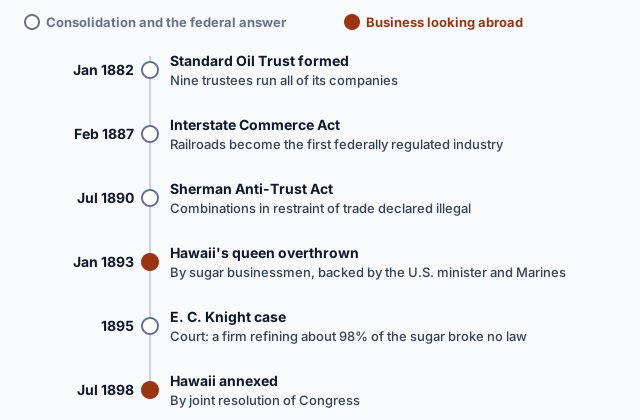 Tap to open the picture full size
Part 1 Think first One board, many companies
Commit to a guess first. Being wrong now makes the right idea stick better.
Predict first
On January 2, 1882, the stockholders of the Standard Oil companies placed all the Standard properties in the hands of a board of nine trustees. The trustees received all the profits of the companies and elected their directors and officers. What do you think this arrangement let Standard Oil do?
In short. After 1865 large-scale industry, new technology and pro-growth government policies drove rapid economic growth, and business leaders consolidated companies into trusts and holding companies that concentrated wealth, while businesses also looked abroad for markets and resources.
- Businesses used new financial and management structures, advances in marketing and a growing labor force to produce far more goods.
- Trusts such as the Standard Oil Trust of 1882 put many companies under one board; the Sherman Anti-Trust Act of 1890 outlawed combinations in restraint of trade, but the Supreme Court narrowed it in 1895.
- Businesses looked to the Pacific Rim, Asia and Latin America for markets and resources, as American sugar planters did in Hawaii.
Part 2 Learn it The rise of industrial capitalism
2a. Bigger production, new structures
After the Civil War, large-scale industrial production came with huge technological change, growing international communication networks and pro-growth government policies. Together they produced rapid economic growth and the merging of businesses into fewer, larger firms.
Government helped. The Pacific Railway Act of 1862 gave federal subsidies in land and loans to build a transcontinental railroad, and the last rails were laid on May 10, 1869. Technology moved fast: on January 27, 1880, Thomas Edison received his patent for an incandescent lamp, which opened the way to electric light in homes.
Businesses then redesigned how they raised money and how they were managed, advanced their marketing, and drew on a growing labor force to produce far more goods. Presidents treated this growth as national strength. In his inaugural address of March 4, 1889, Benjamin Harrison said: "Every new mine, furnace, and factory is an extension of the productive capacity of the State more real and valuable than added territory." He added, "I look hopefully to the continuance of our protective system," meaning tariffs on imports that shielded American industry. He also wanted links abroad: "We should encourage the establishment of American steamship lines. The exchanges of commerce demand stated, reliable, and rapid means of communication."
Sources: Pacific Railway Act (National Archives); Edison's patent (National Archives); Harrison's inaugural, 1889 (Avalon Project).
Quick check · Sort it
Each card is one force behind industrial growth after 1865. Tap a card, then the kind of force it is.
Pro-growth government policy
New technology
New ways of running and selling a business
2b. Trusts, holding companies and the Sherman Act
Many business leaders chased higher profits by consolidating: combining corporations into large trusts and holding companies. In a trust, stockholders of several companies hand their shares to one board of trustees. A holding company does a similar job by owning a controlling share of other companies. Either way, competing firms come under one control, and wealth gathers in fewer hands.
The Standard Oil Trust, formed in 1882, is the classic case. Its nine trustees ran all the component companies, so Standard Oil could function as a monopoly.
States had passed laws against trusts, but those laws reached only business inside a state's borders. On July 2, 1890, President Harrison signed the Sherman Anti-Trust Act. It declared that every combination "in restraint of trade or commerce among the several States, or with foreign nations, is hereby declared to be illegal," and it punished "Every person who shall monopolize, or attempt to monopolize."
The law was weaker in practice. In United States v. E. C. Knight Company (1895), the Supreme Court ruled that the American Sugar Refining Company had not broken it, even though the company controlled about 98 percent of the nation's sugar refining. The Court reasoned that controlling manufacture was not controlling trade.
Source: Sherman Anti-Trust Act, transcript and summary (National Archives).
Quick check · Multiple choice
Which statement best describes the effect of trusts like the Standard Oil Trust?
2c. Markets and resources beyond U.S. borders
Businesses also looked outside the country to gain more influence and control over markets and natural resources in the Pacific Rim, Asia and Latin America.
Presidents spoke for those interests. Harrison said in 1889: "Our citizens domiciled for purposes of trade in all countries and in many of the islands of the sea demand and will have our adequate care in their personal and commercial rights." He added, "The necessities of our Navy require convenient coaling stations and dock and harbor privileges." In 1897 William McKinley praised tariff deals that had opened "new and advantageous markets for our surplus agricultural and manufactured products" and called for "the opening up of new markets for the products of our country."
Hawaii shows how far business interests could reach. A trade agreement let Hawaiian sugar enter the U.S. market tax-free, and American sugar plantation owners came to dominate the islands' politics. When Queen Liliuokalani introduced a new constitution to restore her power and Hawaiian rights, a Committee of Safety of American businessmen and politicians with sugar interests moved against her. Backed by the U.S. minister to Hawaii, John Stevens, and Marines from the warship USS Boston, it overthrew her on January 17, 1893. The National Archives notes that the planters feared a U.S. tariff on sugar and wanted to protect Hawaii's free-trade status. The United States annexed Hawaii on July 7, 1898.
Sources: Harrison, 1889 and McKinley, 1897 (Avalon Project); Annexation of Hawaii (National Archives).
Quick check · Match
Match each piece of evidence to what it shows about business looking beyond U.S. borders.
2d. Putting a development in context
Contextualization means placing a development inside the bigger story of its time: what came before it, what was happening around it, and what it was answering.
Take one sentence from Grover Cleveland's second inaugural address, March 4, 1893: "The existence of immense aggregations of kindred enterprises and combinations of business interests formed for the purpose of limiting production and fixing prices is inconsistent with the fair field which ought to be open to every independent activity."
Read alone, it sounds like a general complaint. In context it says more. Trusts had dominated major industries for a decade, beginning with Standard Oil in 1882. Congress had passed the Sherman Anti-Trust Act less than three years earlier. Cleveland was saying that the problem the law aimed at was still there, and he asked that the federal government restrain combinations "To the extent that they can be reached and restrained by Federal power." That phrase admits a limit, and two years later the E. C. Knight ruling showed how real the limit was.
Source: Cleveland's second inaugural, 1893 (Avalon Project).
Quick check · Fill the statement
In 1893 President Grover Cleveland complained of combinations of business interests formed to limit production and fix prices. Complete a student's note that places his complaint in context.
Cleveland spoke after more than a decade in which had come to dominate major industries. Congress had already tried to answer them with the .
Part 3 Watch it done Place the Sherman Act in context
Watch each step, then do the last one yourself.
President Harrison signed the Sherman Anti-Trust Act on July 2, 1890. It declared every combination "in restraint of trade or commerce among the several States, or with foreign nations, is hereby declared to be illegal." Explain the broader context that led Congress to pass it.
Predict first
Before the steps, what do you think Congress was mostly reacting to?
Step 1 · Look at what came before
In 1882 the Standard Oil Trust put its companies under nine trustees. The National Archives notes that toward the end of the 1800s trusts came to dominate a number of major industries, destroying competition. Several states passed laws against them, but those laws reached only business inside one state.
Why this step?
Why does it matter that the state laws stopped at state lines?
Trusts like Standard Oil did business across many states. A problem bigger than any one state pushed the question to Congress, which holds the power to regulate commerce among the states.
Step 2 · Look at what Congress had already done
In 1887 the Interstate Commerce Act made railroads the first industry subject to federal regulation. Congress had already used its power over interstate commerce to police one industry before it turned to trusts across all of them.
Your step · Decide and justify
Finish it. Which broader context best explains why Congress passed the Sherman Act in 1890?
Which evidence best supports your answer?
Part 4 Try it A president on combinations
In his inaugural address of March 4, 1889, more than a year before the Sherman Act, Benjamin Harrison described the oath he took as a promise to the people. He said the president agrees to execute the laws so that "neither wealth, station, nor the power of combinations shall be able to evade their just penalties."
Try it · Multiple choice
Which development of the 1880s best explains why Harrison named the power of combinations in his oath of office?
Try it · Spot the error
A student writes a context paragraph on Harrison's 1889 promise. Which line is the first to go wrong?
Part 5 Explain it Write it like a document-based answer
Nothing you type leaves this page. Check your answer against the model and each scoring point.
Free-response practice · Question 1 style
A short practice in the shape of the document-based question: three documents instead of seven, and a thesis with one body paragraph instead of a full essay.
Evaluate the extent to which the federal government restrained business consolidation from 1889 to 1897.
Document 1. Benjamin Harrison, inaugural address, March 4, 1889: the president promises to execute the laws so that "neither wealth, station, nor the power of combinations shall be able to evade their just penalties."
Document 2. Sherman Anti-Trust Act, signed July 2, 1890, Section 1: every contract, combination or conspiracy "in restraint of trade or commerce among the several States, or with foreign nations, is hereby declared to be illegal."
Document 3. Grover Cleveland, second inaugural address, March 4, 1893: "The existence of immense aggregations of kindred enterprises and combinations of business interests formed for the purpose of limiting production and fixing prices is inconsistent with the fair field which ought to be open to every independent activity." And: "To the extent that they can be reached and restrained by Federal power the General Government should relieve our citizens from their interference and exactions."
Write a thesis, one sentence of historical context, and one paragraph that uses at least two documents and explains the purpose, audience, point of view or situation of one of them.
Model answer
Thesis: From 1889 to 1897 the federal government restrained business consolidation only to a limited extent: it declared combinations in restraint of interstate trade illegal, but presidents kept naming the same problem and the Supreme Court soon narrowed the law.
Context: after the Civil War, large-scale industry and new business structures let leaders such as the organizers of the Standard Oil Trust of 1882 put whole industries under one board, and state laws against trusts could not reach business that crossed state lines.
In 1889 Harrison promised that "the power of combinations" would not escape the law (Document 1), and in 1890 Congress declared combinations in restraint of interstate trade illegal (Document 2), a real change in federal power. Yet in 1893 Cleveland still described combinations that were "limiting production and fixing prices" (Document 3). Cleveland was returning to office after Harrison's term and spoke to the whole nation to set out his program, so he had reason to stress problems the last administration left unsolved; even so, his phrase "To the extent that they can be reached" concedes that federal power had limits. Two years later the E. C. Knight ruling proved those limits, holding that a company refining about 98 percent of the nation's sugar had not broken the law.
Score your own answer. This is a self-check, not a grade. Tick each point your answer makes.
Part 6 Check yourself Two presidents on combinations
The case questions use the two excerpts. The others mix the ideas from the whole lesson.
Both excerpts come from inaugural addresses, four years apart. McKinley is quoting the past platform of his own party, which he calls the party now restored to power. Sources: Cleveland, 1893; McKinley, 1897 (Avalon Project).
| Document | Excerpt |
|---|---|
| Grover Cleveland, second inaugural address, March 4, 1893 | Of "combinations of business interests formed for the purpose of limiting production and fixing prices": "nor should the people to be served lose the benefit of cheapness which usually results from wholesome competition" |
| William McKinley, first inaugural address, March 4, 1897 | His party's declaration of "opposition to all combinations of capital organized in trusts, or otherwise, to control arbitrarily the condition of trade among our citizens" |
Case question 1 · Multiple choice
Which development best explains why both presidents still addressed combinations in the 1890s?
Case question 2 · Multiple choice
Cleveland's excerpt worries that the people could lose the benefit of cheapness. Which argument about trusts does it most directly answer?
The rest stand on their own and do not use the case.
Check yourself · Put it in order
Put these events in the order they happened, earliest first.
Check yourself · Select all
Which two pieces of evidence show American business seeking markets or resources outside U.S. borders? Select two.
Select 2 answers, then check.
Part 7 Keep it Bring back earlier ideas
This lesson stands on the technological innovation of Topic 6.5 and the western railroads and markets of Topic 6.2.
Bring it back · Multiple choice
In the late 1800s a steel company adopts a new production process and buys iron mines in the Great Lakes region. Which development do these choices best illustrate?
Bring it back · Fill the statement
Read the situation, then complete the sentences.
Congress gives a railroad company land and loans to build a line to the Pacific. This is a government for transportation. Once the line is finished, towns grow up along it as new centers of .
In three lines
- Large-scale industry, technology and pro-growth policies such as railroad subsidies and tariffs drove rapid growth after 1865.
- Trusts and holding companies concentrated wealth; the Sherman Act of 1890 outlawed combinations in restraint of trade, but the E. C. Knight ruling of 1895 narrowed it.
- Businesses reached for markets and resources in the Pacific Rim, Asia and Latin America, as American sugar planters did in Hawaii.
Exam strategy for this topic
- Section I Part A, Multiple Choice: 55 questions in 55 minutes.
- Section I Part B, Short Answer: 3 questions in 40 minutes.
- Section II, Document-Based Question and Long Essay: 2 questions in 100 minutes.
- This lesson's Explain it is shaped like free-response question 1, Document-based.
When you contextualize, name a specific development from before or around the time, such as the Standard Oil Trust of 1882 or the state laws that stopped at state lines, and say in a sentence how it shaped the development you are explaining.
Questions students ask
What is the difference between a trust and a monopoly?
A trust is a way of organizing: stockholders of several companies hand their shares to one board. A monopoly is a result: one firm controls a market. The Standard Oil Trust's nine trustees ran all its companies, which let Standard Oil function as a monopoly.
Did the Sherman Anti-Trust Act work?
Only in part. It declared combinations in restraint of interstate and foreign trade illegal, but in 1895 the Supreme Court ruled in the E. C. Knight case that a company refining about 98 percent of the nation's sugar had not broken it, because controlling manufacture was not controlling trade.
Why did presidents care so much about tariffs?
A protective tariff taxes imports so that American goods face less foreign competition. Harrison in 1889 hoped for the continuance of the protective system, while Cleveland in 1893 took office with a party pledged to tariff reform. Tariffs were one of the government policies that shaped industrial growth.
Why is Hawaii in a lesson about business?
American sugar planters came to dominate Hawaii's politics, and in 1893 a group of American businessmen with sugar interests, backed by the U.S. minister and Marines from the USS Boston, overthrew the queen. They wanted to protect the islands' free-trade status in the U.S. market. It is a clear case of business seeking control over markets and resources in the Pacific Rim.
Where can I read these documents in full?
Each excerpt links to its full text at the National Archives or the Avalon Project at Yale Law School, the primary-source collections this lesson was checked against.
Course alignment, for teachers
AP U.S. History topic 6.6, Unit 6: Period 6: 1865–1898.
- Skill 4.B: Explain how a specific historical development or process is situated within a broader historical context.
This lesson maps all 4 essential knowledge statements of the topic, and the one learning objective with none of its own, to the part that teaches each one: 5 are checked by a scored question. The map is in the lesson file.