Unit 3 · Topic 3.9 · about 30 minutes · 7 parts · 13 scored checks, 4 of them multiple choice
AP U.S. History 3.9: The Constitution
Unit 3: 10 to 17% of the multiple-choice section
What you'll be able to do
- Explain the continuities and changes in the structure and functions of the government with the ratification of the Constitution, and connect the Constitution's design to the Articles of Confederation it replaced.
Key vocabulary
| Term | What it means | The exam trap |
|---|---|---|
| Federalism | The division of power between a national government and the state governments. | Federalism is about nation and states, not about the branches of the national government. |
| Separation of powers | The division of national power among the legislative, executive and judicial branches. | Separate branches still share some powers; read the text before saying a branch acts alone. |
| Checks and balances | The ways each branch can block or limit the others. | A check needs one branch acting on another; a power a branch uses on its own is not a check. |
| Limited government | A government that holds only the powers its constitution grants and must respect stated limits on them. | Limited describes what the government may do, not how strong or weak it is in practice. |
| Continuity and change | Comparing what stays the same and what is new across a turning point in history. | A strong answer names both, with evidence for each, instead of only one. |
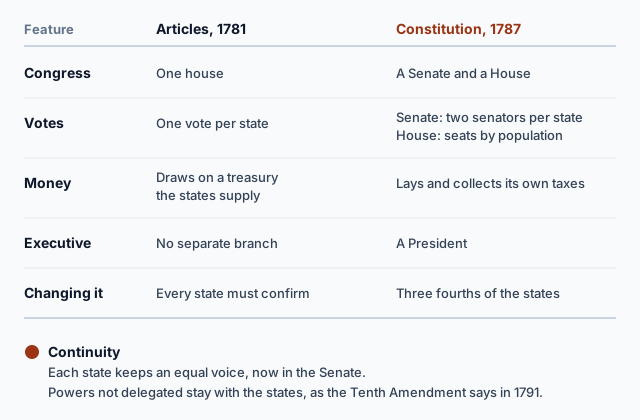 Tap to open the picture full size
Part 1 Think first A government that could not tax
Commit to a guess first. Being wrong now makes the right idea stick better.
Predict first
Under the Articles of Confederation, Congress could not tax. It paid its bills from "a common treasury, which shall be supplied by the several States," and by the mid-1780s it was trying to function with a depleted treasury. Suppose you are a delegate in Philadelphia in 1787. Which fix do you expect the convention to choose?
In short. The Constitution replaced the Articles of Confederation with a limited but dynamic central government that shares power with the states, which is federalism, and divides its own power among three branches that check one another.
- Change: Congress gained two houses, the power to tax and regulate commerce, and a President and federal courts beside it; amendments no longer needed every state.
- Continuity: the states kept their own governments and every power not delegated, and each state kept an equal voice in the Senate.
- The government was limited to the powers the Constitution grants, yet dynamic, since Congress may make laws necessary and proper to carry them out and the Constitution can be amended.
Part 2 Learn it The government the Constitution built
2a. What carried over from the Articles, and what changed
The Articles of Confederation, in force from 1781, set up a Congress of one house: "In determining questions in the United States in Congress assembled, each State shall have one vote." Congress could not tax. The old Congress chose one member to preside, but there was no executive branch. Changing the Articles required approval from Congress and then confirmation "by the legislatures of every State."
Historians look for continuity and change: what stays the same across a turning point, and what is new. The Constitution has both.
Continuity: the states remained governments of their own, keeping every power not given to the central government. In the Senate each state still had an equal voice: "The Senate of the United States shall be composed of two Senators from each State."
Change: Congress gained a second house, the House of Representatives, with seats by population. It gained powers the old Congress lacked, among them "To lay and collect Taxes, Duties, Imposts and Excises" and "To regulate Commerce with foreign Nations, and among the several States, and with the Indian Tribes." A President would hold "The executive Power," and federal courts "The judicial Power." An amendment would need three fourths of the states, not every one.
Sources: Articles of Confederation (Avalon Project); Articles of Confederation (National Archives); The Constitution (National Archives).
Quick check · Sort it
Each card is a feature of the government under the Constitution. Tap a card, then whether it continued from the Articles or changed.
Continuity from the Articles
Change from the Articles
2b. Federalism: power shared with the states
Federalism divides power between a national government and the states. Federalist No. 51, published on February 8, 1788 (the Avalon Project lists the author as Hamilton or Madison), described it this way: "In the compound republic of America, the power surrendered by the people is first divided between two distinct governments, and then the portion allotted to each subdivided among distinct and separate departments."
Where the two governments clash, the national government wins. The Constitution, federal laws and treaties "shall be the supreme Law of the Land." Some powers are taken from the states altogether: "No State shall enter into any Treaty, Alliance, or Confederation."
The rest stay with the states. Madison wrote in Federalist No. 45: "The powers delegated by the proposed Constitution to the federal government are few and defined. Those which are to remain in the State governments are numerous and indefinite." The Tenth Amendment of 1791 put that into the Constitution: powers not delegated "are reserved to the States respectively, or to the people."
Sources: Federalist No. 51 (Avalon Project); Federalist No. 45 (Avalon Project); The Constitution (National Archives); Bill of Rights (National Archives).
Quick check · Multiple choice
Madison wrote that the national government's powers are "few and defined" while the states' are "numerous and indefinite." Which feature of the Constitution best fits his claim?
2c. Three branches that check each other
The Constitution splits national power among three branches, each in its own article. "All legislative Powers herein granted shall be vested in a Congress of the United States, which shall consist of a Senate and House of Representatives." "The executive Power shall be vested in a President of the United States of America." "The judicial Power of the United States, shall be vested in one supreme Court, and in such inferior Courts as the Congress may from time to time ordain and establish." This is the separation of powers.
Each branch can also block the others, a system called checks and balances. The President may return a bill with objections, but "If after such Reconsideration two thirds of that House shall agree to pass the Bill," and two thirds of the other house agree, it becomes law anyway. The President makes treaties "by and with the Advice and Consent of the Senate, to make Treaties, provided two thirds of the Senators present concur." The House "shall have the sole Power of Impeachment," and "The Senate shall have the sole Power to try all Impeachments."
Federalist No. 51 explained why: "Ambition must be made to counteract ambition." Each branch would guard its own powers against the others.
Sources: The Constitution (National Archives); Federalist No. 51 (Avalon Project).
Quick check · Match
Match each power in the Constitution to the check it creates.
2d. Limited, but able to grow
The new government was limited. Congress holds the "legislative Powers herein granted," the ones the Constitution lists, not every power a government could claim. The First Amendment adds a direct limit: "Congress shall make no law respecting an establishment of religion, or prohibiting the free exercise thereof; or abridging the freedom of speech, or of the press."
It was also dynamic, able to grow and adjust. The last power on Congress's list is "To make all Laws which shall be necessary and proper for carrying into Execution the foregoing Powers." The Constitution itself can change once an amendment is "ratified by the Legislatures of three fourths of the several States," or by conventions in three fourths of them.
The courts show the design at work. Article III is much shorter than the articles on Congress and the President, and it leaves the lower courts for Congress to create. One of the new Congress's first acts was the Judiciary Act, signed by President Washington on September 24, 1789, which set up a federal court system.
Sources: The Constitution (National Archives); Bill of Rights (National Archives); Federal Judiciary Act (National Archives).
Quick check · Fill the statement
Complete the sentences about the government the Constitution created.
The central government is limited because Congress holds only the powers in the Constitution. It is dynamic because Congress may pass laws for carrying out those powers, and because an amendment needs three fourths of the states, not of them.
Part 3 Watch it done Trace reserved powers from 1781 to 1791
Watch each step, then do the last one yourself.
Three texts deal with powers the central government was not given: Article II of the Articles of Confederation (1781), the first amendment Massachusetts recommended when it ratified (February 6, 1788), and the Tenth Amendment (ratified December 15, 1791). Identify one continuity, find the word that changed, and explain what a later reader said the change meant.
Predict first
Before the steps, what do you expect to find across the three texts?
Step 1 · Line the passages up
Articles, 1781: each state keeps "every power, jurisdiction, and right, which is not by this Confederation expressly delegated to the United States, in Congress assembled." Massachusetts, 1788: "all Powers not expressly delegated by the aforesaid Constitution are reserved to the several States." Tenth Amendment, 1791: "The powers not delegated to the United States by the Constitution, nor prohibited by it to the States, are reserved to the States respectively, or to the people."
Why this step?
Why compare the exact words instead of summaries?
A pattern can hide in a single word. Summaries of all three would sound alike, and the change you are looking for would disappear.
Step 2 · Name the continuity
All three say that powers not given to the central government stay with the states, and the Tenth adds "or to the people." The idea runs unbroken from 1781 to 1791. One word does not: the Articles and Massachusetts both say expressly delegated, and the Tenth Amendment says only delegated.
Your step · Decide and justify
Finish it. In 1819 Chief Justice John Marshall, deciding McCulloch v. Maryland, noted that the Tenth Amendment omits the word expressly, leaving each disputed power "to depend on a fair construction of the whole instrument." On his reading, what did leaving out expressly mean for national power?
Which evidence best supports your answer?
Part 4 Try it The first Congress builds the courts
Article III created one supreme Court and left "such inferior Courts as the Congress may from time to time ordain and establish." It did not say how many lower courts there would be or where they would sit. On September 24, 1789, President Washington signed the Judiciary Act, which set up a federal court system.
Sources: The Constitution (National Archives); Federal Judiciary Act (National Archives).
Try it · Multiple choice
What does the Judiciary Act of 1789 show about the government the Constitution created?
Try it · Spot the error
A student writes a paragraph on continuity and change from the Articles to the Constitution. Which line is the first to go wrong?
Part 5 Explain it Write it like a document-based answer
Nothing you type leaves this page. Check your answer against the model and each scoring point.
Free-response practice · Question 1 style
A short practice in the shape of the document-based question: three documents instead of seven, and a thesis with one body paragraph instead of a full essay.
Evaluate the extent to which the Constitution changed the powers of the central government compared with the Articles of Confederation.
Document 1. Articles of Confederation, Article II, in force from 1781: "Each state retains its sovereignty, freedom, and independence, and every power, jurisdiction, and right, which is not by this Confederation expressly delegated to the United States, in Congress assembled."
Document 2. The Constitution, Article I, Section 8, signed September 17, 1787: Congress shall have power "To lay and collect Taxes, Duties, Imposts and Excises" and "To make all Laws which shall be necessary and proper for carrying into Execution the foregoing Powers."
Document 3. The Federalist No. 45 (the Avalon Project gives the author as James Madison), written during the ratification debate: "The powers delegated by the proposed Constitution to the federal government are few and defined. Those which are to remain in the State governments are numerous and indefinite."
Write a thesis, one sentence of historical context, and one paragraph that uses at least two documents and explains the purpose, audience, point of view or situation of one of them.
Model answer
Thesis: The Constitution greatly expanded the central government's powers, giving it the power to tax and room to grow, but it kept the Articles' principle that powers not delegated stay with the states.
Context: under the Articles, Congress could not tax and tried to function with a depleted treasury, which convinced many leaders that the central government needed more power.
The Articles left each state its "sovereignty" and every power not "expressly delegated" (Document 1), so the old Congress depended on the states. The Constitution changed that by giving Congress the power "To lay and collect Taxes" and to pass laws "necessary and proper" to carry out its powers (Document 2), a lasting and flexible grant. Madison insisted the new powers were "few and defined" while the states' were "numerous and indefinite" (Document 3). He wrote to win ratification from readers who feared a distant government, so he had reason to make federal power sound small. Read beside Document 2, his essay shows both the change, new and stronger national powers, and the continuity, states that kept most of their authority.
Score your own answer. This is a self-check, not a grade. Tick each point your answer makes.
Part 6 Check yourself Congress, before and after
The case questions use the two excerpts. The others mix the ideas from the whole lesson.
Two descriptions of Congress: one from the Articles of Confederation, in force from 1781, when Congress was a single body in which each state's delegates voted together, and one from the Constitution, signed in 1787. Sources: Articles of Confederation (Avalon Project); The Constitution (National Archives).
| Document | Excerpt |
|---|---|
| Articles of Confederation, Article V, 1781 | "In determining questions in the United States in Congress assembled, each State shall have one vote." |
| The Constitution, Article I, 1787 | "All legislative Powers herein granted shall be vested in a Congress of the United States, which shall consist of a Senate and House of Representatives." ... "The Senate of the United States shall be composed of two Senators from each State" |
Case question 1 · Multiple choice
Which statement best describes the change and continuity the excerpts show?
Case question 2 · Select all
Which two conclusions do the excerpts support? Select two.
Select 2 answers, then check.
The rest stand on their own and do not use the case.
Check yourself · Put it in order
A bill the President opposes becomes law anyway. Put the steps in order, first to last.
Check yourself · Rank it
There were thirteen states, so three fourths of them meant at least ten. Rank these decisions by how many states had to agree, most first.
Most states needed first
Give each one a place, 1 for first. Give two the same place if they are equal.
Your ranking: none yet
Part 7 Keep it Bring back earlier ideas
This lesson stands on the convention's compromises over slavery from Topic 3.8 and the calls for equality during the Revolution from Topic 3.6.
Bring it back · Multiple choice
At the Constitutional Convention, why did delegates from slave states want enslaved people counted in a state's population?
Bring it back · Fill the statement
Complete the sentence about the Revolution's effect on American society.
During and after the American Revolution, a growing awareness of in society led some people to call for the of slavery and for greater political democracy.
In three lines
- The Constitution kept the states and each state's equal voice in the Senate, but gave Congress two houses and the power to tax, and added a President and federal courts.
- Federalism divides power between the nation and the states; the separation of powers divides national power among three branches that check one another.
- The government was limited to its granted powers yet dynamic, through the necessary and proper clause, the amendment process and laws such as the Judiciary Act of 1789.
Exam strategy for this topic
- Section I Part A, Multiple Choice: 55 questions in 55 minutes.
- Section I Part B, Short Answer: 3 questions in 40 minutes.
- Section II, Document-Based Question and Long Essay: 2 questions in 100 minutes.
- This lesson's Explain it is shaped like free-response question 1, Document-based.
When a question asks about continuity and change, name one thing that carried over and one that was new, and give a specific piece of evidence for each, such as the equal vote of each state and the new taxing power.
Questions students ask
What is the difference between federalism and the separation of powers?
Federalism divides power between the national government and the states. The separation of powers divides the national government's own power among Congress, the President and the courts.
Why was the Constitution easier to change than the Articles?
The Articles needed every state legislature to confirm a change. The Constitution can be amended with the approval of three fourths of the states, so one or two states cannot block every change.
Did the Constitution give the national government unlimited power?
No. Congress holds the legislative powers granted in the Constitution, the Bill of Rights adds limits, and powers not delegated are reserved to the states or the people. The necessary and proper clause lets Congress carry out its listed powers, not invent unrelated ones.
Who wrote Federalist No. 51?
The Avalon Project, whose text this lesson quotes, lists the author as Hamilton or Madison, so this lesson names both.
Where can I read these documents in full?
Each excerpt links to its full text at the National Archives or the Avalon Project at Yale Law School, the primary-source collections this lesson was checked against.
Course alignment, for teachers
AP U.S. History topic 3.9, Unit 3: Period 3: 1754–1800.
- Skill 5.A: Identify patterns among or connections between historical developments and processes.
This lesson maps the one essential knowledge statement of the topic, and the one learning objective with none of its own, to the part that teaches each one: 2 are checked by a scored question. The map is in the lesson file.