Unit 4 · Topic 4.8 · about 30 minutes · 7 parts · 11 scored checks, 4 of them multiple choice, plus 2 from earlier lessons
AP U.S. History 4.8: Jackson and Federal Power
Unit 4: 10 to 17% of the multiple-choice section
What you'll be able to do
- Explain the causes and effects of continuing policy debates about the role of the federal government from 1800 to 1848, and judge how evidence supports, modifies or refutes the claims in the documents of those debates.
Key vocabulary
| Term | What it means | The exam trap |
|---|---|---|
| Veto | A president's refusal to sign a bill, sending it back to Congress with his objections. | A veto stops a bill unless Congress overrides it; it is not a court ruling on the law. |
| Nullification | The theory that a state may judge a federal law unconstitutional and refuse to let it operate. | Nullification was a claim about particular laws; read which laws a document names. |
| Protective tariff | A tax on imports set high enough to keep foreign goods from underselling American-made ones. | Tariffs were a party issue as well as a sectional one. |
| Internal improvements | Roads, canals and other transportation projects, especially those paid for with federal money. | The question in this period was who should pay for them and under what power, not whether roads were useful. |
| Indian removal | The federal policy of moving American Indian nations from lands east of the Mississippi River to lands in the West. | Removal was not one event: it ran for years, through many treaties and more than one presidency. |
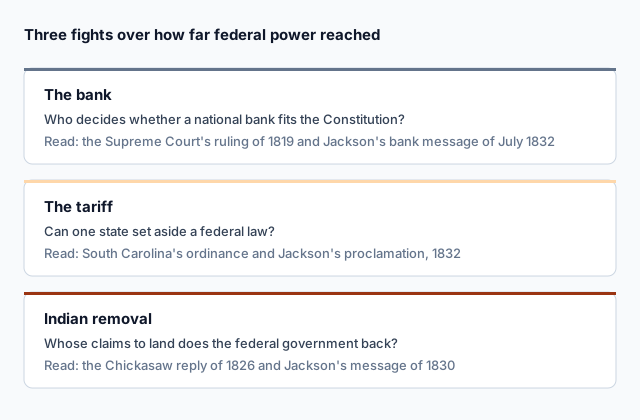 Tap to open the picture full size
Part 1 Think first The Court said yes. What would the president do?
Commit to a guess first. Being wrong now makes the right idea stick better.
Predict first
In 1819 the Supreme Court decided that Congress had the power to charter a national bank. In 1832 Congress passed a bill to renew the charter of the Bank of the United States, and sent it to President Andrew Jackson. What do you think Jackson did?
In short. In the 1820s and 1830s Andrew Jackson's Democrats and Henry Clay's Whigs fought over the role and powers of the federal government, including the national bank, tariffs and federally funded roads and canals, while frontier settlers pressed for Indian lands and the federal government moved American Indian nations west against their resistance.
- Jackson vetoed the national bank's new charter in 1832, saying it favored the rich and invaded the rights of the states; his opponents, led by Clay, organized as the Whigs.
- When South Carolina declared the federal tariffs of 1828 and 1832 null within its borders, Jackson answered that the Constitution "forms a government, not a league."
- Under the Indian Removal Act of 1830 the federal government pressed American Indian nations to move west. Many resisted, and the forced removal of the Cherokees in 1838 and 1839, after Jackson left office, cost about 4,000 of 16,000 lives.
Part 2 Learn it Jackson, his opponents and the reach of federal power
2a. The bank veto
In 1816 Congress chartered the Second Bank of the United States. It held the money the government collected from tariffs and issued banknotes backed by it. In 1819, in McCulloch v. Maryland, the Supreme Court held that chartering a bank was an implied power of Congress.
Jackson's veto of July 10, 1832 makes three kinds of argument. A constitutional one: some of the bank's powers were "unauthorized by the Constitution, subversive of the rights of the States." A social one: "It is to be regretted that the rich and powerful too often bend the acts of government to their selfish purposes." The bank, he wrote, enriched its stockholders, while "the humble members of society" (he named "the farmers, mechanics, and laborers") had no means of winning such favors. And one about his own office: the Court's view did not settle the question for a president, since each officer swears to support the Constitution "as he understands it."
He also granted that a national bank "is in many respects convenient for the Government and useful to the people." His quarrel was with this bank's powers and privileges.
Sources: McCulloch v. Maryland (National Archives); The Two-Party System (National Archives); Bank veto message, 1832 (Avalon Project).
Quick check · Multiple choice
Jackson's veto claimed that some of the bank's powers were "unauthorized by the Constitution." Which evidence would a supporter of the bank most likely use to refute that claim?
2b. Democrats and Whigs
The bank fight helped split national politics into two parties. In September 1833 Jackson removed the government's deposits from the bank. In March 1834 the Senate, led by Henry Clay, resolved that the President "has assumed upon himself authority and power not conferred by the Constitution and laws, but in derogation of both." Jackson's Protest of April 15, 1834 answered that he held office "through the voluntary suffrages of the American people." A cartoon of 1833 had already drawn him as "King Andrew I," and that spring Clay began calling Jackson's opponents Whigs, the name of the Revolution's opponents of King George III.
The National Archives sums up the difference. The Democrats believed in presidential leadership of a limited federal government that left much policy to the states. The Whigs believed in a stronger federal government, led by Congress, that actively supported national development. Clay had long promoted a protective tariff and federal money for roads and canals, the program he called the American System. Jackson's supporters in the 1820s wanted low tariffs and opposed federal spending on internal improvements.
Sources: The Two-Party System (National Archives); Jackson's Protest to the Senate, 1834 (Avalon Project).
Quick check · Sort it
Tap each statement, then the party whose view it fits better.
Democrats, led by Jackson
Whigs, led by Clay
2c. Nullification
The next fight was over the tariff. On November 24, 1832 a South Carolina convention adopted an Ordinance of Nullification. It charged that the federal tariffs of 1828 and 1832, written as taxes on imports, were "in reality intended for the protection of domestic manufactures," and it declared them "null, void, and no law, nor binding upon this State, its officers or citizens." Nullification is a state's claim that it may refuse to enforce a federal law it judges unconstitutional.
Jackson, who had defended the rights of the states against the bank, answered with a Proclamation on December 10, 1832: "I consider, then, the power to annul a law of the United States, assumed by one State, incompatible with the existence of the Union." The Union was not a pact each state could undo: "The Constitution of the United States, then, forms a government, not a league."
So Jackson's view of federal power was not one simple rule. He fought a federal bank he judged unconstitutional, and he defended a federal tariff law against a state.
Sources: South Carolina Ordinance of Nullification (Avalon Project); Jackson's Proclamation on Nullification (Avalon Project).
Quick check · Match
Match each phrase from the nullification crisis of 1832 to the work it does in its document's argument.
2d. Removal and resistance
In 1826 federal commissioners asked Chickasaw leaders to exchange their lands for lands west of the Mississippi. The leaders answered that "we never had a thought of exchanging our land for any others," and that leaving would be like "transplanting an old tree, which would wither and die away, and we are fearful we would come to the same." The commissioners then pressed them to sell part of their land: "His white children never will be satisfied until they have a communication, through their own settlements, between the city of New Orleans and the State of Tennessee."
The Indian Removal Act of May 28, 1830 let the President negotiate removal treaties with nations east of the Mississippi. That December Jackson told Congress removal would "incalculably strengthen the southwestern frontier" and "will retard the progress of decay, which is lessening their numbers." By the end of his presidency his administration had negotiated almost 70 removal treaties.
Many Cherokees opposed the Treaty of New Echota, ratified in 1836, and refused to leave. Jackson's second term ended in 1837. Under his successor, Martin Van Buren, troops forced the Cherokees out, and in 1838 and 1839 about 4,000 of 16,000 died on the way west. The course framework adds that American Indian resistance led to a sequence of wars.
Sources: Chickasaw refusal, 1826 (Avalon Project); Jackson's message on Indian removal (National Archives); Jackson's second inaugural, 1833 (Avalon Project); The Amistad Case (National Archives).
Quick check · Select all
Which two pieces of evidence show American Indian resistance to removal? Select two.
Select 2 answers, then check.
Part 3 Watch it done Test a president's claim against the evidence
Watch each step, then do the last one yourself.
In his message of December 6, 1830, Jackson told Congress that removal would help the Indians themselves: it "will retard the progress of decay, which is lessening their numbers." Explain whether the evidence of what happened to the Cherokees supports that claim, refutes it, or has no bearing on it.
Predict first
Before the steps, what do you expect the later evidence to do to Jackson's claim?
Step 1 · Pin down the claim, its audience and its purpose
Jackson was writing to Congress, which had passed the Removal Act that year, about a policy he had signed. His claim is a prediction: moving west would slow the loss of Indian lives.
Why this step?
Why name the audience and purpose before judging the claim?
A president defending his own policy to the lawmakers who passed it has reason to stress its benefits. Knowing that tells you the claim needs evidence from outside the message before you accept it.
Step 2 · Find evidence from outside the source
The National Archives reports that in the fall and winter of 1838 and 1839, after Jackson had left office, the Cherokees were forcibly moved west, some walking as many as 1,000 miles over four months, and that about 4,000 of 16,000 died on the way.
Your step · Decide and justify
Finish it. Does the evidence of 1838 and 1839 support or refute Jackson's claim that removal would slow the decline in Indian numbers?
Which evidence best supports your answer?
Part 4 Try it A promise and a censure
Two statements about the same president's power, five years apart. In his first inaugural address, on March 4, 1829, Jackson promised to "keep steadily in view the limitations as well as the extent of the Executive power." In March 1834, after he removed the government's deposits from the bank, the Senate resolved that the President "has assumed upon himself authority and power not conferred by the Constitution and laws, but in derogation of both."
Sources: First Inaugural Address of Andrew Jackson (Avalon Project); Jackson's Protest to the Senate, 1834 (Avalon Project).
Try it · Multiple choice
How does the Senate's resolution of March 1834 relate to Jackson's promise of 1829?
Try it · Spot the error
A student writes a paragraph on Jackson and federal power. Which line is the first to go wrong?
Part 5 Explain it Write it like a document-based answer
Nothing you type leaves this page. Check your answer against the model and each scoring point.
Free-response practice · Question 1 style
A short practice in the shape of the document-based question: three documents instead of seven, and a thesis with one body paragraph instead of a full essay.
Evaluate the extent to which Andrew Jackson's presidency expanded the power of the federal government.
Document 1. Andrew Jackson, veto of the bill to renew the Bank of the United States, July 10, 1832: some of the bank's powers are "unauthorized by the Constitution, subversive of the rights of the States." And: "It is to be regretted that the rich and powerful too often bend the acts of government to their selfish purposes."
Document 2. Andrew Jackson, Proclamation Regarding Nullification, December 10, 1832: "I consider, then, the power to annul a law of the United States, assumed by one State, incompatible with the existence of the Union."
Document 3. Andrew Jackson, message to Congress, December 6, 1830: removal will "incalculably strengthen the southwestern frontier."
Write a thesis, one sentence of historical context, and one paragraph that uses at least two documents and explains the purpose, audience, point of view or situation of one of them.
Model answer
Thesis: Jackson's presidency expanded federal power over the states and over American Indian nations, and expanded the president's own power, even as it cut back federal sponsorship of banking.
Context: In 1819 the Supreme Court had held in McCulloch v. Maryland that Congress could charter a national bank and that a state could not tax it.
In his bank veto Jackson attacked a federal institution as "subversive of the rights of the States" (Document 1), so in banking he narrowed what the federal government did. The veto was addressed to the Senate in an election year and speaks for the people against "the rich and powerful," so its purpose was likely as much to rally voters as to settle a constitutional point, and it also claims for the president a right to judge the Constitution for himself. When South Carolina tried to annul the tariff, Jackson called that power "incompatible with the existence of the Union" (Document 2): the fight was over whether federal law bound a state, and he said it did. And his 1830 message promoted a removal policy meant to "incalculably strengthen the southwestern frontier" (Document 3), which the federal government carried out by treaty and, under his successor, by troops. Federal sponsorship of banking shrank, but federal and presidential power over states and Indian nations grew.
Score your own answer. This is a self-check, not a grade. Tick each point your answer makes.
Part 6 Check yourself A state and a president, two weeks apart
The case questions use the two excerpts. The others mix the ideas from the whole lesson.
Both excerpts come from the nullification crisis of 1832. Sources: South Carolina Ordinance of Nullification (Avalon Project); Jackson's Proclamation on Nullification (Avalon Project).
| Document | Excerpt |
|---|---|
| South Carolina Ordinance of Nullification, November 24, 1832 | The tariff acts, written as taxes on imports, are "in reality intended for the protection of domestic manufactures," though the Constitution "confers on it no authority to afford such protection," and they "are null, void, and no law, nor binding upon this State, its officers or citizens." |
| Jackson's Proclamation Regarding Nullification, December 10, 1832 | "I consider, then, the power to annul a law of the United States, assumed by one State, incompatible with the existence of the Union." And: "The Constitution of the United States, then, forms a government, not a league." |
Case question 1 · Multiple choice
The South Carolina excerpt rests its case against the tariff most directly on which claim?
Case question 2 · Multiple choice
A student claims that Jackson championed the rights of the states against federal power. How does the Proclamation excerpt affect that claim?
The rest stand on their own and do not use the case.
Check yourself · Put it in order
Put these events in the order they happened, earliest first.
Check yourself · Fill the statement
Complete a historian's notes on removal.
Jackson told Congress removal would "incalculably strengthen the southwestern frontier." That claim speaks most directly to the interests of . The Chickasaw leaders' refusal of 1826 is evidence of .
Part 7 Keep it Bring back earlier ideas
This lesson stands on the wider vote from Topic 4.7 and the market revolution's inventions from Topic 4.5.
Both excerpts set the rules for voters in a state. Sources: Constitution of North Carolina, 1776 (Avalon Project); Constitution of Alabama, 1819 (Avalon Project).
| Document | Excerpt |
|---|---|
| Constitution of North Carolina, December 18, 1776 | "all freemen, of the age of twenty-one years, who have been inhabitants of any one county within the State twelve months immediately preceding the day of any election and possessed of a freehold within the same county of fifty acres of land for six months next before, and at the day of election, shall be entitled to vote for a member of the Senate" |
| Constitution of Alabama, December 6, 1819 | "Every white male person of the age of twenty-one years, or upwards, who shall be a citizen of the United States" and has lived in the state a year is a qualified elector, but "no soldier, seaman, or marine, in the regular army or navy of the United States, shall be entitled to vote" |
From 4.7 Expanding Democracy · Multiple choice
Which statement best describes the change in the basis of voting between the two excerpts?
From 4.5 Market Revolution: Industrialization · Match
Match each innovation to the work it made more efficient.
In three lines
- Jackson's Democrats and Clay's Whigs split over the role of the federal government: the bank, tariffs and internal improvements.
- Jackson cut back the bank but defended federal law against South Carolina's nullification.
- Frontier settlers pressed for Indian lands, and federal removal policy forced American Indian nations west despite their resistance.
Exam strategy for this topic
- Section I Part A, Multiple Choice: 55 questions in 55 minutes.
- Section I Part B, Short Answer: 3 questions in 40 minutes.
- Section II, Document-Based Question and Long Essay: 2 questions in 100 minutes.
- This lesson's Explain it is shaped like free-response question 1, Document-based.
When a question asks how evidence affects a claim, say whether it supports, modifies or refutes it, then name the specific part of the claim the evidence touches.
Questions students ask
Did Jackson defy the Supreme Court over the bank?
No court ordered Congress to renew the bank, so he disobeyed no order. But the National Archives notes that he disregarded the Court's 1819 ruling that the bank was constitutional, and his veto claimed that each officer judges the Constitution for himself.
Why did Jackson's opponents call themselves Whigs?
In the Revolution, Whigs were the Americans who opposed the tyranny of King George III. Clay used the name in 1834 for Jackson's opponents, who accused him of acting like a king.
Was nullification the same as secession?
No. Nullification claimed a state could void a federal law and stay in the Union. Jackson's Proclamation rejected both: a state that had joined the Union "cannot from that period possess any right to secede."
What was the Trail of Tears?
The forced removal of the Cherokees to the Indian Territory in the fall and winter of 1838 and 1839, under Jackson's successor, Martin Van Buren. The National Archives reports that some walked as many as 1,000 miles and that about 4,000 of 16,000 died.
Where can I read these documents in full?
Each excerpt links to its full text at the Avalon Project at Yale Law School or the National Archives, the collections this lesson was checked against.
Course alignment, for teachers
AP U.S. History topic 4.8, Unit 4: Period 4: 1800–1848.
- Skill 3.D: Explain how claims or evidence support, modify, or refute a source’s argument.
This lesson maps all 2 essential knowledge statements of the topic, and the one learning objective with none of its own, to the part that teaches each one: 3 are checked by a scored question. The map is in the lesson file.