Unit 7 · Topic 7.9 · about 30 minutes · 7 parts · 13 scored checks, 5 of them multiple choice
AP U.S. History 7.9: The Great Depression
Unit 7: 10 to 17% of the multiple-choice section
What you'll be able to do
- Explain the causes of the Great Depression, from weaknesses in the industrial economy of the 1920s to speculation, bank failures and falling demand, and its effects on the economy, including calls for financial regulation and the start of a limited welfare state.
Key vocabulary
| Term | What it means | The exam trap |
|---|---|---|
| Speculation | Buying stocks or other assets in the hope of a quick rise in price rather than for their lasting value. | Speculation is about the buyer's aim, not about whether a price happens to rise or fall. |
| Credit | Money lent and borrowed, such as a bank loan or stock bought with borrowed money. | Credit links borrowers and lenders, so trouble on one side spreads to the other. |
| Financial regulation | Rules and oversight that government places on banks, stock markets and other parts of the financial system. | Regulation sets rules for private firms; it is not the same as government owning them. |
| Limited welfare state | A government that guarantees some basic economic protections, such as old-age benefits and unemployment insurance, but not all. | Read the word limited: ask which protections were created and which were not. |
| Modern American liberalism | The set of ideas about government that the 1930s reshaped, as the federal government took on part of its citizens' economic security. | In this course the term names a view of government's role, not simply a political party. |
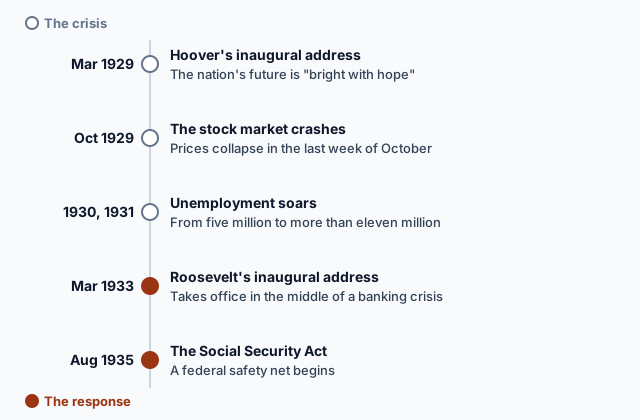 Tap to open the picture full size
Part 1 Think first Bright with hope
Commit to a guess first. Being wrong now makes the right idea stick better.
Predict first
On March 4, 1929, President Herbert Hoover told the nation in his inaugural address: "I have no fears for the future of our country. It is bright with hope." Seven months later the stock market crashed, and within two years more than eleven million Americans were out of work. What do you think did most to turn the crash into a depression that lasted a decade?
In short. The Great Depression began when weaknesses in the booming industrial economy of the 1920s, among them production outpacing demand, struggling farms and banks that gambled with depositors' money, met the stock market crash of 1929, and it led Americans to call for regulation of banks and markets and for a federal safety net.
- The economy kept moving from farms toward cities and industry led by large companies, but by 1929 production was outstripping demand and agriculture had been depressed for much of the decade.
- The crash of October 1929, bank failures and falling spending fed on one another, and unemployment rose from five million in 1930 to more than eleven million in 1931.
- The crisis brought calls for a stronger financial regulatory system and led policymakers to build a limited welfare state.
Part 2 Learn it Causes, collapse and the response
2a. An industrial economy with weak spots
Through the 1920s the United States continued its move from a rural, farming economy to an urban, industrial one led by large companies. Factories turned out cars, radios and appliances in growing numbers.
The boom rested on weak ground. Two historians of Hoover's presidency, Richard Norton Smith and Timothy Walch, point to three weak spots.
- Too many goods for the buyers. The economy faced "a glut of twenty-six million new cars and other consumer goods flooding the market." The average worker's wages of about $1,500 a year failed to keep pace with gains in productivity since 1920, so workers could not buy all they made. "By 1929 production was outstripping demand."
- Farms left behind. "Agriculture, mired in depression for much of the 1920s, was deprived of cash it needed to take part in the consumer revolution."
- No safety net. "Government had yet to devise insurance for the jobless or income maintenance for the destitute." When people lost work, their spending stopped too.
None of these caused a depression alone. Together they meant a shock could spread.
Quick check · Multiple choice
The economy of the 1920s kept moving from farms toward factories and cities. A National Archives history says that "By 1929 production was outstripping demand." Which development best explains that problem?
2b. Crash, credit and collapse
The shock came in late October 1929. "On October 24 alone, radio stocks lost 40 percent of their paper value." On Black Tuesday, October 29, the market collapsed.
The crash spread through credit, money lent and borrowed. Many banks had used their customers' deposits to speculate. Speculation is buying in the hope of a quick rise in price, not for the value of the thing itself. When stocks fell, those banks lost money that was not theirs, and when a bank failed its depositors could lose their savings.
Each loss caused the next. "With unemployment, buying power vanished overnight." In 1930 "frightened consumers cut back their expenditures by 10 percent," and a severe drought struck the farm belt from that summer. Abroad, "Foreign banks went under, draining U.S. wealth and destroying world trade." "Unemployment soared from five million in 1930 to more than eleven million in 1931."
Hoover did not sit still. He met with business leaders, who promised to hold the line on wages, and government and business spent more in the first half of 1930 than in all of 1929. It was not enough to stop the slide.
Quick check · Put it in order
Put these events in the order they happened, earliest first.
2c. Calls for financial regulation
Before the crash, a president who wanted to rein in the market had little room to act. As early as 1925 Hoover, then Secretary of Commerce, had warned that stock speculation was getting out of hand, but "Presidents in 1929 were not supposed to regulate Wall Street."
The Depression changed that. A National Archives lesson sums up the mood of 1933: "The public feared a collapse of the nation's banks, and they also suspected that the unbridled greed of financial manipulators had contributed to the stock market crash of 1929." In his last weeks in office, as banks in two dozen states began to totter, Hoover was desperate enough to propose that the Federal Reserve guarantee every depositor's account; the Federal Reserve preferred a bank holiday.
Franklin Roosevelt's inaugural address of March 4, 1933, made the demand plain: "there must be a strict supervision of all banking and credits and investments; there must be an end to speculation with other people's money." Congress created the Federal Deposit Insurance Corporation to protect depositors' savings when a bank failed. A Senate committee investigated the stock exchange, and in 1934 Americans wrote to their senators both for and against the Securities Exchange Act.
Sources: Launching the New Deal (National Archives); The Pecora Investigation (National Archives); Roosevelt's First Inaugural Address (Avalon Project).
Quick check · Match
Match each problem of the crisis to the call for regulation that answered it.
2d. The start of a limited welfare state
Mass unemployment forced a second change. Before the 1930s, support for the elderly was "a matter of local, state, and family concern rather than a federal concern," and no federal insurance protected the jobless. Roosevelt said in 1933: "Our greatest primary task is to put people to work."
The course framework says policymakers answered the Depression's mass unemployment and social upheaval by transforming the United States into a limited welfare state: a government that guarantees some basic economic protections, not all of them. The Social Security Act of August 1935 created old-age benefits for workers, unemployment insurance, and aid for dependent mothers and children. It was limited by design. Old-age benefits were paid for by taxes on workers' wages and employers' payrolls rather than directly from government funds, and the states ran their own unemployment programs.
The course framework says the change also redefined the goals and ideas of modern American liberalism. A federal government that had left the elderly to localities and families now took on part of its citizens' economic security. Topic 7.10 follows the New Deal programs that built it.
Quick check · Fill the statement
Complete the notes on the federal response to mass unemployment.
Before the 1930s, support for the elderly was mainly a concern. The Social Security Act of 1935 created old-age benefits and , paid for largely by . Economic security became, in part, a responsibility.
Part 3 Watch it done Connect bank failures to the call for regulation
Watch each step, then do the last one yourself.
In his inaugural address of March 4, 1933, Franklin Roosevelt said: "there must be a strict supervision of all banking and credits and investments; there must be an end to speculation with other people's money." Explain how this call relates to the failures in banking that came before it.
Predict first
Before the steps, what do you think "other people's money" refers to?
Step 1 · Name the first development
Through the 1920s many banks speculated: "The United States had too many banks, and too many of them played the stock market with depositors' funds or speculated in their own stocks." After the crash, banks failed, and in the last weeks of Hoover's term banks in two dozen states began to totter.
Why this step?
Why start with what the banks did instead of with Roosevelt's speech?
A call for reform answers a problem. If you know the problem first, you can see what each part of the remedy was meant to stop.
Step 2 · Name the second development
Roosevelt spoke on the day he took office, in the middle of the banking crisis. He also blamed bankers by name: "Practices of the unscrupulous money changers stand indicted in the court of public opinion."
Your step · Decide and justify
Finish it. How does Roosevelt's call relate to the banking failures before it?
Which evidence best supports your answer?
Part 4 Try it A campaign's version of the Depression
Seven years after the crash, on the eve of the 1936 election, Roosevelt told a crowd at Madison Square Garden in New York: "Nine crazy years at the ticker and three long years in the breadlines!" The ticker was the machine that printed stock prices, and breadlines were lines for free food. He said of the Hoover years: "The Nation looked to Government but the Government looked away."
Sources: Roosevelt's Madison Square Garden address, 1936 (National Archives); The Ordeal of Herbert Hoover (National Archives).
Try it · Multiple choice
How should a historian use Roosevelt's 1936 claim that "the Government looked away" as evidence about Hoover's response to the Depression?
Try it · Spot the error
A student writes a paragraph on the causes of the Great Depression. Which line is the first to go wrong?
Part 5 Explain it Write it like a document-based answer
Nothing you type leaves this page. Check your answer against the model and each scoring point.
Free-response practice · Question 1 style
A short practice in the shape of the document-based question: three documents instead of seven, and a thesis with one body paragraph instead of a full essay.
Evaluate the extent to which weaknesses in banking and credit caused the Great Depression.
Document 1. President Herbert Hoover, inaugural address, March 4, 1929: "I have no fears for the future of our country. It is bright with hope."
Document 2. President Franklin Roosevelt, inaugural address, March 4, 1933: "Values have shrunken to fantastic levels," and "a host of unemployed citizens face the grim problem of existence." And: "there must be a strict supervision of all banking and credits and investments; there must be an end to speculation with other people's money."
Document 3. Franklin Roosevelt, campaign address at Madison Square Garden, October 31, 1936: "Nine crazy years at the ticker and three long years in the breadlines!"
Write a thesis, one sentence of historical context, and one paragraph that uses at least two documents and explains the purpose, audience, point of view or situation of one of them.
Model answer
Thesis: Weaknesses in banking and credit did much to turn the crash of 1929 into the Great Depression, because banks that speculated with depositors' money failed and took savings and lending with them, but they were not the only cause, since production had already outrun demand and farms had been depressed for most of the 1920s.
Context: through the 1920s the economy kept moving toward cities and industry led by large companies, while wages lagged behind productivity and agriculture struggled.
In 1929 Hoover saw a future "bright with hope" (Document 1), which shows how little the nation's leaders expected the collapse. Four years later Roosevelt described values "shrunken to fantastic levels" and millions unemployed, and he called for an end to "speculation with other people's money" (Document 2), naming the banks' use of deposits as a cause to be stopped. Document 3 blames "Nine crazy years at the ticker," but it comes from a campaign speech on the eve of an election; its purpose was to win votes by blaming the party in power from 1929 to 1933, so it reduces the 1920s to speculation and the Hoover years to neglect. Records of falling consumer spending and the farm depression show the causes were wider.
Score your own answer. This is a self-check, not a grade. Tick each point your answer makes.
Part 6 Check yourself How a downturn became the Great Depression
The case questions use the excerpts. The others mix the ideas from the whole lesson.
All four excerpts come from one National Archives history of Hoover's presidency, written by two historians in 2004. Source: The Ordeal of Herbert Hoover (National Archives).
| When | Excerpt |
|---|---|
| October 1929 | "On October 24 alone, radio stocks lost 40 percent of their paper value." |
| 1930 | "frightened consumers cut back their expenditures by 10 percent" |
| 1930 to 1931 | "Foreign banks went under, draining U.S. wealth and destroying world trade." |
| 1930 to 1931 | "Unemployment soared from five million in 1930 to more than eleven million in 1931." |
Case question 1 · Multiple choice
Which development best connects the crash in the first row to the unemployment in the last row?
Case question 2 · Multiple choice
What do the excerpts together suggest about the Depression?
The rest stand on their own and do not use the case.
Check yourself · Sort it
Tap each card, then say whether it was part of the limited welfare state built in the 1930s.
Part of the 1930s safety net
Not part of it
Check yourself · Select all
Which two were calls for a stronger financial regulatory system in the early 1930s? Select two.
Select 2 answers, then check.
Part 7 Keep it Bring back earlier ideas
This lesson stands on the urban growth and migration of Topic 7.8 and the large corporations of Topic 6.6.
Bring it back · Multiple choice
A Black family leaves the rural South for Chicago around 1920. Which pair of motives fits the Great Migration as historians describe it?
Bring it back · Fill the statement
Complete the sentence about business in the Gilded Age.
To raise profits, many business leaders merged corporations into giant , putting wealth in hands.
In three lines
- By 1929 production was outrunning demand, farms were depressed and many banks speculated with depositors' money.
- The crash of October 1929, bank failures and falling spending fed on one another, and unemployment passed eleven million by 1931.
- The crisis brought calls for financial regulation and the start of a limited welfare state.
Exam strategy for this topic
- Section I Part A, Multiple Choice: 55 questions in 55 minutes.
- Section I Part B, Short Answer: 3 questions in 40 minutes.
- Section II, Document-Based Question and Long Essay: 2 questions in 100 minutes.
- This lesson's Explain it is shaped like free-response question 1, Document-based.
When a question asks for causes, name the trigger and at least one cause that came before it, and explain how they worked together.
Questions students ask
Did the stock market crash cause the Great Depression?
It was the trigger, not the only cause. By 1929 production was outstripping demand, farms had been depressed for much of the decade, and many banks had speculated with depositors' money. Historians still debate how much each one mattered.
Did Hoover do nothing?
No. He met with business leaders, who promised to hold wages, and government and business spent more in the first half of 1930 than in all of 1929. Late in his term he proposed guaranteeing bank deposits. His efforts did not stop the slide.
How bad did unemployment get?
A National Archives history of Hoover's presidency says unemployment soared from five million in 1930 to more than eleven million in 1931.
What does limited welfare state mean?
The federal government began guaranteeing some protections, such as old-age benefits and unemployment insurance under the Social Security Act of 1935, but not all, and it paid for old-age benefits through taxes on wages and payrolls.
Where can I read these sources in full?
Each excerpt links to its full text at the National Archives or the Avalon Project at Yale Law School, the collections this lesson was checked against.
Course alignment, for teachers
AP U.S. History topic 7.9, Unit 7: Period 7: 1890–1945.
- Skill 5.B: Explain how a historical development or process relates to another historical development or process.
This lesson maps all 3 essential knowledge statements of the topic, and the one learning objective with none of its own, to the part that teaches each one: 4 are checked by a scored question. The map is in the lesson file.