Unit 3 · Topic 3.12 · about 30 minutes · 7 parts · 13 scored checks, 4 of them multiple choice
AP U.S. History 3.12: Movement in the Early Republic
Unit 3: 10 to 17% of the multiple-choice section
What you'll be able to do
- Explain how and why migration and immigration to and within North America caused competition and conflict over time, among American Indian nations, settlers, the United States and Britain.
- Explain the continuities and changes in regional attitudes about slavery as it expanded from 1754 to 1800.
Key vocabulary
| Term | What it means | The exam trap |
|---|---|---|
| Frontier | The edge of settlement, where settlers moving west met American Indian nations and the reach of government thinned out. | The frontier moved over time; check the date before you say where it was. |
| Cede | To give up land or a claim to it, usually by treaty. | A treaty may say a nation ceded land without saying how freely it agreed; read who wrote the treaty and what had just happened. |
| Gradual abolition | Ending slavery over a period of years by law, rather than freeing every enslaved person at once. | A gradual abolition law starts an end to slavery; it does not mean slavery ended in that state the year the law passed. |
| Alliance | An agreement between nations or peoples to support each other, often in war. | Indian nations' alliances changed with circumstances; do not assume a nation's side in one war was its side in the next. |
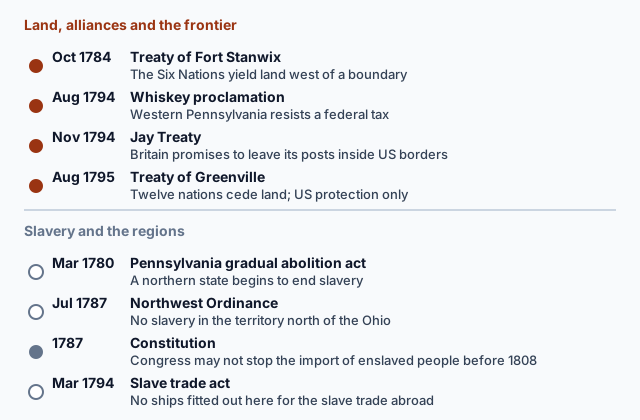 Tap to open the picture full size
Part 1 Think first Why would a treaty let Indians drive off American settlers?
Commit to a guess first. Being wrong now makes the right idea stick better.
Predict first
The Treaty of Greenville of 1795, written "To put an end to a destructive war" between the United States and twelve Indian nations, says that if American citizens settle on the lands it leaves to the Indians, the Indian nation "may drive off the settler, or punish him in such manner as they shall think fit." Why do you think the United States agreed to that?
In short. After independence, settlers and migrants pushed west onto American Indian lands, so Indian nations shifted alliances to protect their land, Britain's ties to those nations strained its relations with the United States, frontier people clashed with the government in the East, and as slavery spread in the deep South while antislavery laws passed in the North, the regions began to take different sides on slavery.
- American Indian nations kept weighing alliances with Britain, other tribes and the United States to limit settlers and hold their land; the 1784 treaty with the Six Nations treats four of them differently from the Oneida and Tuscarora, a sign they had not all made the same choice in the war.
- Britain kept posts on land the 1783 peace gave the United States until the Jay Treaty of 1794 promised to withdraw them, and its alliances with Indian nations deepened tension with the United States.
- Pennsylvania's gradual abolition law and the Northwest Ordinance's ban on slavery stood against the spread of slavery in the deep South, so attitudes toward slavery began to differ by region.
Part 2 Learn it Migration, conflict and regional attitudes
2a. Indian nations weigh their alliances
From 1754 to 1800, American Indian nations kept evaluating and adjusting their alliances: with Britain or France, with other tribes, and with the United States. Their goals stayed steady. They wanted to limit white settlers moving onto their lands and to keep control of those lands and their resources.
The Six Nations show how hard those choices were. At Fort Stanwix in October 1784 the United States made a treaty with them. It refers to prisoners "taken by the said Senecas, Mohawks, Onondagas and Cayugas, or by any of them, in the late war, from among the people of the United States." It says "The United States of America give peace to the Senecas, Mohawks, Onondagas and Cayugas." Two other nations get different treatment: "The Oneida and Tuscarora nations shall be secured in the possession of the lands on which they are settled."
The treaty does not explain the difference, but it points to one. Four nations had taken prisoners from Americans in the Revolution, and they are offered peace. The Oneida and Tuscarora are promised their lands. The league had not made one choice of side in the war.
The price of peace was land: "the Six Nations shall and do yield to the United States, all claims to the country west of the said boundary."
Quick check · Multiple choice
The Treaty of Fort Stanwix (1784) offers peace to the Senecas, Mohawks, Onondagas and Cayugas, and promises the Oneida and Tuscarora that they will keep their lands. What does this difference most likely show?
2b. Britain's posts and its Indian allies
The peace of 1783 gave the United States the land south of the Great Lakes. Britain did not leave it. You met the Jay Treaty in Topic 3.10 as diplomacy; here it shows the British presence among Indian nations. In the Jay Treaty of November 19, 1794, Britain finally promised: "His Majesty will withdraw all His Troops and Garrisons from all Posts and Places within the Boundary Lines assigned by the Treaty of Peace to the United States." The posts were to be handed over by June 1, 1796.
British forts stood in the lands of Indian nations north of the Ohio River, and British alliances with American Indians added to the tension between the United States and Britain. The Treaty of Greenville, concluded on August 3, 1795, by Anthony Wayne, commanding the army of the United States, and the chiefs of twelve nations, "To put an end to a destructive war," shows the British presence in its text. One of the pieces of land it gives to the United States is "One piece twelve miles square, at the British fort on the Miami of the lake, at the foot of the rapids."
The treaty also has the Indian nations accept a new relationship. They are "under the protection of the said United States, and no other power whatever." No other power meant, above all, Britain.
Sources: Jay Treaty (Avalon Project); Treaty of Greenville (Avalon Project).
Quick check · Fill the statement
Complete the notes on the Northwest in the 1790s.
In the Jay Treaty of 1794, Britain agreed to its troops from posts inside the boundaries of the United States. In 1795, at Greenville, the Indian nations accepted the protection of the United States "and no other power whatever," a clause meant to cut off their .
2c. Frontier cultures and their tensions
As more migrants, from the states and from other parts of the world, moved west, frontier cultures that had begun in colonial times kept growing. So did social, political and ethnic tensions.
Crevecoeur, describing the colonies in a book of 1782, said that "the back-settlers of both the Carolinas, Virginia, and many other parts, have been long a set of lawless people." He also described Americans as "a mixture of English, Scotch, Irish, French, Dutch, Germans, and Swedes."
Jefferson, in his Notes on the State of Virginia (written in 1781), worried that immigrants from monarchies would not fit a republic: "They will bring with them the principles of the governments they leave, imbibed in their early youth."
In August 1794 President Washington proclaimed that "combinations to defeat the execution of the laws laying duties upon spirits distilled within the United States and upon stills have from the time of the commencement of those laws existed in some of the western parts of Pennsylvania." Westerners were resisting a federal tax on whiskey. In 1796 his Farewell Address told "The inhabitants of our Western country" that they had been wrong to suspect "a policy in the General Government and in the Atlantic States unfriendly to their interests in regard to the Mississippi."
Sources: Letter III (Avalon Project); Notes on the State of Virginia (Avalon Project); Whiskey Rebellion proclamation (Avalon Project); Farewell Address (Avalon Project).
Quick check · Match
Match each piece of evidence to the frontier tension it shows.
2d. Slavery spreads, and the regions divide
Slavery was expanding in the deep South and the western lands next to it, while antislavery feeling was rising. Together they began to give each region its own attitude toward slavery.
Pennsylvania passed An Act for the Gradual Abolition of Slavery on March 1, 1780. Its preamble, written while the war with Britain was still being fought, says the state's lawmakers believe it their duty "to extend a portion of that freedom to others, which hath been extended to us" (spelling as printed). In 1787 the Northwest Ordinance declared: "There shall be neither slavery nor involuntary servitude in the said territory." In March 1794 Congress banned fitting out ships in the United States "for the purpose of carrying on any trade or traffic in slaves, to any foreign country."
The Constitution of 1787 pulled the other way: "The Migration or Importation of such Persons as any of the States now existing shall think proper to admit, shall not be prohibited by the Congress prior to the Year one thousand eight hundred and eight." Such Persons were enslaved people brought in by the slave trade, which, as the course framework puts it, Congress could ban only after 1808.
Sources: Pennsylvania act, 1780 (Avalon Project); Northwest Ordinance (Avalon Project); Act of 1794 (Avalon Project); Constitution (National Archives).
Quick check · Sort it
Tap each card, then the side of the slavery question it shows.
Rising antislavery sentiment
Protection or spread of slavery
Part 3 Watch it done Connect two treaties signed a year apart
Watch each step, then do the last one yourself.
The Jay Treaty with Britain was signed on November 19, 1794. The Treaty of Greenville with twelve Indian nations was concluded on August 3, 1795. Explain the connection between the two.
Predict first
Before the steps, what do you think one treaty with Britain and one with Indian nations could have in common?
Step 1 · Read the British treaty
In Article 2 of the Jay Treaty Britain agrees that "His Majesty will withdraw all His Troops and Garrisons from all Posts and Places within the Boundary Lines assigned by the Treaty of Peace to the United States." Britain had kept those posts for more than a decade after the peace of 1783.
Why this step?
Why read the British treaty first when the question is about the Indian nations too?
Britain's posts and alliances were part of the Indian nations' situation. To see a pattern you look for what one development changed in the other.
Step 2 · Read the Indian treaty
At Greenville the Indian nations "cede and relinquish forever" a large area. The lands given up include "One piece twelve miles square, at the British fort on the Miami of the lake, at the foot of the rapids." And the nations place themselves "under the protection of the said United States, and no other power whatever."
Your step · Decide and justify
Finish it. Which connection best links the two treaties?
Which evidence best supports your answer?
Part 4 Try it Three places, three attitudes toward slavery
In his 1782 book on the colonies, Crevecoeur wrote: "We have slaves likewise in our northern provinces; I hope the time draws near when they will be all emancipated." Virginia sat between the North and the deep South. Jefferson, writing in 1781, reported that "the assembly passed a law for the perpetual prohibition of the importation of slaves" and called slavery "this great political and moral evil," yet slavery remained, as he admits when he writes of an influence "produced by the existence of slavery among us." Meanwhile slavery spread across the deep South and the western lands next to it.
Sources: Letter IX (Avalon Project); Notes on the State of Virginia (Avalon Project).
Try it · Spot the error
A student writes a paragraph on attitudes toward slavery by 1800. Which line is the first to go wrong?
Try it · Select all
Which two pieces of evidence show rising antislavery sentiment between 1780 and 1800? Select two.
Select 2 answers, then check.
Part 5 Explain it Write it like a document-based answer
Nothing you type leaves this page. Check your answer against the model and each scoring point.
Free-response practice · Question 1 style
A short practice in the shape of the document-based question: three documents instead of seven, and a thesis with one body paragraph instead of a full essay.
Evaluate the extent to which westward migration caused conflict in the United States between 1784 and 1795.
Document 1. Treaty With the Six Nations, concluded at Fort Stanwix, October 22, 1784: "the Six Nations shall and do yield to the United States, all claims to the country west of the said boundary"
Document 2. President George Washington, proclamation of August 7, 1794: "combinations to defeat the execution of the laws laying duties upon spirits distilled within the United States and upon stills have from the time of the commencement of those laws existed in some of the western parts of Pennsylvania"
Document 3. Treaty of Greenville, concluded August 3, 1795, by Anthony Wayne, commanding the United States Army, and the chiefs of twelve Indian nations: if Americans settle on the lands left to the Indians, the Indian nation "may drive off the settler, or punish him in such manner as they shall think fit"; the same article continues, "because such settlements, made without the consent of the United States, will be injurious to them as well as to the Indians, the United States shall be at liberty to break them up, and remove and punish the settlers as they shall think proper."
Write a thesis, one sentence of historical context, and one paragraph that uses at least two documents and explains the purpose, audience, point of view or situation of one of them.
Model answer
Thesis: Westward migration caused serious conflict between 1784 and 1795, with American Indian nations over land and with the federal government over law, though treaties show both sides also trying to manage the movement rather than simply fight over it.
Context: the peace of 1783 gave the United States land west of the Appalachians, but Britain kept posts there and Indian nations still lived on and claimed it.
At Fort Stanwix the Six Nations had to "yield to the United States, all claims to the country west of the said boundary" (Document 1), land given up to make room for settlement. Migration also brought conflict with the government itself: by 1794 westerners in Pennsylvania were organized to defeat the federal tax on distilled spirits (Document 2). The Treaty of Greenville came after a war and lets both the Indian nations and the United States remove settlers who arrive without consent (Document 3). It was concluded by the commander of the United States Army with the chiefs, after a war, so its point of view is largely the government's: it treats unauthorized settlers as trouble the government wanted to control, while the same treaty takes a large cession of land. Migration caused conflict, and the government tried to direct it, not stop it.
Score your own answer. This is a self-check, not a grade. Tick each point your answer makes.
Part 6 Check yourself Two laws, two directions
The case questions use the two excerpts. The others mix the ideas from the whole lesson.
Both excerpts are laws from the years just after independence. Sources: Pennsylvania act, 1780 (Avalon Project); Constitution (National Archives).
| Document | Excerpt |
|---|---|
| Pennsylvania, An Act for the Gradual Abolition of Slavery, March 1, 1780 | The state's people believe it is their duty "to extend a portion of that freedom to others, which hath been extended to us" (spelling as printed) |
| Constitution of the United States, 1787, Article I, Section 9 | "The Migration or Importation of such Persons as any of the States now existing shall think proper to admit, shall not be prohibited by the Congress prior to the Year one thousand eight hundred and eight" |
Case question 1 · Multiple choice
Read together, the two excerpts best illustrate which pattern?
Case question 2 · Multiple choice
The second excerpt protects the import of enslaved people until 1808 for states that "shall think proper to admit" them. Which development best explains why some states wanted that protection?
The rest stand on their own and do not use the case.
Check yourself · Put it in order
Put these events in the order they happened, earliest first.
Check yourself · Fill the statement
Complete the sentences about frontier tension in the 1790s.
In August 1794 Washington proclaimed that groups in the parts of Pennsylvania were organized to defeat the laws laying duties on . Two years later his Farewell Address answered western suspicion that the Atlantic States did not care about the Mississippi.
Part 7 Keep it Bring back earlier ideas
This lesson stands on the new national identity from Topic 3.11 and the Constitution's structure from Topic 3.9.
Bring it back · Multiple choice
In a book about the British colonies published in 1782, Crevecoeur described Americans as people who had left behind their old European manners and taken on new ones from a new way of life. Which development does his description best support?
Bring it back · Fill the statement
Complete the sentences about the Constitution's design.
The Constitution created a limited but dynamic central government. It shared power between the national government and the states, a system called , and it separated national power among branches.
In three lines
- Indian nations kept adjusting their alliances to limit settlers and keep their land, and Britain's posts and Indian alliances strained its relations with the United States.
- Frontier cultures from colonial times kept growing as migrants moved west, fueling social, political and ethnic tensions.
- Slavery spread in the deep South while antislavery laws passed in the North, so the regions began to take different sides.
Exam strategy for this topic
- Section I Part A, Multiple Choice: 55 questions in 55 minutes.
- Section I Part B, Short Answer: 3 questions in 40 minutes.
- Section II, Document-Based Question and Long Essay: 2 questions in 100 minutes.
- This lesson's Explain it is shaped like free-response question 1, Document-based.
When a question asks for a pattern or connection, name two developments, say what links them, and give one piece of evidence that shows the link.
Questions students ask
Why did Britain keep forts on American land after 1783?
The peace of 1783 drew boundaries that put the posts inside the United States, but Britain kept its troops there. The Jay Treaty of 1794 finally promised to withdraw them by June 1, 1796.
What was the Treaty of Greenville?
A treaty concluded on August 3, 1795, between the United States, represented by General Anthony Wayne, and twelve Indian nations of the Northwest. It ended a war, set a boundary, took a large cession of land for the United States and placed the nations under the protection of the United States alone.
Did the Revolution end slavery in the North?
It started an end. Pennsylvania passed a gradual abolition law in 1780, and the Northwest Ordinance banned slavery north of the Ohio River in 1787. Gradual laws freed people over years, and a northern writer in 1782 still spoke of slaves in the northern states.
What was the Whiskey Rebellion?
Resistance in western Pennsylvania to the federal tax on distilled spirits and stills. In August 1794 President Washington issued a proclamation against it, which the Avalon Project files under the title The Whiskey Rebellion, naming the western parts of Pennsylvania as the place where it was happening.
Where can I read these documents in full?
Each excerpt links to its full text at the Avalon Project at Yale Law School or the National Archives, the primary-source collections this lesson was checked against.
Course alignment, for teachers
AP U.S. History topic 3.12, Unit 3: Period 3: 1754–1800.
- Skill 5.A: Identify patterns among or connections between historical developments and processes.
This lesson maps all 3 essential knowledge statements of the topic, and the 2 learning objectives with none of their own, to the part that teaches each one: 5 are checked by a scored question. The map is in the lesson file.