Unit 3 · Topic 3.3 · about 30 minutes · 7 parts · 13 scored checks, 5 of them multiple choice
AP U.S. History 3.3: Taxation Without Representation
Unit 3: 10 to 17% of the multiple-choice section
What you'll be able to do
- Explain how British colonial policies regarding North America led to the Revolutionary War, and identify the point of view, purpose, historical situation and audience of the documents those policies produced.
Key vocabulary
| Term | What it means | The exam trap |
|---|---|---|
| Taxation without representation | The colonists' complaint that Parliament taxed them although they had no members in it. | The complaint is about who has the right to tax, so check whether a source argues about the tax's size or its source. |
| Consent | Agreement given by people themselves or by representatives they choose. | Consent in these documents means a colony's own assembly agreeing, not each person agreeing to every tax. |
| Duty | A tax on goods, often collected when they are imported. | A duty is still a tax; do not read a list of duties as a trade rule only. |
| Non-importation agreement | A pledge by merchants or others not to bring in or buy British goods until a law is repealed. | Signers often called themselves loyal; a boycott was pressure for repeal, not by itself a call for independence. |
| Patriot | A colonist who supported the cause of resistance and, later, independence from Britain. | The word names a side in the conflict; do not use it for every colonist. |
 Tap to open the picture full size
Part 1 Think first Why this tax?
Commit to a guess first. Being wrong now makes the right idea stick better.
Predict first
Colonists in 1765 already paid taxes that their own colonial assemblies voted. That year Parliament in London taxed paper and documents in the colonies, and the protest was loud and fast. What do you think made this tax different?
In short. After the Seven Years' War, Britain's new efforts to tax the colonies without direct colonial representation or consent, and to assert imperial authority, united many colonists in resistance, argued from the rights of British subjects and local self-rule and carried by leaders such as Benjamin Franklin and by merchants, laborers, artisans and women.
- The Stamp Act of 1765 and the Townshend duties of 1767 were laid by a Parliament in which the colonists had no members, so colonists protested that they were taxed without their consent.
- Colonial leaders argued that only their own assemblies could tax them, as British subjects and by their traditions of self-rule.
- Merchants, retailers and people of all ranks boycotted British goods, and when Parliament punished Boston in 1774 and war followed, men and women gave money and supplies to the Patriot cause.
Part 2 Learn it Taxes, rights and resistance
2a. Taxed without consent
The imperial wars of the mid-18th century left Britain with a larger empire and large costs. Parliament then made new efforts to collect taxes from the colonies without direct colonial representation or consent, and to assert imperial authority there.
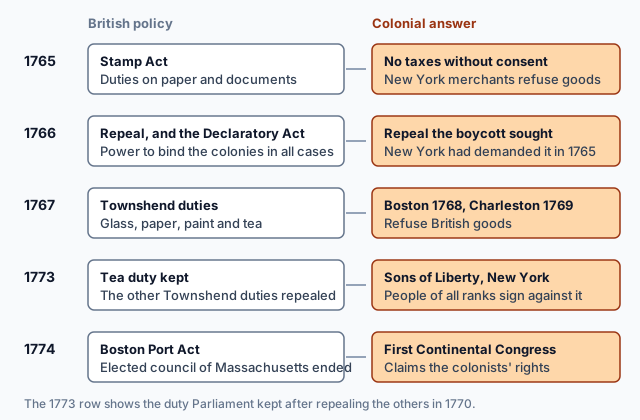
The Stamp Act of March 22, 1765, put duties on paper and documents. Its full title explains its purpose: "An act for granting and applying certain stamp duties, and other duties, in the British colonies and plantations in America, towards further defraying the expences of defending, protecting, and securing the same" (spelling as printed).
Parliament repealed the Stamp Act in 1766 but tried again. Duties are taxes on goods, and the Townshend duties, in force from November 20, 1767, taxed glass, lead, paint, paper and tea: "For every pound weight avoirdupois of tea, three pence."
Colonists felt these as constraints on both their economic activity and their political rights. In 1769 signers in South Carolina complained that their money was "wrung from them, without their consent, or even their being represented." They also spoke of "joining the rest of the colonies in some other loyal and vigorous methods." The policies were beginning to unite colonists who had acted separately before.
Sources: Stamp Act, 1765; Townshend Act, 1767; Charleston Non-Importation Agreement, 1769.
Quick check · Fill the statement
Complete the sentences about British policy after the Seven Years' War.
Parliament laid the Stamp Act and the Townshend duties on the colonies without the colonists' . Resisting those taxes, and Britain's efforts to assert its authority, began to the colonists against Britain.
2b. The case colonial leaders made
Colonial leaders based their calls for resistance on the rights of British subjects, the rights of the individual, local traditions of self-rule and the ideas of the Enlightenment. Four resolutions of the colonial congress of October 19, 1765, read:
- "That it is inseparably essential to the freedom of a people, and the undoubted right of Englishmen, that no taxes be imposed on them, but with their own consent, given personally, or by their representatives."
- "That trial by jury is the inherent and invaluable right of every British subject in these colonies."
- "That the people of these colonies are not, and from their local circumstances cannot be, represented in the House of Commons in Great-Britain."
- "That the only representatives of the people of these colonies, are persons chosen therein by themselves, and that no taxes ever have been, or can be constitutionally imposed on them, but by their respective legislatures."
Put together, the argument runs: Englishmen may be taxed only by their own representatives; colonists cannot sit in Parliament; so only colonial assemblies may tax colonists. Two grounds run through these lines, rights shared with people in Britain and the power of the colonies' own assemblies, and the consent argument joins them. The rights of the individual and Enlightenment ideas, such as rights that belong to every person by nature, also ran through colonial arguments; Topic 3.4 reads them.
Quick check · Sort it
Each card is a phrase from the colonial resolutions of 1765. Tap a card, then the ground it argues from.
Rights shared with people living in Britain
Power kept by each colony's own bodies
2c. Leaders and a popular movement
Colonial leaders such as Benjamin Franklin energized the effort for independence. The Avalon Project credits him, with Thomas Hutchinson, with a plan of colonial union in 1754, and in 1776 he was one of the five members of the committee Congress named to draft the Declaration of Independence.
The resistance did not belong to leaders alone. Popular movements carried it, including the political activism of laborers, artisans and women.
The documents show how wide the circle grew. In New York in October 1765 merchants agreed that "in all orders they send out to Great Britain for goods or merchandise of any nature, kind, or quality whatsoever, usually imported from Great Britain, they will direct their correspondents not to ship them unless the Stamp Act be repealed." "This was subscribed by upwards of two hundred principal merchants." The city's retailers followed, promising to "oblige ourselves not to buy any goods" shipped from Britain after the new year. By December 1773, the association of New York's Sons of Liberty against the tea duty was "signed by a great number of the principal gentlemen of the city, merchants, lawyers, and other inhabitants of all ranks."
Sources: New York Merchants Non-importation Agreement, 1765; Association of the Sons of Liberty in New York, 1773; Albany Plan of Union; The Declaration of Independence: A History (National Archives).
Quick check · Multiple choice
The Sons of Liberty's association of 1773 was signed by "merchants, lawyers, and other inhabitants of all ranks." What does that detail most directly show about the resistance to Britain?
2d. From boycotts to supplying a war
Before the war, refusing British goods put colonists' own money behind the resistance. Boston's merchants in 1768 pledged "to promote industry, frugality, and economy, and to discourage luxury and every kind of extravagance." Charleston's signers in 1769 promised "we will encourage and promote the use of North American manufactures in general."
Then Britain struck harder. After "certain valuable cargoes of teas, being the property of the East India Company" "were seized and destroyed" in Boston, the Boston Port Act of March 31, 1774, stopped "the landing and discharging, lading or shipping, of goods, wares, and merchandise, at the town" of Boston. A port closed to shipping meant shortages. In October 1774 delegates from the colonies met as the First Continental Congress and declared the colonists' rights.
When war came, economic shortages and the British military occupation of some regions pressed hard on colonists. Men and women mobilized in large numbers to provide financial and material support to the Patriot movement, giving money and goods.
Sources: Boston Non-Importation Agreement, 1768; Charleston Non-Importation Agreement, 1769; Boston Port Act, 1774; Declaration and Resolves, 1774.
Quick check · Select all
Which two are examples of colonists putting money or goods behind the resistance before the war, or behind the Patriot cause during it? Select two.
Select 2 answers, then check.
Part 3 Watch it done Source the Sons of Liberty's association
Watch each step, then do the last one yourself.
In December 1773 the Sons of Liberty in New York circulated an association against the tea duty. It opens: "It is essential to the freedom and security of a free people, that no taxes be imposed upon them but by their own consent, or their representatives." Identify the document's purpose.
Predict first
Before the steps, what do you think the document was for?
Step 1 · Name the historical situation
In 1770 Parliament repealed most of the Townshend duties but, in the association's words, "left the duty on tea, as a test of the parliamentary right to tax us." A new act then made it easier for the East India Company to ship its tea to America. The association was written as that tea was expected.
Why this step?
Why does it matter that these words are the association's, not Parliament's?
Point of view shapes every claim. Calling the tea duty a test of Parliament's right to tax is how the Sons of Liberty saw it, and their reading tells you what they wanted others to believe about the duty.
Step 2 · Read the note on who signed
An introduction says it was "signed by a great number of the principal gentlemen of the city, merchants, lawyers, and other inhabitants of all ranks," and that it was still being carried around the city.
Your step · Decide and justify
Finish it. What was the association's main purpose?
Which evidence best supports your answer?
Part 4 Try it Source a boycott agreement
In July 1769 signers in Charleston, South Carolina, agreed to stop importing British goods. They describe themselves as "dutiful and loving subjects, the inhabitants of South Carolina," complain that money was "wrung from them, without their consent, or even their being represented," and promise "we will encourage and promote the use of North American manufactures in general."
Source: Charleston Non-Importation Agreement (Avalon Project).
Try it · Multiple choice
Which best describes the point of view of the Charleston signers?
Try it · Spot the error
A student writes a sourcing paragraph on the Charleston agreement. Which line is the first to go wrong?
Part 5 Explain it Write it like a document-based answer
Nothing you type leaves this page. Check your answer against the model and each scoring point.
Free-response practice · Question 1 style
A short practice in the shape of the document-based question: three documents instead of seven, and a thesis with one body paragraph instead of a full essay.
Evaluate the extent to which British policies between 1765 and 1773 united the colonists in resistance to Britain.
Document 1. New York Merchants Non-importation Agreement, October 31, 1765: the merchants agreed that "in all orders they send out to Great Britain for goods or merchandise of any nature, kind, or quality whatsoever, usually imported from Great Britain, they will direct their correspondents not to ship them unless the Stamp Act be repealed." "This was subscribed by upwards of two hundred principal merchants."
Document 2. Charleston Non-Importation Agreement, July 22, 1769: money is "wrung from them, without their consent, or even their being represented"; the signers seek "joining the rest of the colonies in some other loyal and vigorous methods."
Document 3. Association of the Sons of Liberty in New York, December 15, 1773: "It is essential to the freedom and security of a free people, that no taxes be imposed upon them but by their own consent, or their representatives." It was "signed by a great number of the principal gentlemen of the city, merchants, lawyers, and other inhabitants of all ranks."
Write a thesis, one sentence of historical context, and one paragraph that uses at least two documents and explains the purpose, audience, point of view or situation of one of them.
Model answer
Thesis: Between 1765 and 1773 British taxes laid without colonial consent united colonists to a large extent, widening resistance from merchants' boycotts to people of all ranks and keeping colonies looking to one another, though they still resisted as loyal subjects seeking repeal rather than independence.
Context: in October 1765 a congress of the colonies resolved that only their own legislatures could tax them, so the colonies had already answered the Stamp Act together.
In 1765 New York's resistance was led by men of trade, "upwards of two hundred principal merchants" who refused British goods until the Stamp Act was repealed (Document 1). By 1769 Charleston's signers spoke of "joining the rest of the colonies" (Document 2), so a boycott in one colony looked to the others. Their point of view as self-described loyal subjects explains why they called their methods "loyal and vigorous": they wanted repeal, not separation. By 1773 New York's association reached "other inhabitants of all ranks" (Document 3). Across the three documents the same argument, no taxes without consent, drew in more kinds of colonists, while the goal stayed repeal inside the empire.
Score your own answer. This is a self-check, not a grade. Tick each point your answer makes.
Part 6 Check yourself One tax, two readings
The case questions use the two excerpts. The others mix the ideas from the whole lesson.
The first excerpt is the full title of an act of Parliament; the second comes from a colonial congress that answered it seven months later. Sources: Stamp Act (Avalon Project); Resolutions of October 19, 1765 (Avalon Project).
| Document | Excerpt |
|---|---|
| The Stamp Act, March 22, 1765 | "An act for granting and applying certain stamp duties, and other duties, in the British colonies and plantations in America, towards further defraying the expences of defending, protecting, and securing the same" (spelling as printed) |
| Resolutions of a colonial congress, October 19, 1765 | "That it is inseparably essential to the freedom of a people, and the undoubted right of Englishmen, that no taxes be imposed on them, but with their own consent, given personally, or by their representatives." |
Case question 1 · Multiple choice
What was the main purpose of the congress's resolution in the second excerpt?
Case question 2 · Multiple choice
What do the two excerpts together show about the dispute over the Stamp Act?
The rest stand on their own and do not use the case.
Check yourself · Put it in order
Put these events in the order they happened, earliest first.
Check yourself · Match
Match each person or group to its part in the resistance.
Part 7 Keep it Bring back earlier ideas
This lesson stands on the cost of the Seven Years' War from Topic 3.2 and the new governments of Period 3 from Topic 3.1.
Bring it back · Multiple choice
Why did Britain begin seeking new revenue from its North American colonies after 1763?
Bring it back · Fill the statement
Complete the sentence about the governments Americans created after declaring independence.
New constitutions and declarations of rights protected individual liberties while limiting both power and excessive influence.
In three lines
- After the Seven Years' War, Parliament taxed the colonies without their consent and asserted its authority, which began to unite colonists against Britain.
- Colonial leaders argued from the rights of British subjects and local self-rule: only their own assemblies could tax them.
- Leaders such as Franklin and popular movements of merchants, laborers, artisans and women carried the resistance, and men and women supplied the Patriot cause.
Exam strategy for this topic
- Section I Part A, Multiple Choice: 55 questions in 55 minutes.
- Section I Part B, Short Answer: 3 questions in 40 minutes.
- Section II, Document-Based Question and Long Essay: 2 questions in 100 minutes.
- This lesson's Explain it is shaped like free-response question 1, Document-based.
When a question asks for a document's point of view, quote how the authors describe themselves, then say how that identity shapes what they claim.
Questions students ask
What did taxation without representation mean?
Colonists had no members in Parliament. Their congress of 1765 said the people of the colonies "are not, and from their local circumstances cannot be, represented in the House of Commons," so only their own legislatures could tax them.
Were the colonists trying to leave the empire in the 1760s?
Not yet. They argued as British subjects and pressed for repeal of the taxes. Independence came in 1776, after the conflict had grown into war.
What part did ordinary people play?
A large one. Merchants and retailers refused British goods, laborers, artisans and women were politically active in the popular movements, and during the war men and women gave money and supplies to the Patriot movement.
What did Benjamin Franklin do?
Franklin was a colonial leader. The Avalon Project credits him, with Thomas Hutchinson, with a plan of colonial union in 1754, and in 1776 he served on the five-member committee that drafted the Declaration of Independence.
Where can I read these documents in full?
Each excerpt links to its full text at the Avalon Project at Yale Law School or the National Archives, the primary-source collections this lesson was checked against.
Course alignment, for teachers
AP U.S. History topic 3.3, Unit 3: Period 3: 1754–1800.
- Skill 2.A: Identify a source’s point of view, purpose, historical situation, and/or audience.
This lesson maps all 4 essential knowledge statements of the topic, and the one learning objective with none of its own, to the part that teaches each one: 5 are checked by a scored question. The map is in the lesson file.