Unit 9 · Topic 9.5 · about 30 minutes · 7 parts · 12 scored checks, 4 of them multiple choice
AP U.S. History 9.5: Migration and Immigration in the 1990s and 2000s
Unit 9: 4 to 6% of the multiple-choice section
What you'll be able to do
- Explain the causes and effects of domestic and international migration from 1980 into the 2000s, and explain how a source's point of view, purpose, historical situation and audience limit what it can show about that migration.
Key vocabulary
| Term | What it means | The exam trap |
|---|---|---|
| Domestic migration | Movement of people from one place to another inside the country, such as the shift to the South and West. | Domestic migration moves people within the country; it does not add new residents from abroad. |
| International migration | Movement of people from one country to another, such as the rising migration from Latin America and Asia. | International migration crosses a national border; a move from Ohio to Texas is domestic migration. |
| Sun Belt | The course framework's name for the growing region of the South and West that emerged as a political and economic force after 1945. | The Sun Belt's growth began before 1980; after 1980 it continued. |
| Limits of a source | What a source cannot show, given who made it, for whom, and why. | A limited source is not a false one; it answers some questions and not others. |
 Tap to open the picture full size
Part 1 Think first Where did Americans go?
Commit to a guess first. Being wrong now makes the right idea stick better.
Predict first
Between 1980 and the 2000s, Americans moved within the country and newcomers arrived from abroad. Which regions of the United States do you think gained the most influence as people moved there?
In short. After 1980 Americans kept moving to the South and West, which raised those regions' influence, while migration from Latin America and Asia increased dramatically and changed the nation's culture and workforce.
- As population shifted to the South and West, the political, economic and cultural influence of those regions continued to increase, a movement the course framework traces back to the years after 1945.
- Immigrants from around the world sought opportunity in the United States, especially after new immigration laws in 1965, and in the 1990s and 2000s migration from Latin America and Asia increased dramatically, changing U.S. culture and supplying an important labor force.
- Presidents praised immigrants and diversity in their inaugural addresses, and after the attacks of September 11, 2001, senators weighed immigration's value against tighter controls; each source shows its speaker's view, not immigrants' own experience.
Part 2 Learn it Two movements of people
2a. A continuing shift to the South and West
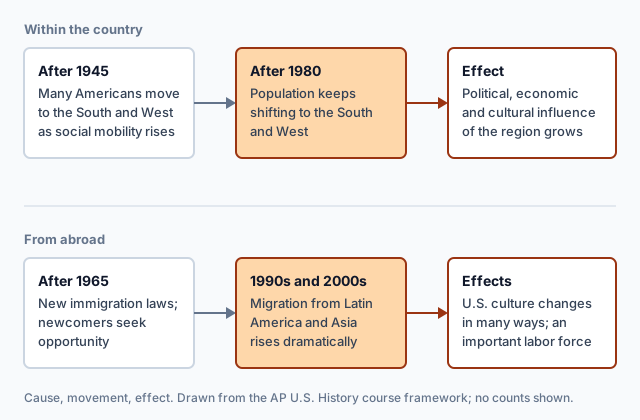
Domestic migration is movement from one place to another inside the country. After 1980 Americans kept moving to the South and the West, and as population shifted there, the political, economic and cultural influence of those regions continued to increase.
Read that as cause and effect. The cause is people moving; the effect is that the regions they moved to counted for more in the nation's politics, its economy and its culture.
The shift did not start in 1980. The AP U.S. History course framework traces it to the decades after 1945, when expanding higher education and new technologies raised social mobility and encouraged many Americans to move to the South and West. In those years the Sun Belt, the framework's name for that growing region, emerged as a significant political and economic force. After 1980 the same movement went on, and so did the growth in the region's influence.
This lesson gives no population figures, because none of its sources states them. To measure the shift, a historian would turn to census records.
Quick check · Multiple choice
Which statement best describes the movement of Americans to the South and West after 1980?
2b. New immigrants from Latin America and Asia
International migration is movement from one country to another. The course framework traces the new immigration to the 1960s: immigrants from around the world sought political, social and economic opportunities in the United States, especially after new immigration laws were passed in 1965. In the 1990s and 2000s, migration from Latin America and Asia increased dramatically.
The framework names two kinds of effect. The new immigrants affected U.S. culture in many ways, and they supplied the economy with an important labor force.
Immigration was also argued over. Intense political and cultural debates continued over immigration policy and diversity, the subject of Topic 9.2. Congress passed enforcement laws in these years: in 2001 Senator Orrin G. Hatch pointed to the "Illegal Immigration Reform and Immigrant Responsibility Act of 1996." When you write about the debates, say who held each view.
A note on balance: the presidents and senators quoted in this lesson all speak of immigration's value, though the senators also call for tighter controls. None of these sources argues for admitting fewer immigrants, so on that question the page shows only one side.
Quick check · Sort it
Each card names a development from the course framework, some from its topics on the years after 1945. Tap a card, then say whether it is a cause of migration (within the country or from abroad) or an effect of it.
A cause of migration
An effect of migration
2c. What a president's speech can and cannot show
Presidents spoke about immigrants in their inaugural addresses. On January 20, 2001, George W. Bush said:
Source it before you use it. Point of view: a new president, on his first day in office. Audience: the whole nation. Situation: Bush took office in January 2001, while migration from Latin America and Asia was increasing dramatically and intense debates over immigration policy and diversity continued. Purpose: to call a divided nation together around shared ideals. He named the division he wanted to heal: sometimes our differences run so deep "it seems we share a continent, but not a country."
Those same four facts set the limits of the source. The speech shows how a president chose to describe immigrants to the country. It does not say where newcomers came from, what work they did or how they were treated. For that, a historian needs other sources, such as census records or immigrants' own accounts.
Quick check · Fill the statement
Complete a historian's notes on Bush's 2001 inaugural address.
Bush spoke on Inauguration Day to the whole country, which is the speech's . He wanted to bring a divided nation together around shared ideals, which is its . For both reasons the speech shows how a president described immigrants, but it is as evidence of what work immigrants did.
Part 3 Watch it done Source Clinton's 1997 inaugural address
Watch each step, then do the last one yourself.
On January 20, 1997, in his second inaugural address, President Clinton said: "The divide of race has been America's constant curse. And each new wave of immigrants gives new targets to old prejudices." Explain how the speech's purpose and audience limit what it can show about immigrants' lives in the 1990s.
Predict first
Before the steps, what do you think this line can show best?
Step 1 · Place it in time
Clinton gave the speech at the start of his second term, "At this last presidential inauguration of the 20th century." He spoke while migration from Latin America and Asia was increasing dramatically and debates over immigration policy and diversity continued.
Why this step?
Why name the moment before reading the line closely?
A line about immigrants means more once you know what was happening when it was said. Here it was a time of new immigration and open debate about it.
Step 2 · Name the speaker, the audience and the purpose
A president on Inauguration Day speaks to the whole nation. Clinton framed his purpose as a question: "will we be one nation, one people, with one common destiny, or not?" He names prejudice against immigrants as one of the forces that threaten that unity, and later says "Our rich texture of racial, religious and political diversity will be a Godsend in the 21st century."
Your step · Decide and justify
Finish it. How do the speech's purpose and audience limit its use as evidence about immigrants in the 1990s?
Which evidence best supports your answer?
Part 4 Try it A patchwork heritage
On January 20, 2009, Barack Obama gave his inaugural address. Right after speaking to "those who seek to advance their aims by inducing terror and slaughtering innocents," he said:
"For we know that our patchwork heritage is a strength, not a weakness. We are a nation of Christians and Muslims, Jews and Hindus, and non-believers. We are shaped by every language and culture, drawn from every end of this Earth"
The quotation stops partway through the sentence, which goes on to say that "because we have tasted the bitter swill of civil war and segregation," Americans believe old hatreds will someday pass.
Try it · Multiple choice
A historian wants evidence of how the new immigration of the 1990s and 2000s changed American life. What is the most important limit on using this passage?
Try it · Spot the error
A student writes a sourcing paragraph on the Obama passage above. Which line is the first to go wrong?
Part 5 Explain it Write it like a document-based answer
Nothing you type leaves this page. Check your answer against the model and each scoring point.
Free-response practice · Question 1 style
A short practice in the shape of the document-based question: three documents instead of seven, and a thesis with one body paragraph instead of a full essay.
Evaluate the extent to which national leaders from 1997 to 2001 treated the new immigration as a strength for the nation.
Document 1. William J. Clinton, Second Inaugural Address, January 20, 1997: "The divide of race has been America's constant curse. And each new wave of immigrants gives new targets to old prejudices." And later: "Our rich texture of racial, religious and political diversity will be a Godsend in the 21st century."
Document 2. George W. Bush, Inaugural Address, January 20, 2001: "America has never been united by blood or birth or soil. We are bound by ideals that move us beyond our backgrounds, lift us above our interests and teach us what it means to be citizens." And: "every immigrant, by embracing these ideals, makes our country more, not less, American."
Document 3. Senator Orrin G. Hatch, opening statement at a Senate Judiciary immigration subcommittee hearing on "Effective Immigration Controls to Deter Terrorism," October 17, 2001: "we must find the appropriate balance between facilitating the legal entry of those who wish to visit or reside here for innocent reasons, and providing sufficient safeguards to prevent the entry of those who desire to harm our government, our citizens and residents, or our institutions." And: "If a nonimmigrant illegally remains in the United States, he or she must be promptly removed if relief from removal is not merited."
Write a thesis, one sentence of historical context, and one paragraph that uses at least two documents and explains the purpose, audience, point of view or situation of one of them.
Model answer
Thesis: From 1997 to 2001 national leaders treated immigration as compatible with national unity, but they differed in emphasis: Clinton called diversity a strength while warning of prejudice, Bush grounded unity in shared ideals, and after the September 11 attacks Hatch weighed legal entry against safeguards and removal.
Context: migration from Latin America and Asia increased dramatically in these years, and the new immigrants supplied the economy with an important labor force while intense political and cultural debates continued over immigration policy.
Clinton called the nation's diversity "a Godsend" for the coming century but warned that "each new wave of immigrants gives new targets to old prejudices" (Document 1). Bush put the weight on shared ideals rather than on diversity itself: Americans are bound by ideals that "move us beyond our backgrounds," and an immigrant makes the country "more, not less, American" by embracing them (Document 2). Hatch spoke weeks after the attacks, at a hearing on immigration controls, and his purpose was to shape changes in immigration law; he sought "the appropriate balance" between legal entry and safeguards, and said a nonimmigrant who stays illegally "must be promptly removed" (Document 3). That situation explains why his statement centers on enforcement, while the inaugural addresses, given to unite a national audience, center on what holds Americans together. None of the three shows how immigrants themselves lived.
Score your own answer. This is a self-check, not a grade. Tick each point your answer makes.
Part 6 Check yourself Immigration controls after September 11
The case questions use the two excerpts. The others mix the ideas from the whole lesson.
Weeks after the attacks of September 11, 2001, a Senate Judiciary subcommittee on immigration held a hearing on "Effective Immigration Controls to Deter Terrorism." Both excerpts are statements to that hearing on October 17, 2001. Hatch opened: "Since the attacks of September 11, one of the many focuses of Congress and the Administration has been on immigration and immigration controls." Sources: Leahy statement (Avalon Project); Hatch statement (Avalon Project).
| Speaker | Excerpt |
|---|---|
| Senator Patrick Leahy | "Now more than ever, we must patrol our border vigilantly and prevent those who wish America harm from gaining entry." And: "Immigrants play a vital role in refreshing our democracy and strengthening our economy, and the measures we take in response to the events of September 11 should take that into account." |
| Senator Orrin G. Hatch | "we must find the appropriate balance between facilitating the legal entry of those who wish to visit or reside here for innocent reasons, and providing sufficient safeguards to prevent the entry of those who desire to harm our government, our citizens and residents, or our institutions." |
Case question 1 · Multiple choice
What position do the two senators share?
Case question 2 · Select all
Which two facts about these statements most limit what they can show about immigration in the 1990s and 2000s? Select two.
Select 2 answers, then check.
The rest stand on their own and do not use the case.
Check yourself · Decide and justify
A student claims the new immigrants of the 1990s and 2000s mattered to the nation's economy but not to its culture. Is the claim right?
Which evidence best supports your answer?
Check yourself · Match
Match each development to what it led to.
Part 7 Keep it Bring back earlier ideas
This lesson stands on the changing economy of Topic 9.4 and the debates over immigration and diversity from Topic 9.2.
Bring it back · Multiple choice
In his 1997 inaugural address Clinton said: "Ten years ago, the Internet was the mystical province of physicists; today, it is a commonplace encyclopedia for millions of schoolchildren." Which development does this line describe?
Bring it back · Fill the statement
Complete the sentences.
Presidents praised the nation's diversity on Inauguration Day, yet debates over immigration policy and diversity . A historian should treat each speech as one among many.
In three lines
- After 1980 population kept shifting to the South and West, and the political, economic and cultural influence of those regions continued to increase.
- Immigrants from around the world sought opportunity after the 1965 laws, and migration from Latin America and Asia increased dramatically; the new immigrants changed U.S. culture and supplied an important labor force.
- Presidents praised diversity to unite a national audience and senators weighed immigration against tighter controls after 2001; each source shows its speaker's view, not immigrants' own experience.
Exam strategy for this topic
- Section I Part A, Multiple Choice: 55 questions in 55 minutes.
- Section I Part B, Short Answer: 3 questions in 40 minutes.
- Section II, Document-Based Question and Long Essay: 2 questions in 100 minutes.
- This lesson's Explain it is shaped like free-response question 1, Document-based.
When a question asks how a source's purpose or audience limits its use, say what the source can show, then name one thing it cannot show and the kind of source that could.
Questions students ask
Where did the new immigrants of this period come from?
The course framework says international migration from Latin America and Asia increased dramatically. It ties the change to the 1960s: immigrants from around the world sought opportunities in the United States, especially after new immigration laws were passed in 1965.
Why does this lesson give no population or immigration numbers?
Every fact on this page comes from the AP U.S. History course framework or a linked primary source, and the speeches and statements quoted here contain no overall counts. Historians find those figures in census records.
Did the immigration debate change after September 11, 2001?
Controls on entry became a focus. Senator Hatch said in October 2001: "Since the attacks of September 11, one of the many focuses of Congress and the Administration has been on immigration and immigration controls." On October 30, 2001 a presidential directive was titled "Combating Terrorism Through Immigration Policies." Topic 9.6 covers the war on terrorism and the questions it raised about civil liberties.
If an inaugural address is limited, why use it at all?
Because it shows clearly how a president chose to describe the nation at one moment, to the widest audience a president has. That is real evidence, as long as you use it for the president's view and not for immigrants' own experience.
Where can I read these speeches in full?
Each excerpt links to its full text at the Avalon Project at Yale Law School, the primary-source collection this lesson was checked against.
Course alignment, for teachers
AP U.S. History topic 9.5, Unit 9: Period 9: 1980–Present.
- Skill 2.C: Explain the significance of a source’s point of view, purpose, historical situation, and/or audience, including how these might limit the use(s) of a source.
This lesson maps all 2 essential knowledge statements of the topic, and the one learning objective with none of its own, to the part that teaches each one: 3 are checked by a scored question. The map is in the lesson file.