Unit 6 · Topic 6.4 · about 30 minutes · 7 parts · 13 scored checks, 5 of them multiple choice
AP U.S. History 6.4: The “New South”
Unit 6: 10 to 17% of the multiple-choice section
What you'll be able to do
- Explain how various factors contributed to continuity and change in the New South from 1877 to 1898, and read the sources of those years for their point of view, purpose, historical situation and audience, including how these limit what a source can show.
Key vocabulary
| Term | What it means | The exam trap |
|---|---|---|
| New South | The program of Southern leaders after Reconstruction, such as Henry Grady, who called for a South built on industry as well as farming. | The New South was a goal its promoters described; it does not mean the South stopped being mainly agricultural. |
| Sharecropping | Farming a landowner's fields in exchange for a share of the crop. | Sharecroppers worked land they did not own, so sharecropping kept them from the land ownership many freedpeople sought. |
| Tenant farming | Renting land from a landowner to farm it. | A tenant rents the land; a sharecropper pays with part of the crop. Both worked land someone else owned. |
| Jim Crow | The system of laws in the South that kept the races separate, upheld by the Supreme Court in Plessy v. Ferguson. | Jim Crow was a system of laws, not a single act, and it spread state by state. |
| Dissent | An opinion by a judge who disagrees with the court's ruling, explaining why. | A dissent has no legal force in the case; it shows that the ruling was contested, not that it was overturned. |
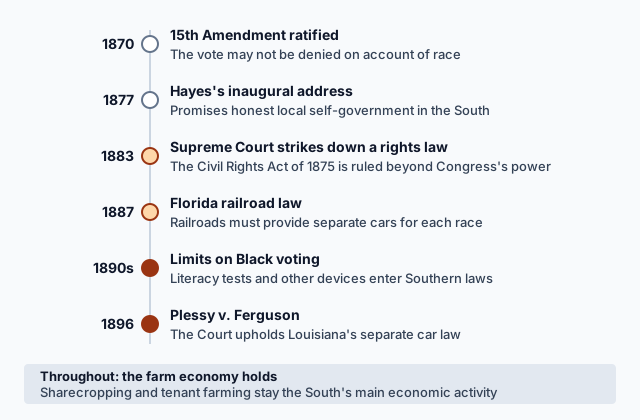 Tap to open the picture full size
Part 1 Think first What did a New South change?
Commit to a guess first. Being wrong now makes the right idea stick better.
Predict first
When Rutherford B. Hayes became president on March 5, 1877, he said of the Southern states: "The material development of that section of the country has been arrested by the social and political revolution through which it has passed." Over the next twenty years, some Southern leaders called for a New South built on industry. By 1898, how do you think most Southerners earned a living?
In short. After 1877 some Southern leaders called for a New South built on industry, and some parts of the economy did industrialize, but sharecropping and tenant farming stayed the South's main work, while Jim Crow laws, upheld by the Supreme Court in Plessy v. Ferguson in 1896, stripped away most of what African Americans had gained during Reconstruction.
- Industry grew in some segments of the Southern economy, such as coal mining around Birmingham, Alabama, but agriculture based on sharecropping and tenant farming remained the primary economic activity.
- In Plessy v. Ferguson the Court upheld a Louisiana law requiring "equal but separate accommodations for the white and colored races," helping to mark the end of most of the political gains of Reconstruction.
- Facing violence, discrimination and scientific theories of race, African American reformers such as the Citizens' Committee of New Orleans and Ida B. Wells kept fighting for political and social equality.
Part 2 Learn it Continuity and change in the New South
2a. Calls for industry, and the farms that stayed
Period 5 ends with the Compromise of 1877, which closed Reconstruction. In his inaugural address that March, President Hayes said the South's "material development" had been held back by "the social and political revolution through which it has passed," and he promised to support "honest and efficient local self-government" there.
Some Southern leaders answered with a call for a New South, one with mines and mills as well as farms. Its best-known promoter was Henry Grady, editor of the Atlanta Constitution, who made the case in a speech to a New England audience in New York in December 1886. Some segments of the economy did industrialize. Henry DeBardeleben, for one, owned several coal mining companies in Birmingham, Alabama.
The change was real but partial. Agriculture based on sharecropping (farming a landowner's fields for a share of the crop) and tenant farming (renting land to farm) stayed the South's primary economic activity. Planters still owned most of the region's land, and the sharecropping system limited Black and poor white Southerners' access to land of their own.
Sources: Inaugural Address of Rutherford B. Hayes, 1877 (Avalon Project). The AP U.S. History course framework names Grady and DeBardeleben as promoters of the New South.
Quick check · Sort it
Each card describes the South between 1877 and 1898. Tap a card, then say whether it shows change or continuity.
Change
Continuity
2b. Jim Crow and Plessy v. Ferguson
During Reconstruction, amendments wrote Black Americans' rights into the Constitution. The 14th, ratified in 1868, says no state shall "deny to any person within its jurisdiction the equal protection of the laws." The 15th, ratified in 1870, says the right to vote "shall not be denied or abridged by the United States or by any State on account of race, color, or previous condition of servitude."
Southern states then built Jim Crow, the system of laws that kept the races apart. Beginning with Florida in 1887, states required railroads to provide separate cars for each race. In 1890 Louisiana required "equal but separate accommodations for the white and colored races."
On May 18, 1896, in Plessy v. Ferguson, the Supreme Court upheld the Louisiana law. Justice Henry Brown wrote for the majority: "We consider the underlying fallacy of the plaintiff's argument to consist in the assumption that the enforced separation of the two races stamps the colored race with a badge of inferiority." If Black citizens saw such a mark, he went on, "it is not by reason of anything found in the act, but solely because the colored race chooses to put that construction upon it." The ruling became known as the doctrine of "separate but equal." The decision helped mark the end of most of the political gains African Americans had made during Reconstruction.
Sources: 14th Amendment; 15th Amendment; Plessy v. Ferguson (National Archives).
Quick check · Multiple choice
Justice Brown writes that if segregation marks Black citizens as inferior, "it is not by reason of anything found in the act, but solely because the colored race chooses to put that construction upon it." What is the Court's argument?
2c. Violence, race science, and the fight for equality
Segregation came with more than laws. African Americans faced increased violence, discrimination, and scientific theories of race, claims dressed as science that ranked races by nature and treated race as something in the blood. Even the Supreme Court wrote of "the proportion of colored blood necessary to constitute a colored person." Black Southerners voted and held office in many Southern states through the 1880s. From the early 1890s, former Confederate states wrote literacy tests, grandfather clauses that shut out men whose ancestors had not voted in the 1860s, and other devices to disenfranchise African Americans into their laws.
African American reformers kept fighting for political and social equality, and they did not all choose the same path.
- In 1891 young Black men of New Orleans formed a Citizens' Committee to test Louisiana's separate car law. On June 7, 1892, Homer Plessy sat in a white compartment and was arrested, giving the committee its test case.
- Ida B. Wells published Southern Horrors in 1892, after lynching and mob violence touched her own life.
- Booker T. Washington, speaking at the opening of the Atlanta Exposition in 1895, urged African Americans to put economic uplift ahead of immediate demands for political and social equality.
Sources: 15th Amendment; Plessy v. Ferguson (National Archives). The course framework names Wells and Washington as reformers of the period.
Quick check · Match
Match each reformer or group to what they did in the fight for equality.
2d. Sourcing a lone dissent
Justice John Marshall Harlan of Kentucky wrote the lone dissent in Plessy. He named what the law was for: "The thing to accomplish was, under the guise of giving equal accommodation for whites and blacks, to compel the latter to keep to themselves while traveling in railroad passenger coaches." And he answered the majority: "Our constitution is color-blind, and neither knows nor tolerates classes among citizens."
To source a document, ask how its point of view, purpose, historical situation and audience shape it, and what that means for how you can use it.
- Point of view. Harlan wrote as the only justice against the ruling. His opinion shows that the decision had a challenger on the Court; it cannot show what most white Americans believed in 1896. His view had limits of its own. Just before the color-blind line he wrote, "The white race deems itself to be the dominant race in this country." Then: "And so it is, in prestige, in achievements, in education, in wealth, and in power."
- Purpose and audience. A dissent does not decide a case. It argues for a different reading of the law, for readers who include later courts. The 14th and 15th Amendments did eventually become the basis for court decisions upholding civil rights in the 20th century.
Quick check · Fill the statement
Complete a historian's notes on Justice Harlan's dissent in Plessy v. Ferguson.
Harlan was the only justice to vote against the ruling, and he still called the white race dominant; both shape his . He wrote to persuade later readers and courts that his colleagues had read the Constitution wrongly, which is the dissent's .
Part 3 Watch it done Source President Hayes's promises to the South
Watch each step, then do the last one yourself.
In his inaugural address of March 5, 1877, President Rutherford B. Hayes promised the Southern states a policy that would serve "the interests of the white and of the colored people both and equally." Explain how the speech's purpose limits what it can show about the rights of Black Southerners after 1877.
Predict first
Before the steps, how much do you think this speech can tell a historian about what happened to Black Southerners' rights after 1877?
Step 1 · Name the purpose and audience
An inaugural address is a new president's statement of plans to the whole nation. Hayes spoke to Northerners and to white and Black Southerners at once, and his promises pulled in two directions. He said that for the Southern states "the time has come when such government is the imperative necessity," meaning local self-government: Southern states running their own affairs. He also said he was "fully determined to protect the rights of all by every constitutional means," and that "only a local government which recognizes and maintains inviolate the rights of all is a true self-government."
Why this step?
Why ask what a speech was for before using it as evidence?
A promise is evidence of what the speaker intended, or wanted listeners to believe. It is not evidence that the promise was kept.
Step 2 · Check it against later evidence
Black Southerners voted and held office in many Southern states through the 1880s. From the early 1890s, literacy tests and other devices to disenfranchise African Americans were written into the laws of former Confederate states, and in 1896 the Supreme Court upheld Louisiana's separate car law.
Your step · Decide and justify
Finish it. How does the speech's purpose limit its use as evidence about the rights of Black Southerners after 1877?
Which evidence best supports your answer?
Part 4 Try it A change that came step by step
In 1883 the Supreme Court struck down the Civil Rights Act of 1875, ruling that the 14th Amendment did not give Congress power to stop discrimination by private individuals. When Louisiana's separate car bill came before the legislature in 1890, the Black community of New Orleans protested, and the state assembly still had 16 Black legislators. The law passed anyway. Six years later the Supreme Court upheld it.
Try it · Multiple choice
Louisiana's assembly still had 16 Black legislators in 1890, and it passed the separate car law anyway. What does this best show about the South from 1877 to 1898?
Try it · Spot the error
A student writes a sourcing paragraph on the majority opinion in Plessy v. Ferguson. Which line is the first to go wrong?
Part 5 Explain it Write it like a document-based answer
Nothing you type leaves this page. Check your answer against the model and each scoring point.
Free-response practice · Question 1 style
A short practice in the shape of the document-based question: three documents instead of seven, and a thesis with one body paragraph instead of a full essay.
Evaluate the extent to which the rights of African Americans in the South changed between 1870 and 1896.
Document 1. 15th Amendment to the Constitution, ratified February 3, 1870: the right of citizens to vote "shall not be denied or abridged by the United States or by any State on account of race, color, or previous condition of servitude."
Document 2. Rutherford B. Hayes, inaugural address, March 5, 1877: the new president promises the Southern states a policy for "the interests of the white and of the colored people both and equally," and support for "honest and efficient local self-government."
Document 3. Plessy v. Ferguson, majority opinion by Justice Henry Brown, May 18, 1896: "If one race be inferior to the other socially, the Constitution of the United States cannot put them upon the same plane."
Write a thesis, one sentence of historical context, and one paragraph that uses at least two documents and explains the purpose, audience, point of view or situation of one of them.
Model answer
Thesis: Between 1870 and 1896 the rights of African Americans in the South changed a great deal for the worse, as rights written into the Constitution during Reconstruction were stripped away step by step, though the amendments themselves stayed in force.
Context: after the Compromise of 1877 ended Reconstruction, Southern leaders called for a New South built on industry, but most Southerners, Black and white, still farmed as sharecroppers or tenants on land planters owned.
In 1870 the 15th Amendment said the vote could not be denied "on account of race, color, or previous condition of servitude" (Document 1). By 1896 the Supreme Court held that the Constitution "cannot put them upon the same plane" when one race was held inferior socially (Document 3), and it upheld Louisiana's separate car law. Between them stands Hayes's promise of equal interests for white and Black Southerners (Document 2). As an inaugural address, it states a new president's plans, and the same speech that pledged equal interests also called for local self-government in the Southern states, so it shows what Hayes pledged, not what followed: from the early 1890s, literacy tests and other devices to disenfranchise African Americans entered Southern laws. The text of the amendments did not change; what changed was how states and courts let them be applied.
Score your own answer. This is a self-check, not a grade. Tick each point your answer makes.
Part 6 Check yourself Two opinions in one case
The case questions use the two excerpts. The others mix the ideas from the whole lesson.
Both excerpts come from Plessy v. Ferguson, decided May 18, 1896. Source: Plessy v. Ferguson (National Archives).
| Opinion | Excerpt |
|---|---|
| Majority opinion, Justice Henry Brown | "In determining the question of reasonableness, it is at liberty to act with reference to the established usages, customs, and traditions of the people" |
| Dissent, Justice John Marshall Harlan | "The arbitrary separation of citizens, on the basis of race, while they are on a public highway, is a badge of servitude wholly inconsistent with the civil freedom and the equality before the law established by the constitution." |
Case question 1 · Multiple choice
Which best explains why the two justices reached opposite conclusions about the same law?
Case question 2 · Multiple choice
A historian wants to use the majority excerpt as evidence. For which purpose is it most useful?
The rest stand on their own and do not use the case.
Check yourself · Put it in order
Put these events in the order they happened, earliest first.
Check yourself · Select all
Which two were pressures African American reformers faced in the South in the 1890s? Select two.
Select 2 answers, then check.
Part 7 Keep it Bring back earlier ideas
This lesson stands on the conflicts of the West from Topic 6.3 and the farm economy of Topic 6.2.
Bring it back · Multiple choice
In the late 1800s, how did the U.S. government respond when American Indians resisted the loss of lands promised to them by treaty?
Bring it back · Fill the statement
Read the situation, then complete the sentences.
Suppose a group of Kansas farmers sell to a few large grain buyers and depend on one railroad to ship their wheat, and its rates keep rising. To bargain together, they respond by forming a . Their trouble comes from growing in agricultural markets, where fewer and larger buyers and railroads set the terms.
In three lines
- Some Southern leaders promoted a New South of industry, but sharecropping and tenant farming stayed the South's primary economic activity.
- Jim Crow laws, upheld in Plessy v. Ferguson in 1896, helped mark the end of most of the political gains African Americans made during Reconstruction.
- Facing violence, discrimination and scientific theories of race, African American reformers kept fighting for political and social equality.
Exam strategy for this topic
- Section I Part A, Multiple Choice: 55 questions in 55 minutes.
- Section I Part B, Short Answer: 3 questions in 40 minutes.
- Section II, Document-Based Question and Long Essay: 2 questions in 100 minutes.
- This lesson's Explain it is shaped like free-response question 1, Document-based.
When a question asks how a source's point of view or purpose limits its use, name whose view the source can show and whose it cannot, such as a Court opinion that speaks for justices, not for the people the law affected.
Questions students ask
Did the New South mean the South became industrial?
Only in part. Some segments industrialized, such as coal mining around Birmingham, Alabama, but agriculture based on sharecropping and tenant farming remained the primary economic activity in the South.
Who was Henry Grady?
The editor of the Atlanta Constitution and the leading promoter of a New South based on industrialization. He made his case in a speech to the New England Club in New York in December 1886. This lesson describes the speech rather than quoting it, because no archive it uses holds the text.
Did Plessy v. Ferguson say separate facilities had to be equal?
The Louisiana law itself called for "equal but separate accommodations for the white and colored races," and the ruling became known as the separate but equal doctrine. But the Court's question was whether the law was a reasonable regulation, judged against custom and tradition, and it did not test whether the cars were equal. The ruling upheld segregation.
Why was Homer Plessy arrested on purpose?
In 1891 a Citizens' Committee of young Black men in New Orleans formed to test the separate car law in court. A test case needs an arrest, so on June 7, 1892, Plessy sat in a white compartment and was charged under the law, which let the challenge go forward.
Where can I read these documents in full?
Each excerpt links to its full text at the National Archives or the Avalon Project at Yale Law School, the primary-source collections this lesson was checked against.
Course alignment, for teachers
AP U.S. History topic 6.4, Unit 6: Period 6: 1865–1898.
- Skill 2.C: Explain the significance of a source’s point of view, purpose, historical situation, and/or audience, including how these might limit the use(s) of a source.
This lesson maps all 2 essential knowledge statements of the topic, and the one learning objective with none of its own, to the part that teaches each one: 3 are checked by a scored question. The map is in the lesson file.