Unit 5 · Topic 5.12 · about 30 minutes · 7 parts · 13 scored checks, 5 of them multiple choice
AP U.S. History 5.12: Comparison in Period 5
Unit 5: 10 to 17% of the multiple-choice section
What you'll be able to do
- Compare the relative significance of the effects of the Civil War on American values, by choosing a criterion, setting evidence about two effects side by side, and judging which mattered more and why.
Key vocabulary
| Term | What it means | The exam trap |
|---|---|---|
| Relative significance | How much one development mattered compared with another, judged on a stated measure. | Significance is always significant for what; a judgment with no measure cannot be checked. |
| Criterion | The yardstick used to judge a comparison, such as how many people a change reached or how long it lasted. | A different criterion can reverse a comparison, so state the one you are using. |
| Continuity and change | What stayed the same and what changed across a span of time. | A strong answer names both; a change described alone misses what carried through. |
| Birthright citizenship | Citizenship held because a person was born in the country. | Being a citizen and being allowed to vote were separate questions in this period. |
| Reconstruction amendments | The 13th, 14th and 15th Amendments, adopted from 1865 to 1870. | Each amendment answers a different question; do not credit one with what another did. |
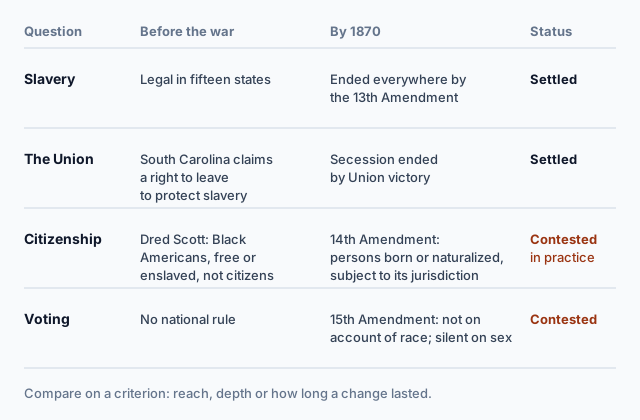 Tap to open the picture full size
Part 1 Think first Which change mattered most?
Commit to a guess first. Being wrong now makes the right idea stick better.
Predict first
Between 1865 and 1870 the Constitution gained three amendments. The 13th ended slavery. The 14th began: "All persons born or naturalized in the United States, and subject to the jurisdiction thereof, are citizens of the United States and of the State wherein they reside." The 15th barred denying the vote "on account of race, color, or previous condition of servitude." Which one do you think changed American values the most?
In short. Comparing the Civil War's effects on American values means choosing a yardstick, such as how many people a change reached or how long it lasted, and weighing the end of slavery, the end of secession, the new definition of citizenship and the changed West against each other with evidence.
- The war settled two questions for good: slavery ended in every part of the United States, and no state could leave the Union.
- The 14th and 15th Amendments made birth in the country, not race, the test of citizenship for those born here and barred denying the vote on account of race, but they left women out, and their protections were stripped away in practice after Reconstruction.
- Expansion went on during and after the war, now tied to free settlers rather than to the spread of slavery.
Part 2 Learn it Weighing the war's effects
2a. Compare on a criterion
To compare the significance of two effects, first choose what you are measuring: how many people a change reached, how deep it went, or how long it lasted. Then set evidence about each one side by side, on that same measure.
Try it on the two acts that moved the country from slavery to freedom. On January 1, 1863, Lincoln's Emancipation Proclamation declared that "all persons held as slaves within said designated States, and parts of States, are, and henceforward shall be free." He issued it "as a fit and necessary war measure for suppressing said rebellion." The National Archives notes that it "only applied to areas of the Confederacy currently in a state of rebellion," and that Lincoln saw it "would have to be followed by a constitutional amendment."
The 13th Amendment, passed by Congress on January 31, 1865 and ratified on December 6, 1865, reached much further: slavery would not exist "within the United States, or any place subject to their jurisdiction."
Measured by reach and permanence, the amendment is the larger change. Measured by immediate effect on the war, the proclamation matters more: it made the end of slavery a purpose of the war, and it said freed people would be received into the Union's armed service. Both answers are defensible, because each names its yardstick.
Sources: Emancipation Proclamation (Avalon Project); 13th Amendment (National Archives).
Quick check · Sort it
Each card describes one of the two acts that moved the country from slavery to freedom. Tap a card, then the act it describes.
Emancipation Proclamation (1863)
13th Amendment (1865)
2b. The Union and the federal government
Before the war, the Union itself was in dispute. South Carolina's declaration of December 24, 1860 claimed "the right of a State to govern itself" in defense of slavery: Northern states, it said, "have denied the rights of property established in fifteen of the States" and elected a president "whose opinions and purposes are hostile to slavery." Northern abolitionists, a visible minority, called slavery a moral wrong; many other Northerners opposed its spread to protect free labor; Southern defenders called it a positive good the Constitution protected. Lincoln answered in March 1861 that "the Union of these States is perpetual" and "Plainly the central idea of secession is the essence of anarchy."
The North's greater manpower and industry, the leadership of Lincoln and others, and emancipation brought Union victory, and the war settled the issue of secession.
The amendments then shifted power toward the federal government. The 13th and the 15th end: "Congress shall have power to enforce this article by appropriate legislation," and the 14th gives Congress the same power. The 14th also says: "No State shall make or enforce any law which shall abridge the privileges or immunities of citizens of the United States."
Before the war, Americans argued over what a state could do to resist the federal government. After it, the Constitution named things a state could not do to its own people.
Sources: South Carolina's declaration (Avalon Project); Lincoln's first inaugural (Avalon Project); 14th Amendment (National Archives).
Quick check · Fill the statement
Complete the comparison of the Union before and after the war.
In 1860 South Carolina claimed a state's right to govern itself in order to protect . The war settled that no state could . After it, the limits on states in the 14th Amendment begin with the words , and Congress gained the power to enforce them.
2c. Citizenship before and after the war
In the Dred Scott case of March 6, 1857, Chief Justice Roger B. Taney asked: "Can a negro whose ancestors were imported into this country, and sold as slaves, become a member of the political community formed and brought into existence by the Constitution of the United States"? The Court said no, for Black Americans "whether emancipated or not." The test was race and ancestry. The 1848 treaty with Mexico left it to Congress to say when Mexicans in the ceded lands would enjoy "all the rights of citizens of the United States."
The 14th Amendment, ratified on July 9, 1868, made birth in the country the test for those born here: "All persons born or naturalized in the United States, and subject to the jurisdiction thereof, are citizens of the United States and of the State wherein they reside." Not everyone was included: Section 2 counts each state's people "excluding Indians not taxed," and most American Indians in tribal nations were left out. The 15th, ratified on February 3, 1870, barred denying the vote "on account of race, color, or previous condition of servitude."
Section 2 also penalized a state only for denying the vote to "male inhabitants," and the 15th named race but not sex, so the women's rights movement was both emboldened and divided.
Sources: Dred Scott v. Sandford (National Archives); Treaty of Guadalupe Hidalgo (Avalon Project); 14th and 15th Amendments (National Archives).
Quick check · Multiple choice
Compared with the Dred Scott decision of 1857, how did the 14th Amendment of 1868 change the definition of American citizenship?
2d. Expansion during and after the war
Before the war, expansion in the Western Hemisphere fed the sectional crisis: from Texas and Oregon to the Mexican Cession to Kansas, each new territory reopened the question of whether slavery could spread there.
During the war, the Homestead Act of May 20, 1862, "An Act to Secure Homesteads to Actual Settlers on the Public Domain," offered public land to any head of a family or person of twenty-one who "is a citizen of the United States, or who shall have filed his declaration of intention to become such," and "who has never borne arms against the United States Government."
Before 1861, the question attached to new land was whether enslaved labor would follow settlers west. The 1862 law offered land to free settlers, including immigrants who had begun the path to citizenship, and shut out anyone who had fought for the Confederacy. The Pacific Railway Act, passed on July 1, 1862, "provided Federal subsidies in land and loans for the construction of a transcontinental railroad."
The course framework names what ran through the whole period: popular enthusiasm for expansion, bolstered by economic and security interests, brought new territories, substantial migration westward and new overseas initiatives, such as Perry's 1854 treaty with Japan. Laws like these two boosted westward migration during and after the war, and many migrants kept arriving, mainly from Ireland and Germany.
Sources: Homestead Act (Avalon Project); Pacific Railway Act (National Archives); Avalon Project index of 19th century documents.
Quick check · Select all
Which two statements correctly compare expansion before 1861 with expansion during the war? Select two.
Select 2 answers, then check.
Part 3 Watch it done Weigh two answers to who is a citizen
Watch each step, then do the last one yourself.
Which was more significant for American ideas of citizenship: the Dred Scott decision of 1857 or the 14th Amendment of 1868?
Predict first
Before the steps, which do you expect the comparison to favor?
Step 1 · Pick a criterion
Use duration and reach: how long each answer held, and how many people it covered.
Why this step?
Why choose the criterion before looking at the evidence?
Without a shared yardstick, each piece of evidence just sounds important. A criterion lets you say which matters more, and the reader can check your judgment against it.
Step 2 · State the similarity
Both were national answers to the same question, who is a citizen of the United States, given by the federal government rather than left to the states.
Step 3 · State the difference
The Dred Scott opinion said Black Americans, free or enslaved, could not be citizens. The 14th Amendment made citizens of "All persons born or naturalized in the United States, and subject to the jurisdiction thereof."
Your step · Decide and justify
Finish it. On duration and reach, which judgment does the comparison support?
Which evidence best supports your answer?
Part 4 Try it Two comparisons to try
The 1869 split. When the 15th Amendment went to the states, women's rights advocates split. In May 1869 Elizabeth Cady Stanton and Susan B. Anthony formed the National Woman Suffrage Association, which opposed the amendment because it excluded women. The American Woman Suffrage Association, founded the same year by Lucy Stone, Julia Ward Howe and Thomas Wentworth Higginson, supported it.
Northern and Southern responses before the war. A comparison of effects also needs a fair picture of where the country started. Before the war, Northern and Southern responses to slavery had diverged sharply, as Learn it showed with South Carolina's grievances and the positions behind them.
Source: Woman Suffrage and the 19th Amendment (National Archives).
Try it · Multiple choice
What does the 1869 split show when you compare the war's effects on the rights of African American men and of women?
Try it · Spot the error
A student compares Northern and Southern responses to slavery in the 1850s. Which line is the first to go wrong?
Part 5 Explain it Write it like a document-based answer
Nothing you type leaves this page. Check your answer against the model and each scoring point.
Free-response practice · Question 1 style
A short practice in the shape of the document-based question: three documents instead of seven, and a thesis with one body paragraph instead of a full essay.
Evaluate the relative significance of two effects of the Civil War on American values: the end of slavery and the new definition of citizenship.
Document 1. Emancipation Proclamation, January 1, 1863, issued "as a fit and necessary war measure for suppressing said rebellion": "all persons held as slaves within said designated States, and parts of States, are, and henceforward shall be free."
Document 2. 13th Amendment, ratified December 6, 1865: "Neither slavery nor involuntary servitude, except as a punishment for crime whereof the party shall have been duly convicted, shall exist within the United States, or any place subject to their jurisdiction."
Document 3. 14th Amendment, ratified July 9, 1868: "All persons born or naturalized in the United States, and subject to the jurisdiction thereof, are citizens of the United States and of the State wherein they reside."
Write a thesis, one sentence of historical context, and one paragraph that uses at least two documents and explains the purpose, audience, point of view or situation of one of them.
Model answer
Thesis: Ending slavery was the more significant change in the short run, because every other right rested on it, but the new definition of citizenship reached further over time, because it set one national rule that the states could not override.
Context: before the war, the Dred Scott decision of 1857 had said Black Americans, free or enslaved, could not be citizens, and Americans had argued for decades over whether slavery could spread into the West.
The Emancipation Proclamation freed enslaved people only in "said designated States" (Document 1). It was issued as a war measure, so its purpose was to weaken the rebellion, which explains why it covered only areas at war with the Union and needed the 13th Amendment to make freedom national and permanent (Document 2). Freedom alone did not say what the freed people were. The 14th Amendment answered that: "All persons born or naturalized" in the country are citizens (Document 3). On reach and duration, then, citizenship goes further: it covered nearly everyone born in the country, not only the formerly enslaved, and it outlasted the Dred Scott rule it replaced. Ending slavery was the precondition; citizenship was the larger change in what being an American meant.
Score your own answer. This is a self-check, not a grade. Tick each point your answer makes.
Part 6 Check yourself Lincoln, four years apart
The case questions use the two excerpts. The others mix the ideas from the whole lesson.
Both excerpts are from Lincoln's inaugural addresses, given on March 4, 1861 and March 4, 1865. Sources: first inaugural (Avalon Project); second inaugural (Avalon Project).
| Document | Excerpt |
|---|---|
| First inaugural address, March 4, 1861 | "I have no purpose, directly or indirectly, to interfere with the institution of slavery in the States where it exists." |
| Second inaugural address, March 4, 1865 | "These slaves constituted a peculiar and powerful interest. All knew that this interest was somehow the cause of the war." |
Case question 1 · Multiple choice
Comparing the two excerpts, which change in how Lincoln spoke about slavery do they show?
Case question 2 · Select all
Which two developments between 1861 and 1865 help explain the change between the excerpts? Select two.
Select 2 answers, then check.
The rest stand on their own and do not use the case.
Check yourself · Put it in order
Put these steps in the argument over freedom and a citizen's rights in the order they came, earliest first.
Check yourself · Sort it
Tap each question, then where it stood once Reconstruction began.
Settled by the war
Still contested afterward
Part 7 Keep it Bring back earlier ideas
This lesson stands on Lincoln's wartime policies from Topic 5.9 and the end of Reconstruction from Topic 5.11.
Bring it back · Multiple choice
Beyond the freedom it declared, which was one effect of Lincoln's decision to issue the Emancipation Proclamation?
Bring it back · Multiple choice
In the 1870s a formerly enslaved family farms land owned by a planter and pays for it with part of each harvest. Which statement best describes the system they are working under?
In three lines
- To compare effects, name a criterion such as reach, depth or duration, then weigh both on it.
- The war settled slavery and secession; the 14th and 15th Amendments redefined citizenship and voting but left women out and were weakly enforced.
- Expansion and migration went on through the war, now tied to free settlers instead of slavery's spread.
Exam strategy for this topic
- Section I Part A, Multiple Choice: 55 questions in 55 minutes.
- Section I Part B, Short Answer: 3 questions in 40 minutes.
- Section II, Document-Based Question and Long Essay: 2 questions in 100 minutes.
- This lesson's Explain it is shaped like free-response question 1, Document-based.
When a prompt asks about relative significance, put the comparison in the thesis itself: name both effects, say which mattered more, and say on what measure.
Questions students ask
Is there a right answer to which effect of the war was most significant?
Not a single one. A judgment earns credit when it names a criterion, uses accurate evidence on both sides, and explains why one effect outweighs the other on that criterion.
What is the difference between the Emancipation Proclamation and the 13th Amendment?
The proclamation, issued on January 1, 1863 as a war measure, freed enslaved people in the areas in rebellion. The 13th Amendment, ratified on December 6, 1865, ended slavery everywhere in the United States.
Why did some women's rights advocates oppose the 15th Amendment?
It barred denying the vote on account of race, color or previous servitude, but not on account of sex. In 1869 Elizabeth Cady Stanton and Susan B. Anthony's association opposed it because it excluded women, while another association supported it.
Did the 14th Amendment protect Black citizens right away?
Not in practice. The National Archives notes that it failed to protect the rights of Black citizens during Reconstruction, though the arguments of the citizens who pressed for its promise became the basis for change in the 20th century.
Where can I read these documents in full?
Each excerpt links to its full text at the National Archives or the Avalon Project at Yale Law School, the collections this lesson was checked against.
Course alignment, for teachers
AP U.S. History topic 5.12, Unit 5: Period 5: 1844–1877.
- Skill 6.C: Use historical reasoning to explain relationships among pieces of historical evidence.
This lesson maps all 9 essential knowledge statements of the topic, and the one learning objective with none of its own, to the part that teaches each one: 10 are checked by a scored question. The map is in the lesson file.