Unit 6 · Topic 6.10 · about 30 minutes · 7 parts · 15 scored checks, 6 of them multiple choice
AP U.S. History 6.10: Development of the Middle Class
Unit 6: 10 to 17% of the multiple-choice section
What you'll be able to do
- Explain the causes of increased economic opportunity and its effects on society, and place documents of the period such as Harrison's 1889 inaugural address and the Yellowstone Act within the broader context of industrial growth.
Key vocabulary
| Term | What it means | The exam trap |
|---|---|---|
| Middle class | In this period, the growing group of managers, clerks and other salaried, schooled workers between the very rich and industrial wage workers. | The new middle class grew from office and managing jobs and schooling, not from factory workers earning higher wages. |
| Clerical worker | An office worker who keeps records, handles letters and accounts, and does a company's paperwork; in this period both men and women. | Do not leave women out: corporations needed both male and female clerical workers. |
| Consumer culture | A way of life built around buying goods and services, entertainment and travel included. | Consumer culture is about how people spent money and free time, not about how goods were made in factories. |
| Gospel of Wealth | The idea that the wealthy had a moral obligation to help the less fortunate and improve society, often through giving. | It is not Social Darwinism: both accepted great fortunes, but only the Gospel of Wealth said the rich owed something back. |
| Philanthropy | Giving money for public purposes, such as schools or improvements to cities. | Philanthropy is private giving by choice, not a tax or a government program. |
| Contextualization | Explaining how a specific development fits within the broader developments around it. | Context comes from outside the document; restating what the document says is not context. |
 Tap to open the picture full size
Part 1 Think first Who ran the paperwork?
Commit to a guess first. Being wrong now makes the right idea stick better.
Predict first
After the Civil War, American corporations grew into giant companies. Besides factory hands, which new kind of worker do you think they needed most?
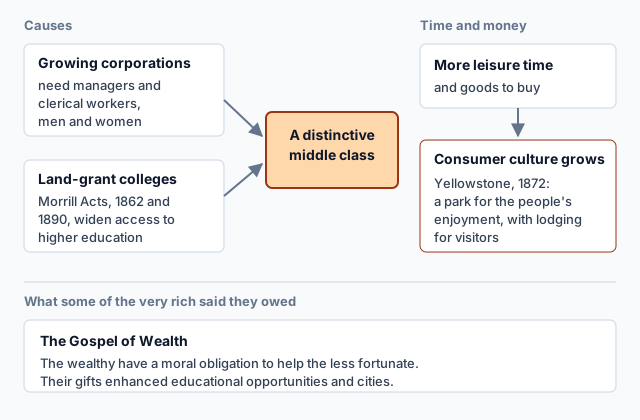
In short. After the Civil War, corporations' need for managers and clerks, men and women, together with wider access to schools and colleges, built a distinctive middle class, while more leisure time helped a consumer culture grow and some wealthy leaders argued, in the Gospel of Wealth, that their fortunes carried a duty to improve society.
- Growing corporations needed managers and male and female clerical workers, and those jobs, with more access to education, fostered a distinctive middle class.
- A growing amount of leisure time helped expand consumer culture; in 1872 Congress set Yellowstone aside as "a public park or pleasuring-ground for the benefit and enjoyment of the people."
- The Gospel of Wealth held that the wealthy had a moral obligation to help the less fortunate, and philanthropists gave to education and to cities.
Part 2 Learn it A middle class of offices, schools and leisure
2a. Office jobs and wider schooling
As corporations grew (Topic 6.6), someone had to run each office and keep the accounts and records. Corporations' need for managers and for clerical workers, both men and women, opened jobs that were neither manual labor nor ownership. Together with increased access to educational institutions, these jobs fostered the growth of a distinctive middle class.
The Morrill Act, passed on July 2, 1862, let states sell federal land grants to fund public colleges. Each college was to teach agriculture and the mechanic arts "to promote the liberal and practical education of the industrial classes in the several pursuits and professions in life." An 1866 amendment, printed in the National Archives transcript, set acceptance "within three years from July 23, 1866," so states were still accepting grants after the war. The National Archives notes that these schools, Cornell and Nebraska among them, opened higher education to thousands of farmers and working people once shut out, and that over 10 million acres of the grant land were taken from Native nations.
Many of these colleges shut out people of color. The Second Morrill Act of 1890, aimed chiefly at the former Confederate states, required states to show that admission was not restricted by race or to establish separate land-grant colleges for Black students. Alabama A&M and Prairie View A&M were among the historically Black colleges that resulted.
Source: Morrill Act, with the National Archives' introduction.
Quick check · Multiple choice
The Morrill Act told its colleges "to promote the liberal and practical education of the industrial classes in the several pursuits and professions in life." How does that goal fit the growth of a middle class after the Civil War?
2b. Leisure time and a culture of buying
A growing amount of leisure time also helped expand consumer culture, a way of life built around buying goods and services, entertainment included.
Travel for pleasure shows the change. On March 1, 1872, Congress made Yellowstone the first federally protected national park. The act set the land aside as "a public park or pleasuring-ground for the benefit and enjoyment of the people." It let the Secretary of the Interior lease small plots for buildings "for the accommodation of visitors," so hotels and services for tourists were part of the plan from the start.
The National Archives adds two details. Western sites such as Yosemite and Yellowstone became popular vacation destinations. And Jay Cooke, a railroad magnate, supported the campaign for the park, expecting more tourists to ride his lines into the region.
Put those pieces together. A park kept for the people's enjoyment, buildings for paying visitors, and a railroad that hoped to sell tickets: leisure was becoming something Americans spent money on, and businesses were ready to sell it.
Source: Act Establishing Yellowstone National Park, with the National Archives' introduction.
Quick check · Match
Match each piece of evidence about Yellowstone to what it shows about leisure in the period.
2c. The Gospel of Wealth
Some business leaders argued that the wealthy had a moral obligation to help the less fortunate and to improve society. The idea is known as the Gospel of Wealth. The course framework names Andrew Carnegie's essay The Gospel of Wealth, published in the North American Review in June 1889, as a statement of it. Leaders who held this view made philanthropic contributions, large gifts for public purposes, that enhanced educational opportunities and urban environments. The framework also notes that John D. Rockefeller hired Frederick T. Gates in 1892 to guide his giving.
Set it beside Social Darwinism from Topic 6.9. Social Darwinism justified the success of those at the top as both appropriate and inevitable. The Gospel of Wealth started from the same fact, that some Americans were very rich, and asked a different question: what do they owe? Its answer was that great wealth carried a duty to improve society.
Charity in general was already growing. Three months before Carnegie's essay, at his inauguration on March 4, 1889, Benjamin Harrison listed it among the nation's gains, beside religion and temperance: "The sweet offices of charity have greatly increased." The Gospel of Wealth put a sharper claim on top of that: the very rich in particular owed society their help.
Source: Inaugural Address of Benjamin Harrison (Avalon Project). No public-domain text of Carnegie's essay is on the archives this lesson checks against, so it is described here, not quoted.
Quick check · Sort it
Each card states an idea about wealth in the Gilded Age. Tap a card, then the idea it belongs to.
Gospel of Wealth
Social Darwinism
Part 3 Watch it done Put Harrison's 1889 claims in context
Watch each step, then do the last one yourself.
On March 4, 1889, at his inauguration, President Benjamin Harrison said: "The masses of our people are better fed, clothed, and housed than their fathers were. The facilities for popular education have been vastly enlarged and more generally diffused." Explain how his claim fits within the broader context of the period.
Predict first
Before the steps, which part of the period do you think best explains Harrison's claim about education?
Step 1 · Say what the source claims, and who claims it
Harrison claims two gains: more Americans live better than their parents did, and schooling is wider and easier to reach. He is a new president speaking to the whole nation on a day meant for confidence.
Why this step?
Why name the speaker and the occasion before the context?
Because contextualizing means placing the claim in the developments around it, and you need to know exactly what is claimed, and in what spirit, before you can say which developments explain it.
Step 2 · Find the broader developments it belongs to
Now look outside the speech. Ask what had been changing in the years before 1889 in the kinds of jobs companies offered, and in who could reach schools and colleges. Then ask which of those changes Harrison's two claims depend on.
Your step · Decide and justify
Finish it. Which context best explains Harrison's claim about wider schooling and better living?
Which evidence best supports your answer?
Part 4 Try it A warning about spending
Four years after Harrison, at his second inauguration on March 4, 1893, President Grover Cleveland warned against "any tendency in public or private station to regard frugality and economy as virtues which we may safely outgrow." Frugality means careful, sparing use of money. He went on: "The toleration of this idea results in the waste of the people's money by their chosen servants and encourages prodigality and extravagance in the home life of our countrymen." Prodigality means wasteful spending. And: "frugality among the people is the best guaranty of a contented and strong support of free institutions."
Most of the speech around these lines is about government: tariff protection, subsidies and public spending. But here he reaches into private homes too.
Source: Second Inaugural Address of Grover Cleveland (Avalon Project).
Try it · Spot the error
A student writes a contextualization paragraph on Cleveland's 1893 warning. Which line is the first to go wrong?
Try it · Multiple choice
Which broader development best helps a historian make sense of a president's worry, in 1893, about extravagance in American homes?
Now go back two decades. In 1872 Congress set Yellowstone aside as "a public park or pleasuring-ground for the benefit and enjoyment of the people," and allowed leases of small plots "for the accommodation of visitors."
Source: Act Establishing Yellowstone National Park (National Archives).
Try it · Fill the statement
Complete a contextualization of the Yellowstone Act.
In 1872 Congress set Yellowstone aside "for the benefit and enjoyment of the people" and allowed buildings "for the accommodation of visitors." The act is an early sign of a change that ran through the period: a growing amount of helped expand .
Part 5 Explain it Write it like a document-based answer
Nothing you type leaves this page. Check your answer against the model and each scoring point.
Free-response practice · Question 1 style
A short practice in the shape of the document-based question: three documents instead of seven, and a thesis with one body paragraph instead of a full essay.
Evaluate the extent to which economic growth changed how Americans lived between 1865 and 1898.
Document 1. Act Establishing Yellowstone National Park, March 1, 1872: the land is set apart as "a public park or pleasuring-ground for the benefit and enjoyment of the people," with leases of small plots "for the accommodation of visitors."
Document 2. Inaugural Address of Benjamin Harrison, March 4, 1889: "The masses of our people are better fed, clothed, and housed than their fathers were. The facilities for popular education have been vastly enlarged and more generally diffused." And: "Not all of our people are happy and prosperous."
Document 3. Second Inaugural Address of Grover Cleveland, March 4, 1893: tolerating "any tendency in public or private station to regard frugality and economy as virtues which we may safely outgrow" wastes public money and "encourages prodigality and extravagance in the home life of our countrymen," while "frugality among the people is the best guaranty of a contented and strong support of free institutions."
Write a thesis, one sentence of historical context, and one paragraph that uses at least two documents and explains the purpose, audience, point of view or situation of one of them.
Model answer
Thesis: Between 1865 and 1898 economic growth greatly changed how a growing middle class lived, bringing more schooling, leisure and spending, but the change was uneven, and even its boosters admitted that many Americans were left out.
Context: as corporations grew, they needed managers and male and female clerical workers, and land-grant colleges opened higher education to farmers and working people, so a distinctive middle class took shape.
By 1872 Congress was setting aside land as a "pleasuring-ground" for the people's enjoyment, with lodging for visitors (Document 1), a sign that travel for pleasure had become something Americans spent money on. Harrison claimed in 1889 that most Americans were better fed and housed than their parents and that education was far more widely available (Document 2). As a new president speaking to the nation on a day meant for confidence, he had every reason to stress progress, so his claim is stronger evidence of how leaders saw the country than of how every family lived, and he conceded that "Not all of our people are happy and prosperous." Cleveland's 1893 warning about "extravagance in the home life of our countrymen" (Document 3) shows that a president thought private spending worth warning against, a concern that fits a growing consumer culture, though it does not measure what families spent. Growth changed daily life for many, but not for all.
Score your own answer. This is a self-check, not a grade. Tick each point your answer makes.
Part 6 Check yourself What two presidents noticed
The case questions use the excerpts in the table. The others mix the ideas from the whole lesson.
Three passages from two inaugural addresses, four years apart. Sources: Harrison, 1889 (Avalon Project); Cleveland, 1893 (Avalon Project).
| Speech | Excerpt |
|---|---|
| Benjamin Harrison, March 4, 1889 | "The facilities for popular education have been vastly enlarged and more generally diffused." |
| Benjamin Harrison, March 4, 1889 | "The sweet offices of charity have greatly increased." |
| Grover Cleveland, March 4, 1893 | "frugality among the people is the best guaranty of a contented and strong support of free institutions" |
Case question 1 · Multiple choice
Which development of the period best explains Harrison's claim about popular education?
Case question 2 · Multiple choice
Harrison's line about charity fits best with which idea that took shape in the same years?
Case question 3 · Select all
Which two facts should a historian weigh before using Harrison's 1889 claims as proof that most Americans were doing well? Select two.
Select 2 answers, then check.
The rest stand on their own and do not use the case.
Check yourself · Put it in order
Put these events in the order they happened, earliest first.
Check yourself · Fill the statement
Complete the comparison of two ideas about wealth.
Social Darwinism described the success of those at the top as . The Gospel of Wealth said the wealthy had a to help the less fortunate and improve society.
Check yourself · Sort it
Tap a card, then the change it belongs to.
Helped build the new middle class
Grew out of more leisure time
Part 7 Keep it Bring back earlier ideas
This lesson stands on the responses to immigration from Topic 6.9 and the rise of industrial capitalism from Topic 6.6.
Bring it back · Multiple choice
In a large city in the 1890s, a woman moves into a house in a poor neighborhood, where she runs English classes and helps newly arrived families find their way in American life. Her work is an example of which response to immigration?
Bring it back · Multiple choice
In the late 1800s, the owners of many competing companies hand control of their firms to a single board that runs them all together. What did business leaders seek from this kind of arrangement, and what was one result?
In three lines
- Corporations' need for managers and male and female clerks, with wider access to schools and colleges, fostered a distinctive middle class.
- More leisure time helped consumer culture grow, from vacation travel to a national park kept for the people's enjoyment.
- The Gospel of Wealth said the wealthy owed help to the less fortunate, and their gifts went to education and cities.
Exam strategy for this topic
- Section I Part A, Multiple Choice: 55 questions in 55 minutes.
- Section I Part B, Short Answer: 3 questions in 40 minutes.
- Section II, Document-Based Question and Long Essay: 2 questions in 100 minutes.
- This lesson's Explain it is shaped like free-response question 1, Document-based.
To earn the context point, name a specific development outside the documents, such as corporations' need for clerks or the land-grant colleges, and say in a sentence how it connects to the prompt.
Questions students ask
What made this middle class new?
Its jobs. Growing corporations needed managers and male and female clerical workers, work that was neither manual labor nor ownership, and more Americans could reach the schooling those jobs called for.
Who wrote The Gospel of Wealth?
The course framework names Andrew Carnegie's essay of that title, published in the North American Review in June 1889. This lesson describes the idea rather than quoting it, because no public-domain copy is on the archives it checks against.
Why is a national park in a lesson about the middle class?
Because a growing amount of leisure time helped expand consumer culture. Yellowstone, set aside in 1872 for the people's enjoyment, with lodging for visitors and a railroad hoping for tourists, shows leisure becoming something Americans spent money on.
Did everyone share in the new opportunities?
No. Many land-grant colleges shut out people of color until the Second Morrill Act of 1890, the land for the grants was largely taken from Native nations, and even Harrison admitted in 1889 that not all Americans were happy and prosperous.
Where can I read these documents in full?
Each excerpt links to its full text at the National Archives or the Avalon Project at Yale Law School, the primary-source collections this lesson was checked against.
Course alignment, for teachers
AP U.S. History topic 6.10, Unit 6: Period 6: 1865–1898.
- Skill 4.B: Explain how a specific historical development or process is situated within a broader historical context.
This lesson maps all 2 essential knowledge statements of the topic, and the one learning objective with none of its own, to the part that teaches each one: 3 are checked by a scored question. The map is in the lesson file.