Unit 7 · Topic 7.8 · about 30 minutes · 7 parts · 13 scored checks, 5 of them multiple choice
AP U.S. History 7.8: 1920s: Cultural and Political Controversies
Unit 7: 10 to 17% of the multiple-choice section
What you'll be able to do
- Explain the causes and effects of migration in the 1910s and 1920s: the move to cities, the Great Migration, and the quota laws that restricted immigration from southern and eastern Europe and from Asia.
- Explain the causes and effects of the cultural developments of the 1920s, from the Harlem Renaissance to the controversies over gender roles, modernism, science, religion, race and immigration.
Key vocabulary
| Term | What it means | The exam trap |
|---|---|---|
| Nativism | The belief that people born in the country should be favored over newcomers, often joined to hostility toward particular immigrant groups. | Nativism is a belief or movement; a quota is a law. Keep the cause and the policy separate. |
| Quota | A fixed limit on how many people from a group may enter or be admitted. | A quota is one kind of barrier; earlier laws had already shut out some Asian immigrants entirely. |
| Great Migration | The movement of Black southerners to cities of the North, Midwest and West, beginning in the 1910s. | It is a migration within the United States, not immigration from abroad. |
| Harlem Renaissance | A flowering of African American art, music and writing centered in Harlem, New York. | The name is for a cultural movement, so expect music, theater and writing, not one art form. |
| Modernism | New ideas and styles in the arts, science and religion that broke with tradition. | Modernism names a set of ideas and styles, not simply anything that happened in the modern era. |
 Tap to open the picture full size
Part 1 Think first A formula with a purpose
Commit to a guess first. Being wrong now makes the right idea stick better.
Predict first
The Immigration Act of 1924 limited each nationality to 2 percent of the people of that nationality living in the United States as counted by the census of 1890, more than thirty years earlier. Which immigrants do you think the law was written to limit most?
In short. By 1920 most Americans lived in cities, which drew women, immigrants and Black southerners with new opportunities, and the 1920s then split the country over immigration quotas, gender roles, Prohibition, religion, science and race, even as migrants created new art such as the Harlem Renaissance.
- Cities offered new economic opportunities to women, to international migrants and to Black southerners moving north in the Great Migration.
- After World War I, nativist campaigns produced quota laws in 1921 and 1924 that restricted immigration, particularly from southern and eastern Europe, and raised barriers to Asian immigration.
- Migration gave rise to new art and literature, such as the Harlem Renaissance, while Americans argued over gender roles, modernism, science, religion and race.
Part 2 Learn it Migration, art and argument in the 1920s
2a. A nation of cities
By 1920 a majority of Americans lived in urban centers. A National Archives exhibit calls the country of the 1920s "a nation that was now predominately urban." Cities offered new economic opportunities to three groups the course framework names.
Women. A growing number had attended college and entered the work force since the late 1800s, usually in teaching or social work. During World War I, "Women found themselves working in jobs previously closed to them."
International migrants. The course framework names immigrants from abroad among the groups the cities drew, until the laws of 1921 and 1924 cut their numbers.
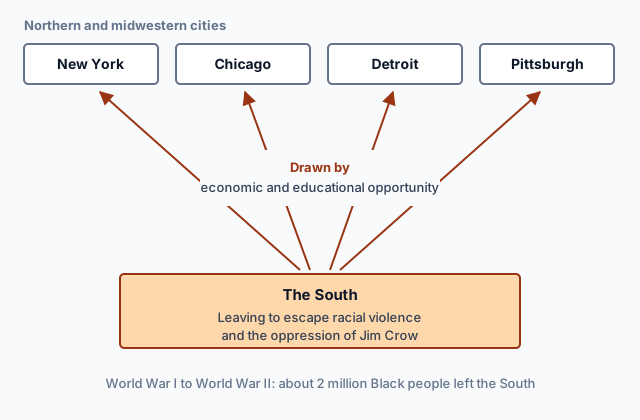
Internal migrants. In the Great Migration, Black southerners moved north. "The First Great Migration (1910-1940) had Black southerners relocate to northern and midwestern cities including: New York, Chicago, Detroit, and Pittsburgh." They went to "escape racial violence, pursue economic and educational opportunities, and obtain freedom from the oppression of Jim Crow." The war opened the door: "When the war effort ramped up in 1917, more able bodied men were sent off to Europe to fight leaving their industrial jobs vacant."
Opportunity was not equality. The same exhibit notes that prosperity did not extend to all groups.
Sources: The Great War and the New Era (National Archives); The Great Migration (National Archives).
Quick check · Multiple choice
A historian writes that by 1920 American cities offered women new economic opportunities. Which example best supports that claim?
2b. Closing the door: nativism and quotas
Nativism is the belief that people born in the country should be favored over newcomers, often joined to fear or dislike of particular immigrant groups. After World War I, nativist campaigns against some ethnic groups pushed Congress toward "quotas and requirements pertaining to national origin." A quota is a fixed limit on how many people from a group may enter.
Congress passed two restriction laws, in 1921 and 1924. The Immigration Act of 1924 set each nationality's limit at 2 percent of the people of that nationality living in the United States as recorded in the 1890 census. The aim, in the National Archives' words: "Congress shifted its attention to limiting immigration from a wider variety of countries, including many in Southern and Eastern Europe and all of Asia." The course framework adds that the laws increased barriers to Asian immigration, which earlier laws had already narrowed: the Chinese Exclusion Act of 1882 had banned Chinese laborers outright.
The laws worked as intended: "As a result of two immigration restriction laws passed in 1921 and 1924, the number of foreigners entering America had declined precipitously." Immigrants already here faced Americanization programs that tried to strip away their native customs and habits.
Sources: Chinese Exclusion Act and later laws (National Archives); The 1930 Census in Perspective (National Archives).
Quick check · Fill the statement
Complete the notes on the Immigration Act of 1924.
The act limited each nationality to of the people of that nationality living in the United States in . It aimed to limit immigration from many countries of southern and eastern Europe and from .
2c. The Harlem Renaissance
Migration did more than move workers. The course framework says it gave rise to new forms of art and literature that expressed ethnic and regional identities, and its main example is the Harlem Renaissance.
The National Archives describes it this way: "The African American community's first major expression of its culture, intelligence, and society happened in the early twentieth century." Starting in the 1910s in Harlem, a neighborhood of Manhattan in New York City, "the cultural explosion quickly attracted curious onlookers from outside of the community." Harlem is in New York, one of the cities the Great Migration filled, and the movement grew from the people who came.
It reached past Harlem. "Jazz music was morphing from its origins in New Orleans into new forms in Kansas City, and Washington, DC." In 1922, the National Archives says, Paul Robeson gave up football and law to focus on the stage, and used his fame to fight racism. W.E.B. Du Bois edited The Crisis, the NAACP's monthly magazine.
Source: Arts, Intellectuals, and Entertainment during World War I (National Archives).
Quick check · Match
Match each name to its place in the cultural movement that grew out of migration.
2d. The culture wars of the 1920s
Fast change brought sharp argument. The course framework lists what Americans debated: gender roles, modernism (new ideas and styles that broke with tradition), science, religion, race and immigration.
Gender roles. The 19th Amendment, ratified on August 18, 1920, says the vote "shall not be denied or abridged by the United States or by any State on account of sex." "In the 1920s, this image of the new woman merged with a more sexualized, urbane image of the flapper." Young women of the 1920s were in fact more likely to marry than older women, yet "social conservatives continued to fear that women's expanded educational and career ambitions would cause them to postpone marriage and childbearing."
Prohibition. The 18th Amendment banned the manufacture, sale and transportation of alcoholic liquor. "Enforcing Prohibition proved to be extremely difficult"; "by 1925 in New York City alone there were anywhere from 30,000 to 100,000 speakeasy clubs."
Science. Faith in science was part of modernism. A National Archives history of the 1930 census finds in its questions "twentieth-century optimism regarding the potential for science to explain society's ills," while other questions "reveal the persistence of older racial views."
Race. "The Red Summer of 1919 was rooted in tensions and prejudice that arose from white people having to adjust to the demographic changes in their local communities."
Sources: 19th Amendment (National Archives); The Volstead Act (National Archives); The Great Migration (National Archives).
Quick check · Sort it
Each card is a development of the late 1910s and 1920s. Tap a card, then the side of the decade's debates it belongs to.
Pushing toward change
Pushing back against change
Part 3 Watch it done Put Hoover's words on Prohibition in context
Watch each step, then do the last one yourself.
In his inaugural address of March 4, 1929, President Herbert Hoover spoke "Of the undoubted abuses which have grown up under the eighteenth amendment," blaming part of them on "the failure of some States to accept their share of responsibility for concurrent enforcement." Explain the broader context that shaped this statement.
Predict first
Before the steps, what do you think Hoover was responding to?
Step 1 · Name the development
The 18th Amendment banned the manufacture, sale and transportation of alcoholic liquor. Women had strongly supported the temperance movement behind it, and enough states approved it within 13 months.
Why this step?
Why look beyond the speech itself?
A statement answers a situation. If you know what had been happening for the years before it, you can tell what problem the speaker was facing and why he chose these words.
Step 2 · Place it in the broader setting
Enforcing Prohibition proved to be extremely difficult. By 1929 Hoover was speaking to a nation that had lived under the ban for years.
Your step · Decide and justify
Finish it. Which broader context best explains why a new president spoke of abuses under the eighteenth amendment?
Which evidence best supports your answer?
Part 4 Try it Context in other places
Context explains documents that seem to have nothing to do with a controversy. A census form is one. A National Archives history of the 1930 census notes: "Meanwhile, the number of questions about immigration had been reduced for the 1930 census."
Try it · Multiple choice
Which broader development best explains why the 1930 census asked fewer questions about immigration than earlier censuses?
Try it · Spot the error
A student writes a paragraph placing the Harlem Renaissance in context. Which line is the first to go wrong?
Part 5 Explain it Write it like a document-based answer
Nothing you type leaves this page. Check your answer against the model and each scoring point.
Free-response practice · Question 1 style
A short practice in the shape of the document-based question: three documents instead of seven, and a thesis with one body paragraph instead of a full essay.
Evaluate the extent to which Americans in the 1920s were divided between those who welcomed change and those who resisted it.
Document 1. The 19th Amendment, ratified August 18, 1920: "The right of citizens of the United States to vote shall not be denied or abridged by the United States or by any State on account of sex."
Document 2. A National Archives history of immigration law, on the laws that followed World War I: "Congress shifted its attention to limiting immigration from a wider variety of countries, including many in Southern and Eastern Europe and all of Asia."
Document 3. President Herbert Hoover, inaugural address, March 4, 1929, speaking "Of the undoubted abuses which have grown up under the eighteenth amendment," part of which he blamed on "the failure of some States to accept their share of responsibility for concurrent enforcement."
Write a thesis, one sentence of historical context, and one paragraph that uses at least two documents and explains the purpose, audience, point of view or situation of one of them.
Model answer
Thesis: Americans in the 1920s were deeply divided over change, as new rights for women and new urban habits met restrictions on immigration and the enforcement of Prohibition, though the lines did not always fall cleanly, since both sides used the Constitution and federal law to press their goals.
Context: by 1920 most Americans lived in cities, and the arrival of immigrants and Black southerners in those cities made questions of who belonged and how to live more urgent.
The 19th Amendment (Document 1) wrote a major change into the Constitution: the vote could not be denied "on account of sex." Yet Congress also moved to limit immigrants from "Southern and Eastern Europe and all of Asia" (Document 2), an effort to hold back the newer immigration that had filled the cities. Prohibition shows the same conflict from another side. Hoover spoke as a new president at his inauguration, addressing the whole nation, and his purpose was to defend enforcement of the law; that is why he admits "undoubted abuses" but blames states that would not share "responsibility for concurrent enforcement" (Document 3). A law meant to restore an older morality was being defied in practice, and the president had to answer for it.
Score your own answer. This is a self-check, not a grade. Tick each point your answer makes.
Part 6 Check yourself Migration and the cities
The case questions use the excerpts. The others mix the ideas from the whole lesson.
Four excerpts from National Archives histories of migration in these years. Sources: The Great Migration; The 1930 Census in Perspective.
| Topic | Excerpt |
|---|---|
| The Great Migration | "The First Great Migration (1910-1940) had Black southerners relocate to northern and midwestern cities including: New York, Chicago, Detroit, and Pittsburgh." |
| Wartime jobs | "When the war effort ramped up in 1917, more able bodied men were sent off to Europe to fight leaving their industrial jobs vacant." "The labor supply was further strained with a decline in immigration from Europe" |
| The Red Summer | "The Red Summer of 1919 was rooted in tensions and prejudice that arose from white people having to adjust to the demographic changes in their local communities." |
| Immigration restriction | "As a result of two immigration restriction laws passed in 1921 and 1924, the number of foreigners entering America had declined precipitously." |
Case question 1 · Multiple choice
Which conclusion about Black migrants to northern cities do the excerpts best support?
Case question 2 · Multiple choice
Which broader development most helps explain why northern industry needed Black workers from the South in these years?
The rest stand on their own and do not use the case.
Check yourself · Put it in order
Put these events in the order they happened, earliest first.
Check yourself · Select all
A historian argues that the 1920s saw a backlash against changes in immigration and in women's lives. Which two pieces of evidence best support the argument? Select two.
Select 2 answers, then check.
Part 7 Keep it Bring back earlier ideas
This lesson stands on the mass media of Topic 7.7 and the Gilded Age debates over Americanization in Topic 6.9.
Bring it back · Multiple choice
Which statement best describes the effect of new mass media such as radio and film in the 1920s?
Bring it back · Fill the statement
Complete the sentences about immigration in the Gilded Age.
As more immigrants arrived, Americans argued over and Americanization. Many immigrants worked out between the culture they brought and the one they found.
In three lines
- By 1920 most Americans lived in cities, which offered new opportunities to women, immigrants and Black southerners in the Great Migration.
- Nativist campaigns produced the quota laws of 1921 and 1924, aimed at southern and eastern Europe and Asia.
- Migration gave rise to the Harlem Renaissance, while Americans fought over gender roles, Prohibition, religion, science and race.
Exam strategy for this topic
- Section I Part A, Multiple Choice: 55 questions in 55 minutes.
- Section I Part B, Short Answer: 3 questions in 40 minutes.
- Section II, Document-Based Question and Long Essay: 2 questions in 100 minutes.
- This lesson's Explain it is shaped like free-response question 1, Document-based.
To contextualize, name a development outside the document that was happening at the same time, then say how it shaped what the document says. A date alone is not context.
Questions students ask
Why did the 1924 law use the 1890 census?
The law tied each nationality's limit to its numbers in 1890, and the National Archives says Congress was trying to limit immigration from many countries of southern and eastern Europe and all of Asia. The older census was part of that design.
Was the Harlem Renaissance only in Harlem?
Harlem was its center, but the National Archives notes that jazz was taking new forms in Kansas City and Washington, DC, in the same years.
Did Prohibition work?
In part. A National Archives lesson notes that alcohol consumption fell, but enforcement proved extremely difficult, bootlegging became rampant, and by 1925 New York City alone had tens of thousands of speakeasies.
What does modernism have to do with science?
Modernism includes a new faith in science. A National Archives history of the 1930 census finds in its questions an optimism that science could explain society's ills, alongside older racial views that persisted. The course framework also lists science and religion among the decade's controversies.
Where can I read these sources in full?
Each excerpt links to its full text at the National Archives or the Avalon Project at Yale Law School, the collections this lesson was checked against.
Course alignment, for teachers
AP U.S. History topic 7.8, Unit 7: Period 7: 1890–1945.
- Skill 4.B: Explain how a specific historical development or process is situated within a broader historical context.
This lesson maps all 4 essential knowledge statements of the topic, and the 2 learning objectives with none of their own, to the part that teaches each one: 6 are checked by a scored question. The map is in the lesson file.