Unit 8 · Topic 8.11 · about 30 minutes · 7 parts · 13 scored checks, 4 of them multiple choice
AP U.S. History 8.11: The Civil Rights Movement Expands
Unit 8: 10 to 17% of the multiple-choice section
What you'll be able to do
- Explain how and why various groups responded to calls for the expansion of civil rights from 1960 to 1980, and how their movements related to the African American civil rights movement.
Key vocabulary
| Term | What it means | The exam trap |
|---|---|---|
| Feminism | The movement for women's legal, economic and social equality with men. | Feminists of these years worked both through law and through challenges to custom; one does not rule out the other. |
| Equal Rights Amendment | A proposed amendment, first drafted in 1923 and sent to the states in 1972, guaranteeing equal rights under the law regardless of sex. | Congress passed it, but it was never ratified by enough states to become part of the Constitution. |
| Redress | A remedy for a past injustice, such as an official apology, compensation or the return of what was taken. | Ending an unjust policy can be a first step toward redress; it is not the same as the remedy the wronged group sought. |
| Termination | The federal policy, announced in 1953, of ending federal recognition of tribes and the aid and protections that came with it. | Termination did not grant Indians citizenship; they had been citizens since 1924. |
| Self-determination | The federal Indian policy, from 1970, of letting tribes govern their own affairs. | Self-determination puts tribes, not states, in charge; it reversed the transfer of power to states that termination began. |
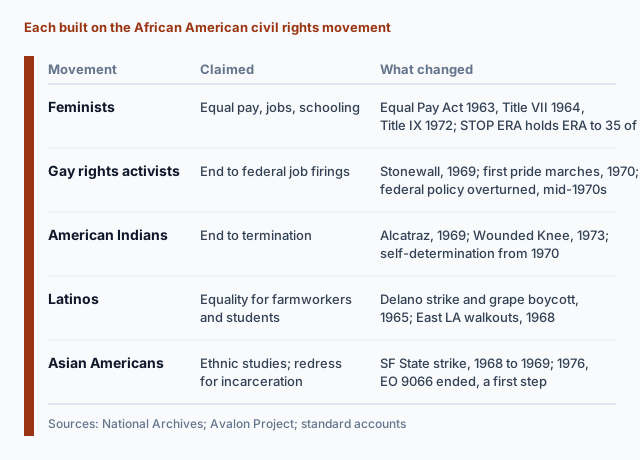 Tap to open the picture full size
Part 1 Think first Who else could use the law?
Commit to a guess first. Being wrong now makes the right idea stick better.
Predict first
The Civil Rights Act of 1964 grew out of the African American freedom struggle and a bill meant to guarantee equal treatment regardless of race. Title VII of the act, on jobs, bans discrimination on several grounds. Which of these do you think it also covers?
In short. Responding to social conditions and to the African American civil rights movement, feminists, gay rights activists and Latino, American Indian and Asian American movements claimed legal, economic and social equality and redress of past injustices, and from 1963 to 1980 they won new laws and changes in federal policy, though the Equal Rights Amendment fell short.
- Feminists, organized in groups such as NOW, won the Equal Pay Act, a ban on sex discrimination in jobs and Title IX, but Phyllis Schlafly's STOP ERA helped stall the Equal Rights Amendment at 35 of the 38 states it needed.
- Gay rights activists such as Frank Kameny challenged firings from federal jobs, and the Stonewall Uprising of 1969 became a turning point in the struggle for equal protection.
- Farmworkers led by Cesar Chavez and Dolores Huerta, Chicano and Asian American students, and American Indian activists at Alcatraz and Wounded Knee pressed for equality and redress, and federal Indian policy turned to self-determination.
Part 2 Learn it More movements for equality
2a. Feminists and the law
Feminism is the movement for women's legal, economic and social equality with men. In 1963 Betty Friedan's book The Feminine Mystique described the frustration of educated women confined to the home, and in 1966 she helped found the National Organization for Women (NOW) to press for equal treatment.
The first laws came in the workplace. The Equal Pay Act of June 10, 1963, was written "To prohibit discrimination on account of sex in the payment of wages." In 1964 Representative Howard Smith of Virginia, an opponent of the civil rights bill, proposed adding sex to its ban on job discrimination, and Representative Martha Griffiths was instrumental in keeping it there, so Title VII covers sex as well as race. In 1972 President Nixon signed the Education Amendments, whose Title IX bars sex discrimination in any education program receiving federal money.
The largest goal was the Equal Rights Amendment (ERA), first drafted in 1923 by the suffragist Alice Paul, which "guaranteed equal rights under the law for Americans regardless of their sex." The House approved it in 1971 and the Senate in March 1972, sending it to the states with a seven-year deadline.
Sources: Equal Pay Act (Avalon Project); Women's Rights legislation; Martha Griffiths and the ERA (National Archives).
Quick check · Fill the statement
Complete a student's notes on what feminists won.
Feminists won a law against unequal pay in and a ban on sex discrimination in education programs that receive federal money, known as . Their biggest goal, the Equal Rights Amendment, was never added to the .
2b. Women's liberation, and the fight over the ERA
Younger feminists went further. Many had worked in the civil rights and antiwar movements and found themselves kept out of leadership there. In women's liberation groups they met to talk about their own lives, a practice called consciousness-raising. Like others in the 1960s counterculture, they rejected many of the social, economic and political values of their parents' generation, and they pressed for changes in sexual norms, the unwritten rules about sex, dating and marriage. In 1968 activists protested the Miss America pageant in Atlantic City for judging women by their looks, and in 1970 a Boston women's collective published Our Bodies, Ourselves, a frank guide to women's health.
Not all women agreed. In 1972 Phyllis Schlafly, a conservative activist, founded STOP ERA. She and her allies argued that the amendment would subject women to the draft, end legal protections for wives and homemakers, and erase rules that kept the sexes apart. Ratification stalled. Congress extended the deadline to June 30, 1982, but by then only 35 states had ratified, three short of the 38 needed.
Sources: Martha Griffiths and the ERA; Equal Rights Amendment (National Archives).
Quick check · Multiple choice
Which of these women of the late 1960s best fits the feminists who took part in the counterculture?
2c. Gay rights activists
By the 1950s, in the climate of the Cold War, hundreds of gay men and lesbians were fired from or refused federal jobs, in what is known as the Lavender Scare.
Frank Kameny, an astronomer for the Army Map Service, was one of them. He fought his firing through appeals and then in the courts, petitioning the Supreme Court in January 1961. He co-founded the Washington, DC, branch of the Mattachine Society, an early gay rights group, and organized the earliest protests for gay rights in the 1960s.
On June 28, 1969, New York City police raided the Stonewall Inn, a gay bar in Greenwich Village. Patrons fought back, and protests went on until July 3. The National Archives writes: "The Stonewall Uprising is considered one of the seminal moments in the struggle for LGBTQIA+ equal protection rights." Afterward the movement grew louder. Groups such as the Gay Liberation Front formed, and in June 1970 the first pride marches marked Stonewall's anniversary. In 1973, under pressure from activists including Kameny, the American Psychiatric Association stopped classifying homosexuality as a mental illness. The federal policy against gay employees was overturned in the mid-1970s.
Sources: LGBTQIA+ records; LGBTQIA+ protest and reform (National Archives).
Quick check · Put it in order
Put these events in the order they happened, earliest first.
2d. Latino and Asian American movements
Latino and Asian American movements continued older demands for social and economic equality and for redress, a remedy such as an apology, compensation or restored rights for a past injustice.
In 1965 Filipino and Mexican American grape pickers struck at Delano, California. Cesar Chavez and Dolores Huerta, co-founders of the union that became the United Farm Workers, led a nonviolent strike and a nationwide grape boycott that won union contracts in 1970. Young Chicanos, as many Mexican Americans now called themselves, built a movement of their own: in 1968 thousands of students walked out of East Los Angeles high schools to protest poor schools.
In 1968 students in California adopted the name Asian American for a movement joining Chinese, Japanese, Filipino and Korean Americans. At San Francisco State, Asian American, Black and Latino students struck in 1968 and 1969 and won the nation's first college of ethnic studies. In Lau v. Nichols (1974), a case brought for Chinese American children, the Supreme Court ruled that schools must help students who do not speak English. Japanese Americans began a campaign for redress for their wartime incarceration. In 1976 President Ford formally ended the order behind it, a first step; the campaign for an apology and compensation went on into the 1980s.
Sources: Hispanic heritage records; Asian American and Pacific Islander Heritage Month (National Archives).
Quick check · Sort it
Each card is a step a movement took or won. Tap a card, then say which demand it served most directly.
Economic and social equality
Redress of a past injustice
Part 3 Watch it done Connect two movements through one law
Watch each step, then do the last one yourself.
The Civil Rights Act of 1964 grew out of the African American civil rights movement. Explain how that development relates to the legal gains of the women's movement.
Predict first
Before the steps, how do you think the two are most likely connected?
Step 1 · Name the first development
The Civil Rights Act came out of years of sit-ins and marches and a bill President Kennedy proposed to guarantee equal treatment of every American regardless of race. It was, first, a law for racial equality.
Why this step?
Why name the earlier development first?
Relating two developments means showing how one shaped the other. You need to know what the first one was, and what it was for, before you can show what it passed on.
Step 2 · Find where the two meet
In 1964 Representative Howard Smith of Virginia, who opposed the bill, proposed adding sex to its ban on job discrimination. Representative Martha Griffiths of Michigan was instrumental in getting that change passed, and it stayed in the final law.
Your step · Decide and justify
Finish it. How does the Civil Rights Act of 1964 relate to the women's movement's legal gains?
Which evidence best supports your answer?
Part 4 Try it American Indian activism and the end of termination
On August 1, 1953, Congress announced the policy known as termination in House Concurrent Resolution 108. It aimed to make American Indians subject to the same laws as other citizens and "to end their status as wards of the United States." Termination ended federal recognition of affected tribes, and with it the federal aid and services that came with recognition. From 1953 until 1970, Congress began 60 termination proceedings, and tribes gave up over three million acres of land.
American Indians fought back. In March 1968 President Johnson sent Congress a special message titled "The Forgotten American." In November 1969 a group calling itself Indians of All Tribes occupied Alcatraz Island in San Francisco Bay and held it until 1971. In July 1970 President Nixon told Congress that termination was wrong, and his administration shifted federal policy toward self-determination, tribes governing their own affairs. Protest went on: in 1972 the American Indian Movement (AIM) led the Trail of Broken Treaties caravan to Washington, and in 1973 AIM members occupied Wounded Knee, South Dakota, the site of the 1890 massacre, for more than two months. Congress restored federal recognition to the Menominee Tribe in 1973 and passed the Indian Self-Determination and Education Assistance Act in 1975.
Sources: Termination records (National Archives); Native American Heritage Month (National Archives).
Try it · Multiple choice
How does American Indian activism relate to the federal turn away from termination?
Try it · Spot the error
A student writes a paragraph on House Concurrent Resolution 108. Which line is the first to go wrong?
Part 5 Explain it Write it like a document-based answer
Nothing you type leaves this page. Check your answer against the model and each scoring point.
Free-response practice · Question 1 style
A short practice in the shape of the document-based question: three documents instead of seven, and a thesis with one body paragraph instead of a full essay.
Evaluate the extent to which women's rights activists achieved legal equality between 1963 and 1982.
Document 1. Equal Pay Act, June 10, 1963, its title: "To prohibit discrimination on account of sex in the payment of wages."
Document 2. Civil Rights Act of 1964, Title VII, which makes it unlawful for an employer to discriminate against any individual "because of such individual's race, color, religion, sex, or national origin."
Document 3. President Jimmy Carter, proclamation declaring August 26, 1978, Women's Equality Day, issued in 1978 as the Equal Rights Amendment's ratification deadline neared: "In a society that is free, democratic, and humane, there can be no time limit on equality."
Write a thesis, one sentence of historical context, and one paragraph that uses at least two documents and explains the purpose, audience, point of view or situation of one of them.
Model answer
Thesis: Between 1963 and 1982 women's rights activists won a good deal of legal equality in pay, jobs and education, but fell short of their largest goal, equality written into the Constitution.
Context: the African American civil rights movement had shown how protest and federal law could attack discrimination, and feminists used both its methods and its laws.
The Equal Pay Act (Document 1) made unequal pay for women illegal in 1963, and Title VII (Document 2) added sex to the grounds on which employers could not discriminate, a ban Representative Martha Griffiths helped place in a law written for racial equality. Title IX extended the same principle to education in 1972. Carter's proclamation (Document 3) shows the limit. He wrote as a president who supported the ERA, in 1978, when the amendment lacked the states it needed and its deadline was close, so his claim that there can be "no time limit on equality" was an argument for extending the deadline, not a description of the law. Organized opposition, led by Phyllis Schlafly's STOP ERA, had stalled ratification. Congress did extend the deadline, to June 30, 1982, but only 35 of the 38 states needed had ratified it by then. Women gained equality in statutes but not in the Constitution.
Score your own answer. This is a self-check, not a grade. Tick each point your answer makes.
Part 6 Check yourself Federal answers, 1970 to 1976
The case questions use the table. The others mix the ideas from the whole lesson.
The table lists federal actions of the early and middle 1970s that answered the claims of several movements. Sources: Termination (National Archives); Women's Rights legislation (National Archives); Martha Griffiths and the ERA (National Archives); Asian American and Pacific Islander Heritage Month (National Archives); LGBTQIA+ records (National Archives).
| When | Group | Federal action |
|---|---|---|
| 1970 | American Indians | Nixon administration repudiates termination and turns policy toward self-determination |
| 1972 | Women | Title IX bars sex discrimination in education programs that receive federal money |
| 1972 | Women | Congress sends the Equal Rights Amendment to the states, with a seven-year deadline |
| 1973 | Menominee Tribe | Congress restores the federal recognition that termination had ended |
| 1976 | Japanese Americans | President Ford formally ends the order behind their wartime incarceration |
| Mid-1970s | Gay and lesbian Americans | The federal policy of firing or refusing gay workers is overturned |
Case question 1 · Multiple choice
Which two rows come closest to redress, a remedy for a particular past wrong, rather than a rule for equal treatment going forward?
Case question 2 · Select all
Which two statements does the table support? Select two.
Select 2 answers, then check.
The rest stand on their own and do not use the case.
Check yourself · Match
Match each person to what they did.
Check yourself · Fill the statement
Complete the notes on the Equal Rights Amendment.
Congress sent the Equal Rights Amendment to the states in . By the extended deadline of June 30, 1982, states had ratified it, short of the it needed.
Part 7 Keep it Bring back earlier ideas
This lesson stands on the African American civil rights movement from Topic 8.10 and the challenges to postwar conformity from Topic 8.5.
Bring it back · Multiple choice
In 1966 a civil rights leader rallies marchers in Mississippi with a call for Black Power. What does the call most directly show?
Bring it back · Fill the statement
Read the situation, then complete the sentence.
In the 1950s families from Maine to California watched the same few network shows and shopped at the same chain stores, while Beat writers and young rock and roll fans pushed back against the pressure to . Historians describe that postwar mass culture as increasingly .
In three lines
- Responding to social conditions and to the African American movement, feminists and LGBTQ+ activists mobilized for legal, economic and social equality.
- Feminists of the counterculture rejected many of their parents' values and advocated changes in sexual norms.
- Latino, American Indian and Asian American movements demanded social and economic equality and redress of past injustices.
Exam strategy for this topic
- Section I Part A, Multiple Choice: 55 questions in 55 minutes.
- Section I Part B, Short Answer: 3 questions in 40 minutes.
- Section II, Document-Based Question and Long Essay: 2 questions in 100 minutes.
- This lesson's Explain it is shaped like free-response question 1, Document-based.
When you connect a later movement to the African American civil rights movement, name the specific thing that carried over, such as a law, a method or the idea of equal protection, rather than saying the movements were alike.
Questions students ask
Did the women's movement get anything from the Civil Rights Act of 1964?
Yes. Title VII bars job discrimination "because of such individual's race, color, religion, sex, or national origin," and Representative Martha Griffiths was instrumental in getting the ban on sex discrimination added.
Why did the Equal Rights Amendment fail?
An amendment needs three-fourths of the states. After Congress sent the ERA out in 1972, Phyllis Schlafly's STOP ERA and its allies argued it would draft women, end protections for wives and homemakers and erase rules separating the sexes. Ratification stalled, and by the extended deadline of June 30, 1982, only 35 of the 38 states needed had ratified it.
What was the Stonewall Uprising?
On June 28, 1969, New York City police raided the Stonewall Inn, a gay bar in Greenwich Village. Patrons fought back, and protests went on until July 3. The National Archives calls it one of the seminal moments in the struggle for LGBTQIA+ equal protection rights.
What did American Indian activists want changed?
Above all, an end to termination, which from 1953 to 1970 cost tribes federal recognition and over three million acres. Activists occupied Alcatraz Island from 1969 to 1971, and AIM led the Trail of Broken Treaties in 1972 and the occupation of Wounded Knee in 1973. Federal policy turned to self-determination in 1970, and Congress passed the Indian Self-Determination and Education Assistance Act in 1975.
What was the Asian American movement?
In 1968 students in California adopted the name Asian American for a movement joining Chinese, Japanese, Filipino and Korean Americans. They won ethnic studies through the San Francisco State strike of 1968 and 1969, pressed for language help in schools, upheld in Lau v. Nichols (1974), and began the Japanese American campaign for an apology and compensation for wartime incarceration.
Course alignment, for teachers
AP U.S. History topic 8.11, Unit 8: Period 8: 1945–1980.
- Skill 5.B: Explain how a historical development or process relates to another historical development or process.
This lesson maps all 3 essential knowledge statements of the topic, and the one learning objective with none of its own, to the part that teaches each one: 4 are checked by a scored question. The map is in the lesson file.