Unit 3 · Topic 3.10 · about 30 minutes · 7 parts · 13 scored checks, 3 of them multiple choice
AP U.S. History 3.10: Shaping a New Republic
Unit 3: 10 to 17% of the multiple-choice section
What you'll be able to do
- Explain how and why competition intensified conflicts among peoples and nations from 1754 to 1800, reading treaties and proclamations of the 1790s for their point of view, purpose, historical situation and audience.
- Explain how and why political ideas, institutions, and party systems developed and changed in the new republic.
Key vocabulary
| Term | What it means | The exam trap |
|---|---|---|
| Precedent | An action or decision that later leaders treat as an example to follow. | A precedent can be a habit rather than a law; check whether the Constitution's text requires it. |
| Political party | An organized group that seeks to win elections and shape government around shared positions. | In the 1790s, Federalist names a party; earlier, in the ratification debate, it named supporters of the Constitution. |
| Neutrality | A policy of taking no side in a war between other nations. | Neutral does not mean cut off; a neutral nation still trades and still faces pressure from both sides. |
| Strict and broad construction | Two ways of reading the Constitution: holding the government to the powers it names, or allowing the means that carry those powers out. | The quarrel is over how to read the words, not over whether the Constitution should be obeyed. |
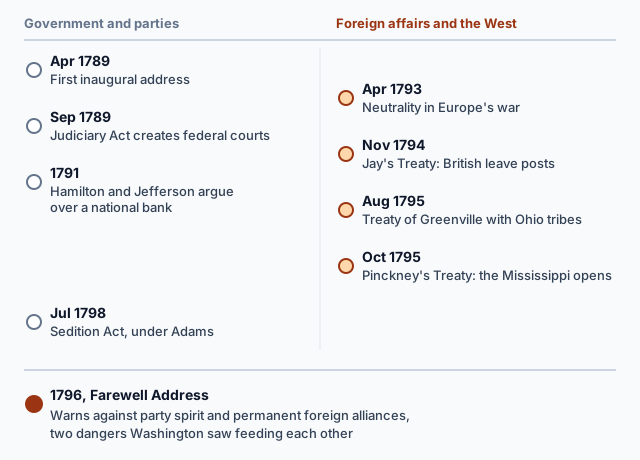 Tap to open the picture full size
Part 1 Think first An ally at war
Commit to a guess first. Being wrong now makes the right idea stick better.
Predict first
In 1778 the United States signed a treaty of alliance with France and agreed to aid France should England attack. In 1793 a new war began: "a state of war exists between Austria, Prussia, Sardinia, Great Britain, and the United Netherlands, of the one part, and France on the other." What do you think President Washington did?
In short. In the 1790s, Presidents Washington and Adams turned the Constitution into a working government, leaders split into the first political parties, and the young republic used diplomacy and neutrality to deal with Britain, Spain, revolutionary France and American Indian nations.
- Washington and Adams set precedents that put the Constitution into practice, from the first inaugural address to Washington's choice to leave office.
- Disagreements over national power, the economy, foreign policy, and liberty and order produced the Federalists, led by Alexander Hamilton, and the Democratic-Republicans, led by Thomas Jefferson and James Madison.
- Jay's Treaty and Pinckney's Treaty dealt with Britain and Spain in the West, and Washington's Farewell Address warned against party spirit and permanent foreign alliances.
Part 2 Learn it The new republic at home and abroad
2a. Putting the Constitution into practice
The Constitution was a plan. George Washington, the first President, and John Adams, the second, had to turn it into a working government. What they did first became precedents, examples later leaders followed.
Some precedents filled gaps in the text. The Constitution required an oath of office but no speech. Washington gave the first inaugural address anyway, on April 30, 1789, in New York, where Congress was meeting. He spoke of "the weighty and untried cares before me." Untried is the point: no one had held the office before. That September, Congress used its power under Article III to create federal courts in the Judiciary Act, which Washington signed on September 24, 1789.
Other precedents concerned power itself. The Constitution set a four-year term for a President and no limit on how many terms he could serve. In his Farewell Address of 1796, Washington announced "the resolution I have formed, to decline being considered among the number of those out of whom a choice is to be made." He left office by choice, and Adams, elected after him, took the office under the Constitution's rules.
Sources: First Inaugural Speech (National Archives); Federal Judiciary Act (National Archives); Farewell Address (Avalon Project).
Quick check · Select all
Which two of these were precedents Washington set, rather than rules the Constitution's text required? Select two.
Select 2 answers, then check.
2b. Hamilton, Jefferson and the first parties
In the 1790s the nation's leaders split. They disagreed about the relationship between the national government and the states, about economic policy, about foreign policy, and about the balance between liberty and order. Two political parties formed: the Federalists, led by Alexander Hamilton, and the Democratic-Republicans, led by Thomas Jefferson and James Madison.
A national bank, debated in 1791, showed the split. The Constitution lets Congress make laws necessary and proper for its listed powers. Jefferson argued that those powers "can all be carried into execution without a bank," so a bank was not necessary and Congress could not create one. Hamilton answered that "necessary often means no more than needful, requisite, incidental, useful, or conducive to." A strict reading keeps the national government small; a broad one lets it grow.
Liberty and order clashed in 1798. Expecting war with France, a Federalist Congress passed the Sedition Act, which President Adams approved on July 14. It punished "any false, scandalous and malicious writing or writings against the government of the United States." The only journalists prosecuted under it edited Democratic-Republican newspapers.
Sources: Jefferson on the bank (Avalon Project); Hamilton on the bank (Avalon Project); Sedition Act (Avalon Project); Alien and Sedition Acts (National Archives).
Quick check · Sort it
Each card is a position or event of the 1790s. Tap a card, then the party it belongs with.
Federalists (Hamilton)
Democratic-Republicans (Jefferson and Madison)
2c. Britain, Spain and the war in Europe
As settlers moved west of the Appalachian Mountains, two European powers still stood in their way. Britain kept troops at posts on land the 1783 peace treaty had given the United States. Western settlers also wanted free navigation of the Mississippi River, which ran past Spanish New Orleans to the sea.
Diplomacy answered both. In Jay's Treaty of November 19, 1794, Britain agreed: "His Majesty will withdraw all His Troops and Garrisons from all Posts and Places within the Boundary Lines assigned by the Treaty of Peace to the United States." In Pinckney's Treaty of October 27, 1795, Spain agreed that "the navigation of the said River in its whole breadth from its source to the Occean shall be free only to his Subjects, and the Citizens of the United States" (spelling as printed). Spain also let Americans store goods at New Orleans for three years.
The war between Britain and France made every choice harder. Neutrality raised questions of free trade and foreign policy, and Americans disagreed about which side deserved sympathy. By 1798, the National Archives explains, Federalists feared that noncitizens would sympathize with France in a war and called Democratic-Republican criticism disloyal.
Sources: Jay's Treaty (Avalon Project); Pinckney's Treaty (Avalon Project); Alien and Sedition Acts (National Archives).
Quick check · Match
Match each action of the 1790s to the problem it dealt with.
2d. Native nations and Spanish California
The Constitution left the place of American Indian nations unclear. It gives Congress power "To regulate Commerce with foreign Nations, and among the several States, and with the Indian Tribes," naming tribes as neither foreign nations nor states. The United States made treaties with tribes as if with nations, yet also claimed power over their land. That ambiguous relationship led to lasting problems over treaties and over Indian claims to land that was seized.
The Treaty of Greenville, concluded August 3, 1795, shows the tension. Tribes of the Ohio country ceded large lands. For the lands they kept, the treaty said they "are quietly to enjoy them, hunting, planting, and dwelling thereon, so long as they please, without any molestation from the United States." Yet "when those tribes, or any of them, shall be disposed to sell their lands, or any part of them, they are to be sold only to the United States." A tribe kept its land but could not choose its buyer.
Far to the west, Spain expanded its mission settlements into California. The missions were supported by the bonded labor of local American Indians. For soldiers the missions offered chances to rise in society, and Spanish and native ways blended into new cultures.
Sources: The Constitution (National Archives); Treaty of Greenville (Avalon Project). The description of the California missions follows the AP U.S. History course framework.
Quick check · Fill the statement
Complete the sentences about two frontiers of the period.
Under the Treaty of Greenville, the tribes could live on their remaining lands but could sell them . In Spanish California, the missions relied on the labor of local American Indians.
Part 3 Watch it done Source Washington's Farewell Address
Watch each step, then do the last one yourself.
Washington's Farewell Address of 1796 warns "in the most solemn manner against the baneful effects of the spirit of party generally," and says: "It is our true policy to steer clear of permanent alliances with any portion of the foreign world." Explain how the address's historical situation shapes these warnings.
Predict first
Before the steps, what kind of document do you think this is?
Step 1 · Place it in time
In 1796 Washington still writes of "the still subsisting war in Europe," the war that began in 1793. He points to "the formation of two treaties, that with Great Britain, and that with Spain," the treaties of 1794 and 1795. And the Federalists and Democratic-Republicans were now organized against each other.
Why this step?
Why look at the date before the words?
A warning is aimed at a danger. Knowing what was happening in 1796 tells you which dangers Washington had in mind when he chose his words.
Step 2 · Name the audience and purpose
It opens "Friends and Citizens," so it speaks to the whole public, not to Congress alone. Its first purpose is to announce that he will not be a candidate again; it then gives advice for the country after he is gone.
Your step · Decide and justify
Finish it. Why does Washington warn against party spirit and permanent alliances in the same address?
Which evidence from the address best supports your answer?
Part 4 Try it Source the Treaty of Greenville
The Treaty of Greenville was concluded on August 3, 1795, after a war between the United States and tribes of the Ohio country. The United States was represented by Anthony Wayne, the major general commanding its army and its sole commissioner. The tribes were represented "by their sachems, chiefs, and warriors." The two sides met "at Greenville, the head quarters of the said army." Among its terms: "when those tribes, or any of them, shall be disposed to sell their lands, or any part of them, they are to be sold only to the United States." The treaty gives its purpose: "To put an end to a destructive war, to settle all controversies, and to restore harmony and friendly intercourse."
Try it · Multiple choice
Which detail best shows the position of the United States when the treaty was made?
Try it · Spot the error
A student writes a sourcing paragraph on the Treaty of Greenville. Which line is the first to go wrong?
Part 5 Explain it Write it like a document-based answer
Nothing you type leaves this page. Check your answer against the model and each scoring point.
Free-response practice · Question 1 style
A short practice in the shape of the document-based question: three documents instead of seven, and a thesis with one body paragraph instead of a full essay.
Evaluate the extent to which the war between Britain and France shaped political divisions in the United States in the 1790s.
Document 1. George Washington, Proclamation of Neutrality, April 22, 1793: since "a state of war exists between Austria, Prussia, Sardinia, Great Britain, and the United Netherlands, of the one part, and France on the other," the United States should pursue "a conduct friendly and impartial toward the belligerant Powers" (spelling as printed).
Document 2. George Washington, Farewell Address, 1796, writing of the spirit of party: "It opens the door to foreign influence and corruption, which finds a facilitated access to the government itself through the channels of party passions."
Document 3. Sedition Act, passed by Congress and approved July 14, 1798: it punished "any false, scandalous and malicious writing or writings against the government of the United States."
Write a thesis, one sentence of historical context, and one paragraph that uses at least two documents and explains the purpose, audience, point of view or situation of one of them.
Model answer
Thesis: The war between Britain and France did much to deepen the divide between Federalists and Democratic-Republicans, turning disagreements that began over national power and economic policy into fights about loyalty and liberty.
Context: the parties first formed over domestic questions, such as the 1791 debate between Hamilton and Jefferson over whether Congress could charter a national bank.
In 1793 Washington tried to keep the war at a distance by pledging "a conduct friendly and impartial" toward both sides (Document 1). By 1796 he warned that party spirit "opens the door to foreign influence and corruption" (Document 2). He was leaving office and speaking to the whole public, so his purpose was to urge unity, and he describes the danger without naming the parties he saw taking sides. Two years later, with war with France expected, a Federalist Congress made it a crime to publish "false, scandalous and malicious" writing against the government (Document 3), and only Democratic-Republican editors were prosecuted. The foreign war did not create the parties, but it raised the stakes until each side questioned the other's loyalty.
Score your own answer. This is a self-check, not a grade. Tick each point your answer makes.
Part 6 Check yourself Two treaties for the West
The case questions use the two excerpts. The others mix the ideas from the whole lesson.
One treaty with Britain, one with Spain, eleven months apart. Article XXII of the treaty with Spain also let Americans deposit their goods at New Orleans for three years. Sources: Jay's Treaty (Avalon Project); Pinckney's Treaty (Avalon Project).
| Treaty | Excerpt |
|---|---|
| Jay's Treaty with Great Britain, November 19, 1794, Article 2 | "His Majesty will withdraw all His Troops and Garrisons from all Posts and Places within the Boundary Lines assigned by the Treaty of Peace to the United States." |
| Pinckney's Treaty with Spain, October 27, 1795, Article IV | "the navigation of the said River in its whole breadth from its source to the Occean shall be free only to his Subjects, and the Citizens of the United States" (the river is the Mississippi; spelling as printed) |
Case question 1 · Multiple choice
Which goal of the United States did both treaties serve?
Case question 2 · Select all
Which two things did Pinckney's Treaty give citizens of the United States? Select two.
Select 2 answers, then check.
The rest stand on their own and do not use the case.
Check yourself · Put it in order
Put these events in the order they happened, earliest first.
Check yourself · Decide and justify
A student writes that Spain's California missions kept Spanish and native peoples apart. Is the student's claim right, and which evidence decides it?
Which evidence best supports your answer?
Part 7 Keep it Bring back earlier ideas
This lesson stands on the Constitution's design from Topic 3.9 and the Northwest Ordinance from Topic 3.7.
Bring it back · Multiple choice
Which feature of the Constitution divides national power among the legislative, executive and judicial branches?
Bring it back · Fill the statement
Complete the sentence about the West in the 1780s.
As settlers moved westward, Congress enacted the , which set rules for admitting new states and banned in the Northwest Territory.
In three lines
- Washington and Adams set precedents that put the Constitution into practice, such as the first inaugural address and Washington's choice to leave office.
- Disputes over national power, the bank, foreign policy, and liberty and order produced the Federalists under Hamilton and the Democratic-Republicans under Jefferson and Madison.
- Treaties with Britain, Spain and native nations, and neutrality in Europe's war, shaped the West, and the Farewell Address warned against party spirit and permanent alliances.
Exam strategy for this topic
- Section I Part A, Multiple Choice: 55 questions in 55 minutes.
- Section I Part B, Short Answer: 3 questions in 40 minutes.
- Section II, Document-Based Question and Long Essay: 2 questions in 100 minutes.
- This lesson's Explain it is shaped like free-response question 1, Document-based.
When a question asks about a source's historical situation, name a specific event from just before it, such as the war in Europe for the 1793 proclamation, and say how that event explains what the source says.
Questions students ask
Why do some quotations here have unusual spellings, such as "belligerant" and "Occean"?
Every excerpt is copied exactly as the archive prints it, so you can check it against the source linked beside it.
If Washington warned against permanent alliances, did he want to break the 1778 alliance with France?
No. He advised the country to keep the engagements it had already made "with perfect good faith," and to avoid tying itself to new permanent alliances with any part of the foreign world.
Did the Federalists of the 1790s and the Federalists of 1787 have the same name for the same reason?
The names connect: Hamilton supported the Constitution in 1787 and led the Federalist Party in the 1790s. But Madison, a Federalist in 1787, helped lead the Democratic-Republicans, so the two groups were not the same people.
Why does this lesson not quote a source on the California missions?
The primary-source collections this lesson uses do not hold a text from the missions, so the lesson describes them from the AP U.S. History course framework instead of quoting.
Where can I read these documents in full?
Each excerpt links to its full text at the National Archives or the Avalon Project at Yale Law School, the primary-source collections this lesson was checked against.
Course alignment, for teachers
AP U.S. History topic 3.10, Unit 3: Period 3: 1754–1800.
- Skill 2.A: Identify a source’s point of view, purpose, historical situation, and/or audience.
This lesson maps all 7 essential knowledge statements of the topic, and the 2 learning objectives with none of their own, to the part that teaches each one: 9 are checked by a scored question. The map is in the lesson file.