Unit 7 · Topic 7.14 · about 30 minutes · 7 parts · 13 scored checks, 4 of them multiple choice
AP U.S. History 7.14: Postwar Diplomacy
Unit 7: 10 to 17% of the multiple-choice section
What you'll be able to do
- Explain the consequences of U.S. involvement in World War II, and read the documents of the peace for their point of view, purpose, historical situation and audience.
Key vocabulary
| Term | What it means | The exam trap |
|---|---|---|
| Yalta Conference | The meeting of Roosevelt, Churchill and Stalin in the Crimea in February 1945 that planned the United Nations and set terms for the end of the war. | Yalta came before the war ended in Europe; keep its date in mind when you judge its choices. |
| Potsdam Conference | The meeting of the United States, Britain and the Soviet Union near Berlin in July and August 1945 that planned the occupation of Germany and the peace settlements. | The Potsdam Conference and the terms issued to Japan from it are two different texts; say which one you mean. |
| United Nations | The international organization founded by the charter signed at San Francisco in June 1945 to keep the peace. | The Allies called themselves the United Nations during the war, years before the organization existed; check the date. |
| Security Council | The United Nations body responsible for keeping the peace, whose five permanent members each hold a veto. | Permanent members are only part of the council; do not count them as the whole of it. |
| Peace settlement | The treaties and agreements that set the terms of peace after a war, such as borders, occupation and reparations. | A surrender ends the fighting; a peace settlement comes later and can take years. |
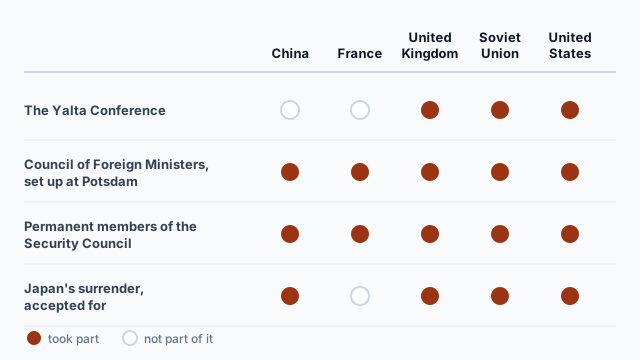 Tap to open the picture full size
Part 1 Think first Who came out on top?
Commit to a guess first. Being wrong now makes the right idea stick better.
Predict first
When the fighting ended in 1945, much of Europe and Asia had been fought over for years. Which nation do you think came out of the war in the strongest position?
In short. World War II left Europe and Asia in ruins while the United States, distant from the fighting, played the leading part in the Allied victory and the peace settlements, and together those facts made it the most powerful nation on Earth.
- When the war ended in 1945, Europe's cities were shattered, its economies devastated and its people facing famine, and Japan and occupied China had been ravaged as well.
- At Yalta, San Francisco and Potsdam in 1945, the United States hosted the founding of the United Nations, kept its charter, and helped set the terms for occupied Germany and Japan.
- By 1947 the United States could pay for Europe's recovery, but the Soviet Union's control of Eastern Europe made it a rival.
Part 2 Learn it A ruined world and a leading power
2a. Europe and Asia in ruins
The war left Europe and Asia ravaged. In July 1945 the Allies' own warning to Japan said their power had "laid waste to the lands, the industry and the method of life of the whole German people." At Hiroshima and Nagasaki, the Army's 1946 study found, "The central portions of the cities underneath the explosions suffered almost complete destruction." Much of China had been occupied by Japan: at Yalta in February 1945 the Soviet Union offered its armed forces "for the purpose of liberating China from the Japanese yoke."
In June 1947 Secretary of State George Marshall said the harm went deeper than ruins. The world had judged "the visible destruction of cities, factories, mines, and railroads" correctly, he said, but "this visible destruction was probably less serious than the dislocation of the entire fabric of European economy."
The United States was the exception. As Topic 7.12 showed, its strong industrial base had equipped millions of its own troops and its allies. Marshall saw a problem in that distance from the fighting: he told his audience that "the people of this country are distant from the troubled areas of the earth and it is hard for them to comprehend the plight and consequent reaction of the long-suffering peoples."
Sources: Potsdam Conference documents (Avalon Project); Manhattan Engineer District report, 1946 (Avalon Project); Yalta Conference (Avalon Project); Marshall Plan (National Archives).
Quick check · Fill the statement
Complete the notes on the world in 1945.
When the war ended, much of Europe and Asia lay in . The United States, from most of the fighting, came out of the war with its industry .
2b. Victory and the peace settlements
The United States also had a dominant part in the Allied victory and in the peace settlements that followed.
At Yalta, in the Crimea, from February 4 to 11, 1945, Roosevelt, Churchill and Stalin agreed "That a United Nations conference on the proposed world organization should be summoned for Wednesday, 25 April, 1945, and should be held in the United States of America." The United States would speak "on behalf of the three powers" to China and France. The charter signed at San Francisco on June 26, 1945, was to "remain deposited in the archives of the Government of the United States of America."
At the Berlin (Potsdam) Conference, from July 17 to August 2, 1945, the three powers set up a council of foreign ministers "to do the necessary preparatory work for the peace settlements." They set the aims of the occupation of Germany, beginning with "The complete disarmament and demilitarization of Germany." On September 2 General Douglas MacArthur, an American, accepted Japan's surrender as "Supreme Commander for the Allied Powers," under the Potsdam terms Japan had accepted, which said "points in Japanese territory to be designated by the Allies shall be occupied."
Sources: Yalta Conference (Avalon Project); United Nations Charter (National Archives); Potsdam Conference documents (Avalon Project); Surrender of Japan (National Archives).
Quick check · Match
Match each meeting or signing of 1945 to what it did.
2c. The most powerful nation on Earth
Put together, the ruin abroad and the American role in winning and settling the war left the United States the most powerful nation on Earth.
The evidence is wide. The new United Nations was founded on American soil and kept its charter in American archives. The United States was one of the five permanent members of the Security Council, each of which was given an individual veto. It had built and used the atomic bomb, and the Soviet Union did not test one of its own until 1949. It could pay for other nations' recovery: under the Marshall Plan, signed in April 1948, Congress appropriated 13.3 billion dollars over four years for European recovery. That figure comes from 1948, but it measures what the war had left the United States able to do.
Power brought a rival. The National Archives notes that in the two years after the war, the Soviet Union's control of Eastern Europe heightened the sense of crisis. That rivalry belongs to the next period of the course.
Sources: United Nations Charter (National Archives); Manhattan Project Notebook (National Archives); Marshall Plan (National Archives).
Quick check · Select all
Which two facts are evidence of American power itself, rather than of conditions in other countries? Select two.
Select 2 answers, then check.
2d. Reading the documents of the peace
The documents of the peace are sources, made by people for a reason. Ask who made each one (point of view), whom it was for (audience), what it was meant to do (purpose), and what was happening around it (historical situation).
Take Marshall's speech at Harvard University on June 5, 1947. He spoke as Secretary of State, two years after the war, at a moment when "Recovery has been seriously retarded by the fact that 2 years after the close of hostilities a peace settlement with Germany and Austria has not been agreed upon." He spoke at a university, but he named the audience that mattered most: "An essential part of any successful action on the part of the United States is an understanding on the part of the people of America of the character of the problem and the remedies to be applied." Aid would cost Americans money, so he needed their support. He also told every listener, at home and abroad: "Our policy is directed not against any country or doctrine but against hunger, poverty, desperation, and chaos."
Source: Marshall Plan (National Archives).
Quick check · Fill the statement
Complete a historian's notes on Marshall's 1947 speech.
Marshall says success depends on "an understanding on the part of the people of America," which tells us his . He speaks as the nation's Secretary of State, which is his . He wants Americans to back aid to Europe, which is his .
Part 3 Watch it done Source the Yalta agreement on Japan
Watch each step, then do the last one yourself.
The Yalta agreement on Japan, signed by Stalin, Roosevelt and Churchill on February 11, 1945, says that "in two or three months after Germany has surrendered and the war in Europe is terminated, the Soviet Union shall enter into war against Japan on the side of the Allies." Its conditions include: "The Kurile Islands shall be handed over to the Soviet Union." Explain how the historical situation shapes the agreement.
Predict first
Before the steps, why do you think Roosevelt agreed to conditions like these?
Step 1 · Place it in time
The agreement was signed on February 11, 1945. Germany would not surrender until May 7, and the first atomic bomb would not be tested until July 16.
Why this step?
Why compare the date with what came later?
The authors knew only what had happened by February 1945. A reader who forgets that will judge their choices with knowledge they did not have.
Step 2 · Name the authors
Stalin, Roosevelt and Churchill signed it together, each for his own government. Read the problem again for what each side gives and gets.
Your step · Decide and justify
Finish it. How does the situation in February 1945 shape the agreement?
Which evidence best supports your answer?
Part 4 Try it Source the Potsdam terms for Japan
On July 26, 1945, the leaders of the United States, China and Great Britain issued terms to Japan. Beside its warning, the proclamation said: "We do not intend that the Japanese shall be enslaved as a race or destroyed as a nation, but stern justice shall be meted out to all war criminals." It promised: "Freedom of speech, of religion, and of thought, as well as respect for the fundamental human rights shall be established." And it said: "The occupying forces of the Allies shall be withdrawn from Japan as soon as these objectives have been accomplished."
Try it · Multiple choice
What was the main purpose of telling Japan that the Allies did not intend the Japanese to be "enslaved as a race or destroyed as a nation"?
Try it · Spot the error
A student writes a sourcing paragraph on the Potsdam terms for Japan. Which line is the first to go wrong?
Part 5 Explain it Write it like a document-based answer
Nothing you type leaves this page. Check your answer against the model and each scoring point.
Free-response practice · Question 1 style
A short practice in the shape of the document-based question: three documents instead of seven, and a thesis with one body paragraph instead of a full essay.
Evaluate the extent to which the United States' role in the Allied victory and the peace settlements explains its emergence as the most powerful nation on Earth.
Document 1. Protocol of the Yalta Conference, signed by the foreign secretaries of the United States, Britain and the Soviet Union, February 11, 1945: "That a United Nations conference on the proposed world organization should be summoned for Wednesday, 25 April, 1945, and should be held in the United States of America."
Document 2. Protocol of the Proceedings of the Berlin (Potsdam) Conference of the United States, Britain and the Soviet Union, July 17 to August 2, 1945: "There shall be established a Council composed of the Foreign Ministers of the United Kingdom, the Union of Soviet Socialist Republics, China, France, and the United States." Its task was "to do the necessary preparatory work for the peace settlements."
Document 3. Secretary of State George Marshall, speech at Harvard University, June 5, 1947: "the visible destruction of cities, factories, mines, and railroads" was, he said, "probably less serious than the dislocation of the entire fabric of European economy." And: "the people of this country are distant from the troubled areas of the earth and it is hard for them to comprehend the plight and consequent reaction of the long-suffering peoples."
Write a thesis, one sentence of historical context, and one paragraph that uses at least two documents and explains the purpose, audience, point of view or situation of one of them.
Model answer
Thesis: The United States' role in the victory and the peace explains its rise to a large extent, because it sat at the center of the new world organization and the peace settlements, but the war-ravaged condition of Europe and Asia mattered as much, since American power stood out against the ruin of everyone else.
Context: the United States entered the war after Pearl Harbor in 1941, and its industry equipped both its own forces and the Allies through 1945.
At Yalta the three powers agreed that the conference to found the United Nations "should be held in the United States of America" (Document 1), and at Potsdam the United States took one of five seats on the council preparing "the peace settlements" (Document 2). Both show a leading role, though a shared one, since each decision was made with Britain and the Soviet Union. Marshall's speech shows the other side (Document 3). He spoke to win Americans' support for aid, and he worried that because Americans were "distant from the troubled areas of the earth," it was "hard for them to comprehend the plight" of Europe. That worry is itself evidence: the war had been fought far from most Americans, which is why American strength counted for so much in 1947.
Score your own answer. This is a self-check, not a grade. Tick each point your answer makes.
Part 6 Check yourself Where the peace was made
The case questions use the three excerpts. The others mix the ideas from the whole lesson.
Three excerpts from the documents of 1945. The first comes from the protocol of the Yalta Conference, signed by the three powers' foreign secretaries; the State Department released the text in March 1945. Sources: Yalta Conference (Avalon Project); United Nations Charter (National Archives); Surrender of Japan (National Archives).
| Document | Excerpt |
|---|---|
| Protocol of the Yalta Conference, February 1945 | The world organization's conference "should be held in the United States of America." |
| United Nations Charter, signed June 26, 1945 | The Charter "shall remain deposited in the archives of the Government of the United States of America" |
| Instrument of Surrender, Tokyo Bay, September 2, 1945 | Accepted by General Douglas MacArthur as "Supreme Commander for the Allied Powers" |
Case question 1 · Multiple choice
Taken together, the three excerpts best support which claim?
Case question 2 · Multiple choice
The Yalta excerpt comes from a protocol signed by the foreign secretaries of the three powers. What can a historian most safely conclude from a source of this kind?
The rest stand on their own and do not use the case.
Check yourself · Put it in order
Put these events in the order they happened, earliest first.
Check yourself · Sort it
Each card is one piece of the explanation for American power after the war. Tap a card, then the kind of reason it gives.
The war-ravaged condition of other nations
The U.S. role in the victory and the peace
Part 7 Keep it Bring back earlier ideas
This lesson stands on the Allied victory from Topic 7.13 and the fate of the League of Nations from Topic 7.5.
Bring it back · Multiple choice
Which best explains the Allied victory over Germany in 1945?
Bring it back · Fill the statement
Complete the sentence about the end of World War I.
Despite Woodrow Wilson's deep involvement in the peace talks after World War I, the refused to ratify the Treaty of Versailles or let the United States join the .
In three lines
- World War II left Europe and Asia ravaged, while the United States, distant from the fighting, came out with its industry stronger.
- The United States led in the victory and the peace: the United Nations was founded on its soil, and it shared in the occupation and peace work at Potsdam.
- Together those facts made it the most powerful nation on Earth, though the Soviet Union soon became its rival.
Exam strategy for this topic
- Section I Part A, Multiple Choice: 55 questions in 55 minutes.
- Section I Part B, Short Answer: 3 questions in 40 minutes.
- Section II, Document-Based Question and Long Essay: 2 questions in 100 minutes.
- This lesson's Explain it is shaped like free-response question 1, Document-based.
When a question asks why the United States emerged from the war so powerful, give a reason from the condition of the rest of the world and a reason from the American role in the victory and the peace.
Questions students ask
Why did the United States come out of World War II so powerful?
Europe and Asia had been ravaged by the war, while the United States, distant from the fighting, played the leading part in the Allied victory and the peace settlements. Together those facts made it the most powerful nation on Earth.
What was decided at Yalta?
Among other things, Roosevelt, Churchill and Stalin agreed in February 1945 to call a United Nations conference in the United States for April 1945, and the Soviet Union agreed to enter the war against Japan two or three months after Germany surrendered, on conditions that included the Kurile Islands.
What did the Potsdam Conference do?
Meeting near Berlin from July 17 to August 2, 1945, the United States, Britain and the Soviet Union set up a Council of Foreign Ministers to prepare the peace settlements and set the aims of the occupation of Germany, beginning with its disarmament.
Is the Marshall Plan part of this topic?
This lesson uses Marshall's 1947 speech as evidence of Europe's ruin and of American wealth. The plan itself, signed in April 1948, belongs to the start of the Cold War, the next period of the course.
Where can I read these documents in full?
Each excerpt links to its full text at the National Archives or the Avalon Project at Yale Law School, the primary-source collections this lesson was checked against.
Course alignment, for teachers
AP U.S. History topic 7.14, Unit 7: Period 7: 1890–1945.
- Skill 2.B: Explain the point of view, purpose, historical situation, and/or audience of a source.
This lesson maps the one essential knowledge statement of the topic, and the one learning objective with none of its own, to the part that teaches each one: 2 are checked by a scored question. The map is in the lesson file.