Unit 5 · Topic 5.10 · about 30 minutes · 7 parts · 13 scored checks, 5 of them multiple choice
AP U.S. History 5.10: Reconstruction
Unit 5: 10 to 17% of the multiple-choice section
What you'll be able to do
- Explain how government policy during Reconstruction, from the 13th, 14th and 15th Amendments to Congress's contest with the president, changed American society from 1865 to 1877, and explain how evidence supports or challenges a source's argument about it.
Key vocabulary
| Term | What it means | The exam trap |
|---|---|---|
| Reconstruction | The rebuilding of the Union after the Civil War, from 1865 to 1877, including the terms for restoring the Confederate states and the rights of formerly enslaved people. | Reconstruction was political as well as physical; it is about laws and rights as much as rebuilt railroads and towns. |
| Radical Republicans | The members of the Republican Party in Congress who pushed hardest for strict terms for the defeated South and for the rights of freedpeople. | Radical describes how far they wanted change to go, not a separate party. |
| Pocket veto | Killing a bill by leaving it unsigned when Congress adjourns, so Congress has no chance to override it. | A pocket veto needs no veto message; the president simply does not sign. |
| Impeachment | A formal charge of wrongdoing against an official, brought by the House of Representatives. | Impeachment is the charge; removal takes a separate trial and vote in the Senate. |
| Equal protection | The 14th Amendment's promise that no state may deny any person within its jurisdiction the equal protection of the laws. | Equal protection is about how the law treats people, which is a different question from who is a citizen. |
| Suffrage | The right to vote. | Suffrage means voting, not suffering; universal suffrage means the vote for all adults. |
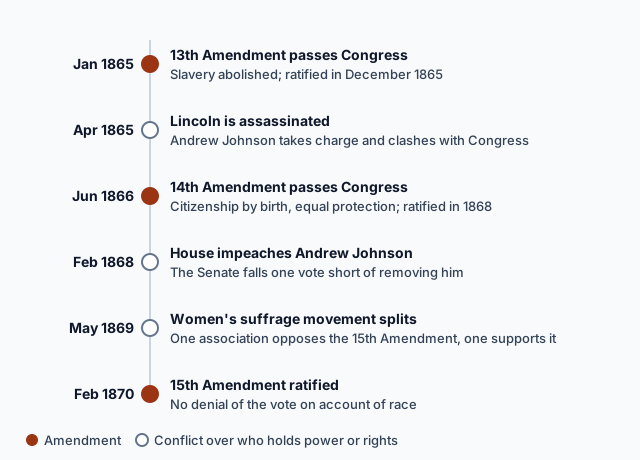 Tap to open the picture full size
Part 1 Think first What was new in one sentence?
Commit to a guess first. Being wrong now makes the right idea stick better.
Predict first
The 14th Amendment, ratified in 1868, says that no state shall "deny to any person within its jurisdiction the equal protection of the laws." What do you think was most new about that promise?
In short. Reconstruction, from 1865 to 1877, rewrote the Constitution so that the national government protected freedom, citizenship and the vote against the states, shifted power from the president toward Congress, and opened public life to formerly enslaved men, before Southern resistance and fading Northern resolve brought it down.
- The 13th Amendment abolished slavery; the 14th made citizens of all persons born or naturalized in the United States and promised them equal protection; the 15th barred denying the vote on account of race.
- Radical and moderate Republicans in Congress won control of Reconstruction from President Andrew Johnson, and the House impeached him in 1868.
- The amendments emboldened the women's rights movement and also split it, because they protected Black men's votes but not women's.
Part 2 Learn it Reconstruction and the meaning of citizenship
2a. Three amendments
Reconstruction was the rebuilding of the Union after the Civil War, from 1865 to 1877. Its foundation was three amendments to the Constitution, which Congress submitted to the states to guarantee civil and legal rights to Black citizens.
The 13th Amendment, passed by Congress on January 31, 1865, and ratified that December, abolished slavery: "Neither slavery nor involuntary servitude, except as a punishment for crime whereof the party shall have been duly convicted, shall exist within the United States, or any place subject to their jurisdiction."
The 14th Amendment, ratified in July 1868, made citizens of "All persons born or naturalized in the United States." It goes on: "No State shall make or enforce any law which shall abridge the privileges or immunities of citizens of the United States," nor "deny to any person within its jurisdiction the equal protection of the laws."
The 15th Amendment, ratified in February 1870, says the vote "shall not be denied or abridged by the United States or by any State on account of race, color, or previous condition of servitude."
Notice who is being limited: the states. And each amendment closes by giving Congress the power to enforce it. That changed the relationship between the states and the federal government.
Sources: 13th Amendment (National Archives); 14th Amendment (National Archives); 15th Amendment (National Archives).
Quick check · Match
Match each part of the Reconstruction amendments to the change it made.
2b. Congress against the president
Who would set the terms for restoring the Confederate states, the president or Congress?
In December 1863 Lincoln proposed that a Confederate state could form a new government once 10 percent of its male population took loyalty oaths and the state recognized the permanent freedom of formerly enslaved people. Several Republicans in Congress thought that too lenient. In February 1864 Senator Benjamin Wade and Representative Henry Winter Davis proposed a stricter plan, requiring 50 percent of a state's white men to take an oath. Congress passed it; Lincoln killed it with a pocket veto.
Lincoln was assassinated in April 1865, and President Andrew Johnson took charge. He saw rebuilding the South as the president's job and vetoed every congressional plan. But the progressive wing of the Republican Party dominated Congress, and in time Congress won the contest and took the upper hand in shaping federal policy toward the defeated South. When Johnson fired Secretary of War Edwin Stanton, breaking the Tenure of Office Act, the House voted on February 24, 1868, to impeach him. The Senate fell one vote short of removing him.
Republicans also set out to change race relations in the South. In March 1865 Congress created the Freedmen's Bureau, whose agents gave out rations and clothing, ran hospitals and supervised labor contracts between planters and freedpeople. The Radical Republicans pressed for the most sweeping changes.
Sources: Wade-Davis Bill (National Archives); Impeachment of Andrew Johnson (National Archives); The Freedmen's Bureau (National Archives).
Quick check · Put it in order
Put these events in the order they happened, earliest first.
2c. Who else would count?
Rewriting citizenship raised a question the amendments did not settle: who else was included?
Many women's rights activists had also been abolitionists whose goals included universal suffrage, the right to vote for all adults. The amendments emboldened them, since the Constitution was being rewritten around equal rights. But the 14th Amendment's second section cuts a state's representation in Congress when the vote is "denied to any of the male inhabitants of such State, being twenty-one years of age, and citizens of the United States." It protects only men's votes. The 15th Amendment names race, color and previous servitude, and says nothing about sex.
The movement divided over the 15th Amendment. In May 1869 Elizabeth Cady Stanton and Susan B. Anthony formed the National Woman Suffrage Association, which opposed the amendment because it excluded women. The same year Lucy Stone, Julia Ward Howe and Thomas Wentworth Higginson founded the American Woman Suffrage Association, which supported it and worked for women's voting in the states; a federal amendment was not its priority. The National association looked to Congress, and after ratification it petitioned Congress to extend suffrage to women.
The debate reached other groups too. The 14th Amendment counted people for representation "excluding Indians not taxed," and in 1869 President Grant said he would favor any course toward Native Americans "which tends to their civilization and ultimate citizenship," citizenship as a future goal.
Sources: Woman Suffrage (National Archives); 14th Amendment (National Archives); Grant's first inaugural (Avalon Project).
Quick check · Sort it
In 1869 the women's suffrage movement split into two national associations. Tap a card, then the association it describes.
National Woman Suffrage Association
American Woman Suffrage Association
2d. New doors, and how they closed
Reconstruction opened political life to formerly enslaved people. During Reconstruction, African Americans voted and held office in many Southern states. Black men won seats in Congress, and Hiram Revels and Blanche Bruce, both of Mississippi, became the first African Americans elected to the U.S. Senate. After them, the next Black person elected to the Senate was Edward Brooke of Massachusetts, nearly a century later.
That gap is a clue to how the story ends. Reconstruction ultimately failed, for two reasons that worked together. White Southerners resisted with determination: the Ku Klux Klan used terror and force to keep Black men from voting, and Congress answered with the Enforcement Acts of 1870 and 1871, which suppressed the Klan for a time before the Supreme Court undermined them. And the North's resolve faded. In 1873 President Grant admitted that the freed slave "is not possessed of the civil rights which citizenship should carry with it" and called that a wrong to be corrected, yet in the same speech he claimed the former Confederate states were "now happily rehabilitated." In 1877 federal troops were withdrawn from the former Confederate states, and Reconstruction collapsed. Topic 5.11 follows what came next.
The gains while they lasted were real: slavery gone, citizenship in the Constitution, and Black voters and officeholders across the South.
Sources: Black Americans and the Vote (National Archives); Grant's second inaugural (Avalon Project); Laws and Court Cases (National Archives).
Quick check · Fill the statement
Complete a student's notes on the U.S. Senate.
During Reconstruction, Hiram Revels and Blanche Bruce of Mississippi became the first African Americans elected to the Senate. That is evidence that Reconstruction . No other Black person was elected to the Senate for nearly a century, which is evidence that its gains .
Part 3 Watch it done Test Grant's argument against the evidence
Watch each step, then do the last one yourself.
On March 4, 1869, in his first inaugural address, President Ulysses S. Grant said: "The question of suffrage is one which is likely to agitate the public so long as a portion of the citizens of the nation are excluded from its privileges in any State. It seems to me very desirable that this question should be settled now, and I entertain the hope and express the desire that it may be by the ratification of the fifteenth article of amendment to the Constitution." Explain how the split in the women's suffrage movement that year affects Grant's argument.
Predict first
Before the steps, what do you think the split does to Grant's argument?
Step 1 · Split the argument into reason and conclusion
Grant's reason: the vote will keep stirring up the public as long as any citizens are shut out of it. His conclusion: the question should be settled now, by ratifying the 15th Amendment.
Why this step?
Why separate the reason from the conclusion?
A piece of evidence can agree with an argument's reason and still undercut its conclusion. You need both parts in view to say which one the evidence touches.
Step 2 · Read the evidence
In May 1869 Stanton and Anthony formed the National Woman Suffrage Association, which opposed the 15th Amendment because it excluded women. Under the 14th Amendment women born in the country were citizens, but the 15th did not protect their vote.
Your step · Decide and justify
Finish it. How does the evidence affect Grant's hope that ratifying the 15th Amendment would settle the question of suffrage?
Which point best supports your answer?
Part 4 Try it A lenient peace, and its critics
On March 4, 1865, with the war still under way, Lincoln closed his second inaugural address: "With malice toward none, with charity for all, with firmness in the right as God gives us to see the right, let us strive on to finish the work we are in, to bind up the nation's wounds." He was arguing for a peace without revenge. In April he was assassinated, and others would decide what that peace looked like.
Try it · Multiple choice
Which piece of evidence most directly shows that many Republicans in Congress did not share Lincoln's lenient approach to the South?
Try it · Spot the error
A student uses evidence to test Lincoln's call for charity. Which line is the first to go wrong?
Part 5 Explain it Write it like a document-based answer
Nothing you type leaves this page. Check your answer against the model and each scoring point.
Free-response practice · Question 1 style
A short practice in the shape of the document-based question: three documents instead of seven, and a thesis with one body paragraph instead of a full essay.
Evaluate the extent to which the Reconstruction amendments changed who counted as a full citizen of the United States between 1865 and 1870.
Document 1. 14th Amendment, first section, ratified 1868: "All persons born or naturalized in the United States, and subject to the jurisdiction thereof, are citizens of the United States and of the State wherein they reside."
Document 2. 15th Amendment, ratified 1870: "The right of citizens of the United States to vote shall not be denied or abridged by the United States or by any State on account of race, color, or previous condition of servitude."
Document 3. Ulysses S. Grant, first inaugural address, March 4, 1869: "The question of suffrage is one which is likely to agitate the public so long as a portion of the citizens of the nation are excluded from its privileges in any State. It seems to me very desirable that this question should be settled now, and I entertain the hope and express the desire that it may be by the ratification of the fifteenth article of amendment to the Constitution."
Write a thesis, one sentence of historical context, and one paragraph that uses at least two documents and explains the purpose, audience, point of view or situation of one of them.
Model answer
Thesis: Between 1865 and 1870 the amendments changed citizenship a great deal for African American men, who became citizens with a protected vote, but far less for women, whose exclusion from the vote the amendments left in place.
Context: the 13th Amendment had abolished slavery in 1865, and after Lincoln's death Republicans in Congress took control of Reconstruction from President Johnson and wrote the new amendments.
The 14th Amendment made citizens of "All persons born or naturalized in the United States" (Document 1), so formerly enslaved people became citizens of the nation and of their state. The 15th Amendment then barred any state from denying the vote "on account of race, color, or previous condition of servitude" (Document 2), a national rule on who could vote. Grant spoke as a newly inaugurated president to the whole country, and his purpose was to urge ratification, so he presented the amendment as a way to settle the suffrage question "now" (Document 3). Yet his own reason, that the question stays open while citizens are "excluded," fits women, who were citizens under Document 1 but whom Document 2 did not protect. The split in the women's movement in 1869 shows the amendments changed citizenship by race far more than by sex.
Score your own answer. This is a self-check, not a grade. Tick each point your answer makes.
Part 6 Check yourself Two amendments, read closely
The case questions use the two excerpts. The others mix the ideas from the whole lesson.
Both excerpts are from amendments Congress sent to the states during Reconstruction. Sources: 14th Amendment (National Archives); 15th Amendment (National Archives).
| Document | Excerpt |
|---|---|
| 14th Amendment, second section, ratified 1868. A state's representation in Congress is reduced when the vote is: | "denied to any of the male inhabitants of such State, being twenty-one years of age, and citizens of the United States" |
| 15th Amendment, first section, ratified 1870 | "The right of citizens of the United States to vote shall not be denied or abridged by the United States or by any State on account of race, color, or previous condition of servitude" |
Case question 1 · Multiple choice
Based on the excerpts, why did Stanton and Anthony's association oppose the 15th Amendment?
Case question 2 · Multiple choice
What do both excerpts show about how Reconstruction changed the relationship between the states and the federal government?
The rest stand on their own and do not use the case.
Check yourself · Select all
Which two developments show Congress gaining power over Reconstruction at the president's expense? Select two.
Select 2 answers, then check.
Check yourself · Sort it
A student claims that Reconstruction made formerly enslaved people full and equal citizens. Tap each piece of evidence, then say whether it supports or challenges the claim.
Supports the claim
Challenges the claim
Part 7 Keep it Bring back earlier ideas
This lesson stands on the Union victory from Topic 5.8 and Lincoln's wartime policies from Topic 5.9.
Bring it back · Multiple choice
Early in the Civil War the Confederacy showed military initiative and daring. Which best explains why the Union won anyway?
Bring it back · Multiple choice
Lincoln and most Union supporters began the Civil War to preserve the Union. How did the Emancipation Proclamation affect the Confederacy's search for support from European powers?
In three lines
- The 13th Amendment abolished slavery; the 14th made citizens of all born in the country and promised equal protection; the 15th barred denying the vote by race, and all three limited the states.
- Republicans in Congress won control of Reconstruction from President Johnson, and the House impeached him; Black men voted and held office across the South.
- The women's movement was emboldened and split over the amendments, and Reconstruction failed as Southern resistance met fading Northern resolve.
Exam strategy for this topic
- Section I Part A, Multiple Choice: 55 questions in 55 minutes.
- Section I Part B, Short Answer: 3 questions in 40 minutes.
- Section II, Document-Based Question and Long Essay: 2 questions in 100 minutes.
- This lesson's Explain it is shaped like free-response question 1, Document-based.
When a question asks whether evidence supports or challenges an argument, first split the argument into its reason and its conclusion, then say which one the evidence touches.
Questions students ask
Why did the 13th Amendment have an exception for crime?
Its text bans slavery and involuntary servitude "except as a punishment for crime whereof the party shall have been duly convicted." The exception is in the amendment as ratified, so read it whenever you use the amendment as evidence.
Was Andrew Johnson removed from office?
No. The House impeached him on February 24, 1868, after he fired Secretary of War Edwin Stanton in violation of the Tenure of Office Act, but the Senate fell one vote short of removing him.
Did the 15th Amendment give every man the vote?
It barred the United States and the states from denying the vote on account of race, color, or previous condition of servitude. It did not forbid other tests, which mattered after Reconstruction, as Topic 5.11 shows.
Why did the women's suffrage movement split in 1869?
Over the 15th Amendment. The National Woman Suffrage Association, formed by Elizabeth Cady Stanton and Susan B. Anthony, opposed it because it excluded women. The American Woman Suffrage Association, founded by Lucy Stone, Julia Ward Howe and Thomas Wentworth Higginson, supported it.
Where can I read these documents in full?
Each excerpt links to its full text at the National Archives or the Avalon Project at Yale Law School, the primary-source collections this lesson was checked against.
Course alignment, for teachers
AP U.S. History topic 5.10, Unit 5: Period 5: 1844–1877.
- Skill 3.D: Explain how claims or evidence support, modify, or refute a source’s argument.
This lesson maps all 4 essential knowledge statements of the topic, and the one learning objective with none of its own, to the part that teaches each one: 5 are checked by a scored question. The map is in the lesson file.