Unit 7 · Topic 7.6 · about 30 minutes · 7 parts · 13 scored checks, 4 of them multiple choice
AP U.S. History 7.6: World War I: Home Front
Unit 7: 10 to 17% of the multiple-choice section
What you'll be able to do
- Explain the causes and effects of international and internal migration patterns during and after World War I, and how claims and evidence support, modify or refute a source's argument about them.
Key vocabulary
| Term | What it means | The exam trap |
|---|---|---|
| Great Migration | The movement of African Americans out of the South to the North and West, beginning during World War I. | The name describes a movement, not an outcome; ask what migrants actually found where they arrived. |
| Push and pull factors | Causes that drive people out of a place (push) and causes that draw them to a new one (pull). | The same event can be described either way, so say which place it belongs to. |
| Nativism | Hostility to immigrants in the name of protecting the native-born. | Nativism targeted particular groups at particular times, so name which ones. |
| Alien enemy | During World War I, a native or subject of Germany or its allies living in the United States, placed under special wartime rules. | The label came from birth or citizenship, not from anything the person had done. |
| Red Scare | A wave of fear of radicalism after World War I and the Russian Revolution. | Do not stop at fear of communists; say what other people and causes the fear was turned against. |
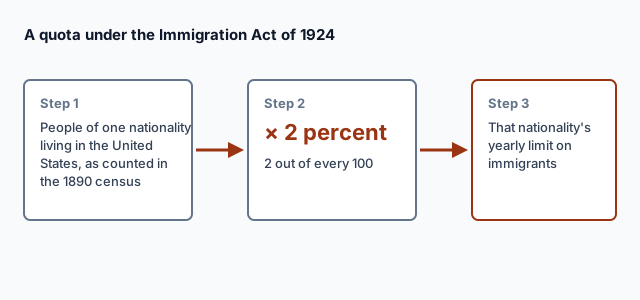
| National-origin quota | A yearly limit on immigrants from each country, set by a formula based on an earlier count of that nationality. | A quota limits a number; it is not the same as excluding a group entirely. |
 Tap to open the picture full size
Part 1 Think first Who would fill the factory jobs?
Commit to a guess first. Being wrong now makes the right idea stick better.
Predict first
Before World War I, northern factories had relied on a steady flow of workers arriving from Europe. Once the war began, those factories had more orders than ever for war goods. Where do you think they found their new workers?
In short. World War I changed who moved where: the demand for war labor drew Americans to industrial cities, African Americans escaping segregation and violence in the South began the Great Migration north and west, and fear of disloyalty and radicalism brought controls on immigrants and speech, a Red Scare and, after the war, immigration quotas.
- With immigration from Europe cut off and men in the army, factories recruited workers, and many Americans moved to cities for wartime jobs.
- African Americans who left the South found new jobs, schools and the vote in the North, but also segregated neighborhoods and the violence of the Red Summer of 1919.
- Wartime controls on enemy aliens and speech, and fear of radicalism after the Russian Revolution, fed a Red Scare, and the quotas that followed restricted immigration from southern and eastern Europe and all of Asia.
Part 2 Learn it The war on the move at home
2a. War work and the move to the cities
Immigration from Europe reached its peak in the years before World War I. The war changed that. Defense production rose while the war cut off the flow of immigrant labor, and when the war effort ramped up in 1917 many men left their industrial jobs to fight in Europe.
The increased demand for war production and labor led many Americans to move to urban centers in search of economic opportunity. Employers recruited southern African Americans to work in northern and midwestern factories, and many found jobs in manufacturing, automobile and food industries. Many followed the rail lines to cities such as Philadelphia, New York, Detroit, Cincinnati, Chicago and Milwaukee.
A move like this has two sides. Causes that drive people out of a place are push factors; causes that draw them to a new one are pull factors. War jobs were a pull. What pushed African Americans out of the South is the subject of the next chunk.
Sources: The 369th Infantry and African Americans in World War I (National Archives); The First Great Migration (National Archives); Labor during World War I (National Archives).
Quick check · Fill the statement
Complete the explanation of wartime migration to the cities.
War orders raised factories' demand for . At the same time the war cut off the flow of and drew many men into the army, so employers recruited workers from the rural South and Americans moved to urban centers.
2b. The Great Migration
The Great Migration was the movement of African Americans out of the South to the North and West, beginning during World War I. From World War I until World War II, about 2 million Black people left the South.
The National Archives sums up why: "The driving force behind the mass movement was to escape racial violence, pursue economic and educational opportunities, and obtain freedom from the oppression of Jim Crow." Migrants left behind segregation, lynching and limited economic opportunity.
The North offered real gains and real limits. "In the North, African Americans were able to take advantage of the public schools, decent jobs, social life, and access to the ballot. However, life in the North was challenging." The same account goes on: "African Americans lived in segregated sections of the city with poor housing, overcrowding, underemployment, crime, and harassment by local whites and law enforcement officials."
In 1919 the Red Summer brought white-on-black violence across the country, much of it aimed at Black veterans returning from Europe. The bloodiest attack was in Elaine, Arkansas, where over 100 African Americans were killed, and violence also struck the North, most notably Chicago.
Sources: The Great Migration; The First Great Migration; The Red Summer (all National Archives).
Quick check · Sort it
Tap each card, then the part of the migrants' story it belongs to.
Pushed them out of the South
Opportunity they found in the North
Discrimination they met in the North
2c. Closing the door to immigrants
The war also changed who could enter the country. Nativism, hostility to immigrants in the name of protecting the native-born, grew during the war, and nativist campaigns targeted some ethnic groups. By early 1917 anti-German sentiment was growing, and once war came, residents born in Germany were treated as alien enemies (the next chunk).
Restriction aimed at Asia was already old. The Chinese Exclusion Act of 1882 banned Chinese laborers for ten years, and its extension was made permanent in 1902. During the war the Immigration Act of 1917 added a literacy test and barred immigration from a geographically designated "Asiatic Barred Zone."
After the war, as immigration rose again, Congress turned to quotas based on national origin. The Immigration Act of 1924 set each nationality's limit at 2 percent of the people of that nationality living in the United States in the 1890 census. It limited immigration from many countries in southern and eastern Europe, and by barring immigrants "ineligible for citizenship" it effectively prohibited immigration from Asian countries. The quota system, with changes, lasted until 1965.
Sources: Zimmermann Telegram; Chinese Exclusion Act; Immigration from Asia and the Pacific (all National Archives).
Quick check · Multiple choice
Which best describes the immigration restrictions that followed World War I?
2d. Loyalty, speech and the Red Scare
Official restrictions on freedom of speech grew during the war. Wilson's war message warned: "If there should be disloyalty, it will be dealt with with a firm hand of stern repression." The Espionage Act of 1917 and the Sedition Act of 1918 were broadly used to prosecute supposed enemies of the United States.
On June 16, 1918, Eugene Debs, a leading Socialist, gave an antiwar speech in Canton, Ohio, with Justice Department agents in the crowd: "They have always taught you that it is your patriotic duty to go to war and slaughter yourselves at their command. You have never had a voice in the war." He was indicted under the Espionage Act, and in April 1919 the Supreme Court upheld his conviction. He was sentenced to ten years.
Immigrants faced their own controls. From April 6, 1917, natives and subjects of Germany and its allies living here were "alien enemies," and rules added in November 1917 required them to register with a photograph and fingerprints. A volunteer group, the American Protective League, reported "disloyal persons" to federal investigators.
In November 1917 the Bolsheviks seized power in Russia. Anxiety about radicalism led to a Red Scare and to attacks on labor activism and immigrant culture. The fear outlasted the war: in the 1920s opponents of a child labor amendment called it a "communist-inspired plot."
Sources: Debs in Canton; War Message; Enemy Alien Records; American Protective League records; Keating-Owen Act (all National Archives).
Quick check · Select all
Which two show official limits on immigrants or speech growing during the war? Select two.
Select 2 answers, then check.
Part 3 Watch it done Test an argument about the Great Migration
Watch each step, then do the last one yourself.
The National Archives' research guide on the Great Migration sums up the movement this way: "The driving force behind the mass movement was to escape racial violence, pursue economic and educational opportunities, and obtain freedom from the oppression of Jim Crow." Explain how evidence from 1919 supports or modifies this argument.
Predict first
Before the steps, what do you think violence against Black Americans in a northern city would do to this argument?
Step 1 · Break the argument into claims
The sentence makes three claims about why people moved: to escape racial violence, to pursue economic and educational opportunity, and to gain freedom from Jim Crow. Each can be tested on its own.
Why this step?
Why split one sentence into separate claims?
Evidence rarely supports or refutes a whole argument at once. Testing claim by claim shows exactly which part the evidence strengthens and which part it changes.
Step 2 · Test the claims with evidence
Factory jobs, public schools and access to the ballot in the North support the claim about opportunity. Then turn to the evidence from 1919, the year of the Red Summer.
Your step · Decide and justify
Finish it. The account implies that by moving north, migrants escaped racial violence. What does the Red Summer evidence do to that implication?
Which evidence best supports your answer?
Part 4 Try it How a quota was counted
The Immigration Act of 1924 set each nationality's yearly limit at 2 percent of the people of that nationality living in the United States as counted in the 1890 census. The two questions below use made-up numbers for imaginary nationalities, so you can see how the formula worked.
Source: Immigration from Asia and the Pacific, on the 1924 act (National Archives).
Try it · Calculate
Suppose the 1890 census counted 150,000 people born in a certain European country living in the United States. Under the 1924 formula, how many immigrants from that country could be admitted each year?
Try it · Multiple choice
Now take a different imaginary nationality that numbered 50,000 in 1890 but 300,000 by 1910, because most of its immigrants arrived after 1890. What does basing the quota on 1890 instead of 1910 do to its yearly limit?
Part 5 Explain it Write it like a document-based answer
Nothing you type leaves this page. Check your answer against the model and each scoring point.
Free-response practice · Question 1 style
A short practice in the shape of the document-based question: three documents instead of seven, and a thesis with one body paragraph instead of a full essay.
Evaluate the extent to which World War I narrowed civil liberties in the United States.
Document 1. Woodrow Wilson, war message to Congress, April 2, 1917, on residents of German birth or sympathy: "They are, most of them, as true and loyal Americans as if they had never known any other fealty or allegiance." And: "If there should be disloyalty, it will be dealt with with a firm hand of stern repression."
Document 2. Regulation 12 of the president's regulations for alien enemies, April 1917: "an alien enemy whom there may be reasonable cause to believe to be aiding or about to aid the enemy . . . or violates any regulation promulgated by the President . . . will be subject to summary arrest . . . and to confinement in such penitentiary, prison, jail, or military camp."
Document 3. Federal indictment of Eugene V. Debs, June 29, 1918, for a speech against the war on June 16: Debs "did then and there unlawfully, willfully, and feloniously make and convey certain false reports and false statements . . . to promote the success of the enemy of the United States."
Write a thesis, one sentence of historical context, and one paragraph that uses at least two documents and explains the purpose, audience, point of view or situation of one of them.
Model answer
Thesis: World War I narrowed civil liberties a great deal, since the government that publicly praised immigrants' loyalty also placed people of enemy birth under arrest powers and prosecuted critics of the war for their words, and the fear behind those measures fed the Red Scare.
Context: immigration from Europe had reached its peak in the years before the war, so millions of residents had been born in Europe, many of them in Germany, the country the United States was now fighting.
Wilson told Congress that most residents of German birth were "as true and loyal Americans" as any, while promising "stern repression" of disloyalty (Document 1). His audience was Congress and a nation he was asking to go to war, so his praise may say more about the unity he hoped for than about how immigrants would be treated. Regulation 12 carried out the threat: an alien enemy suspected of aiding the enemy faced "summary arrest" and confinement (Document 2), and by the National Archives' count 6,300 enemy aliens were arrested. The limits reached citizens' speech too. Debs, a leading Socialist, was indicted for "false statements" made in an antiwar speech (Document 3), and the Supreme Court upheld his conviction in 1919. The controls fell on a group by birth and on critics by their words, a narrowing that outlasted the fighting.
Score your own answer. This is a self-check, not a grade. Tick each point your answer makes.
Part 6 Check yourself Weighing an account of life in the North
The case questions use the two excerpts. The others mix the ideas from the whole lesson.
The excerpts come from two separate National Archives research guides, one on the First Great Migration and one on the Red Summer. Both are unsigned summaries written to point readers to records the Archives holds. Sources: The First Great Migration; The Red Summer (both National Archives).
| Excerpt | Text |
|---|---|
| 1. The First Great Migration | "In the North, African Americans were able to take advantage of the public schools, decent jobs, social life, and access to the ballot. However, life in the North was challenging." |
| 2. Racial Violence and the Red Summer | "The presence of racial hostility in the North was partly a reaction of Northern whites to the large influx of African Americans into Northern cities during the Great Migration, though this hostility did not prevent large numbers of African Americans from heading North." |
Case question 1 · Multiple choice
Which piece of evidence would most strengthen Excerpt 1's claim that the North offered real opportunities?
Case question 2 · Multiple choice
How does Excerpt 2 relate to the argument that the North was a place of opportunity for African Americans?
The rest stand on their own and do not use the case.
Check yourself · Put it in order
Put these events in the order they happened, earliest first.
Check yourself · Spot the error
A student writes about civil liberties during the war. Which line is the first to go wrong?
Part 7 Keep it Bring back earlier ideas
The home front followed from the war of Topic 7.5, and the immigration debate began among the Progressives of Topic 7.4.
Bring it back · Match
Match each event of World War I diplomacy to its result.
Bring it back · Fill the statement
Complete the sentence about the Progressives.
Progressives did not agree on everything. Some wanted government run more by , while others wanted voters to decide more directly, and they split over whether to .
In three lines
- War production and the loss of immigrant labor drew many Americans to cities, and African Americans escaping segregation, violence and limited opportunity in the South began the Great Migration.
- Migrants found jobs, schools and the vote in the North and West, but also segregation, poor housing and the Red Summer violence of 1919.
- Wartime controls on enemy aliens and speech, and fear of radicalism, fed a Red Scare, and 1924 quotas restricted immigration from southern and eastern Europe and all of Asia.
Exam strategy for this topic
- Section I Part A, Multiple Choice: 55 questions in 55 minutes.
- Section I Part B, Short Answer: 3 questions in 40 minutes.
- Section II, Document-Based Question and Long Essay: 2 questions in 100 minutes.
- This lesson's Explain it is shaped like free-response question 1, Document-based.
When a question asks about causes of migration, give a push and a pull and say which place each belongs to. When it asks about effects, give one gain and one limit migrants met where they arrived.
Questions students ask
Why did the Great Migration begin during World War I?
The war cut off the flow of immigrant workers and drew many white men into the army, while war production rose. Northern and midwestern factories recruited southern African Americans, who were also escaping Jim Crow, lynching and oppressive economic conditions.
Did African Americans escape discrimination by moving north?
Not fully. They gained access to public schools, decent jobs and the ballot, but they also lived in segregated sections of cities with poor housing and overcrowding, and in 1919 the Red Summer brought racial violence to the North as well as the South.
What was an enemy alien in World War I?
From April 1917, natives and subjects of Germany and its allies living in the United States were treated as alien enemies. They faced special regulations, and from November 1917 they had to register with a photograph and fingerprints. More than 480,000 registered and 6,300 were arrested.
How did the 1924 immigration quotas work?
The Immigration Act of 1924 limited each nationality to 2 percent of the number of that nationality living in the United States in the 1890 census. It limited immigration from many countries in southern and eastern Europe and from all of Asia.
Where can I read these documents in full?
Each excerpt links to its full text at the National Archives, the primary-source collection this lesson was checked against.
Course alignment, for teachers
AP U.S. History topic 7.6, Unit 7: Period 7: 1890–1945.
- Skill 3.D: Explain how claims or evidence support, modify, or refute a source’s argument.
This lesson maps all 4 essential knowledge statements of the topic, and the one learning objective with none of its own, to the part that teaches each one: 5 are checked by a scored question. The map is in the lesson file.