Unit 4 · Topic 4.3 · about 30 minutes · 7 parts · 12 scored checks, 5 of them multiple choice, plus 1 from earlier lessons
AP U.S. History 4.3: Politics and Regional Interests
Unit 4: 10 to 17% of the multiple-choice section
What you'll be able to do
- Explain how different regional interests affected debates about the role of the federal government in the early republic, and read the documents of those debates for their point of view, purpose, historical situation and audience.
Key vocabulary
| Term | What it means | The exam trap |
|---|---|---|
| War Hawks | Members of Congress from the South and West who pressed for war with Britain before 1812. | The name describes who wanted the war, not who fought in it. |
| American System | Henry Clay's name for a program to tie the regions into one economy through a protective tariff, a national bank and federal roads and canals. | Read who said the plan served every region and who denied it; the name alone does not tell you whose interest it served. |
| Protective tariff | A tax on imported goods set high enough to shield the country's own manufacturers from foreign competition. | Ask who pays for a tariff as well as whom it protects. |
| Internal improvements | Roads, canals and similar public works that connect markets inside the country. | The argument was often about who should pay for them and under what power, not whether they were useful. |
| Missouri Compromise | The 1820 agreement on how Missouri would enter the Union and on slavery in the rest of the Louisiana territory. | Keep apart what it decided for Missouri and what it decided for the land around it. |
| Nullification | The claim that a state may declare a federal law void and refuse to enforce it inside its borders. | Declaring a law void is a claim about the Constitution; whether a state may do it was the question in dispute. |
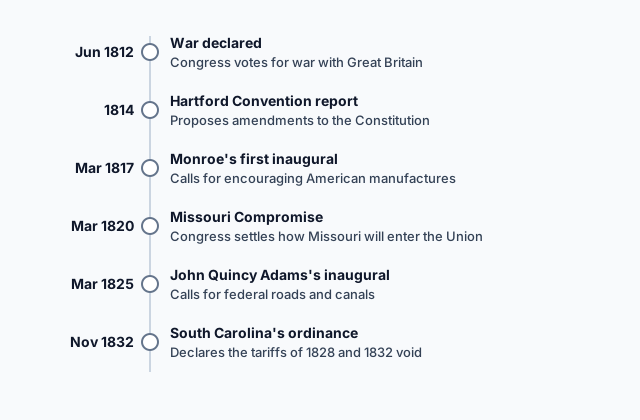 Tap to open the picture full size
Part 1 Think first One new state, a whole Congress divided
Commit to a guess first. Being wrong now makes the right idea stick better.
Predict first
In 1819, as Congress debated letting Missouri in as a state, a representative from New York proposed admitting it as a free state. What do you think best predicted how a member of Congress felt about the proposal?
In short. In the early republic many political leaders took positions on slavery and economic policy that served their own region first, so debates over the War of 1812, the American System and Missouri's admission split Congress by section, and the Missouri Compromise held those tensions down only for a time.
- During the War of 1812, the Hartford Convention of 1814 proposed amendments to protect the Northeast's trade and to limit the growing power of the South and West in Congress.
- Plans to tie the economy together, such as Henry Clay's American System of a protective tariff, a national bank and federal roads and canals, raised the question of whether they helped farmers or manufacturers, and so which section gained.
- The Missouri Compromise of 1820 paired a slave state, Missouri, with a free state, Maine, and banned slavery in the rest of the Louisiana territory north of 36°30', a line repealed in 1854.
Part 2 Learn it Region before nation
2a. War, trade and the Hartford Convention
At war in Europe, Britain blockaded neutral countries such as the United States and took American sailors from their ships. Members of Congress from the South and West, the War Hawks, pressed for war. On June 1, 1812, President James Madison asked for a declaration of war, and Congress approved it on June 18 over the opposition of every Federalist. Centered in the seaports, the Federalists opposed the war because it disrupted trade.
In 1814 delegates from several Northeastern states met at Hartford. Their report to their state legislatures complained that the defense of their states had been neglected, "as it has been since the commencement of the war," and proposed amendments to the Constitution. Congress could not hold American ships in port by an embargo "for more than sixty days," and could not cut off foreign trade, declare war or admit a new state without a two-thirds vote of both houses. House seats would be counted "according to their respective numbers of free persons," ending the clause that let states add "three fifths of all other Persons," the enslaved.
Each proposal guarded one region's trade or its weight in Congress. The protest backfired: it damaged the Federalists' reputation after the war.
Sources: Treaty of Ghent (National Archives); The Two-Party System (National Archives); Hartford Convention amendments (Avalon Project); The Constitution (National Archives).
Quick check · Sort it
Each card is a proposal from the Hartford Convention's report. Tap a card, then the regional interest it served.
Protecting the Northeast's trade at sea
Limiting the power of the South and West in Congress
2b. The American System: who gains?
After the war, national leaders proposed tying the regions into one economy: a protective tariff (a tax on imports high enough to help American factories compete), a national bank, chartered again in 1816, and federal money for internal improvements, roads and canals. Henry Clay of Kentucky later promoted this program as the American System.
James Monroe made the case for manufactures in his first inaugural address, on March 4, 1817: "Possessing as we do all the raw materials, the fruit of our own soil and industry, we ought not to depend in the degree we have done on supplies from other countries." Factories would help farmers too: "Equally important is it to provide at home a market for our raw materials, as by extending the competition it will enhance the price and protect the cultivator against the casualties incident to foreign markets." (A cultivator is a farmer.)
The sections split. The programs were popular in the North and Northwest, where people expected to gain from roads and canals. Southern planters, who exported most of their cotton and bought manufactured goods, paid the higher prices a tariff brought. In 1825 John Quincy Adams granted that "Some diversity of opinion has prevailed with regard to the powers of Congress for legislation upon objects of this nature," and hoped the objections would be removed.
Sources: Monroe's first inaugural (Avalon Project); The Two-Party System (National Archives); Adams's inaugural (Avalon Project); McCulloch v. Maryland (National Archives).
Quick check · Multiple choice
In 1817 Monroe argued that the country should encourage its own manufactures. According to his address, how would that policy help farmers?
2c. Missouri and the line at 36°30'
Slavery split the sections more deeply than any tariff. Each new state sent two senators to Washington, and Missouri's application for statehood threatened the long balance between the number of slave states and free states.
In 1819 a representative from New York, James Tallmadge, proposed admitting Missouri as a free state. A long debate followed. In March 1820 Congress reached the Missouri Compromise: Maine entered as a free state, and Missouri was allowed to form a state government without a ban on slavery, entering as a slave state in 1821, so the balance stayed equal. In the rest of the Louisiana territory, the part "which lies north of thirty-six degrees and thirty minutes north latitude" and outside Missouri, slavery was "forever prohibited."
Forever lasted 34 years. The Kansas-Nebraska Act repealed the line in 1854, and in 1857 the Supreme Court ruled the compromise unconstitutional in Dred Scott v. Sandford. Congress had quieted the conflict between opponents and defenders of slavery. It had not settled it.
Sources: Missouri Compromise (National Archives); The Two-Party System (National Archives). The course framework names Tallmadge and his amendment among its sources for this topic.
Quick check · Match
Match each part of the Missouri debate to what it did or would have done.
2d. Reading a document for its region
On November 24, 1832, a convention of the people of South Carolina adopted an ordinance aimed at the tariff acts approved on May 19, 1828 and July 14, 1832. It called them "in reality intended for the protection of domestic manufactures and the giving of bounties to classes and individuals engaged in particular employments, at the expense and to the injury and oppression of other classes and individuals." It declared them "null, void, and no law, nor binding upon this State, its officers or citizens," and forbade any officer, state or federal, to collect the duties inside the state.
Source it before you use it. Point of view: South Carolina's planters exported most of their cotton and bought manufactured goods from the North or Europe, so a tariff that protected factories cost them while it helped manufacturers elsewhere. Purpose: to stop the duties from being collected in South Carolina. Audience: the state's own people and the national government it defied. Historical situation: two tariff acts, of 1828 and 1832, that the state's convention judged unconstitutional.
The tariff's defenders had long argued, as Monroe did in 1817, that a home market served farmers too. Both sides argued from the Constitution, and each side's reading of it matched its section's interest.
Sources: South Carolina Ordinance of Nullification (Avalon Project); The Two-Party System (National Archives).
Quick check · Fill the statement
Complete a student's sourcing notes on South Carolina's 1832 ordinance.
The ordinance says the tariff helps some "classes and individuals" at the expense of others. Its authors spoke for planters who sold their crops and bought most of their manufactured goods, so they saw the tariff as a cost to themselves; that position is the document's . It declares the tariff acts "null, void, and no law" so that no officer could collect the duties in the state, which is its .
Part 3 Watch it done Source the Hartford Convention's report
Watch each step, then do the last one yourself.
The Hartford Convention of 1814 proposed two amendments to the Constitution: "Congress shall not have power to lay any embargo on the ships or vessels of the citizens of the United States, in the ports or harbors thereof, for more than sixty days." And: "Congress shall not make or declare war, or authorize acts of hostility against any foreign nation, without the concurrence of two-thirds of both Houses." Explain how the historical situation shaped these two proposals.
Predict first
Before the steps, what do you think the delegates mainly wanted from the federal government?
Step 1 · Place it in time
Congress declared war on Britain in June 1812, pressed by members from the South and West. The delegates' party, the Federalists, had opposed the war because it disrupted trade. By late 1814 the war had gone on for more than two years, and the delegates complained that the defense of their states had been neglected. Peace was signed at Ghent on December 24, 1814, but word of it spread slowly.
Why this step?
Why start with who voted for the war?
A proposal answers a problem. Knowing which side lost the vote that started the problem tells you what the authors wanted the Constitution to prevent next time.
Step 2 · Name the authors and the audience
The delegates came from Northeastern states, and the report is addressed to the legislatures of those states, asking them to put the amendments forward. A region wrote it, for that region's own governments.
Your step · Decide and justify
Finish it. How does the historical situation shape the two proposals?
Which evidence best supports your answer?
Part 4 Try it A new president speaks to every section
Andrew Jackson gave his first inaugural address on March 4, 1829, less than a year after the tariff act of May 19, 1828, the act South Carolina would later declare void. On the tariff he said: "With regard to a proper selection of the subjects of impost with a view to revenue, it would seem to me that the spirit of equity, caution and compromise in which the Constitution was formed requires that the great interests of agriculture, commerce, and manufactures should be equally favored, and that perhaps the only exception to this rule should consist in the peculiar encouragement of any products of either of them that may be found essential to our national independence." Impost means a tax on imports. Internal improvements, he added, were of high importance "so far as they can be promoted by the constitutional acts of the Federal Government."
Try it · Multiple choice
Which best explains the purpose of Jackson's words on the tariff?
Try it · Spot the error
A student writes a sourcing paragraph on Jackson's first inaugural address. Which line is the first to go wrong?
Part 5 Explain it Write it like a document-based answer
Nothing you type leaves this page. Check your answer against the model and each scoring point.
Free-response practice · Question 1 style
A short practice in the shape of the document-based question: three documents instead of seven, and a thesis with one body paragraph instead of a full essay.
Evaluate the extent to which regional interests shaped debates over the powers of the federal government between 1814 and 1832.
Document 1. Hartford Convention, proposed amendments, 1814: "Congress shall not have power to lay any embargo on the ships or vessels of the citizens of the United States, in the ports or harbors thereof, for more than sixty days." And: "No new State shall be admitted into the union by Congress in virtue of the power granted by the Constitution, without the concurrence of two-thirds of both Houses."
Document 2. James Monroe, first inaugural address, March 4, 1817: "Equally important is it to provide at home a market for our raw materials, as by extending the competition it will enhance the price and protect the cultivator against the casualties incident to foreign markets."
Document 3. South Carolina Ordinance of Nullification, November 24, 1832, on the tariff acts: "in reality intended for the protection of domestic manufactures and the giving of bounties to classes and individuals engaged in particular employments, at the expense and to the injury and oppression of other classes and individuals."
Write a thesis, one sentence of historical context, and one paragraph that uses at least two documents and explains the purpose, audience, point of view or situation of one of them.
Model answer
Thesis: Between 1814 and 1832 regional interests shaped debates over federal power to a great extent, since each section judged federal power over trade, war and tariffs by what it would cost that section, though national leaders such as Monroe argued that one policy could serve every region.
Context: the War of 1812 had been voted in by the South and West over the objections of the Northeast's Federalists, and after it national leaders turned to plans for tying the sections into one economy.
In 1814 Northeastern delegates, whose side had lost the vote for war in 1812, asked that Congress be barred from holding ships in port "for more than sixty days" and that new states need a two-thirds vote (Document 1), limits that protected their shipping and their weight in Congress against the growing South and West. By 1832 South Carolina, a planting state, called the tariff a gift to manufacturers paid for by "other classes and individuals" (Document 3); because the ordinance was written to justify refusing the duties, it states the planters' grievance as strongly as possible. Monroe, speaking to the whole nation in 1817, claimed that a home market for raw materials would help farmers too (Document 2). His national argument did not end the regional quarrel; fifteen years later a state rejected the tariff altogether.
Score your own answer. This is a self-check, not a grade. Tick each point your answer makes.
Part 6 Check yourself New states and the balance of power
The case questions use the two excerpts. The others mix the ideas from the whole lesson.
One excerpt is from the Hartford Convention's proposed amendments, the other from the Missouri Compromise law Congress approved on March 6, 1820. Sources: Hartford Convention amendments (Avalon Project); Missouri Compromise (National Archives).
| Document | Excerpt |
|---|---|
| Hartford Convention, proposed amendments, 1814 | "No new State shall be admitted into the union by Congress in virtue of the power granted by the Constitution, without the concurrence of two-thirds of both Houses." |
| Missouri Compromise, Section 8, March 6, 1820 | In the Louisiana territory "which lies north of thirty-six degrees and thirty minutes north latitude" and outside the new state, "slavery and involuntary servitude, otherwise than in the punishment of crimes, whereof the parties shall have been duly convicted, shall be, and is hereby, forever prohibited" |
Case question 1 · Multiple choice
Both excerpts respond most directly to which development?
Case question 2 · Multiple choice
Which statement best describes the effect of the Missouri Compromise of 1820?
The rest stand on their own and do not use the case.
Check yourself · Put it in order
Put these events in the order they happened, earliest first.
Check yourself · Select all
Which two statements describe arguments made in the debate over plans like the American System? Select two.
Select 2 answers, then check.
Part 7 Keep it Bring back earlier ideas
This lesson stands on the Constitutional Convention's bargains over slavery from Topic 3.8 and the Supreme Court's early decisions from Topic 4.2.
Bring it back · Multiple choice
In 1807 Congress passed a law banning the import of enslaved people into the United States from January 1, 1808. Which provision of the founding years best explains the timing of that law?
From 4.2 The Rise of Political Parties and the Era of Jefferson · Match
Match each line from Marshall's Court to the principle it states.
In three lines
- Many leaders took positions on war, trade and slavery that served their region first, as the Northeast's Hartford Convention did in 1814.
- Plans like the American System promised to tie the economy together, but sections argued over whether they favored agriculture or industry.
- The Missouri Compromise kept the balance of slave and free states in 1820, and its line held only until 1854.
Exam strategy for this topic
- Section I Part A, Multiple Choice: 55 questions in 55 minutes.
- Section I Part B, Short Answer: 3 questions in 40 minutes.
- Section II, Document-Based Question and Long Essay: 2 questions in 100 minutes.
- This lesson's Explain it is shaped like free-response question 1, Document-based.
When a document comes from one region, name what that region's economy needed, then say how that interest shaped the document's claim about federal power.
Questions students ask
Who were the War Hawks?
Democratic-Republican members of Congress from the South and West who pressed for war with Britain before 1812. The National Archives names Henry Clay of Kentucky and John C. Calhoun of South Carolina among them.
Did the Hartford Convention try to break up the Union?
Its report proposed amendments to the Constitution and asked the Northeastern states to press for them. It said another convention, at Boston, might be needed only if Washington refused the states' requests, the war went on and the region's defense stayed neglected. The protest damaged the Federalists' reputation after the war.
Who named the American System?
Henry Clay of Kentucky promoted the program of a protective tariff, a national bank and federal roads and canals under that name. The National Archives notes that his support was strong in the Northwest, where people expected to benefit from internal improvements.
Why did a tariff divide the sections?
A protective tariff raised the price of imported goods. Southern planters exported most of their cotton and bought manufactured goods from the North or Europe, so they paid more, as South Carolina's 1832 ordinance complained. The North and Northwest, where factories and roads and canals promised gains, were more favorable.
Why was Maine part of the Missouri Compromise?
Admitting Maine as a free state in the same compromise that let Missouri in as a slave state kept the number of free and slave states equal, so neither side gained in the Senate. Maine entered in 1820 and Missouri in 1821.
Where can I read these documents in full?
Each excerpt links to its full text at the National Archives or the Avalon Project at Yale Law School, the primary-source collections this lesson was checked against.
Course alignment, for teachers
AP U.S. History topic 4.3, Unit 4: Period 4: 1800–1848.
- Skill 2.B: Explain the point of view, purpose, historical situation, and/or audience of a source.
This lesson maps all 3 essential knowledge statements of the topic, and the one learning objective with none of its own, to the part that teaches each one: 4 are checked by a scored question. The map is in the lesson file.