Unit 4 · Topic 4.14 · about 30 minutes · 7 parts · 11 scored checks, 4 of them multiple choice, plus 2 from earlier lessons
AP U.S. History 4.14: Causation in Period 4
Unit 4: 10 to 17% of the multiple-choice section
What you'll be able to do
- Explain the extent to which politics, economics, and foreign policy promoted the development of American identity from 1800 to 1848.
Key vocabulary
| Term | What it means | The exam trap |
|---|---|---|
| Suffrage | The right to vote. | Suffrage is the right to vote, not the right to hold office. |
| Market revolution | The fast growth of manufacturing, commerce and transportation in the first half of the 1800s. | It names a long process of change, not one event with a single date. |
| Nullification | A state's claim that it may declare a federal law void inside its own borders. | Nullification is a claim about a state's power, not a ruling by a court. |
| Monroe Doctrine | President Monroe's 1823 message to Congress setting out American policy toward Europe and the Western Hemisphere. | In 1823 it was a statement of policy in a message to Congress, not a treaty or a law. |
| Causation | Reasoning about how one development led to another. | Name the link between cause and effect; a list of causes is not yet an explanation. |
 Tap to open the picture full size
Part 1 Think first Bold abroad, divided at home
Commit to a guess first. Being wrong now makes the right idea stick better.
Predict first
In December 1823 President Monroe told Congress that "the American continents, by the free and independent condition which they have assumed and maintain, are henceforth not to be considered as subjects for future colonization by any European powers." In November 1832 a convention of the people of South Carolina declared two federal tariff laws "null, void, and no law" inside the state. How do you think one nation could speak so boldly to the world and then split so sharply at home?
In short. From 1800 to 1848, wider democracy, a market economy and expansion across the continent built a stronger American identity, while the same forces gave the regions different interests and raised the question of slavery in the West.
- Politics: suffrage moved from owning property to being an adult white man, parties grew, and many Americans worked outside government to make society match the nation's ideals.
- Economics: new transportation, factories and farm production sped up the economy, tying the regions together while helping them grow apart.
- Foreign policy: the United States claimed territory across the continent and promoted trade, and its new western lands set off contests over slavery.
Part 2 Learn it Three forces, two directions
2a. Politics: more voters, new parties, one people
From 1800 to 1848 the United States moved toward a more participatory democracy. Suffrage, the right to vote, shifted from a system based on owning property to one based on being an adult white man. Alabama's 1819 constitution shows the new rule. It made a voter of "Every white male person of the age of twenty-one years, or upwards, who shall be a citizen of the United States, and shall have resided in this State one year next preceding an election," with no property test. Women and Black men stayed outside it.
Political parties grew with the vote. The course framework names Andrew Jackson as the leader of the new Democrats. Vetoing a bill to continue the Bank of the United States in July 1832, Jackson attacked laws that work "to make the rich richer and the potent more powerful."
Americans came to define their nation by its democracy and celebrated a new national culture (4.9 The Development of an American Culture). At the same time, groups such as enslaved and free African Americans built distinctive cultures of their own (4.12 African Americans in the Early Republic). And many Americans, inspired by the Second Great Awakening (4.10 The Second Great Awakening) and other religious and intellectual movements, worked mostly outside government to make society match the nation's ideals (4.11 An Age of Reform), in temperance societies, antislavery groups and the women's rights convention at Seneca Falls.
Sources: Constitution of Alabama, 1819 (Avalon Project); Jackson's Bank veto, 1832 (Avalon Project).
Quick check · Match
Match each piece of evidence from 1800 to 1848 to the development it shows.
2b. Economics: a market that tied regions together and set them apart
New technology, farm methods and ways of doing business sped up the American economy in what is called the market revolution. Steamboats, canals and railroads carried goods farther and faster, and factories and farms produced far more. More Americans, especially women and men working in factories, stopped farming mainly for their own needs and made goods for distant markets instead. A larger middle class grew, and so did a population of laboring poor. New domestic ideals cast the home as a private sphere apart from public life.
The new economy linked the regions. By mid-century, a National Archives summary notes, most American cotton was shipped to England or New England to be made into cloth. It also gave the regions different interests, as the course framework notes of the tariff debates. A protective tariff helped Northern mills but raised what Southern planters paid for imported goods. In November 1832 South Carolina's convention called the tariff laws "intended for the protection of domestic manufactures" and passed "at the expense and to the injury and oppression of other classes and individuals." The same economic growth that helped unify the nation encouraged the regions to grow in different directions.
Sources: Patent for Cotton Gin (National Archives); South Carolina Ordinance of Nullification (Avalon Project).
Quick check · Sort it
Each card is a development of the market revolution. Tap a card, then what it did to the relationship between the regions.
Tied the regions together
Pulled the regions apart
2c. Foreign policy and expansion: a continental nation
Seeking an independent place in the world, the United States set out to claim territory across North America and to expand its trade. It bought the Louisiana Territory from France in 1803. A treaty with Algiers in 1815 said Algiers would require no tribute from the United States and set trade on most-favored-nation terms. Monroe's message to Congress of December 1823 opened on talks with Russia over the two nations' rights on the northwest coast of North America, and it declared that the American continents "are henceforth not to be considered as subjects for future colonization by any European powers."
New land also raised the question of whether slavery would go into it. When Missouri, part of the Louisiana lands, asked to become a state, Congress split, because adding it would change the balance between slave and free states. The Missouri Compromise of 1820 let Missouri enter as a slave state, paired with Maine as a free state, and banned slavery in the rest of the Louisiana lands north of thirty-six degrees and thirty minutes north latitude.
The question did not stay settled. In March 1845, as Texas asked to join the Union, President Polk warned that "sectional jealousies and heartburnings must be discountenanced" and insisted that as the nation grew, "the bonds of our Union, so far from being weakened, will become stronger."
Sources: Monroe Doctrine (Avalon Project); Missouri Compromise (National Archives); Treaty with Algiers (Avalon Project); Polk's inaugural (Avalon Project).
Quick check · Multiple choice
What does Monroe's 1823 statement most directly show about American identity in this period?
2d. Causation: connecting the evidence
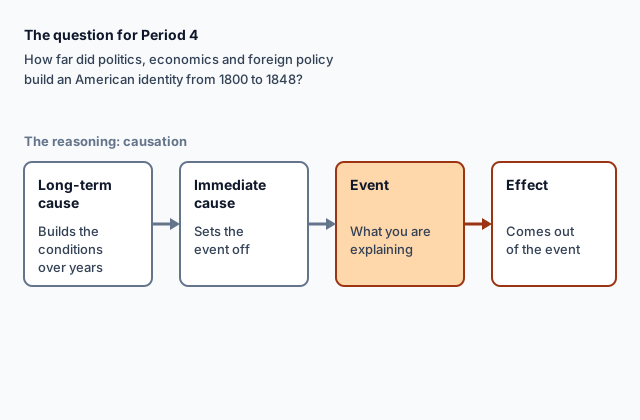
Causation is reasoning about how one development led to another. A causation question often hands you two pieces of evidence and asks how they relate. Three questions help.
Which came first, and could the first have produced the second? Monroe's message of 1823 came after the Missouri Compromise of 1820, so it cannot have caused the compromise.
Is the link immediate or long-term? An immediate cause sets an event off. A long-term cause builds the conditions over years. Missouri's request for statehood set off the crisis of 1820. The spread of slavery into the new western lands after 1800 was a long-term cause, because it made slavery's future in those lands worth fighting over. The compromise that ended the crisis was an effect.
Do two pieces of evidence share a cause? Monroe's message and the Missouri Compromise come from different sides of the same growth: claims across the continent fed confidence abroad and conflict at home.
To judge how much a cause mattered, ask what else had to be true. Expansion by itself did not divide the country. The question of slavery in the new lands did.
Quick check · Fill the statement
Complete a historian's notes on the nullification crisis of 1832.
South Carolina's convention declared the tariff laws of 1828 and 1832 void. Those tariff laws were the cause of the crisis. The different economies of the North and the South, growing apart for decades, were among its causes. Jackson's proclamation that the Union was a government, not a league, was one of it.
Part 3 Watch it done Relate two documents from 1832
Watch each step, then do the last one yourself.
On November 24, 1832, a South Carolina convention declared the federal tariff laws void inside the state. On December 10, 1832, President Jackson issued a proclamation answering it. Explain the relationship between the two documents and what it shows about American identity.
Predict first
Before the steps, how do you think the two documents are related?
Step 1 · Place them in time
The ordinance came first. Jackson's proclamation followed sixteen days later, and its first lines name the South Carolina convention and its ordinance.
Why this step?
Why check the order before reading the content?
A cause has to come before its effect. If the second document answers the first, its claims are a reply, and you read them as one side of a dispute.
Step 2 · Read each claim
South Carolina called the tariffs "intended for the protection of domestic manufactures" at the expense of "other classes and individuals," and declared them "null, void, and no law." Jackson replied that one state's power to annul a federal law was "incompatible with the existence of the Union," and that "The Constitution of the United States, then, forms a government, not a league." He also wrote: "We are ONE PEOPLE in the choice of the President and Vice President."
Your step · Decide and justify
Finish it. What does the relationship between the two documents best show?
Which evidence best supports your answer?
Part 4 Try it Build the chain, then weigh it
Try it · Put it in order
Put these developments in the order they happened, earliest first.
Try it · Multiple choice
Which statement best evaluates the extent to which westward expansion promoted a shared American identity from 1800 to 1848?
Part 5 Explain it Write it like a document-based answer
Nothing you type leaves this page. Check your answer against the model and each scoring point.
Free-response practice · Question 1 style
A short practice in the shape of the document-based question: three documents instead of seven, and a thesis with one body paragraph instead of a full essay.
Evaluate the extent to which politics, economics and foreign policy promoted the development of an American national identity from 1800 to 1848.
Document 1. Monroe Doctrine, from President Monroe's annual message to Congress, December 2, 1823: "the American continents, by the free and independent condition which they have assumed and maintain, are henceforth not to be considered as subjects for future colonization by any European powers."
Document 2. South Carolina Ordinance of Nullification, November 24, 1832, describing federal tariff laws as "intended for the protection of domestic manufactures and the giving of bounties to classes and individuals engaged in particular employments, at the expense and to the injury and oppression of other classes and individuals."
Document 3. President Jackson's veto of a bill to continue the Bank of the United States, July 10, 1832, objecting to laws that work "to make the rich richer and the potent more powerful."
Write a thesis, one sentence of historical context, and one paragraph that uses at least two documents and explains the purpose, audience, point of view or situation of one of them.
Model answer
Thesis: Politics and foreign policy did much to promote an American national identity from 1800 to 1848, as leaders spoke for the nation and its people in the hemisphere and at home, but economic growth gave the regions different interests that tested that identity by 1832.
Context: in these years suffrage spread to most adult white men, and canals, railroads and factories bound the regions into a market economy.
In 1823 Monroe spoke for "the American continents" and warned Europe against new colonies (Document 1), a sign that Americans saw their nation as an independent power. Jackson's Bank veto (Document 3) attacked laws that work "to make the rich richer and the potent more powerful." He wrote as a party leader speaking to the voters that wider suffrage had created, so the veto shows a president casting the national government as answerable to ordinary people, not proof that every voter agreed. Economics pulled the other way. South Carolina called the tariff a law for "domestic manufactures" passed to the "injury and oppression of other classes and individuals" (Document 2), meaning planters like its own, so a policy meant to build the national economy looked to cotton planters like one region taxing another. National identity grew, but it was contested.
Score your own answer. This is a self-check, not a grade. Tick each point your answer makes.
Part 6 Check yourself Two documents, one growing nation
The case questions use the two excerpts. The others mix the ideas from the whole lesson.
Both excerpts are from the federal government, three years apart. Sources: Missouri Compromise (National Archives); Monroe Doctrine (Avalon Project).
| Document | Excerpt |
|---|---|
| Missouri Compromise, Section 8, approved March 6, 1820, on the Louisiana lands north of thirty-six degrees and thirty minutes north latitude, outside Missouri | "slavery and involuntary servitude, otherwise than in the punishment of crimes, whereof the parties shall have been duly convicted, shall be, and is hereby, forever prohibited" |
| Monroe Doctrine, President Monroe's message to Congress, December 2, 1823 | "the American continents, by the free and independent condition which they have assumed and maintain, are henceforth not to be considered as subjects for future colonization by any European powers" |
Case question 1 · Multiple choice
Which best describes a relationship between the two excerpts?
Case question 2 · Multiple choice
The dispute that the 1820 excerpt was written to settle arose most directly from which development?
The rest stand on their own and do not use the case.
Check yourself · Select all
Which two changes did the market revolution bring to many American families? Select two.
Select 2 answers, then check.
Check yourself · Spot the error
A student writes a causation paragraph about expansion and slavery. Which line is the first to go wrong?
Part 7 Keep it Bring back earlier ideas
This review stands on the South's cotton economy from Topic 4.13 and the expansion of voting from Topic 4.7.
From 4.13 The Society of the South in the Early Republic · Decide and justify
Did the South's reliance on staple exports cut it off from the rest of the nation's economy?
Which evidence best supports your answer?
From 4.7 Expanding Democracy · Put it in order
Put these events in the order they happened, earliest first.
In three lines
- Wider suffrage, new parties and reform movements made democracy part of how Americans defined the nation.
- The market revolution tied the regions together through trade while giving them different interests, as the tariff fight of 1832 showed.
- Expansion built national ambition abroad and, through the question of slavery in new lands, conflict at home that did not stay settled.
Exam strategy for this topic
- Section I Part A, Multiple Choice: 55 questions in 55 minutes.
- Section I Part B, Short Answer: 3 questions in 40 minutes.
- Section II, Document-Based Question and Long Essay: 2 questions in 100 minutes.
- This lesson's Explain it is shaped like free-response question 1, Document-based.
When a question asks how two pieces of evidence relate, check their dates first, then name the link: one caused the other, one answered the other, or both came from a shared cause.
Questions students ask
Is this lesson new material or review?
Review. It pulls the whole period from 1800 to 1848 together under three forces, politics, economics and foreign policy, and asks how each built or strained an American identity.
What does a causation question ask me to do?
Explain how one development led to another, or how two pieces of evidence are connected by cause and effect. Check the order, name the link, and say whether the cause was immediate or long-term.
Why does a lesson about national identity spend so long on regional conflict?
Because the period's growth did both. The same economy and expansion that gave Americans a stronger sense of one nation also gave the regions different interests, and judging the extent of a national identity means weighing both.
Why is ONE PEOPLE in capital letters?
Every excerpt is copied exactly as the archive prints it, so you can check it against the source linked beside it. The capitals are in the Avalon Project's text of Jackson's proclamation.
Where can I read these documents in full?
Each excerpt links to its full text at the National Archives or the Avalon Project at Yale Law School, the primary-source collections this lesson was checked against.
Course alignment, for teachers
AP U.S. History topic 4.14, Unit 4: Period 4: 1800–1848.
- Skill 6.C: Use historical reasoning to explain relationships among pieces of historical evidence.
This lesson maps all 11 essential knowledge statements of the topic, and the one learning objective with none of its own, to the part that teaches each one: 12 are checked by a scored question. The map is in the lesson file.