Unit 5 · Topic 5.9 · about 30 minutes · 7 parts · 13 scored checks, 5 of them multiple choice
AP U.S. History 5.9: Government Policies During the Civil War
Unit 5: 10 to 17% of the multiple-choice section
What you'll be able to do
- Explain how Lincoln's leadership during the Civil War changed American ideals over the course of the war: how the Emancipation Proclamation turned a war to save the Union into a war against slavery and kept European powers from fully backing the Confederacy, how African Americans who fled slavery and enlisted undermined the Confederacy, and how Lincoln's speeches tied the fight against slavery to the nation's founding ideals while he sought to reunite the country.
Key vocabulary
| Term | What it means | The exam trap |
|---|---|---|
| Emancipation | Freeing people from slavery. | Declaring people free and their actually being free are different; ask what made the freedom real in a given place. |
| War measure | An action a government takes under its power to wage war, justified by the needs of the fighting. | Calling something a war measure says where its authority comes from, not whether its author also thought it right. |
| United States Colored Troops | The Union army regiments of Black soldiers organized under a War Department order of 1863. | Black sailors served in the Navy, outside these army regiments; read which service a source counts. |
| Contrabands | The Union army's word during the war for enslaved people who reached Union lines. | The word is the army's, from the time; a source that uses it shows the army's point of view. |
| Historical situation | What was happening when and where a source was made. | Situation is about the moment, not the speaker's opinion; keep it apart from point of view. |
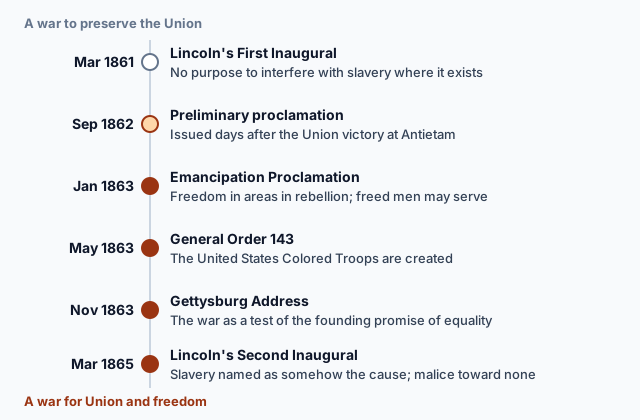 Tap to open the picture full size
Part 1 Think first What changed Lincoln's course?
Commit to a guess first. Being wrong now makes the right idea stick better.
Predict first
On March 4, 1861, in his first inaugural address, Abraham Lincoln said: "I have no purpose, directly or indirectly, to interfere with the institution of slavery in the States where it exists." On January 1, 1863, he issued the Emancipation Proclamation. What do you think did most to change his course?
In short. Lincoln and most Union supporters went to war to save the Union, but the Emancipation Proclamation of 1863 made the war a fight against slavery as well, African Americans who fled slavery and enlisted weakened the Confederacy, and Lincoln's speeches presented that fight as the fulfillment of the nation's founding ideals while he worked to reunite the country.
- Issued as a war measure, the Emancipation Proclamation freed enslaved people only in areas in rebellion, but it reframed the war's purpose and helped keep European powers from fully backing the Confederacy.
- Many African Americans fled plantations for Union lines and enlisted in the Union army and navy, which undermined the Confederacy from inside and strengthened the Union.
- At Gettysburg in 1863 Lincoln tied the war to the founding idea that all men are created equal, and in 1865 he called for a peace "With malice toward none, with charity for all."
Part 2 Learn it Lincoln, emancipation and the meaning of the war
2a. A war to save the Union
Lincoln and most Union supporters began the war to preserve the Union. At his inauguration Lincoln had promised: "I have no purpose, directly or indirectly, to interfere with the institution of slavery in the States where it exists." The National Archives sums up the start: the North fought to prevent the secession of the Southern states and preserve the Union, and ending slavery was not a goal of the war.
Politics held Lincoln back. Slave states on the border had stayed loyal, and his administration worried that recruiting Black soldiers would push them to secede. When two Union generals, John C. Frémont in Missouri and David Hunter in South Carolina, issued orders freeing enslaved people in their regions, their superiors revoked them.
The war's needs changed the calculation. By mid-1862 more and more enslaved people were reaching Union lines, white volunteers were declining and the army needed men. On July 17, 1862, Congress passed the Second Confiscation and Militia Act, which among other things freed enslaved people whose enslavers were in the Confederate Army.
Sources: Lincoln's First Inaugural Address (Avalon Project); Emancipation Proclamation (National Archives); War Department General Order 143 (National Archives).
Quick check · Multiple choice
In 1861, why did Lincoln hold back from making the end of slavery a goal of the war?
2b. The Emancipation Proclamation
On September 22, 1862, days after the Union victory at Antietam, Lincoln issued a preliminary proclamation: enslaved people in areas still in rebellion on January 1, 1863, would be declared free. On that day he issued the Emancipation Proclamation. He described the order "as a fit and necessary war measure for suppressing said rebellion." Its central sentence declares "that all persons held as slaves within said designated States, and parts of States, are, and henceforward shall be free."
Because it rested on war powers, it reached only areas in rebellion. Slavery in the loyal border states was untouched, and parts of the Confederacy already under Union control were exempted. And the freedom it promised depended on Union victory.
After January 1, 1863, writes the National Archives, every advance of federal troops expanded the domain of freedom. The war for the Union was now also a war against slavery. Lincoln also hoped the proclamation would keep England and France from giving the Confederacy political recognition and military aid. Britain had signed a treaty in April 1862 with the United States "for the suppression of the slave trade carried on upon the coast of Africa." Reasoning from that: once the Union fought openly against slavery, it was harder for a European government to recognize a slaveholding Confederacy against it. The proclamation helped keep the Confederacy from winning full diplomatic support in Europe.
Sources: Slave Trade Treaty, 1862 (Avalon Project); Emancipation Proclamation (National Archives).
Quick check · Fill the statement
Complete a student's notes on the Emancipation Proclamation.
Lincoln issued the proclamation as Commander-in-Chief, so it freed enslaved people only in areas . Even so, it made the war a fight against slavery as well as for the Union, and Lincoln hoped it would keep from giving the Confederacy recognition and aid.
2c. African Americans and the Union army
Enslaved people did not wait for Washington. From the first days of the war, the National Archives notes, they acted to secure their own liberty. Many fled plantations for Union lines, where the army called them "contrabands." Each person who escaped took labor away from the Confederacy.
The Union had begun to reconsider its ban on Black soldiers in 1862. The Emancipation Proclamation then announced that freed men "will be received into the armed service of the United States to garrison forts, positions, stations, and other places, and to man vessels of all sorts in said service." By announcing that Black men would be accepted into the army and navy, the National Archives says, the proclamation was "enabling the liberated to become liberators." Black recruitment was then pursued in earnest. On May 22, 1863, the War Department's General Order 143 created the United States Colored Troops. Frederick Douglass and other Black leaders urged Black men to enlist to ensure eventual full citizenship. Roughly 179,000 Black men served as soldiers in the U.S. Army, and another 19,000 in the Navy.
They served in segregated units, usually under white officers, and at first for less pay: $10 a month with $3 taken out for clothing, against $13 for white soldiers. In June 1864 Congress granted equal pay to the U.S. Colored Troops.
Sources: Emancipation Proclamation (National Archives); War Department General Order 143 (National Archives); Black Soldiers in the Civil War (National Archives).
Quick check · Match
Match each development to its effect on the war.
2d. Lincoln's words and the nation's ideals
Lincoln also used speeches to give the war its meaning. At Gettysburg on November 19, 1863, ten months after the Emancipation Proclamation, he described the war as a test of the nation's founding promise: "Now we are engaged in a great civil war, testing whether that nation or any nation so conceived and so dedicated can long endure." The nation had been "dedicated to the proposition that all men are created equal." He asked his listeners to take up "the unfinished work which they who fought here have thus far so nobly advanced," and resolved "that these dead shall not have died in vain, that this nation under God shall have a new birth of freedom."
The address never names slavery. Its moment invites a reading: spoken while Union armies were carrying emancipation into the South, it is widely read as presenting the struggle against slavery as the fulfillment of the nation's founding democratic ideals.
In his Second Inaugural, on March 4, 1865, with the war nearly won, Lincoln did name slavery: "These slaves constituted a peculiar and powerful interest. All knew that this interest was somehow the cause of the war." Yet he aimed at reunion, not revenge. "With malice toward none, with charity for all," the nation should work "to bind up the nation's wounds" and seek "a just and lasting peace among ourselves and with all nations."
Sources: Gettysburg Address (Avalon Project); Lincoln's Second Inaugural Address (Avalon Project).
Quick check · Sort it
Each card is a phrase from Lincoln's speeches. Tap a card, then the work it does.
Ties the war to the nation's founding ideals
Looks ahead to reuniting the country
Part 3 Watch it done Source the Emancipation Proclamation's limits
Watch each step, then do the last one yourself.
The Emancipation Proclamation of January 1, 1863, frees enslaved people in the areas it names, but the Union-held areas it lists as exceptions are "left precisely as if this proclamation were not issued." Explain how the proclamation's author and purpose shape this limit.
Predict first
Before the steps, why do you think Lincoln left some areas out?
Step 1 · Find who is acting, and in what role
Lincoln acts "by virtue of the power in me vested as Commander-in-Chief." The author is the president, writing as head of the armed forces in a time of rebellion.
Why this step?
Why start with the author's role?
An author's position decides what a document can do. The powers a president uses set the reach of the order he signs.
Step 2 · Check the places named
Every state and part of a state named is listed as in rebellion. The loyal border states are not named, and areas the Union already held are carved out as exceptions.
Your step · Decide and justify
Finish it. Why does the proclamation leave the loyal border states and Union-held areas untouched?
Which evidence best supports your answer?
Part 4 Try it Two voices on what the war was for
Black leaders gave the war a meaning of their own. A National Archives teaching article on Black soldiers opens with these words, credited only to Frederick Douglass, with no date or occasion given:
"Once let the black man get upon his person the brass letter, U.S., let him get an eagle on his button, and a musket on his shoulder and bullets in his pocket, there is no power on earth that can deny that he has earned the right to citizenship."
Lincoln spoke for the Union government at his second inauguration, on March 4, 1865: "Neither party expected for the war the magnitude or the duration which it has already attained." He went on: "These slaves constituted a peculiar and powerful interest. All knew that this interest was somehow the cause of the war." And he closed: "With malice toward none, with charity for all."
Sources: The Fight for Equal Rights (Freeman, Schamel and West, National Archives); Lincoln's Second Inaugural Address (Avalon Project).
Try it · Multiple choice
The page gives no date or audience for Douglass's words. What can a historian still say about their purpose from the words alone?
Try it · Spot the error
A student writes a sourcing paragraph on Lincoln's Second Inaugural. Which line is the first to go wrong?
Part 5 Explain it Write it like a document-based answer
Nothing you type leaves this page. Check your answer against the model and each scoring point.
Free-response practice · Question 1 style
A short practice in the shape of the document-based question: three documents instead of seven, and a thesis with one body paragraph instead of a full essay.
Evaluate the extent to which the purpose of the Civil War, as Lincoln described it, changed between 1861 and 1865.
Document 1. Abraham Lincoln, First Inaugural Address, March 4, 1861: "I have no purpose, directly or indirectly, to interfere with the institution of slavery in the States where it exists."
Document 2. Emancipation Proclamation, January 1, 1863: Lincoln acts "as a fit and necessary war measure for suppressing said rebellion" and declares "that all persons held as slaves within said designated States, and parts of States, are, and henceforward shall be free."
Document 3. Abraham Lincoln, Second Inaugural Address, March 4, 1865: "These slaves constituted a peculiar and powerful interest. All knew that this interest was somehow the cause of the war." And: "With malice toward none, with charity for all."
Write a thesis, one sentence of historical context, and one paragraph that uses at least two documents and explains the purpose, audience, point of view or situation of one of them.
Model answer
Thesis: Between 1861 and 1865 the purpose of the war as Lincoln described it changed greatly, from saving the Union while leaving slavery alone to destroying slavery, though restoring the Union remained his goal throughout.
Context: Lincoln won the election of 1860 on a free-soil platform without any Southern electoral votes, and after a series of contested debates most slave states voted to secede.
In 1861 Lincoln promised he had "no purpose" to interfere with slavery where it existed (Document 1). He was speaking at his inauguration, in the middle of the secession crisis, so his purpose appears to have been to reassure the South and the loyal border states, and his words show what he hoped would hold the Union together. By 1863 he declared enslaved people in rebellious areas free (Document 2), but as "a fit and necessary war measure," which shows that saving the Union still drove the change. By 1865 he named slavery as "somehow the cause of the war" while calling for "malice toward none" (Document 3). The war had become a fight against slavery, and its goal remained one nation.
Score your own answer. This is a self-check, not a grade. Tick each point your answer makes.
Part 6 Check yourself One president, two years apart
The case questions use the two excerpts. The others mix the ideas from the whole lesson.
Both excerpts are Abraham Lincoln's, at his first inauguration and at Gettysburg. Sources: Lincoln's First Inaugural Address (Avalon Project); Gettysburg Address (Avalon Project).
| Document | Excerpt |
|---|---|
| First Inaugural Address, March 4, 1861 | "I have no purpose, directly or indirectly, to interfere with the institution of slavery in the States where it exists." |
| Gettysburg Address, November 19, 1863 | "that these dead shall not have died in vain, that this nation under God shall have a new birth of freedom" |
Case question 1 · Multiple choice
Which development between the two excerpts best explains the change in what Lincoln said the war was for?
Case question 2 · Multiple choice
The 1863 excerpt never mentions slavery. Which reading of a new birth of freedom does its historical situation best support?
The rest stand on their own and do not use the case.
Check yourself · Put it in order
Put these events in the order they happened, earliest first.
Check yourself · Select all
Which two were actions by African Americans that undermined the Confederacy? Select two.
Select 2 answers, then check.
Part 7 Keep it Bring back earlier ideas
This lesson stands on how the Union won the war from Topic 5.8 and on Lincoln's election and secession from Topic 5.7.
Bring it back · Multiple choice
Suppose a Union general in 1864 argues that wrecking the South's rail lines and burning its stores will end the war sooner than any battle. Which factor in the Union's victory does his plan reflect?
Bring it back · Decide and justify
After Lincoln's election in 1860, did every slave state leave the Union?
Which evidence best supports your answer?
In three lines
- Lincoln and most Union supporters began the war to preserve the Union, and the Emancipation Proclamation made it a war against slavery too.
- The proclamation helped keep European powers from fully backing the Confederacy, and African Americans who fled and enlisted undermined it.
- Lincoln's speeches tied the fight against slavery to the nation's founding ideals, and he sought to reunite the country without revenge.
Exam strategy for this topic
- Section I Part A, Multiple Choice: 55 questions in 55 minutes.
- Section I Part B, Short Answer: 3 questions in 40 minutes.
- Section II, Document-Based Question and Long Essay: 2 questions in 100 minutes.
- This lesson's Explain it is shaped like free-response question 1, Document-based.
When a question asks how Lincoln's goals changed, show both sides: emancipation became a war aim in 1863, and saving the Union stayed his goal throughout. Quote the words, and give the date that explains them.
Questions students ask
Did the Emancipation Proclamation free all enslaved people?
No. It applied only to areas in rebellion, left slavery untouched in the loyal border states and exempted parts of the Confederacy already under Union control. Its freedom depended on Union victory. It still changed the war, because every Union advance after January 1, 1863, expanded the area of freedom.
Why did Lincoln call the proclamation a war measure?
His authority to free people without an act of Congress came from his power as Commander-in-Chief in a time of rebellion. Calling it a war measure named that authority, which is also why it reached only areas in rebellion.
How many African Americans served in the Union forces?
The National Archives reports that roughly 179,000 Black men served as soldiers in the U.S. Army and another 19,000 in the Navy. Black recruitment was pursued in earnest after the Emancipation Proclamation.
Why does Topic 3.4 also use the Gettysburg Address?
Topic 3.4 reads it for what it shows about the Declaration of Independence's ideals lasting into the 1860s. Here the question is what the speech meant in November 1863, ten months after emancipation, and how Lincoln used it to give the war a purpose.
Where can I read these documents in full?
Each excerpt links to its full text at the National Archives or the Avalon Project at Yale Law School, the collections this lesson was checked against.
Course alignment, for teachers
AP U.S. History topic 5.9, Unit 5: Period 5: 1844–1877.
- Skill 2.B: Explain the point of view, purpose, historical situation, and/or audience of a source.
This lesson maps all 2 essential knowledge statements of the topic, and the one learning objective with none of its own, to the part that teaches each one: 3 are checked by a scored question. The map is in the lesson file.