Unit 1 · Topic 1.7 · about 30 minutes · 7 parts · 13 scored checks, 5 of them multiple choice
AP U.S. History 1.7: Causation in Period 1
Unit 1: 4 to 6% of the multiple-choice section
What you'll be able to do
- Explain the effects of transatlantic voyages from 1491 to 1607 on both sides of the Atlantic, and make a historically defensible claim about those effects that the evidence of the period supports.
Key vocabulary
| Term | What it means | The exam trap |
|---|---|---|
| Historically defensible claim | A statement about the past that someone could dispute and that evidence from the period supports. | A true fact is not a claim; a claim takes a position that the evidence then has to support. |
| Columbian Exchange | The movement of plants, animals and diseases between the Americas and the rest of the world after 1492. | It ran both ways: American crops reached Europe, and European diseases, crops and animals reached the Americas. |
| Charter | A written grant from a ruler giving a person or company the right to claim, settle or govern land. | A charter shows what a ruler allowed and hoped for, not what actually happened on the ground. |
| Joint-stock company | A business owned by many investors who buy shares, pool their money and split the profits or losses. | Investors paid for the venture, but the crown still chartered it and claimed a share of any gold and silver. |
| Worldview | A people's basic beliefs about matters such as religion, family, gender roles, land and power. | Different worldviews do not mean one side lacked one; Native and European societies each held their own. |
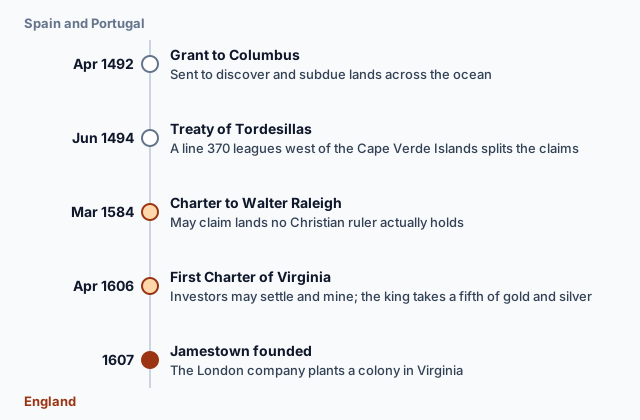 Tap to open the picture full size
Part 1 Think first What did the voyages change?
Commit to a guess first. Being wrong now makes the right idea stick better.
Predict first
In 1492 Ferdinand and Isabella of Spain sent Christopher Columbus "to discover and subdue some Islands and Continent in the ocean." In 1606 King James I of England chartered a group of "Adventurers of and for our City of London" to plant a colony in Virginia. Which claim about the effects of transatlantic voyages between those two dates do you think holds up best?
In short. Transatlantic voyages from 1492 to 1607 changed both sides of the ocean: epidemics, conquest and new labor systems remade the Americas, while competition for land and the new crops and wealth of the Americas changed Europe.
- In 1491 North America held many distinct, complex Native societies, each shaped by how its people adapted to and transformed their environment, so the voyages did not reach an empty or uniform land.
- In the Americas, the Columbian Exchange and the Spanish Empire brought deadly epidemics, forced Native labor, the import of enslaved Africans and a caste system; in Europe, new crops fed population growth, American gold and silver sped the shift toward capitalism, and rival crowns competed for land and converts.
- Europeans and Native Americans held different views of religion, family, gender roles, land and power, and a defensible claim about the period's effects shows both sides of the Atlantic.
Part 2 Learn it Effects on both sides of the Atlantic
2a. Start from 1491, and make a claim
A historically defensible claim takes a position about a cause, an effect or an extent (how much something changed), so someone could argue against it, and evidence from the period supports it. Use that test: does the statement argue a cause, an effect or an extent? Columbus sailed in 1492 argues none of them, so it is a fact, not a claim. The voyages changed Native societies more deeply and more quickly than they changed European ones is a claim: it takes a position you could test.
To judge what the voyages changed, start with what was there before. In 1491 North America was home to many distinct and increasingly complex societies, shaped by how people adapted to and transformed very different environments. Maize farming spread north from present-day Mexico into the Southwest and supported irrigation and settled towns. In the dry Great Basin and on the western Great Plains, many people lived largely mobile lives. In the Northeast, the Mississippi River Valley and along the Atlantic coast, mixed farming and hunting supported permanent villages. In the Northwest and present-day California, the riches of the ocean fed some settled communities.
So a claim that Europeans arrived in an empty land, or met one kind of people, fails before it starts. The evidence contradicts it.
Quick check · Sort it
Each card is a statement about North America before 1492. Tap a card, then the kind of statement it is.
A defensible claim
A claim the evidence contradicts
A fact, not a claim
2b. Effects in Europe: a race across the ocean
Contact changed Europe too. European expansion into the Western Hemisphere set off intense competition among European states, for wealth, for land and for the spread of their faith, and it changed European societies from within.
The competition shows two years after Columbus's first voyage. On June 7, 1494, Spain and Portugal signed the Treaty of Tordesillas because, it says, "a certain controversy exists" over which newly found lands belonged to each crown. They agreed, "for the sake of peace and concord," to a line "three hundred and seventy leagues west of the Cape Verde Islands." Spain could claim lands west of the line and Portugal lands east of it, which later gave Portugal its claim to Brazil.
Other rulers were not part of that bargain. England and France sent voyages of their own. By the late 1500s England's queen, Elizabeth I, was Protestant and Spain's king was Catholic, so the race for land was also a contest between faiths.
Inside Europe, American crops such as maize and potatoes fed a growing population, and gold and silver from American mines carried Europe from feudalism toward capitalism. By the end of the period, English rulers were chartering companies of investors to pay for colonies rather than sending royal expeditions.
Quick check · Multiple choice
In 1494 Spain and Portugal agreed to a line "three hundred and seventy leagues west of the Cape Verde Islands" because "a certain controversy exists" between their crowns. Which effect of transatlantic voyages does the treaty most directly show?
2c. Effects in the Americas: the Columbian Exchange and the Spanish Empire
In the Americas the effects came faster and were far more deadly. Contact among Europeans, Native Americans and Africans produced the Columbian Exchange, the movement of plants, animals and diseases between the hemispheres. Diseases such as smallpox, which Native peoples had never met, spread in widespread epidemics that devastated Native populations. Europeans also brought crops and animals not found in the Americas, such as wheat, horses, cattle and pigs.
The Spanish Empire built new economic and social orders on top of those losses. Under the encomienda system, Spanish colonists forced Native people to work on plantations and in mines. Spain also imported enslaved Africans to labor in plantation agriculture and mining, bought from European traders who partnered with some West African groups that practiced slavery. A caste system carefully defined the status of Europeans, Africans, Native Americans and people of mixed ancestry.
The grant Ferdinand and Isabella gave Columbus on April 30, 1492, already pointed this way. It sent him "to discover and subdue some Islands and Continent in the ocean," and named him admiral and viceroy over what he conquered. Discovery and rule were planned together.
Source: Privileges granted to Columbus, 1492 (Avalon Project).
Quick check · Match
Match each development of the 1500s to the effect it produced.
2d. Different worldviews, and claims about them
Contact also set different worldviews side by side. Europeans and Native Americans held divergent views about religion, gender roles, family, land use and power.
Take land and power. English charters treated the monarch as able to grant land across the ocean. Elizabeth I's 1584 charter licensed Walter Raleigh to find and hold "remote, heathen and barbarous lands, countries, and territories, not actually possessed of any Christian Prince, nor inhabited by Christian People." In the charter's terms, land held only by non-Christians was open to an English claim. Many Native societies saw land as something a community used and shared, not as property a distant ruler could give away.
Religion and family differed too. The 1606 Virginia charter hoped to bring "the Infidels and Savages, living in those parts, to human Civility." Those words are the English view: they treat Native peoples as lacking true religion and civilization. Many Native peoples held their own religious beliefs, often tied to the natural world and to particular places. In many eastern Native societies women did most of the farming, and some traced family through the mother's line; in English families, land and name usually passed through the father.
A defensible claim about worldviews names the issue, shows both sides' views, and points to an effect, such as conflict over land.
Sources: Charter to Raleigh, 1584 (Avalon Project); First Charter of Virginia, 1606 (Avalon Project).
Quick check · Spot the error
A student writes a paragraph about land in early English plans for North America. Which line is the first to go wrong?
Part 3 Watch it done Make a claim from Raleigh's charter
Watch each step, then do the last one yourself.
On March 25, 1584, Elizabeth I of England chartered Walter Raleigh to find and hold lands "not actually possessed of any Christian Prince, nor inhabited by Christian People." Make a defensible claim about what this charter shows about European competition for the Americas ninety years after the Treaty of Tordesillas.
Predict first
Before the steps, what do you think the charter shows about England and the 1494 line?
Step 1 · Place it in time
In 1494 Spain and Portugal divided the newly found lands between themselves, and England was not part of the bargain. By 1584 Spain had conquered a large American empire that sent gold and silver home, and England had no lasting colony in the Americas.
Why this step?
Why set the charter beside the 1494 treaty?
A claim about change needs a before and an after. The treaty is the before: two crowns splitting the claims. The charter shows who else was claiming by 1584.
Step 2 · Read what the words leave out
The charter does not tell Raleigh to stay on one side of any line. It shuts him out only of lands "actually possessed" by a Christian ruler or inhabited by Christians. A claim drawn on a map would not stop him; only real possession would.
Your step · Decide and justify
Finish it. Which claim does the charter best support?
Which evidence best supports your answer?
Part 4 Try it The end of the period: the Virginia charter
In 1492 Columbus had sailed "by our command, with some of our vessels and men" of Spain's monarchs, who hoped for wealth and for converts to Christianity. On April 10, 1606, King James I chartered two groups of English investors to plant colonies on the coast of North America. The first group were "Adventurers of and for our City of London," people who put money at risk in the venture. The charter let the colonies "dig, mine, and search for all Manner of Mines of Gold, Silver, and Copper," with the king taking "the fifth Part only of all the same Gold and Silver." It also named a religious aim, "propagating of Christian Religion" to Native peoples. The London group, organized as the Virginia Company, a joint-stock company owned by investors who bought shares, founded Jamestown in 1607. The crown kept a hand in government: the king appointed "our Council of Virginia," which had "the superior Managing and Direction" of the colonies' government.
Sources: Privileges granted to Columbus, 1492 (Avalon Project); First Charter of Virginia, 1606 (Avalon Project).
Try it · Multiple choice
Which claim about continuity and change from Columbus's 1492 grant to the 1606 Virginia charter is most defensible?
Try it · Put it in order
Put these events in the order they happened, earliest first.
Part 5 Explain it Write it like a document-based answer
Nothing you type leaves this page. Check your answer against the model and each scoring point.
Free-response practice · Question 1 style
A short practice in the shape of the document-based question: three documents instead of seven, and a thesis with one body paragraph instead of a full essay.
Evaluate the extent to which transatlantic voyages changed the goals of European rulers from 1492 to 1606.
Document 1. Grant of Ferdinand and Isabella of Spain to Christopher Columbus, April 30, 1492: Columbus is going "to discover and subdue some Islands and Continent in the ocean."
Document 2. Treaty of Tordesillas between Spain and Portugal, June 7, 1494: because "a certain controversy exists" over newly found lands, the two crowns agree "for the sake of peace and concord" to a dividing line "three hundred and seventy leagues west of the Cape Verde Islands."
Document 3. First Charter of Virginia, granted by James I of England, April 10, 1606, to groups that include "Adventurers of and for our City of London": the venture may serve God in "propagating of Christian Religion to such People, as yet live in Darkness and miserable Ignorance of the true Knowledge and Worship of God, and may in time bring the Infidels and Savages, living in those parts, to human Civility." The colonies may "dig, mine, and search for all Manner of Mines of Gold, Silver, and Copper."
Write a thesis, one sentence of historical context, and one paragraph that uses at least two documents and explains the purpose, audience, point of view or situation of one of them.
Model answer
Thesis: Transatlantic voyages changed European rulers' goals only to a limited extent; from 1492 to 1606 rulers kept seeking land, wealth and converts, but the voyages widened the competition from Spain and Portugal to England and shifted the work from royal expeditions to companies of investors.
Context: in the 1400s Portuguese sailors had worked their way down the west coast of Africa, and better ships let Europeans make longer ocean voyages, so by 1492 the Iberian kingdoms were already competing for new routes and trade.
In 1492 Spain's monarchs sent Columbus "to discover and subdue" lands across the ocean (Document 1), a goal of conquest. Within two years Spain and Portugal needed a treaty to settle "a certain controversy" over who could claim what (Document 2), which shows the voyages had already turned exploration into a rivalry between crowns. More than a century later, England's king wanted the same things: the Virginia charter lets the colonies "dig, mine, and search" for gold and silver and speaks of spreading Christianity (Document 3), but it grants these rights to "Adventurers of and for our City of London," investors rather than a royal commander, which shows the change in means. As a royal grant meant to be read in public, Document 3 states the aims the crown could defend openly, so its Christian language shows the public justification more reliably than the investors' private motives, which its own mining clause suggests ran to gold and silver. The goals stayed; the rivals and the means of reaching them changed.
Score your own answer. This is a self-check, not a grade. Tick each point your answer makes.
Part 6 Check yourself Two grants, a century apart
The case questions use the two excerpts. The others mix the ideas from the whole lesson.
One grant came from the monarchs of Spain, the other from the king of England. Sources: Privileges granted to Columbus, 1492 (Avalon Project); First Charter of Virginia, 1606 (Avalon Project).
| Document | Excerpt |
|---|---|
| Ferdinand and Isabella to Christopher Columbus, April 30, 1492 | Columbus is going "by our command, with some of our vessels and men, to discover and subdue some Islands and Continent in the ocean." |
| James I, First Charter of Virginia, April 10, 1606 | The grantees include "Adventurers of and for our City of London." The colonies may "dig, mine, and search for all Manner of Mines of Gold, Silver, and Copper," paying the king "the fifth Part only of all the same Gold and Silver." |
Case question 1 · Multiple choice
Which claim about change from 1492 to 1606 do the two excerpts best support?
Case question 2 · Multiple choice
Which assumption do both excerpts share?
The rest stand on their own and do not use the case.
Check yourself · Select all
Which two were effects of transatlantic voyages on European societies? Select two.
Select 2 answers, then check.
Check yourself · Fill the statement
Complete the claim about effects on both sides of the Atlantic.
From 1492 to 1607, transatlantic voyages carried that killed huge numbers of Native people in the Americas, while in Europe new American crops supported and American gold and silver pushed economies toward , away from the older feudal order.
Part 7 Keep it Bring back earlier ideas
This lesson stands on the cultural encounters of Topic 1.6 and the Columbian Exchange and Spanish conquest of Topic 1.4.
Bring it back · Multiple choice
Which development most helped small Spanish forces conquer large Native societies in the 1500s?
Bring it back · Fill the statement
Complete the sentence about how Europeans came to think about the peoples they ruled.
As contact went on, European church and government leaders how Native Americans and Africans ought to be treated, and Europeans built up arguments from religion, culture and to justify ruling over them.
In three lines
- In 1491 North America held many distinct Native societies, each shaped by its environment, so the voyages reached a varied and complex world.
- In the Americas, epidemics, conquest, forced labor and slavery remade societies; in Europe, new crops, new wealth and rivalry for land and converts brought change.
- A defensible claim about the period names an effect, shows both sides of the Atlantic, and says how far the change went.
Exam strategy for this topic
- Section I Part A, Multiple Choice: 55 questions in 55 minutes.
- Section I Part B, Short Answer: 3 questions in 40 minutes.
- Section II, Document-Based Question and Long Essay: 2 questions in 100 minutes.
- This lesson's Explain it is shaped like free-response question 1, Document-based.
When a question asks for a claim about effects, name the effect, say who it touched and on which side of the Atlantic, and say how far the change went before you give your evidence.
Questions students ask
Why does Period 1 end in 1607?
In 1607 the Virginia Company's colonists founded Jamestown, the first lasting English colony in North America. The next period follows the colonies that grew from it and from the ventures of other European powers.
Why does the 1492 grant name the queen as Elizabeth, not Isabella?
The English translation the Avalon Project prints renders the queen's name as Elizabeth, the English form of Isabel. The grant is from Ferdinand and Isabella of Spain.
Do I always have to write about both sides of the Atlantic?
Not always, but a claim about the effects of the voyages is stronger when it does, because the changes ran both ways: epidemics, conquest and forced labor in the Americas; new crops, new wealth and new rivalries in Europe.
Why do the quotations capitalize so many words, and spell Raleigh as Ralegh?
Writers of the 1500s and 1600s often capitalized nouns and spelled names in more than one way. Every excerpt is copied exactly as the archive prints it, so you can check it against the source linked beside it.
Where can I read these documents in full?
Each excerpt links to its full text at the Avalon Project at Yale Law School, the primary-source collection this lesson was checked against.
Course alignment, for teachers
AP U.S. History topic 1.7, Unit 1: Period 1: 1491–1607.
- Skill 6.A: Make a historically defensible claim.
This lesson maps all 6 essential knowledge statements of the topic, and the one learning objective with none of its own, to the part that teaches each one: 7 are checked by a scored question. The map is in the lesson file.