Unit 6 · Topic 6.14 · about 30 minutes · 7 parts · 20 scored checks, 8 of them multiple choice
AP U.S. History 6.14: Continuity and Change in Period 6
Unit 6: 10 to 17% of the multiple-choice section
What you'll be able to do
- Explain the extent to which industrialization brought change from 1865 to 1898, and practice building a complex argument by corroborating, qualifying and modifying claims about the period with varied evidence and with connections to earlier periods.
Key vocabulary
| Term | What it means | The exam trap |
|---|---|---|
| Trust | An arrangement in which stockholders in several companies hand their shares to a single set of trustees, who then run the companies together. | In this period a trust is a business combination, not a feeling of confidence or a bank account for an heir. |
| Laissez-faire | The view that government should leave the economy alone and let competition work. | Laissez-faire is a view about how far government should act in the economy, not the name of a law or a party. |
| Corroborate | To support a claim with further evidence that agrees with it, ideally from a different kind of source. | Repeating the same source in other words does not corroborate it; the evidence must be independent. |
| Qualify | To show where a claim stops being true, limiting it without throwing it out. | Qualifying is not the same as disagreeing; a qualified claim is still partly right. |
| Jim Crow | The system of laws enforcing racial segregation, upheld by the Supreme Court in Plessy v. Ferguson in 1896. | Jim Crow names segregation by law, not only private prejudice, which is why a court ruling could uphold it. |
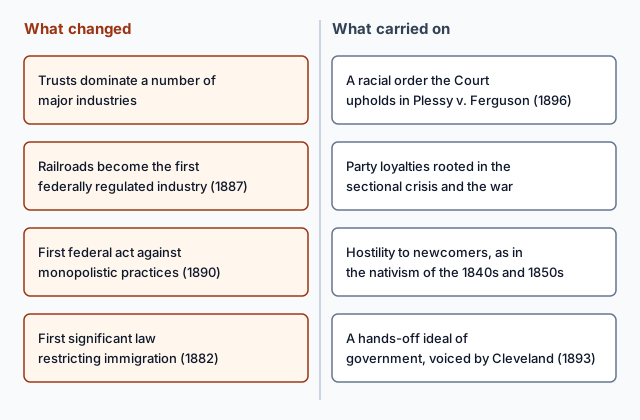 Tap to open the picture full size
Part 1 Think first A president takes on the trusts
Commit to a guess first. Being wrong now makes the right idea stick better.
Predict first
On March 4, 1893, President Grover Cleveland said that business combinations "formed for the purpose of limiting production and fixing prices" were unfair. What do you think he said the government should do about them?
In short. Industrialization changed the scale of American business, the size of cities and the settlement of the West, and it pushed Congress toward its first regulation of business, but the racial order, old political divisions and older hostility to newcomers carried through the period.
- Large-scale production and consolidation into trusts were new, and Congress answered with the Interstate Commerce Act of 1887 and the Sherman Anti-Trust Act of 1890, though both proved weak in practice.
- Migration remade cities and the West, and the Chinese Exclusion Act of 1882 turned older hostility to newcomers into the first significant federal restriction on immigration.
- Plessy v. Ferguson in 1896 upheld segregation, a continuity that qualifies any claim that the period changed everything.
Part 2 Learn it How far did industrialization change the nation?
2a. What changed: the scale of business
Technological advances, large-scale production and new markets built an industrial economy after 1865, and business consolidated. A trust let stockholders in several companies hand their shares to a single set of trustees. The Standard Oil Trust, formed on January 2, 1882, let nine trustees run all of its companies, so Standard Oil could act as a monopoly. Toward the end of the century, trusts came to dominate a number of major industries. In 1893 President Grover Cleveland, a Democrat speaking at his second inauguration, took aim at them:
Read it for change and continuity. The size of the combinations was new. The yardstick Cleveland measured them by, open competition, was old.
Quick check · Sort it
Tap a card, then say whether it is new in the economy of the period or part of the older ideal Cleveland defends.
New in the economy
The older ideal
2b. Hard times and the role of government
Growth came with financial panics and downturns. In 1897 President William McKinley said "The depression of the past four years has fallen with especial severity upon the great body of toilers of the country, and upon none more than the holders of small farms."
Hard times sharpened the argument about government. Some held that laissez-faire, leaving the economy alone, and competition brought growth in the long run, and they opposed government help in downturns. A limited-government ideal ran deep. In March 1893 Cleveland, a Democrat whose party had won on tariff reform, attacked tariff protection, bounties and subsidies as paternalism, favors for some paid by others: "The lessons of paternalism ought to be unlearned and the better lesson taught that while the people should patriotically and cheerfully support their Government its functions do not include the support of the people."
Others organized. Workers formed local and national unions and confronted business leaders. Farmers, squeezed by consolidation and their dependence on railroads, formed cooperatives, and economic instability led agrarian activists to found the People's (Populist) Party, which called for a stronger government role in regulating the economy. In 1887 Congress made railroads the first industry subject to federal regulation, answering decades of public demand, though in practice the law was not very effective.
Sources: McKinley, 1897 (Avalon Project); Cleveland, 1893 (Avalon Project); Interstate Commerce Act (National Archives).
Quick check · Multiple choice
A student argues that by the 1890s Americans had turned toward a bigger role for government in the economy. Which evidence best qualifies that claim?
2c. People on the move
Migration changed where and how Americans lived. Cities with new factories drew immigrants from Asia and from southern and eastern Europe, and African American migrants within and out of the South, and ethnic neighborhoods built a new urban culture. The West filled fast. In 1889 Harrison compared Dakota with the original states at the founding: "The Territory of Dakota has now a population greater than any of the original States (except Virginia) and greater than the aggregate of five of the smaller States in 1790." As migrants poured in and the bison population was decimated, competition for land and resources among white settlers, American Indians and Mexican Americans grew more violent. The federal government violated treaties with American Indians, met resistance with military force and confined them to reservations.
Some of this had roots in earlier periods. In the 1840s and 1850s a strongly anti-Catholic nativist movement had tried to limit immigrants' political power. What was new in 1882 was a federal law, the first significant one restricting immigration and the first to shut out an ethnic group of workers. The Chinese Exclusion Act declared that "the coming of Chinese laborers to this country endangers the good order of certain localities."
Sources: Harrison, 1889 (Avalon Project); Chinese Exclusion Act (National Archives).
Quick check · Match
Match each piece of evidence to the argument it best supports.
2d. What held: race, region and old ideas
Some patterns outlasted the changes. On May 18, 1896, in Plessy v. Ferguson, the Supreme Court upheld a Louisiana law requiring separate railroad coaches for each race. The majority wrote: "If one race be inferior to the other socially, the Constitution of the United States cannot put them upon the same plane." The decision upheld racial segregation, known as Jim Crow, and helped mark the end of most of the political gains African Americans had made during Reconstruction. Justice Harlan dissented: "Our constitution is color-blind, and neither knows nor tolerates classes among citizens." Facing increased violence, discrimination and scientific theories of race, African American reformers kept fighting for political and social equality.
Politics kept old lines too. The major parties appealed to lingering divisions from the Civil War and fought over tariffs and currency, while reformers charged that greed had corrupted government at every level. New ideas cut both ways: Social Darwinism defended those at the top as deserving, while advocates of the Social Gospel challenged the social order.
Quick check · Fill the statement
Complete the notes on what held steady in the period.
Plessy v. Ferguson upheld racial and helped mark the end of most of the political gains African Americans had made during . Harlan's dissent shows that the promise of the 14th Amendment still had on the Court. Among the new ideas of the age, Social Darwinism the social order.
Part 3 Watch it done Qualify a claim about government and business
Watch each step, then do the last one yourself.
A student writes: Industrialization made the federal government a regulator of business between 1865 and 1898. Use evidence to corroborate and qualify the claim, then revise it.
Predict first
Before the steps, how well do you think the claim holds?
Step 1 · Corroborate
In 1887 the Interstate Commerce Act made railroads the first industry subject to federal regulation. In 1890 the Sherman Anti-Trust Act, the first federal act to outlaw monopolistic business practices, said that every contract or combination "in restraint of trade or commerce among the several States, or with foreign nations, is hereby declared to be illegal."
Why this step?
Why look for evidence against the claim too?
A complex argument tests a claim instead of only repeating it. Evidence that cuts the other way shows how far the claim holds, which is exactly what an extent question asks.
Step 2 · Qualify
In practice the 1887 law was not very effective. The Sherman Act was loosely worded, and in United States v. E. C. Knight Company (1895) the Supreme Court ruled that a company controlling about 98 percent of the nation's sugar refining had not violated it. That ruling seemed to end any government regulation of trusts.
Your step · Decide and justify
Finish it. Which revision of the claim fits all the evidence best?
Which evidence best supports your answer?
Part 4 Try it Build a complex argument
A complex argument works with evidence from more than one side. To corroborate is to add evidence that agrees with a claim. To qualify is to show where a claim stops being true. To modify is to revise the claim so it fits all the evidence. Connections to earlier periods count as evidence too: they show whether something was really new.
Try it · Multiple choice
Which evidence would best corroborate Cleveland's 1893 claim that combinations were formed to limit production and fix prices?
Try it · Select all
Which two pieces of evidence qualify the claim that industrial growth brought Americans greater equality? Select two.
Select 2 answers, then check.
Try it · Multiple choice
McKinley said in 1897: "The North and the South no longer divide on the old lines, but upon principles and policies." How should a historian use this claim?
Try it · Spot the error
A student writes a complex argument about government and business. Which line is the first to go wrong?
Try it · Sort it
Tap a card, then say whether it was mostly new in this period or carried over from before 1865.
Mostly new, 1865 to 1898
Carried over from before 1865
Try it · Multiple choice
Which connection across periods best supports the argument that the Chinese Exclusion Act was both a change and a continuity?
Try it · Match
A student claims that in the late 1800s Americans demanded a bigger role for government in the economy. Match each piece of evidence to the job it does for that claim.
Part 5 Explain it Write it like a document-based answer
Nothing you type leaves this page. Check your answer against the model and each scoring point.
Free-response practice · Question 1 style
A short practice in the shape of the document-based question: three documents instead of seven, and a thesis with one body paragraph instead of a full essay.
Evaluate the extent to which industrialization brought change to the United States from 1865 to 1898.
Document 1. Benjamin Harrison, inaugural address, March 4, 1889: "The masses of our people are better fed, clothed, and housed than their fathers were." And: "Not all of our people are happy and prosperous; not all of them are virtuous and law-abiding."
Document 2. Sherman Anti-Trust Act, July 2, 1890: every contract, combination or conspiracy "in restraint of trade or commerce among the several States, or with foreign nations, is hereby declared to be illegal."
Document 3. Plessy v. Ferguson, majority opinion, May 18, 1896: "If one race be inferior to the other socially, the Constitution of the United States cannot put them upon the same plane."
Write a thesis, one sentence of historical context, and one paragraph that uses at least two documents and explains the purpose, audience, point of view or situation of one of them.
Model answer
Thesis: Industrialization changed the American economy greatly, bringing what a president could claim as better living for many and creating combinations so large that Congress moved to outlaw them, but it changed much less in who shared the gains, and the racial order held firm, so the period paired sweeping economic change with deep social continuity.
Context: the Civil War and Reconstruction had ended slavery and granted African Americans citizenship and equal protection under the 14th Amendment, so the 1890s tested whether those promises would survive an industrial age.
Harrison claimed the masses were "better fed, clothed, and housed than their fathers were" (Document 1). As a new president speaking to the whole nation, he had reason to stress progress, so his admission that "Not all of our people are happy and prosperous" comes only to be answered: "But on the whole the opportunities offered to the individual to secure the comforts of life are better than are found elsewhere." The speech is evidence of a confident view, not proof that gains were shared. The scale of business changed too, enough that Congress declared combinations "in restraint of trade" illegal in 1890 (Document 2), though the Supreme Court soon narrowed that law. Yet in 1896 the Court held that the Constitution "cannot put them upon the same plane" (Document 3), upholding segregation and showing that economic change did not bring equal citizenship.
Score your own answer. This is a self-check, not a grade. Tick each point your answer makes.
Part 6 Check yourself A dissent and a warning
The case questions use the two excerpts. The others mix the ideas from the whole lesson.
Both excerpts come from the last years of the period. McKinley's sentence does not say who the victims of lynching were. Sources: Plessy v. Ferguson (National Archives); McKinley, 1897 (Avalon Project).
| Source | Excerpt |
|---|---|
| Justice Harlan, dissent in Plessy v. Ferguson, May 18, 1896 | "Our constitution is color-blind, and neither knows nor tolerates classes among citizens." |
| William McKinley, inaugural address, March 4, 1897 | "Lynchings must not be tolerated in a great and civilized country like the United States; courts, not mobs, must execute the penalties of the law." |
Case question 1 · Multiple choice
McKinley's 1897 statement is best used as evidence that
Case question 2 · Multiple choice
Harlan's dissent best supports which argument about continuity and change?
Case question 3 · Spot the error
A student uses both excerpts in an argument. Which line is the first to go wrong?
The rest stand on their own and do not use the case.
Check yourself · Put it in order
Put these events in the order they happened, earliest first.
Check yourself · Select all
Which two pieces of evidence show migration transforming the West? Select two.
Select 2 answers, then check.
Check yourself · Fill the statement
Complete the notes on the debate over government in hard times.
Defenders of argued that competition brought growth in the long run and opposed government help in downturns. Agrarian activists answered by founding the Party, which called for a stronger government role in regulating the economy.
Part 7 Keep it Bring back earlier ideas
This lesson stands on the trusts from Topic 6.6 and the Populist Party from Topic 6.13.
Bring it back · Multiple choice
Why did many business leaders of the late 1800s consolidate corporations into large trusts and holding companies?
Bring it back · Multiple choice
Economic instability in the late 1800s led agrarian activists to do what?
In three lines
- The scale of business changed most: trusts dominated major industries, and Congress passed its first regulation of railroads and its first ban on combinations, though both proved weak.
- Migration remade cities and the West, and older hostility to newcomers became federal law in the Chinese Exclusion Act.
- The racial order, old party divisions and a hands-off ideal of government carried through, so the period mixed deep economic change with strong continuity.
Exam strategy for this topic
- Section I Part A, Multiple Choice: 55 questions in 55 minutes.
- Section I Part B, Short Answer: 3 questions in 40 minutes.
- Section II, Document-Based Question and Long Essay: 2 questions in 100 minutes.
- This lesson's Explain it is shaped like free-response question 1, Document-based.
On an extent question, name what changed most and one continuity that limits it, and explain how they fit together. Evidence that cuts against your main claim, used on purpose, makes the argument stronger, not weaker.
Questions students ask
What is the difference between corroborating, qualifying and modifying a claim?
Corroborating adds evidence that agrees. Qualifying shows where the claim stops being true. Modifying rewrites the claim so it fits all the evidence, as in Watch it done, where a claim about regulation became a claim about new power that was limited in practice.
Is a complex argument just listing both sides?
No. A list of points for and against leaves the reader to weigh them. A complex argument does the weighing: it says which side matters more, and why the other side limits it.
Why does a lesson about industrialization include Plessy v. Ferguson?
The question asks how far industrialization changed the nation. A ruling that upheld segregation shows something that economic change did not touch, which is the continuity an extent argument needs.
Why is the Populist Party described but not quoted?
This lesson quotes only documents a reader can open and check at the National Archives or the Avalon Project at Yale Law School. The Populists' own words are not among them, so their aims are described in plain words.
Where can I read these documents in full?
Each excerpt links to its full text at the National Archives or the Avalon Project at Yale Law School, the primary-source collections this lesson was checked against.
Course alignment, for teachers
AP U.S. History topic 6.14, Unit 6: Period 6: 1865–1898.
- Skill 6.D: Corroborate, qualify, or modify an argument using diverse and alternative evidence in order to develop a complex argument.
This lesson maps all 10 essential knowledge statements of the topic, and the one learning objective with none of its own, to the part that teaches each one: 11 are checked by a scored question. The map is in the lesson file.