Unit 6 · Topic 6.1 · about 30 minutes · 7 parts · 20 scored checks, 8 of them multiple choice
AP U.S. History 6.1: Contextualizing Period 6
Unit 6: 10 to 17% of the multiple-choice section
What you'll be able to do
- Explain the historical context for the rise of industrial capitalism in the United States, and practice contextualization by placing each document of the period inside the broader developments of the war years and the decades that followed.
Key vocabulary
| Term | What it means | The exam trap |
|---|---|---|
| Industrial capitalism | An economy built on factories, railroads and large private firms that produce goods on a large scale for profit. | It names how the economy was organized, not a political party or a single company. |
| Consolidation | Firms combining into fewer, larger ones, in industry and in agriculture. | Consolidation means fewer and bigger firms, not more small ones competing. |
| Protective tariff | A tax on imports meant to shield American industry and workers from foreign competition. | A tariff taxes goods coming in from abroad, not goods made at home. |
| Gilded Age | The course's name for the decades of rapid industrial growth after Reconstruction. | The name is a label for the era; it does not tell you whether a given person gained or lost in it. |
| Contextualization | Explaining how a specific event or document fits a broader development from before it or around it. | Naming events from the same years is not enough; say how the broader development shaped the specific one. |
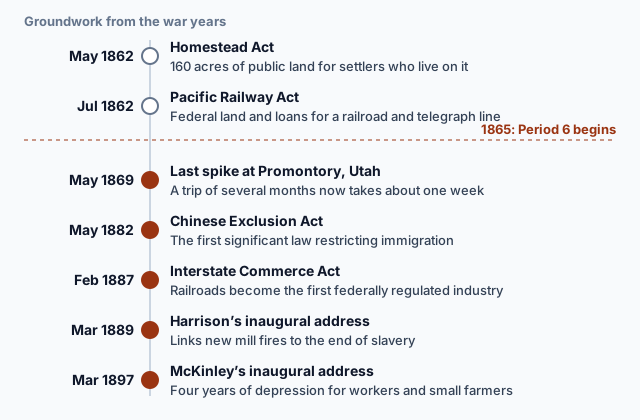 Tap to open the picture full size
Part 1 Think first Factories and the end of slavery
Commit to a guess first. Being wrong now makes the right idea stick better.
Predict first
On March 4, 1889, President Benjamin Harrison said in his inaugural address: "Mill fires were lighted at the funeral pile of slavery." A funeral pile is a pyre for the dead. What connection do you think he was drawing?
In short. Industrial capitalism rose after 1865 on groundwork laid during the Civil War, such as federal aid to a railroad and telegraph line to the Pacific and the end of slavery, and it brought rapid growth along with hard times, mass migration and sharp debates over what government owed business and citizens.
- Technological change, large-scale production, new markets and pro-growth government policies produced rapid economic growth and the consolidation of business.
- Financial panics and downturns, and the power of railroads over farmers, led workers and farmers to organize and argue over the economy.
- Migration to cities and to the West transformed both, and new ideas and political fights over citizenship, corruption and business followed.
Part 2 Learn it The setting for industrial capitalism
2a. Groundwork from the war years
Period 6 runs from the end of the Civil War in 1865 to 1898. Its main story is the rise of industrial capitalism, an economy of factories, railroads and large private firms. Technological advances, large-scale production and the opening of new markets encouraged it.
Much groundwork came during the war. The Pacific Railway Act of July 1, 1862, was an act "To aid in the construction of a railroad and telegraph line from the Missouri River to the Pacific Ocean," funded with federal land and loans. When the last spike was driven at Promontory, Utah, on May 10, 1869, a journey of several months shrank to about one week. Pro-growth policies like this, with massive technological change and expanding international communication networks, brought rapid growth and business consolidation, firms combining into fewer, larger ones.
In 1889 President Benjamin Harrison, a Republican defending the protective tariff, argued that slavery had kept the South's cotton and mining states from building mills:
Quick check · Sort it
Tap a card, then say whether it is groundwork laid by 1865 or growth that came after.
Groundwork laid by 1865
Growth from 1865 to 1898
2b. Hard times for workers and farmers
Growth did not run smoothly. It came with financial panics and downturns, and during them Americans argued about the economy and labor. Some said competition and a hands-off government brought growth in the long run and opposed government help during downturns. Workers organized local and national unions and at times confronted business leaders directly. In March 1897 President William McKinley described the slump the country was in:
"The depression of the past four years has fallen with especial severity upon the great body of toilers of the country, and upon none more than the holders of small farms. Agriculture has languished and labor suffered."
Farmers faced a squeeze of their own. Better machines raised output and helped push food prices down, and new systems of production and transportation let agriculture consolidate. After the Civil War, railroads were privately owned and entirely unregulated, and their rebates to large shippers especially hurt farmers, who shipped too little to win better rates. Farmers answered with local and regional cooperatives, with Granger-controlled state legislatures acting against the railroads in the 1870s, and later with the People's (Populist) Party.
Sources: McKinley's first inaugural address (Avalon Project); Interstate Commerce Act (National Archives).
Quick check · Multiple choice
McKinley's words in 1897 best support which statement about the period?
2c. Cities, migrants and the West
Migration transformed both city and countryside. Cities with new factories drew immigrants from Asia and from southern and eastern Europe, and African American migrants moving within and out of the South. Neighborhoods built around particular ethnicities, races and classes gave rise to a new urban culture.
Others went west for land and work. The Homestead Act of 1862 was "An Act to secure Homesteads to actual Settlers on the Public Domain": 160 acres of public land for five years' residence, though most of the land went to speculators, cattle owners, miners, loggers and railroads. Railroad building drew workers too. The Union Pacific employed more than 8,000 Irish, German and Italian immigrants, and the Central Pacific's workforce included over 10,000 Chinese laborers. Competition for land and resources among white settlers, American Indians and Mexican Americans often turned violent, and the railroads crossed American Indians' ancestral lands.
In 1889 Harrison expected that "the new census about to be taken will show another stride to the westward." He added: "We should not cease to be hospitable to immigration, but we should cease to be careless as to the character of it."
Sources: Homestead Act (National Archives); Pacific Railway Act (National Archives); Harrison's inaugural address (Avalon Project).
Quick check · Match
Match each piece of evidence to the change in migration and settlement that it shows.
2d. New ideas and political fights
The Gilded Age, the course's name for these decades, brought new cultural and intellectual movements. Some propped up the social order. Theories later called Social Darwinism treated the success of those at the top as both right and inevitable. The Gospel of Wealth held that the rich had a moral duty to help the less fortunate. Other movements challenged the order: agrarians, utopians, socialists and advocates of the Social Gospel offered other visions of the economy and society.
Dramatic social change also fed political debates. Reformers charged that greed had corrupted government at every level. Citizenship was contested: the Chinese Exclusion Act of 1882 barred courts from granting citizenship to Chinese residents. And Americans argued over the proper relationship between business and government. Harrison warned the largest companies in 1889:
"If our great corporations would more scrupulously observe their legal limitations and duties, they would have less cause to complain of the unlawful limitations of their rights or of violent interference with their operations."
Sources: Harrison's inaugural address (Avalon Project); Chinese Exclusion Act (National Archives).
Quick check · Fill the statement
Complete the notes on the ideas and debates of the Gilded Age.
Social Darwinism the social order of the Gilded Age, while the Social Gospel it. Reformers charged that greed had government at every level. Harrison's warning to the great corporations belongs to a debate over the proper relationship between and government.
Part 3 Watch it done Put the Interstate Commerce Act in context
Watch each step, then do the last one yourself.
The Interstate Commerce Act, approved on February 4, 1887, said railroad charges "shall be reasonable and just; and every unjust and unreasonable charge for such service is prohibited and declared to be unlawful." Explain the broader context that produced this law.
Predict first
Before the steps, who do you think had pushed hardest for a law like this?
Step 1 · Say what was new
The act created a five-member Interstate Commerce Commission to oversee the railroads. With it, the railroads became the first industry subject to federal regulation.
Why this step?
Why start with what was new about the law?
Context explains a change. Once you know that federal regulation of an industry was new, you know what needs explaining: why Congress acted in 1887 and had not before.
Step 2 · Look at what came before
After the Civil War, railroads were privately owned and entirely unregulated. Their rebates to large shippers especially hurt farmers, who lacked the volume to win better rates. In the 1870s Granger-controlled state legislatures in the West and South acted against the railroads. In 1886, in the Wabash case, the Supreme Court struck down an Illinois rate law and made clear that only Congress could regulate interstate commerce. Congress passed the 1887 law largely in response to decades of public demand.
Your step · Decide and justify
Finish it. Which broader context best explains the 1887 law?
Which evidence best supports your answer?
Part 4 Try it Place documents in their setting
Contextualization means placing a specific document or event inside a broader development, from before it or around it, and saying how that development shaped it. Two presidents spoke about the tariff, a tax on imports. Harrison in 1889: "I look hopefully to the continuance of our protective system and to the consequent development of manufacturing and mining enterprises in the States hitherto wholly given to agriculture." McKinley in 1897 said "the controlling principle in the raising of revenue from duties on imports is zealous care for American interests and American labor."
Sources: Harrison, 1889 (Avalon Project); McKinley, 1897 (Avalon Project).
Try it · Multiple choice
Which broader context best explains why both presidents praised tariff protection?
Try it · Select all
A student is writing context for an essay on industrial growth from 1865 to 1898. Which two developments come from before the period and could set it up? Select two.
Select 2 answers, then check.
The Chinese Exclusion Act, approved May 6, 1882, was the first significant law restricting immigration into the United States. Its preamble gave the government's reason: "the coming of Chinese laborers to this country endangers the good order of certain localities."
Try it · Multiple choice
Which broader development best explains the law's claim about Chinese laborers and good order?
Try it · Spot the error
A student writes a context paragraph for the Chinese Exclusion Act. Which line is the first to go wrong?
Try it · Fill the statement
Complete the context for the Interstate Commerce Act.
The act came after decades of protest against railroad that favored large shippers. Before 1887 the railroads had faced action mainly from legislatures, and the act made them the first industry under regulation.
Try it · Multiple choice
Harrison told "our great corporations" in 1889 to observe their "legal limitations and duties." Which context best explains why a president would say this?
Try it · Match
Match each document to the broader development it belongs to.
Part 5 Explain it Write it like a document-based answer
Nothing you type leaves this page. Check your answer against the model and each scoring point.
Free-response practice · Question 1 style
A short practice in the shape of the document-based question: three documents instead of seven, and a thesis with one body paragraph instead of a full essay.
Evaluate the extent to which government policy encouraged the rise of industrial capitalism in the United States from 1865 to 1898.
Document 1. Benjamin Harrison, inaugural address, March 4, 1889: "I look hopefully to the continuance of our protective system and to the consequent development of manufacturing and mining enterprises in the States hitherto wholly given to agriculture."
Document 2. Interstate Commerce Act, February 4, 1887: railroad charges "shall be reasonable and just; and every unjust and unreasonable charge for such service is prohibited and declared to be unlawful."
Document 3. William McKinley, inaugural address, March 4, 1897: "The depression of the past four years has fallen with especial severity upon the great body of toilers of the country, and upon none more than the holders of small farms. Agriculture has languished and labor suffered."
Write a thesis, one sentence of historical context, and one paragraph that uses at least two documents and explains the purpose, audience, point of view or situation of one of them.
Model answer
Thesis: Government policy encouraged industrial capitalism to a large extent, through railroad aid and a protective tariff, but by the late 1880s it had also begun, cautiously, to restrain business, and it could not shield workers and farmers from downturns.
Context: during the Civil War, Congress funded a railroad and telegraph line to the Pacific with federal land and loans, and the end of slavery, as Harrison later argued, cleared the way for mills and mines in the South.
Harrison hoped the "protective system" would spread manufacturing and mining to states "hitherto wholly given to agriculture" (Document 1). As a new president speaking to the whole nation at his inauguration, his purpose was to promise a policy, so the address shows what the government intended more than what it achieved. The same government also set limits: in 1887 it required railroad charges to be "reasonable and just" (Document 2), answering decades of protest by farmers against rebates. Encouragement and limits together did not prevent the depression that McKinley said fell hardest on "the holders of small farms" (Document 3).
Score your own answer. This is a self-check, not a grade. Tick each point your answer makes.
Part 6 Check yourself Two presidents, eight years apart
The case questions use the two excerpts. The others mix the ideas from the whole lesson.
Both excerpts come from inaugural addresses, each given on March 4. Sources: Harrison, 1889 (Avalon Project); McKinley, 1897 (Avalon Project).
| Address | Excerpt |
|---|---|
| Benjamin Harrison, 1889 | "Every new mine, furnace, and factory is an extension of the productive capacity of the State more real and valuable than added territory." |
| William McKinley, 1897 | "The depression of the past four years has fallen with especial severity upon the great body of toilers of the country, and upon none more than the holders of small farms. Agriculture has languished and labor suffered." |
Case question 1 · Multiple choice
Which context best explains the difference in tone between the two excerpts?
Case question 2 · Multiple choice
Harrison rates a new factory as "more real and valuable than added territory." Which view does this reflect?
Case question 3 · Spot the error
A student contextualizes McKinley's excerpt. Which line is the first to go wrong?
The rest stand on their own and do not use the case.
Check yourself · Put it in order
Put these events in the order they happened, earliest first.
Check yourself · Select all
Which two were responses by farmers to consolidation and the power of the railroads? Select two.
Select 2 answers, then check.
Check yourself · Sort it
Tap a card, then say whether the idea propped up or challenged the social order of the Gilded Age.
Propped up the social order
Challenged the social order
Part 7 Keep it Bring back earlier ideas
This lesson stands on wartime laws for the West from Topic 5.2 and the Reconstruction amendments from Topic 5.10.
Bring it back · Multiple choice
Which development best explains why westward migration grew during and after the Civil War?
Bring it back · Multiple choice
Which change did the 14th Amendment make?
In three lines
- Wartime laws and the end of slavery set the stage for industrial capitalism, which grew through new technology, large-scale production, new markets and pro-growth policy.
- Growth came with panics and downturns, and workers and farmers organized against falling fortunes and the power of railroads and big business.
- Migration remade cities and the West, and new ideas and political fights over citizenship, corruption and business followed.
Exam strategy for this topic
- Section I Part A, Multiple Choice: 55 questions in 55 minutes.
- Section I Part B, Short Answer: 3 questions in 40 minutes.
- Section II, Document-Based Question and Long Essay: 2 questions in 100 minutes.
- This lesson's Explain it is shaped like free-response question 1, Document-based.
When a question asks for context, describe a broader development from before or during the period, then write a full sentence saying how it shaped the development in the question. Naming it without that link is not enough.
Questions students ask
What years does Period 6 cover?
From the end of the Civil War in 1865 to 1898. The lesson reaches back to 1862 only for context, since laws passed during the war set up much of what followed.
Why does this lesson quote presidents' inaugural addresses so much?
An inaugural address is a president speaking to the whole nation about its condition and his plans, so it shows what national leaders thought the big issues were. It is also a promise, which is why the lesson asks what each one can and cannot prove.
Why are Social Darwinism, the Gospel of Wealth and the Social Gospel described but not quoted?
This lesson quotes only documents a reader can open and check at the National Archives or the Avalon Project at Yale Law School. Those ideas are described in plain words instead.
Does contextualization mean writing everything I know about the era?
No. Pick the broader development that best explains the one in the question, describe it, and say how it led to or shaped that development.
Where can I read these documents in full?
Each excerpt links to its full text at the National Archives or the Avalon Project at Yale Law School, the primary-source collections this lesson was checked against.
Course alignment, for teachers
AP U.S. History topic 6.1, Unit 6: Period 6: 1865–1898.
- Skill 4.B: Explain how a specific historical development or process is situated within a broader historical context.
This lesson maps all 10 essential knowledge statements of the topic, and the one learning objective with none of its own, to the part that teaches each one: 11 are checked by a scored question. The map is in the lesson file.