Unit 3 · Topic 3.13 · about 30 minutes · 7 parts · 12 scored checks, 4 of them multiple choice, plus 1 from earlier lessons
AP U.S. History 3.13: Continuity and Change in Period 3
Unit 3: 10 to 17% of the multiple-choice section
What you'll be able to do
- Explain how the American independence movement affected society from 1754 to 1800, supporting each claim with specific and relevant evidence.
Key vocabulary
| Term | What it means | The exam trap |
|---|---|---|
| Continuity and change | Reading a period for what stayed the same as well as what became different. | A strong answer names both; an argument that only one happened leaves half the period out. |
| Specific evidence | Evidence that names a document or event, its date, and what it says or did. | Naming a famous document is not the same as using it; say what in it supports the claim. |
| Relevant evidence | Evidence that supports the exact claim being made, not just the topic in general. | A true statement from the right years can still be irrelevant to the claim. |
| Neutrality | A nation's policy of taking no side in a war between other nations. | Neutrality limits taking sides in a war; it does not mean ending trade with the nations at war. |
 Tap to open the picture full size
Part 1 Think first What changed between 1754 and 1800?
Commit to a guess first. Being wrong now makes the right idea stick better.
Predict first
In 1754 colonial delegates at Albany proposed asking Parliament for an act "by virtue of which one general government may be formed in America, including all the said colonies." Its head was "to be appointed and supported by the crown." By 1800, which description of the country do you think fits best?
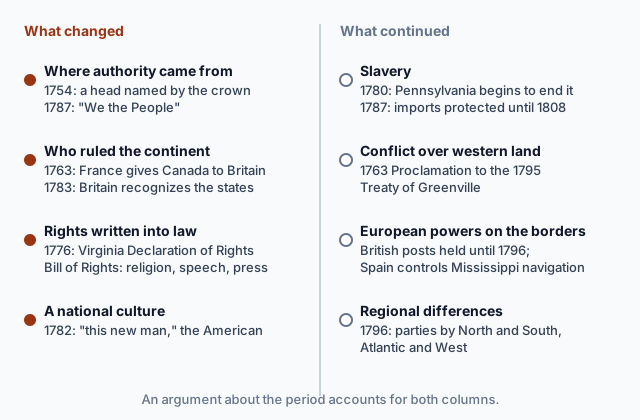
In short. From 1754 to 1800 the independence movement turned British colonies into independent states with governments resting on the people and on declared rights, and it began a national culture, while slavery, regional differences and conflict over western land and European neighbors carried on into the new nation.
- Britain's victory over France in the Seven Years' War, then its tighter control and new taxes, met colonial resolve for self-government and led to independence.
- Revolutionary ideals produced new experiments in government, from state declarations of rights to the Articles and the Constitution, which protected individual liberties while limiting both central power and popular influence.
- Some things continued: slavery was protected in much of the nation, regions still differed, and migration west and the presence of Britain and Spain kept conflict going on the borders.
Part 2 Learn it How the independence movement affected society
2a. From empire to independence, 1754 to 1776
In 1754 the British, the French and American Indian nations were competing for trade and power in North America. Colonial delegates at Albany planned a union, but inside the empire, with a head "to be appointed and supported by the crown."
That competition led to the Seven Years' War, in which Britain defeated France and the Indian nations allied with it. In the Treaty of Paris of February 10, 1763, "his Most Christian Majesty cedes and guaranties to his said Britannick Majesty, in full right, Canada, with all its dependencies" (spelling as printed). His Most Christian Majesty is the king of France.
Britain then tried to tighten control. The Royal Proclamation of October 7, 1763, kept western lands "for the use of the said Indians" and forbade "all our loving Subjects from making any Purchases or Settlements whatever, or taking Possession of any of the Lands above reserved." New taxes followed.
Many colonists answered with a resolve to govern themselves. That clash produced an independence movement and a war, and in 1776 Congress declared "That these United Colonies are, and of Right ought to be Free and Independent States."
Sources: Albany Plan (Avalon Project); Treaty of Paris, 1763 (Avalon Project); Royal Proclamation (Avalon Project); Declaration of Independence (National Archives).
Quick check · Put it in order
Put these events in the order they happened, earliest first.
2b. New governments built on rights
The ideals behind the Revolution came from new beliefs about politics, religion and society that had grown through the 1700s. The Declaration's claim that "all men are created equal" is the best known. After independence those ideals inspired experiments in government: new ways of deciding who holds power and what limits it.
Virginia's Declaration of Rights of June 12, 1776, began with the people: "That all power is vested in, and consequently derived from, the people." Yet it tied the right to vote to "sufficient evidence of permanent common interest with, and attachment to, the community," a test that limited popular influence.
The Articles of Confederation, in force from March 1, 1781, guarded against central power: "Each state retains its sovereignty, freedom, and independence." The Constitution of 1787 built a stronger national government and rested it on the whole people: "We the People of the United States, in Order to form a more perfect Union." The Bill of Rights then limited that government: "Congress shall make no law respecting an establishment of religion, or prohibiting the free exercise thereof; or abridging the freedom of speech, or of the press."
Together these documents set out the roles of state and national governments while protecting liberties and limiting both central power and too much popular influence.
Sources: Virginia Declaration of Rights (Avalon Project); Articles of Confederation (Avalon Project); Constitution (National Archives); Bill of Rights (National Archives).
Quick check · Match
Match each passage to what it did in the new experiments in government.
2c. One nation, many regions
Independence produced new national institutions, a Congress, a president and federal courts. A national culture grew too. Even Crevecoeur's book about the British colonies, published in London in 1782, asked "What then is the American, this new man?"
Regional variations continued alongside them, and so did differences over economic, political, social and foreign policy issues.
On slavery, a social and economic question, the regions split. Pennsylvania began to end slavery by law on March 1, 1780, saying its people had a duty "to extend a portion of that freedom to others, which hath been extended to us" (spelling as printed). Seven years later the Constitution said: "The Migration or Importation of such Persons as any of the States now existing shall think proper to admit, shall not be prohibited by the Congress prior to the Year one thousand eight hundred and eight."
In politics, Washington's Farewell Address of 1796 warned that parties were being characterized by "geographical discriminations, Northern and Southern, Atlantic and Western." The new nation was real, and so were its regions.
Sources: Letter III (Avalon Project); Pennsylvania act, 1780 (Avalon Project); Constitution (National Archives); Farewell Address (Avalon Project).
Quick check · Sort it
Tap each card, then what it is evidence of.
A new national culture or institution
A continuing regional difference
2d. Land, rivals and borders
Migration within North America and competition over resources, boundaries and trade made conflicts sharper. After independence, Indian nations, settlers and governments competed for land, alliances shifted, and cultures blended.
The treaties show the pattern. At Fort Stanwix in 1784 "the Six Nations shall and do yield to the United States, all claims to the country west of the said boundary." At Greenville in 1795 twelve nations placed themselves "under the protection of the said United States, and no other power whatever."
European powers stayed on the nation's borders, so the United States had to protect its borders, its trade as a neutral and its economic interests. When Britain and France went to war, Washington's proclamation of April 22, 1793, told Americans to "adopt and pursue a conduct friendly and impartial toward the belligerant Powers" (spelling as printed). In the Jay Treaty of 1794, "His Majesty will withdraw all His Troops and Garrisons from all Posts and Places within the Boundary Lines assigned by the Treaty of Peace to the United States." In 1795 Spain agreed that "the navigation of the said River in its whole breadth from its source to the Occean shall be free only to his Subjects, and the Citizens of the United States" (spelling as printed), opening the Mississippi to Americans.
Sources: Fort Stanwix (Avalon Project); Greenville (Avalon Project); Proclamation of Neutrality (Avalon Project); Jay Treaty (Avalon Project); Treaty with Spain (Avalon Project).
Quick check · Multiple choice
Which goal best links the Proclamation of Neutrality (1793), the Jay Treaty (1794) and the treaty with Spain (1795)?
Part 3 Watch it done Back a claim with specific evidence
Watch each step, then do the last one yourself.
Claim: The American independence movement changed where political authority came from, but slavery continued in much of the nation. Support the claim with specific and relevant evidence.
Predict first
Before the steps, how many pieces of evidence do you think this claim needs at the least?
Step 1 · Split the claim
The claim has two halves joined by the word but: a change (where authority came from) and a continuity (slavery). Each half needs its own evidence.
Why this step?
Why look for evidence from two dates for the first half?
A claim about change compares a before and an after. One document from 1787 cannot show a change unless you also show what came before it.
Step 2 · Support the first half
Before: the Albany Plan of 1754 needed an act of Parliament and gave its head "to be appointed and supported by the crown," with "a Grand Council, to be chosen by the representatives of the people of the several Colonies met in their respective assemblies." After: the Constitution of 1787 opened "We the People of the United States, in Order to form a more perfect Union." Each names a document, a date and what it says. Together they show final authority moving from Parliament and the crown to the people.
Your step · Decide and justify
Finish it. Which piece of evidence best supports the second half of the claim, that slavery continued?
Why is that the better evidence?
Part 4 Try it Test the evidence
A claim is only as strong as its evidence. Specific evidence names a document, a date and what it says. Relevant evidence supports the exact claim being made. Use both tests on the items below.
Try it · Spot the error
A student writes a paragraph on western land. Which line is the first to go wrong?
Try it · Select all
Claim: after independence, European powers in North America kept challenging the United States. Which two pieces of evidence are most specific and relevant? Select two.
Select 2 answers, then check.
Part 5 Explain it Write it like a document-based answer
Nothing you type leaves this page. Check your answer against the model and each scoring point.
Free-response practice · Question 1 style
A short practice in the shape of the document-based question: three documents instead of seven, and a thesis with one body paragraph instead of a full essay.
Evaluate the extent to which the American independence movement changed American society from 1754 to 1800.
Document 1. Albany Plan of Union, 1754: a general government for the colonies, to be created by an act of Parliament, with "a Grand Council, to be chosen by the representatives of the people of the several Colonies met in their respective assemblies" and a head "to be appointed and supported by the crown."
Document 2. Pennsylvania, An Act for the Gradual Abolition of Slavery, March 1, 1780: the state's people believe it their duty "to extend a portion of that freedom to others, which hath been extended to us" (spelling as printed).
Document 3. Constitution of the United States, 1787: "The Migration or Importation of such Persons as any of the States now existing shall think proper to admit, shall not be prohibited by the Congress prior to the Year one thousand eight hundred and eight"
Write a thesis, one sentence of historical context, and one paragraph that uses at least two documents and explains the purpose, audience, point of view or situation of one of them.
Model answer
Thesis: The independence movement changed American society a great deal in where political authority came from, and it started an attack on slavery in the North, but it left slavery protected in much of the nation, so the change was large in government and partial in society.
Context: after the Seven Years' War, Britain's efforts to tighten control and collect new taxes met colonial resolve to govern themselves, which turned resistance into independence.
In 1754 colonial leaders still imagined a union created by Parliament, with an elected council but a head "to be appointed and supported by the crown" (Document 1); by 1787 the Constitution rested the whole government on the people. The Revolution's ideals also reached slavery: Pennsylvania's 1780 law tied ending slavery to the freedom Americans were fighting for (Document 2). Its preamble was written by Pennsylvania lawmakers in the middle of their own war for freedom from Britain, so it frames abolition as a share of the liberty they claimed, an argument their situation made natural. Yet the Constitution kept Congress from stopping the import of enslaved people until 1808 (Document 3), a compromise that protected slavery where it was growing. The movement transformed government but changed society unevenly from region to region.
Score your own answer. This is a self-check, not a grade. Tick each point your answer makes.
Part 6 Check yourself Two treaties of Paris
The case questions use the two excerpts. The others mix the ideas from the whole lesson.
Two treaties signed at Paris, twenty years apart, ended two wars. Sources: Treaty of Paris, 1763 (Avalon Project); Treaty of Paris, 1783 (Avalon Project).
| Treaty | Excerpt |
|---|---|
| Treaty of Paris, February 10, 1763 | "his Most Christian Majesty cedes and guaranties to his said Britannick Majesty, in full right, Canada, with all its dependencies" (spelling as printed; the first king named is the king of France) |
| Treaty of Paris, September 3, 1783 | The king of Great Britain acknowledges the thirteen states named in the treaty "to be free sovereign and independent states" |
Case question 1 · Multiple choice
What change between 1763 and 1783 do the two excerpts show?
Case question 2 · Multiple choice
Which development between the two treaties best explains the change they show?
The rest stand on their own and do not use the case.
Check yourself · Fill the statement
Complete the sentences about the Revolution's ideals and the governments they produced.
The Declaration's claim that "all men are created equal" reflected new beliefs about politics, religion and society that had been developing . After independence, new constitutions and declarations of rights protected while limiting both central power and too much popular influence.
Check yourself · Fill the statement
Complete the sentences about the United States and the European powers in the 1790s.
In 1793, when were at war, Washington told Americans to be "friendly and impartial" toward the powers at war, a policy of neutrality. In 1795 a treaty with opened navigation of the Mississippi River to American citizens.
Part 7 Keep it Bring back earlier ideas
This lesson stands on frontier tensions from Topic 3.12 and the religious language of the Declaration from Topic 3.4.
Bring it back · Multiple choice
In 1794 armed groups in western Pennsylvania resisted a federal tax on distilled spirits. Which development does this best illustrate?
From 3.4 Philosophical Foundations of the American Revolution · Select all
Which two phrases from the Declaration of Independence call on God to stand behind the signers' cause, rather than saying where rights come from? Select two.
Select 2 answers, then check.
In three lines
- Britain's victory in the Seven Years' War, its tighter control and new taxes, and colonial resolve for self-government led to independence.
- Revolutionary ideals produced new governments that rested power on the people, protected liberties and limited both central power and popular influence.
- A national culture grew, but slavery, regional differences and conflict over land and borders carried on into the new nation.
Exam strategy for this topic
- Section I Part A, Multiple Choice: 55 questions in 55 minutes.
- Section I Part B, Short Answer: 3 questions in 40 minutes.
- Section II, Document-Based Question and Long Essay: 2 questions in 100 minutes.
- This lesson's Explain it is shaped like free-response question 1, Document-based.
Before you write a paragraph, say in one sentence how each piece of evidence supports your claim. If you cannot, choose different evidence.
Questions students ask
What does continuity and change in Period 3 mean?
It means weighing what the independence movement changed between 1754 and 1800, such as where government's authority came from, against what it left in place, such as slavery in much of the nation and conflict over western land.
What counts as specific evidence?
Evidence that names a document or event, gives its date and says what it said or did. The Constitution of 1787 opening with "We the People of the United States, in Order to form a more perfect Union" is specific; the bare name of the document is not.
Why does a quotation in this lesson spell ocean as "Occean"?
Every excerpt is copied exactly as the archive prints it, so you can check it against the source linked beside it. The same goes for Britannick and belligerant.
Did independence end conflict with European powers?
No. Britain kept posts on US soil until the Jay Treaty of 1794 promised to withdraw them, Spain controlled navigation of the Mississippi and opened it to Americans only by a treaty of 1795, and war between Britain and France led Washington to declare neutrality in 1793.
Where can I read these documents in full?
Each excerpt links to its full text at the Avalon Project at Yale Law School or the National Archives, the primary-source collections this lesson was checked against.
Course alignment, for teachers
AP U.S. History topic 3.13, Unit 3: Period 3: 1754–1800.
- Skill 6.B: Support an argument using specific and relevant evidence.
This lesson maps all 10 essential knowledge statements of the topic, and the one learning objective with none of its own, to the part that teaches each one: 11 are checked by a scored question. The map is in the lesson file.