Unit 7 · Topic 7.12 · about 30 minutes · 7 parts · 13 scored checks, 5 of them multiple choice
AP U.S. History 7.12: World War II: Mobilization
Unit 7: 10 to 17% of the multiple-choice section
What you'll be able to do
- Explain how and why U.S. participation in World War II transformed American society, from war production and new jobs for women and minorities to debates over segregation and the incarceration of Japanese Americans.
Key vocabulary
| Term | What it means | The exam trap |
|---|---|---|
| Mobilization | The turning of a nation's people, industry and money to the work of war. | It covers factories, workers and taxpayers at home, not only soldiers. |
| Civil liberties | Freedoms the government may not take away without due process of law, such as freedom of speech or freedom from imprisonment without charges. | A wartime measure can be legal under the courts of its day and still be a denial of civil liberties. |
| Executive order | A directive the president issues to the executive branch under powers the Constitution or Congress gives the office. | An executive order is not a law passed by Congress, even when it has the force of law. |
| Bracero Program | A program under which Mexican guest workers came to the United States to work, from 1942 to 1964. | Guest workers came under labor contracts, which is not the same as permanent immigration. |
| Incarceration | Confinement by the government. The National Archives uses the word for the wartime confinement of Japanese Americans in guarded camps. | The National Archives page also uses relocation centers and internment camps; most of the people held were American citizens. |
 Tap to open the picture full size
Part 1 Think first From unemployment to shortage
Commit to a guess first. Being wrong now makes the right idea stick better.
Predict first
On December 9, 1941, two days after Pearl Harbor, President Roosevelt told the nation by radio that the government had decided "to rush additions to the capacity of production by building more new plants, by adding to old plants, and by using the many smaller plants for war needs." Only a few years earlier, millions of Americans had been out of work. What do you think the new demand did to the jobless of the Depression?
In short. Mobilizing for World War II put the country's factories and workers to full use, which helped end the Great Depression and equipped both American troops and their allies; it also opened jobs to women and minorities for the war's duration, set off debates over segregation, and led to the incarceration of Japanese Americans.
- War production built new plants and filled old ones, supplying American forces and the allies fighting Germany and Japan.
- Women and minorities found new work in war industries, but most of the gains for women lasted only as long as the war.
- Wartime fears produced challenges to civil liberties, above all the forced removal of about 122,000 people of Japanese descent from the West Coast.
Part 2 Learn it A nation mobilized
2a. The arsenal of the Allies
Mobilization is the turning of a nation's people, factories and money to the work of war.
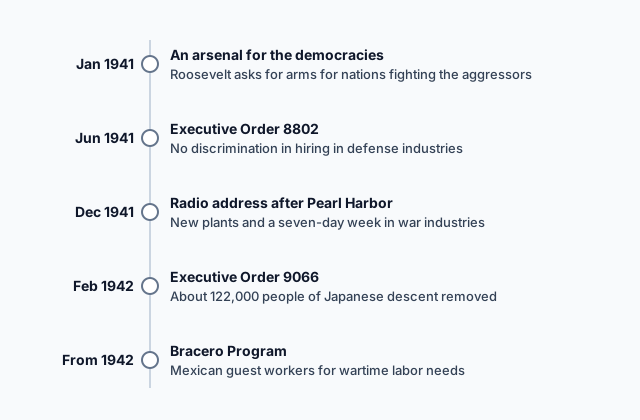
It began before the United States entered the war. On January 6, 1941, Roosevelt told Congress: "Our most useful and immediate role is to act as an arsenal for them as well as for ourselves," meaning the nations already fighting the aggressors.
After Pearl Harbor the pace jumped. In his radio address of December 9, 1941, Roosevelt set out the scale: "The production must be not only for our own Army and Navy and air forces. It must reinforce the other armies and navies and air forces fighting the Nazis and the war lords of Japan throughout the Americas and the world." He also warned: "There will be a clear and definite shortage of metals of many kinds for civilian use."
The course framework draws two conclusions. The mass mobilization of American society helped end the Great Depression. And the country's strong industrial base played a pivotal role in winning the war, by equipping and supplying its allies and millions of U.S. troops.
Sources: Four Freedoms message, 1941 (National Archives); Radio address, December 9, 1941 (Avalon Project).
Quick check · Fill the statement
Complete the notes on war production.
War orders put idle plants and workers back to work, so mass mobilization helped end the . American factories equipped U.S. troops and also supplied the .
2b. Women on the production line
During the Depression many people had argued that women should give up their jobs so unemployed men could work. The war reversed that. With men off to fight across the Atlantic and the Pacific, the National Archives explains, women were called to take their place on the production line. The War Manpower Commission, a federal agency set up to increase the manufacture of war materials, recruited women into war work.
The change was large and local. In Mobile, Alabama, an estimated ninety thousand workers poured into the city's shipyards and its ALCOA aluminum plant. That one plant produced 34 percent of the nation's aluminum, a metal needed to build airplanes.
The gains lasted only for the war's duration. "After the war, most women returned home, let go from their jobs." Yet the archive also notes a longer effect: "Women had proven that they could do the job," and within a few decades women in the workforce became common. Many had saved their wages, since there was little to buy during the war.
Source: Women in the Work Force during World War II (National Archives).
Quick check · Multiple choice
Which statement best describes how mobilization changed women's work?
2c. New work, and the fight over segregation
In early 1941 millions of defense jobs were being created, mostly in cities. African Americans moved north and west to take them and were often met with violence and discrimination. A. Philip Randolph, president of the Brotherhood of Sleeping Car Porters, and other Black leaders demanded an executive order against job discrimination in defense work, and they threatened a mass march on Washington.
On June 25, 1941, Roosevelt issued Executive Order 8802. It declared "there shall be no discrimination in the employment of workers in defense industries or government because of race, creed, color, or national origin" and set up a Committee on Fair Employment Practice. Randolph called off the march. The order was the first presidential directive on race since Reconstruction, though most historians judge the committee weak, especially in the South. The armed forces stayed segregated until President Truman's order of 1948.
Migration from Mexico and elsewhere in the Western Hemisphere also increased. The Bracero Program began in 1942 to bring Mexican guest workers to fill wartime labor needs. The War Manpower Commission signed railroad labor contracts for Mexican workers from 1943 to 1945. Over the program's whole life, "The Bracero Program (1942 to 1964) brought millions of Mexican guest workers to the United States." The course framework adds that this migration grew in spite of contradictory government policies toward Mexican immigration.
Sources: Executive Order 8802 (National Archives); Records of the War Manpower Commission (National Archives); Bracero Program records (National Archives).
Quick check · Match
Match each wartime development to what it shows.
2d. Civil liberties and Japanese American incarceration
Civil liberties are freedoms the government may not take away without due process of law, such as freedom from imprisonment without charges.
After Pearl Harbor, the National Archives explains, fear for national security, economic competition and long-standing anti-Asian racism turned into disaster for Japanese Americans. On February 19, 1942, Roosevelt issued Executive Order 9066. It began by saying that "the successful prosecution of the war requires every possible protection against espionage and against sabotage," and it let military commanders set up military areas "from which any or all persons may be excluded."
The order named no ethnic group. But the Army's Western Defense Command announced curfews that included only Japanese Americans, and in March 1942 it began removing people of Japanese descent from the West Coast on 48 hours' notice. About 122,000 men, women and children were forcibly moved, first to assembly centers and then to fenced and guarded camps. Nearly 70,000 were American citizens. "The government made no charges against them, nor could they appeal their incarceration." The Supreme Court upheld the government's actions. More than 30,000 Japanese Americans served in the war, in segregated units. In 1988 Congress acknowledged the injustice and apologized.
Quick check · Sort it
Each card is a fact about Executive Order 9066. Tap a card, then say whether it comes from the order's own text or from how the order was carried out.
In the order's own text
In how it was carried out
Part 3 Watch it done Explain how mobilization produced Executive Order 8802
Watch each step, then do the last one yourself.
On June 25, 1941, Roosevelt issued Executive Order 8802, banning discrimination in defense industries and government. Explain why the process of mobilization led to this order.
Predict first
Before the steps, what do you think gave Black leaders their bargaining power in 1941?
Step 1 · Place it in the process
In early 1941 the United States was arming itself and supplying Britain. Millions of defense jobs were being created, mostly in cities, and African Americans who moved to take them were often turned away or met with violence.
Why this step?
Why start with the jobs rather than the order?
Explaining a development means showing what produced it. Here the cause is a mismatch: a nation short of workers, and workers barred because of race.
Step 2 · Read the order's own reasons
The order says the nation acts "in the firm belief that the democratic way of life within the Nation can be defended successfully only with the help and support of all groups within its borders," and that "there is evidence that available and needed workers have been barred from employment in industries engaged in defense production solely because of considerations of race, creed, color, or national origin."
Your step · Decide and justify
Finish it. Why did mobilization lead to Executive Order 8802?
Which evidence best supports your answer?
Part 4 Try it What Roosevelt asked of the home front
In the same radio address of December 9, 1941, Roosevelt told Americans what the war would ask of them at home: "It is not a sacrifice for the industrialist or the wage earner, the farmer or the shopkeeper, the trainman or the doctor, to pay more taxes, to buy more bonds, to forego extra profits, to work longer or harder at the task for which he is best fitted." Rather, he said, it was a privilege.
Try it · Multiple choice
What does the list of people Roosevelt names show about mobilization?
The War Manpower Commission's appeals reached women directly. Among the National Archives' documents on women war workers is a 1942 job flyer urging women to register for war jobs. A student uses that record and the lesson to write about women and the wartime economy.
Source: Women in the Work Force during World War II (National Archives).
Try it · Spot the error
A student writes a paragraph on women and the wartime economy. Which line is the first to go wrong?
Part 5 Explain it Write it like a document-based answer
Nothing you type leaves this page. Check your answer against the model and each scoring point.
Free-response practice · Question 1 style
A short practice in the shape of the document-based question: three documents instead of seven, and a thesis with one body paragraph instead of a full essay.
Evaluate the extent to which mobilization for World War II expanded opportunity in American society from 1941 to 1945.
Document 1. Franklin D. Roosevelt, radio address, December 9, 1941: "The production must be not only for our own Army and Navy and air forces. It must reinforce the other armies and navies and air forces fighting the Nazis and the war lords of Japan throughout the Americas and the world."
Document 2. Executive Order 8802, June 25, 1941: "there shall be no discrimination in the employment of workers in defense industries or government because of race, creed, color, or national origin."
Document 3. Executive Order 9066, February 19, 1942: military commanders may set up military areas "from which any or all persons may be excluded."
Write a thesis, one sentence of historical context, and one paragraph that uses at least two documents and explains the purpose, audience, point of view or situation of one of them.
Model answer
Thesis: Mobilization expanded opportunity a great deal for workers, including women and African Americans, but the gains were limited to the war years for many and were denied outright to Japanese Americans.
Context: in the 1930s mass unemployment had lasted through the New Deal, so the demand for war production arrived in an economy with millions of idle workers and plants.
Roosevelt's call for production for American forces and their allies "throughout the Americas and the world" (Document 1) meant work on a scale the Depression had never offered. Executive Order 8802 declared that there would be "no discrimination in the employment of workers in defense industries or government" (Document 2), opening that work to Black workers who had been turned away. The order's situation matters: Roosevelt issued it after A. Philip Randolph threatened a march on Washington, so it shows what Black leaders could win when the nation needed every worker, not a change of heart in government. Document 3 shows the limit. Its text names no group, but under it about 122,000 people of Japanese descent were removed from the West Coast without charges. Mobilization widened opportunity for many Americans while taking liberty from others.
Score your own answer. This is a self-check, not a grade. Tick each point your answer makes.
Part 6 Check yourself Two sides of mobilization
The case questions use the table of figures. The others mix the ideas from the whole lesson.
Each figure is from the National Archives' accounts of women war workers in Mobile, Alabama, and of Executive Order 9066. Sources: Women in the Work Force during World War II (National Archives); Executive Order 9066 (National Archives).
| Place or group | Figure |
|---|---|
| Mobile, Alabama, war factories | An estimated 90,000 workers moved to the city to work in its shipyards and aluminum plant |
| ALCOA plant, Mobile | 34 percent of the nation's aluminum, a metal needed for airplanes |
| People of Japanese descent removed from the West Coast, 1942 | About 122,000, nearly 70,000 of them American citizens |
| Japanese Americans in the armed forces | More than 30,000, in segregated units |
Case question 1 · Multiple choice
What do the first two rows show about mobilization?
Case question 2 · Multiple choice
Read the last two rows together. What do they suggest about the wartime experience of Japanese Americans?
The rest stand on their own and do not use the case.
Check yourself · Put it in order
Put these events in the order they happened, earliest first.
Check yourself · Select all
Which two developments show mobilization opening new economic opportunities for minorities? Select two.
Select 2 answers, then check.
Part 7 Keep it Bring back earlier ideas
This lesson stands on the road to war in Topic 7.11 and the New Deal of Topic 7.10.
Bring it back · Multiple choice
In the late 1930s, what did most Americans think the United States should do about Nazi Germany and Japan?
Bring it back · Fill the statement
Complete the sentence about the New Deal's aims.
Franklin Roosevelt's New Deal used government power to give to the poor, stimulate and the American economy.
In three lines
- War production put idle plants and workers to work, helped end the Great Depression, and supplied American troops and their allies.
- Women and minorities found new work for the war's duration, and wartime needs gave civil rights leaders bargaining power, while segregation remained.
- Fear after Pearl Harbor led to the forced removal and incarceration of about 122,000 people of Japanese descent, nearly 70,000 of them American citizens.
Exam strategy for this topic
- Section I Part A, Multiple Choice: 55 questions in 55 minutes.
- Section I Part B, Short Answer: 3 questions in 40 minutes.
- Section II, Document-Based Question and Long Essay: 2 questions in 100 minutes.
- This lesson's Explain it is shaped like free-response question 1, Document-based.
When a question asks how the war transformed American society, give a change and its limit together: a gain for a group, and how long it lasted or who was left out.
Questions students ask
Did World War II end the Great Depression?
The course framework says the mass mobilization of American society helped end it. War orders filled old plants, built new ones, and put the unemployed of the 1930s to work.
What did Executive Order 8802 do?
Issued on June 25, 1941, it banned discrimination in hiring in defense industries and government because of race, creed, color or national origin, and set up a Committee on Fair Employment Practice. It did not end segregation in the armed forces.
Why were Japanese Americans removed from the West Coast?
The National Archives points to fear for national security after Pearl Harbor, combined with economic competition, distrust and long-standing anti-Asian racism. Executive Order 9066 gave the Army the power, and the Army used it to remove people of Japanese descent, and only them, from the West Coast.
What was the Bracero Program?
A program begun in 1942 to bring Mexican guest workers to the United States as wartime demand for labor grew. Over its whole life, from 1942 to 1964, it brought millions of workers.
Where can I read these documents in full?
Each excerpt links to its full text or summary at the National Archives or the Avalon Project at Yale Law School, the primary-source collections this lesson was checked against.
Course alignment, for teachers
AP U.S. History topic 7.12, Unit 7: Period 7: 1890–1945.
- Skill 1.B: Explain a historical concept, development, or process.
This lesson maps all 3 essential knowledge statements of the topic, and the one learning objective with none of its own, to the part that teaches each one: 4 are checked by a scored question. The map is in the lesson file.