Unit 8 · Topic 8.4 · about 30 minutes · 7 parts · 13 scored checks, 4 of them multiple choice
AP U.S. History 8.4: Economy after 1945
Unit 8: 10 to 17% of the multiple-choice section
What you'll be able to do
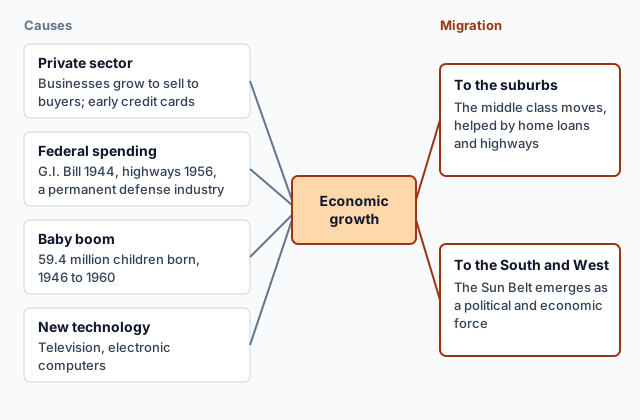
- Explain the causes of economic growth in the years after World War II, including the private sector, federal spending, the baby boom and new technology.
- Explain the causes and effects of the migration of various groups of Americans after 1945, to the suburbs and to the South and West, and read the sources of those years for how their situation and purpose limit what they can show.
Key vocabulary
| Term | What it means | The exam trap |
|---|---|---|
| G.I. Bill | The Servicemen's Readjustment Act of 1944, which paid for veterans' education and training and guaranteed their home loans. | It was signed in 1944, before the war ended; its benefits were used after the war. |
| Baby boom | The sharp rise in births after World War II, about 59.4 million children from 1946 to 1960. | The baby boom is a cause of growth here, but it was also an effect of postwar confidence and prosperity; say which way you are using it. |
| Suburb | A community of homes built near a city, from which many residents traveled to work. | Suburbs grew because of loans, cars and highways, not only because families wanted more space. |
| Social mobility | Movement of people into a higher (or lower) level of income, education or status. | Social mobility is about moving up or down in society, not about moving house, though the two often went together. |
| Sun Belt | The fast-growing region of the South and West that emerged after 1945 as a significant political and economic force. | The Sun Belt is about growth and power, not climate alone; name an economic cause when you use it. |
 Tap to open the picture full size
Part 1 Think first What happens when 15 million come home?
Commit to a guess first. Being wrong now makes the right idea stick better.
Predict first
While World War II was still being fought, the Department of Labor estimated that about 15 million men and women then in the armed forces would be out of work once the war ended. The Great Depression was only a few years behind them. What do you think happened to the U.S. economy in the fifteen years after 1945?
In short. After 1945 a growing private sector, heavy federal spending, the baby boom and new technology drove a long economic boom, and rising incomes, college degrees and new roads carried the middle class to the suburbs and many Americans to the South and West, where the Sun Belt became a political and economic force.
- Federal money did a great deal of the work: the G.I. Bill paid for veterans' schooling and backed their home loans, the 1956 highway act authorized $25 billion for interstates, and Cold War defense built a permanent arms industry.
- The suburbs grew on cheap mortgages, cars and highways, but Black veterans were often shut out of white suburban neighborhoods, and new highways cut through poorer city neighborhoods.
- Expanding colleges and new technology raised social mobility, and the South and West grew into the Sun Belt, a region with new economic and political weight.
Part 2 Learn it Growth, and the moves it set off
2a. Four engines of growth
The postwar economy grew for several reasons at once, and an exam answer is stronger when it names more than one.
The private sector. Businesses expanded to sell to Americans with money to spend. The course framework points to the aerospace and automobile industries and to the first credit cards of the 1950s, which let people buy now and pay later.
Federal spending. Washington paid for veterans' education and home loans, for highways and for a huge defense establishment. The next chunk takes these one at a time.
The baby boom. About 59.4 million children were born in the United States between 1946 and 1960. The 1950 census, which counted 151 million people, was the first to include the baby boom generation. Every new family needed a home, a car, appliances and, soon, schools.
Technology. The 1950 census was also the first to ask Americans whether they owned a TV. New machines, from televisions to electronic computers, created industries and jobs.
Sources: 1950 Census Fact Sheet (National Archives); Marilyn Irvin Holt, Children as Topic No. 1 (Prologue, 2010).
Quick check · Sort it
Each card is a development of the postwar years. Tap a card, then the cause of growth it best shows.
Federal spending
Private sector and technology
Baby boom
2b. Federal dollars: veterans, roads and defense
The G.I. Bill (1944) paid tuition, books and living costs for veterans in school and guaranteed their home loans. The National Archives says: "It put higher education within the reach of millions of veterans of WWII and later military conflicts." About 2.3 million veterans attended colleges and universities under it, and by 1955 it had backed 4.3 million home loans.
The interstate highway act (1956) authorized $25 billion to build 41,000 miles of highway. Eisenhower had seen the value of good roads in a 1919 Army convoy and in Germany's autobahns during the war.
Defense. In his farewell address of January 17, 1961, Eisenhower said that "we have been compelled to create a permanent armaments industry of vast proportions" and that "three and a half million men and women are directly engaged in the defense establishment." Research changed too: "A steadily increasing share is conducted for, by, or at the direction of, the Federal government."
Eisenhower was a former general leaving office after eight years, speaking on national television to warn his successors. Because he meant it as a warning, the speech shows his fears more surely than it proves the danger.
Sources: G.I. Bill (National Archives); Highway Act (National Archives); Eisenhower's Farewell Address (National Archives).
Quick check · Fill the statement
Complete a historian's notes on Eisenhower's farewell address of January 17, 1961.
Eisenhower spoke as a military leader and hero of World War II who had spent half a century in the country's service, which is his . He meant to warn the next leaders against the "unwarranted influence" of the arms industry, which is his . So the speech is strong evidence of how large defense spending had grown, but weaker evidence that the defense industry was actually misusing its power.
2c. To the suburbs
Rising pay, cheap home loans and new roads let millions of middle-class families leave cities for suburbs, new towns of single-family houses built near a city. The Veterans Administration's guaranteed mortgages helped families build or buy homes, and suburbs such as Levittown, New York, became the model new communities of the era. Veterans bought about 20 percent of all new homes built after the war. For a growing share of the baby boom, family mobility meant growing up in the suburbs.
The highways did as much as the loans. The National Archives says that after the 1956 act "the pattern of community development in America was fundamentally altered and was henceforth based on the automobile."
Not everyone could make the move. Black veterans were often unable to get bank loans for homes in Black neighborhoods and faced discrimination that largely kept them from buying in white suburbs. In cities, the new superhighways cut through neighborhoods and destroyed housing, much of it in poorer sections.
Sources: G.I. Bill (National Archives); Highway Act (National Archives); Marilyn Irvin Holt, Children as Topic No. 1 (Prologue, 2010).
Quick check · Match
Match each development to its effect on where Americans lived.
2d. South and West: the Sun Belt
The second big move went south and west. As colleges and new technologies expanded quickly, more Americans could rise into better jobs, and that social mobility drew many of them to the South and West. The growing region of the South and West came to be called the Sun Belt, and it emerged as a significant political and economic force.
Why there? The historian Marilyn Irvin Holt, writing in the National Archives magazine Prologue in 2010, notes population shifts to states that boomed with jobs in defense industries, so the defense spending of 2b mattered here too. The course framework adds a technology that made hot places easier to live and work in: air conditioning. Its examples of fast-growing places include California, Florida and the area around Houston, Texas.
The move changed politics as well as maps. The course framework points to the growth of grassroots conservatism in California in the 1950s and 1960s, one sign of the region's rising political weight.
Sources: Marilyn Irvin Holt, Children as Topic No. 1 (Prologue, 2010). The examples of California, Florida, Houston and air conditioning are from the AP U.S. History course framework.
Quick check · Select all
Which two developments help explain why many Americans moved to the South and West after 1945? Select two.
Select 2 answers, then check.
Part 3 Watch it done Source the name of the interstate system
Watch each step, then do the last one yourself.
The 1956 highway act renamed the planned road network the National System of Interstate and Defense Highways, "Because of its primary importance to the national defense." Explain how the act's historical situation shapes that name, and what the name can and cannot show a historian.
Predict first
Before the steps, what do you think the defense name tells you most surely?
Step 1 · Place it in time
Eisenhower signed the act on June 29, 1956, during the Cold War. He had seen the value of good roads on a 1919 Army convoy and saw the advantage Germany's autobahns gave in World War II.
Why this step?
Why does the date matter for a name?
A name is a choice made at a particular moment for particular readers. In a Cold War year, linking a costly program to national defense gave it a reason that fit the fears of the moment.
Step 2 · Ask what happened next
The National Archives says the highways spurred substantial growth in interstate commerce and suburbanization over the next decades.
Your step · Decide and justify
Finish it. What can the defense name in the 1956 act show a historian?
Which evidence best supports your answer?
Part 4 Try it What a summary and a speech can show
The National Archives' page on the G.I. Bill is a modern summary written to introduce the law. It reports that about 2.3 million veterans attended colleges and universities under the act and that degrees awarded by U.S. colleges more than doubled between 1940 and 1950. It also says that Black veterans were often unable to get bank loans for homes in Black neighborhoods and faced prejudice and discrimination that kept them from buying in white suburban neighborhoods.
Try it · Multiple choice
A student uses the G.I. Bill's total of home loans as evidence that all veterans shared equally in the move to the suburbs. What is the main limit of that evidence?
The second source is a speech. Eisenhower gave his farewell address on January 17, 1961, on national television from the Oval Office, three days before he left the presidency. In it he said: "In the councils of government, we must guard against the acquisition of unwarranted influence, whether sought or unsought, by the military-industrial complex."
Try it · Spot the error
A student writes a sourcing paragraph on Eisenhower's farewell address. Which line is the first to go wrong?
Part 5 Explain it Write it like a document-based answer
Nothing you type leaves this page. Check your answer against the model and each scoring point.
Free-response practice · Question 1 style
A short practice in the shape of the document-based question: three documents instead of seven, and a thesis with one body paragraph instead of a full essay.
Evaluate the extent to which federal spending caused economic growth in the United States from 1945 to 1961.
Document 1. The National Archives on the Servicemen's Readjustment Act (the G.I. Bill), signed June 22, 1944: "It put higher education within the reach of millions of veterans of WWII and later military conflicts." About 2.3 million veterans attended colleges and universities under it, and by 1955 it had backed 4.3 million home loans.
Document 2. National Interstate and Defense Highways Act, June 29, 1956: the act authorized $25 billion for a 41,000-mile system and renamed it for defense "Because of its primary importance to the national defense."
Document 3. President Dwight D. Eisenhower, farewell address on national television, January 17, 1961: "we have been compelled to create a permanent armaments industry of vast proportions." And: "In the councils of government, we must guard against the acquisition of unwarranted influence, whether sought or unsought, by the military-industrial complex."
Write a thesis, one sentence of historical context, and one paragraph that uses at least two documents and explains the purpose, audience, point of view or situation of one of them.
Model answer
Thesis: Federal spending was a major cause of postwar growth, since it paid for veterans' education and homes, the interstates and a permanent defense industry, but it worked together with a growing private sector, the baby boom and new technology rather than alone.
Context: with the Great Depression only a few years past, the Department of Labor estimated during the war that about 15 million returning service members would be out of work once it ended.
The G.I. Bill put "higher education within the reach of millions of veterans" and backed 4.3 million home loans by 1955 (Document 1), money that built skills and created demand for houses. The 1956 highway act authorized $25 billion in road building (Document 2), though that money was spread over fiscal 1957 to 1969, so most of it falls after this period. By 1961 Eisenhower described "a permanent armaments industry of vast proportions" (Document 3). Eisenhower was a former general leaving office, and his purpose was to warn his successors, so his description of the arms industry's size is strong evidence of how large defense spending had become, while his fear of its influence is a warning, not proof. Federal money did not work alone: about 59.4 million births between 1946 and 1960 supplied the families, and federal loans and roads made it possible for them to buy the houses and cars that kept private business growing.
Score your own answer. This is a self-check, not a grade. Tick each point your answer makes.
Part 6 Check yourself What the G.I. Bill paid for
The case questions use the table. The others mix the ideas from the whole lesson.
These figures are from the National Archives' page on the Servicemen's Readjustment Act of 1944, a modern summary of the law. Source: Servicemen's Readjustment Act (National Archives).
| Benefit | Number of veterans or loans |
|---|---|
| Attended colleges and universities | About 2,300,000 |
| Received school training | About 3,500,000 |
| Received on-the-job training | About 3,400,000 |
| Home loans granted by 1955 | 4.3 million, total face value $33 billion |
Case question 1 · Multiple choice
Which conclusion do the figures in the table best support?
Case question 2 · Multiple choice
A historian wants to know whether the G.I. Bill helped Black and white veterans equally in buying suburban homes. Why is the table alone not enough?
The rest stand on their own and do not use the case.
Check yourself · Put it in order
Put these events in the order they happened, earliest first.
Check yourself · Fill the statement
Complete the sentences.
As colleges and new technologies expanded, more Americans could move up into better jobs, which historians call . Many moved to the South and West, where the region called the became a significant political and economic force.
Part 7 Keep it Bring back earlier ideas
This lesson stands on the Cold War policies of Topic 8.2 and the Red Scare of Topic 8.3.
Bring it back · Multiple choice
As the wartime alliance with the Soviet Union broke down, which approach did the United States take toward non-Communist nations?
Bring it back · Fill the statement
Read the situation, then complete the sentences.
Suppose two senators of different parties both vote for aid to anti-communist governments abroad, but they argue bitterly over how a Senate committee goes about exposing suspected communists at home. They agree on the strategy of . They disagree over the used to find communists inside the United States.
In three lines
- A growing private sector, federal spending, the baby boom and new technology together drove the postwar boom.
- Home loans, cars and highways carried the middle class to the suburbs, though discrimination kept many Black families out.
- Expanding colleges, technology and defense jobs drew many Americans to the South and West, and the Sun Belt became a political and economic force.
Exam strategy for this topic
- Section I Part A, Multiple Choice: 55 questions in 55 minutes.
- Section I Part B, Short Answer: 3 questions in 40 minutes.
- Section II, Document-Based Question and Long Essay: 2 questions in 100 minutes.
- This lesson's Explain it is shaped like free-response question 1, Document-based.
When a question asks why the economy grew after 1945, name more than one cause and link them, for example federal home loans meeting the demand of new baby boom families.
Questions students ask
Was the G.I. Bill only about college?
No. It also paid for school and on-the-job training, and it guaranteed home loans. The National Archives reports that by 1955 it had backed 4.3 million home loans, and that veterans bought about 20 percent of all new homes built after the war.
Why was the interstate system named for defense?
The 1956 act renamed it the National System of Interstate and Defense Highways, "Because of its primary importance to the national defense." The name tells you how the law presented the roads in a Cold War year. The roads' effects on trade and the suburbs come from what happened later.
What did Eisenhower mean by the military-industrial complex?
He meant the new combination of a huge military and a permanent arms industry. He said that "This conjunction of an immense military establishment and a large arms industry is new in the American experience." He warned that it could gain too much influence in government.
Did technology change ordinary life, or only factories?
Both. The 1950 census was the first to ask whether people owned a TV, and Eisenhower noted in 1961 that "For every old blackboard there are now hundreds of new electronic computers." Television also changed culture, which is the subject of Topic 8.5.
Where can I read these documents in full?
Each excerpt links to the National Archives page it was checked against, where you can read the transcript or the full description of the document.
Course alignment, for teachers
AP U.S. History topic 8.4, Unit 8: Period 8: 1945–1980.
- Skill 2.C: Explain the significance of a source’s point of view, purpose, historical situation, and/or audience, including how these might limit the use(s) of a source.
This lesson maps all 2 essential knowledge statements of the topic, and the 2 learning objectives with none of their own, to the part that teaches each one: 4 are checked by a scored question. The map is in the lesson file.