Unit 7 · Topic 7.4 · about 30 minutes · 7 parts · 13 scored checks, 4 of them multiple choice
AP U.S. History 7.4: The Progressives
Unit 7: 10 to 17% of the multiple-choice section
What you'll be able to do
- Compare the goals and effects of the Progressive reform movement, and read its documents for their point of view, purpose, historical situation and audience.
- Compare attitudes toward the use of natural resources from 1890 to 1945.
Key vocabulary
| Term | What it means | The exam trap |
|---|---|---|
| Progressives | Reformers of the early 1900s who exposed political corruption, social injustice and economic inequality and asked government to act on them. | The name covers people who disagreed sharply, so a claim about all Progressives needs evidence from more than one group. |
| Direct election of senators | Choosing U.S. senators by popular vote in each state, required by the 17th Amendment. | It changed who chooses senators, not how long they serve or how many each state has. |
| Prohibition | The national ban on making, selling and transporting alcoholic liquor, set by the 18th Amendment. | Prohibition was a reform, so do not file it under the 1920s alone; reformers built the campaign for it long before. |
| Preservationist | Someone who wants wild places kept in their natural condition. | Supporting a national park does not by itself tell you which side of the resource debate a person was on. |
| Conservationist | Someone who wants natural resources used with planning and renewal so they last. | The word sounds like preservation, so read what the writer wants done with the land before you label it. |
 Tap to open the picture full size
Part 1 Think first Why pay for photographs?
Commit to a guess first. Being wrong now makes the right idea stick better.
Predict first
In 1904 a group of reformers founded the National Child Labor Committee to end child labor. A few years later it hired Lewis Hine, a New York City schoolteacher, to travel the country photographing children at work in coal mines, textile mills and canneries. Why do you think the committee spent its money on photographs?
In short. Progressives were reformers of the early 1900s who exposed corruption, injustice and inequality and then turned to government, including federal laws and constitutional amendments, to regulate the economy, widen democracy and reform morals, though they disagreed among themselves about race, experts, immigration and natural resources.
- Journalists and reformers, many of them middle- and upper-class women, exposed problems such as child labor and worked for change in cities and immigrant communities.
- At the national level Progressives won laws such as the Keating-Owen Act and amendments for direct election of senators, prohibition and women's suffrage, though courts and state laws limited some of them.
- Preservationists and conservationists both backed national parks but differed on how government should respond to the overuse of natural resources.
Part 2 Learn it What Progressives wanted, and what they won
2a. Exposing the problem
Progressives were reformers of the early 1900s who responded to political corruption, economic instability and social concerns by calling for government action. Some Progressive Era journalists attacked what they saw as political corruption, social injustice and economic inequality. Reformers, often from the middle and upper classes and including many women, worked for social change in cities and among immigrant families. Jane Addams, who co-founded Chicago's Hull-House settlement in 1889, was by 1905 one of the most influential women in America and a leader of the movement.
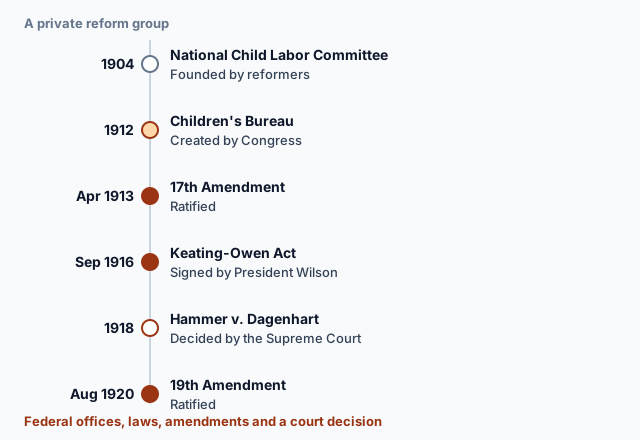
Child labor shows how investigators worked. In 1904 a group of progressive reformers founded the National Child Labor Committee. It hired investigators to gather evidence and then organized exhibitions of photographs and statistics. Its photographer, Lewis Hine, photographed children in coal mines, meatpacking houses, textile mills and canneries. In 1908 Hine put it this way: "There is work that profits children, and there is work that brings profit only to employers. The object of employing children is not to train them, but to get high profits from their work."
The children he found were often from immigrant and rural families who needed the wages. Exposure was a means, not the goal. Hine believed that if people could see the abuses for themselves, they would demand laws to end them, and in 1912 Congress created the Children's Bureau as a federal information clearinghouse. A federal child labor law followed in 1916.
Sources: Photographs of Lewis Hine; Jane Addams Papers (both National Archives).
Quick check · Sort it
Each card is a step in the campaign against child labor. Tap a card, then the kind of step it is.
Exposing the problem to the public
Acting through government
2b. Federal laws and amendments
On the national level, Progressives sought federal laws they believed would regulate the economy, expand democracy and bring moral reform. Four changes show each aim.
- Regulating the economy. The Keating-Owen Act, signed by President Woodrow Wilson on September 1, 1916, banned the interstate sale of goods from factories that employed children under 14 and mines that employed children under 16. In 1918, in Hammer v. Dagenhart, the Supreme Court ruled it unconstitutional.
- Expanding democracy. Before 1913, state legislatures chose U.S. senators, and reformers called the Senate a "millionaires' club" serving private interests. The 17th Amendment, ratified April 8, 1913, made senators "elected by the people thereof."
- Moral reform. Temperance societies and Progressive reformers, with women strongly behind them, pushed for a national ban on alcohol. Congress sent the prohibition amendment, the 18th, to the states in 1917; it barred the manufacture, sale and transportation of alcoholic liquors.
- Women's suffrage. The 19th Amendment, ratified August 18, 1920, reads: "The right of citizens of the United States to vote shall not be denied or abridged by the United States or by any State on account of sex." Even so, discriminatory state voting laws kept many women from voting for decades.
Sources: Keating-Owen Act; 17th Amendment; Prohibition documents; 19th Amendment (all National Archives).
Quick check · Match
Match each federal change to the Progressive aim it most directly served.
2c. Progressives divided
A National Archives lesson calls the reformers "a diverse group, frequently with different views." They were politicians, labor leaders, religious leaders and teachers, and they split on several questions.
Race. Some Progressives supported Southern segregation, while others ignored it. Wilson issued no executive order on it, but under his administration segregation became the de facto practice in many federal agencies. (A different National Archives page says he ordered it in 1913; when two sources disagree, check what each one rests on.) When the House passed amendments for direct election of senators in 1910 and 1911, they carried a "race rider" meant to bar federal intervention in racial discrimination among voters. A substitute by Senator Joseph Bristow of Kansas dropped it.
The people or the experts. In 1911 the National Progressive Republican League called for direct election of senators, direct primaries, and the initiative, referendum and recall. Other Progressives wanted government to rely more on professional and technical experts to make it efficient. When Wilson planned the peace after World War I, he relied on reports from about 150 political and social scientists.
Federal power. Wilson worried about states' rights and disagreed with Theodore Roosevelt's call for federal control of industry.
Immigration. Progressives also disagreed about whether to restrict it.
Sources: Election of 1912 (National Archives); Labor during World War I (National Archives); 17th Amendment (National Archives); Fourteen Points (National Archives).
Quick check · Sort it
Progressives split over several questions. Tap each card, then the question it shows Progressives taking a side on.
Give voters more direct power
Rely on trained experts
Race and segregation
2d. Parks, preservation and conservation
Americans argued over natural resources from the 1890s through the New Deal. As background, in 1872 Congress made Yellowstone the first federally protected national park. The act said the land was "dedicated and set apart as a public park or pleasuring-ground for the benefit and enjoyment of the people," and it called for "the preservation, from injury or spoliation, of all timber, mineral deposits, natural curiosities, or wonders within said park, and their retention in their natural condition."
Preservationists wanted wild places kept as nature left them. Conservationists wanted resources used, but planned and renewed so they would last. Theodore Roosevelt made conservation one of his issues. Wilson's 1913 inaugural made the conservationist complaint: "We have squandered a great part of what we might have used, and have not stopped to conserve the exceeding bounty of nature." His list of wrongs included "watercourses undeveloped, waste places unreclaimed, forests untended, fast disappearing without plan or prospect of renewal, unregarded waste heaps at every mine."
Both groups supported national parks. They differed on what government should do about the overuse of resources everywhere else.
Sources: Yellowstone Act (National Archives); Wilson's first inaugural (Avalon Project).
Quick check · Fill the statement
Complete the notes comparing two documents.
The Yellowstone Act calls for keeping the park's wonders in their natural condition, which fits the view. Wilson faults the nation for leaving land unreclaimed and forests untended, which fits the view.
Part 3 Watch it done Source Wilson's first inaugural
Watch each step, then do the last one yourself.
In his first inaugural address, on March 4, 1913, Woodrow Wilson said: "Sanitary laws, pure food laws, and laws determining conditions of labor which individuals are powerless to determine for themselves are intimate parts of the very business of justice and legal efficiency." Explain how the speech's historical situation and purpose limit what it can show about Progressive reform.
Predict first
Before the steps, what do you think a new president's inaugural address is best evidence of?
Step 1 · Place it in time
Wilson spoke on the day he took office. He opened: "There has been a change of government." The House had become Democratic two years before, and the Senate about to meet would be Democratic too. Nothing he described had yet been voted on by the new Congress.
Why this step?
Why does the date matter so much for this source?
A speech given before a program exists can show what a leader intended, not what happened. Knowing the speech came first tells you to read it as a plan.
Step 2 · Name the audience and purpose
He spoke to the whole nation, and he wanted to reassure it as well as stir it. He complained that "The great Government we loved has too often been made use of for private and selfish purposes, and those who used it had forgotten the people," and then promised: "We shall restore, not destroy."
Your step · Decide and justify
Finish it. How does the situation limit using this passage as evidence about Progressive reform?
Which evidence best supports your answer?
Part 4 Try it A dam on the Colorado
The argument over natural resources outlasted the Progressive Era. On December 21, 1928, Congress passed the Boulder Canyon Project Act, which authorized what became Hoover Dam on the Colorado River. The act states its aim: "for the purpose of controlling the floods, improving navigation and regulating the flow of the Colorado River, providing for storage and for the delivery of the stored waters thereof for reclamation of public lands and other beneficial uses," along with the generation of electric power. The dam was finished in 1935.
Try it · Multiple choice
Which best describes how the Boulder Canyon Project Act (1928) differs from the Yellowstone Act (1872) in its attitude toward natural resources?
Try it · Spot the error
A student compares the two acts. Which line is the first to go wrong?
Part 5 Explain it Write it like a document-based answer
Nothing you type leaves this page. Check your answer against the model and each scoring point.
Free-response practice · Question 1 style
A short practice in the shape of the document-based question: three documents instead of seven, and a thesis with one body paragraph instead of a full essay.
Evaluate the extent to which Progressive reformers relied on the federal government to reach their goals between 1908 and 1920.
Document 1. Lewis Hine, photographer for the National Child Labor Committee, 1908: "There is work that profits children, and there is work that brings profit only to employers. The object of employing children is not to train them, but to get high profits from their work."
Document 2. Woodrow Wilson, first inaugural address, March 4, 1913: "Sanitary laws, pure food laws, and laws determining conditions of labor which individuals are powerless to determine for themselves are intimate parts of the very business of justice and legal efficiency."
Document 3. The 19th Amendment, passed by Congress June 4, 1919, and ratified August 18, 1920: "The right of citizens of the United States to vote shall not be denied or abridged by the United States or by any State on account of sex."
Write a thesis, one sentence of historical context, and one paragraph that uses at least two documents and explains the purpose, audience, point of view or situation of one of them.
Model answer
Thesis: Between 1908 and 1920 Progressive reformers came to rely heavily on the federal government, moving from exposing problems to the public toward federal laws and constitutional amendments, although the courts and state laws limited what that federal action achieved.
Context: as the nation moved from a rural, agricultural economy to an urban, industrial one led by large companies, Progressives responded to political corruption, economic instability and social concerns by calling for greater government action.
In 1908 Lewis Hine attacked employers who hired children for "high profits" (Document 1). Hine wrote as the hired photographer of a committee whose goal was to abolish child labor, so his purpose was to persuade, and his words show what reformers wanted the public to believe more than how every family saw children's work. Persuasion was meant to lead to law: by 1913 a president called labor laws part of "the very business of justice" (Document 2), and Congress passed the Keating-Owen Act in 1916. Yet the Supreme Court struck that act down in 1918, a limit on federal action. Reformers then changed the Constitution itself: the 19th Amendment barred any state from denying the vote "on account of sex" (Document 3), though discriminatory state laws still kept many women from voting.
Score your own answer. This is a self-check, not a grade. Tick each point your answer makes.
Part 6 Check yourself Who chooses the government?
The case questions use the two excerpts. The others mix the ideas from the whole lesson.
Both excerpts come from 1912 and 1913. Sources: Wilson's first inaugural (Avalon Project); 17th Amendment (National Archives).
| Document | Excerpt |
|---|---|
| Woodrow Wilson, first inaugural address, March 4, 1913 | "The great Government we loved has too often been made use of for private and selfish purposes, and those who used it had forgotten the people." |
| 17th Amendment, passed by Congress May 13, 1912, ratified April 8, 1913 | Each state's two senators are to be "elected by the people thereof," no longer chosen by the state legislature. |
Case question 1 · Multiple choice
Which Progressive goal do both excerpts most directly share?
Case question 2 · Multiple choice
A historian uses the 17th Amendment as evidence that Progressives agreed on expanding democracy. Which fact most limits that use of the source?
The rest stand on their own and do not use the case.
Check yourself · Put it in order
Put these events in the order they happened, earliest first.
Check yourself · Decide and justify
A student claims that because preservationists and conservationists both supported national parks, they agreed about how to treat the nation's natural resources. Does the evidence support the claim, or does it need changing?
Which point best supports your answer?
Part 7 Keep it Bring back earlier ideas
Progressives answered problems that Gilded Age reformers had already named in Topics 6.11 and 6.13.
Bring it back · Multiple choice
How did big-city political machines of the Gilded Age build loyalty among newcomers?
Bring it back · Fill the statement
Complete the sentence about women in the Gilded Age.
Before 1900, a woman who wanted a public role in reform often found it through such as clubs and societies, and more women gained training for reform by going to .
In three lines
- Progressive journalists and reformers exposed corruption, injustice and inequality, and many reformers were middle- and upper-class women working in cities and immigrant communities.
- Progressives turned to federal laws and amendments to regulate the economy, expand democracy and reform morals, but they disagreed about segregation, experts, federal power and immigration.
- Preservationists and conservationists both backed national parks but differed on how government should respond to the overuse of natural resources.
Exam strategy for this topic
- Section I Part A, Multiple Choice: 55 questions in 55 minutes.
- Section I Part B, Short Answer: 3 questions in 40 minutes.
- Section II, Document-Based Question and Long Essay: 2 questions in 100 minutes.
- This lesson's Explain it is shaped like free-response question 1, Document-based.
When you use a law or amendment as evidence for a Progressive goal, say what happened to it next, such as a court ruling or a state law that limited it. That is how a paragraph shows effects as well as goals.
Questions students ask
Were the Progressives a political party?
Mostly not. Progressives were found among Republicans and Democrats, and in 1912 Theodore Roosevelt ran for president at the head of a new Progressive Party. Wilson, a Democrat, also ran as a reformer, and the two disagreed about how much federal control over industry was right.
Did the Keating-Owen Act end child labor?
No. Congress passed it and Wilson signed it in 1916, banning the interstate sale of goods from factories employing children under 14 and mines employing children under 16, but in 1918 the Supreme Court ruled it unconstitutional in Hammer v. Dagenhart.
Which amendments came out of the Progressive Era?
The 17th Amendment (1913) made senators elected by the voters of each state, the 18th brought national prohibition, and the 19th (1920) barred denying the vote on account of sex.
Did every woman gain the vote in 1920?
The 19th Amendment barred denying the vote on account of sex, but the National Archives notes that many women remained unable to vote long into the 20th century because of discriminatory state voting laws.
Where can I read these documents in full?
Each excerpt links to its full text at the National Archives or the Avalon Project at Yale Law School, the primary-source collections this lesson was checked against.
Course alignment, for teachers
AP U.S. History topic 7.4, Unit 7: Period 7: 1890–1945.
- Skill 2.C: Explain the significance of a source’s point of view, purpose, historical situation, and/or audience, including how these might limit the use(s) of a source.
This lesson maps all 4 essential knowledge statements of the topic, and the 2 learning objectives with none of their own, to the part that teaches each one: 6 are checked by a scored question. The map is in the lesson file.