Unit 7 · Topic 7.1 · about 30 minutes · 7 parts · 13 scored checks, 5 of them multiple choice
AP U.S. History 7.1: Contextualizing Period 7
Unit 7: 10 to 17% of the multiple-choice section
What you'll be able to do
- Explain the context in which America grew into its role as a world power, placing a specific development of 1890 to 1945 inside the broader changes in the economy, culture, migration and foreign affairs of the period.
Key vocabulary
| Term | What it means | The exam trap |
|---|---|---|
| Trust | An arrangement that put the shares of several companies under one set of trustees, so the companies ran as one. | A trust in this sense is a business combination, not a feeling of confidence or a bank account held for someone. |
| Progressive Era | The early 20th century, when reformers answered corruption, economic instability and social problems by calling for greater government action. | Progressives disagreed with each other on many issues, so do not treat them as one party with one program. |
| Limited welfare state | The federal government's new, lasting role in the 1930s in protecting some of its people from economic insecurity. | The phrase belongs to the 1930s; do not use it for the Progressive reforms of the early 1900s. |
| Mass culture | Culture, such as songs, programs and films, that reaches millions of people at once through new media. | Mass culture is not the same as high culture; the word mass describes reach, not quality. |
| Contextualization | Explaining how a specific development fits inside a broader historical development or process. | Context comes from outside the source; summing up the document itself is not contextualization. |
 Tap to open the picture full size
Part 1 Think first From no conquest to Tokyo Bay
Commit to a guess first. Being wrong now makes the right idea stick better.
Predict first
On March 4, 1897, President William McKinley said in his first inaugural address: "We want no wars of conquest; we must avoid the temptation of territorial aggression." On September 2, 1945, Japan's envoys signed their surrender aboard the USS Missouri in Tokyo Bay, and Gen. Douglas MacArthur accepted it "for the United States, Republic of China, United Kingdom, and the Union of Soviet Socialist Republics, and in the interests of the other United Nations at war with Japan." What do you think did most to carry the country from the first moment to the second?
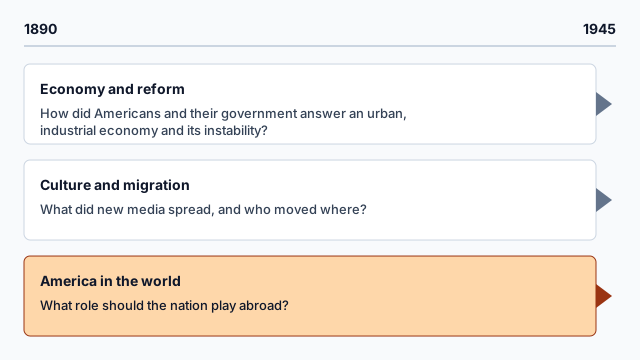
In short. Period 7, 1890 to 1945, is the era in which the United States grew into a world power through a series of global conflicts, while at home a new industrial economy, Progressive reform, the Great Depression, mass culture and shifting migration remade American society.
- The economy finished its turn from farms to an urban, industrial economy led by large companies, and Progressives and then New Dealers answered its instability by calling for more government action.
- Radio, film and other new technology spread a mass culture that Americans argued over, while economic pressure, wars and new laws changed who migrated and where.
- The war with Spain and the two world wars each left the United States more powerful abroad and restarted the argument at home over its proper role in the world.
Part 2 Learn it The forces of Period 7
2a. An industrial economy and the Progressive answer
Across Period 7 the United States kept moving from a rural, farming economy to an urban, industrial one led by large companies. By the end of the 19th century, the National Archives notes, trusts had come to dominate a number of major industries, destroying competition. A trust placed the shares of several companies in the hands of one set of trustees, so the companies ran as one.
Congress answered with the Sherman Anti-Trust Act, which President Benjamin Harrison signed on July 2, 1890. Every contract or combination "in restraint of trade or commerce among the several States, or with foreign nations, is hereby declared to be illegal."
Growth expanded opportunity, but it came with instability and hard conditions. The 1900 census found about 2 million children working in mills, mines, fields, factories, stores and city streets. In the Progressive Era of the early 20th century, reformers answered problems like these, and political corruption, by calling for greater government action. The Keating-Owen Act, approved September 1, 1916 and signed by President Woodrow Wilson, kept out of interstate trade the goods of any factory where "children under the age of fourteen years have been employed or permitted to work." The Supreme Court struck it down in 1918, and federal protection for children waited until the Fair Labor Standards Act of 1938.
Sources: Sherman Anti-Trust Act (National Archives); Keating-Owen Child Labor Act (National Archives).
Quick check · Sort it
Each card is a development from 1890 to 1918. Tap a card, then say whether it is a change or condition in the economy or a response that called for government action.
A change or condition in the economy
A response calling for government action
2b. The Depression and a limited welfare state
In the 1930s the Great Depression brought mass unemployment and social upheaval. Before the 1930s, the National Archives notes, support for the elderly was a matter of local, state and family concern, not a federal one, except for veterans' pensions. The widespread suffering of the Depression built support in Congress for a national old-age insurance system.
The Social Security Act of 1935 was "An act to provide for the general welfare by establishing a system of Federal old-age benefits," with more besides. It set up old-age benefits for workers, unemployment insurance, and aid for dependent mothers and children and for people who are blind or have disabilities.
Historians call the result a limited welfare state. The federal government took lasting responsibility for the economic security of some of its people, through named programs for named groups. Unlike many European nations, the United States paid for its old-age insurance with taxes on workers' wages and employers' payrolls rather than directly from government funds. Opponents still called it governmental overreach into the private sphere.
The New Deal's view, that government should act to protect people from economic insecurity, redefined modern American liberalism.
Quick check · Multiple choice
Why do historians describe the system begun by the Social Security Act of 1935 as a limited welfare state?
2c. Mass culture and migration
New technology in communications changed everyday life. Radio and cinema spread a national culture and also made Americans more aware of regional cultures. Mass culture, the same songs, programs and films reaching millions of people at once, grew in influence. It drew argument too. In the 1920s Americans debated gender roles, modernism, science, religion, race and immigration, and many asked what popular culture was doing to public values, morals and the national identity.
Migration rose and fell sharply with the economy, with wars and with new laws. Immigration from Europe reached its peak in the years before World War I. During and after that war, nativist campaigns against some ethnic groups brought quotas that restricted immigration, especially from southern and eastern Europe, and raised new barriers to Asian immigration.
Inside the country, the demand for war production drew people to cities in both world wars. In the Great Migration during and after World War I, African Americans escaping segregation, racial violence and limited opportunity in the South moved to the North and West, where they found new opportunities and still met discrimination. Migration from Mexico and elsewhere in the Western Hemisphere grew as well.
This chunk follows the AP U.S. History course framework's own summary of Period 7.
Quick check · Fill the statement
Complete the notes on migration in Period 7.
Immigration from Europe reached its in the years before World War I. During and after the war, campaigns against some ethnic groups brought quotas that restricted immigration from southern and eastern Europe. At the same time, African Americans leaving the South for the North and West made up the .
2d. A series of global conflicts
Abroad, the United States grew into a world power through a series of conflicts, and each renewed the argument at home over its proper role in the world.
In 1897 President McKinley had said, "We want no wars of conquest; we must avoid the temptation of territorial aggression." A year later came war with Spain. In the treaty of December 10, 1898, Spain ceded Puerto Rico (printed as "the island of Porto Rico"), Guam and the Philippines to the United States, and a public debate followed over whether to hold overseas possessions at all.
On April 2, 1917, President Woodrow Wilson asked Congress for war on Germany: "The world must be made safe for democracy." Afterward the Senate never adopted the peace treaty, and the United States never joined the League of Nations that Wilson had fought for.
Japan attacked Pearl Harbor on December 7, 1941, and Congress declared war the next day. The war transformed American society. Women were called to take men's places on the production line, and millions of new defense jobs drew large numbers of African Americans to cities in the North and West, where they often met violence and discrimination. Japan surrendered on September 2, 1945, and the victory of the United States and its allies left the country in a position of global political and military leadership.
Sources: Treaty with Spain (Avalon Project); Wilson's war message; 14 Points; Women in the work force; Executive Order 8802 (National Archives).
Quick check · Match
Match each moment to what it did to the country and its place in the world.
Part 3 Watch it done Place Wilson's war message in its context
Watch each step, then do the last one yourself.
On April 2, 1917, President Woodrow Wilson asked a joint session of Congress to declare war on Germany. Explain how his call for war fits into the broader context of Period 7.
Predict first
Before the steps, which broader development do you think the war message belongs to?
Step 1 · Start with what led up to it
When war broke out in Europe in 1914, Wilson declared the country neutral. German submarines then sank ships with Americans aboard; 128 Americans died when the Lusitania was attacked on May 7, 1915. Munitions shipments to Britain and France rose from around $6 million in 1914 to almost $500 million in 1917, and American bankers loaned the Allies over $2 billion. On February 1, 1917, Germany announced it would renew unrestricted submarine warfare.
Why this step?
Why start with the years before the speech instead of the speech itself?
Context is the larger story a document sits inside. The years from 1914 to 1917 show what Wilson was responding to, and they lead into the wider pattern of the period.
Step 2 · Widen the frame
Wilson told Congress, "We have no selfish ends to serve," and said Americans would fight "for the rights and liberties of small nations." Now ask what larger story the speech belongs to. Was this the country's first step into affairs abroad, or one more step in a longer pattern?
Your step · Decide and justify
Finish it. Which sentence best places the war message in the broader context of Period 7?
Which evidence best supports your answer?
Part 4 Try it The League of Nations and the Social Security Act
On January 8, 1918, Wilson proposed to Congress a 14-point program for world peace, ending with a world organization that would provide a system of collective security for all nations. At the peace conference, most of his points were scuttled by the leaders of England and France, but the world organization was written into the Treaty of Versailles as the League of Nations. Wilson campaigned hard to win over the Senate. The Senate never adopted it, and the United States never joined the League.
Try it · Multiple choice
Which broader context best explains the Senate's refusal to join the League of Nations?
Try it · Spot the error
A student writes a context paragraph for an essay on the Social Security Act of 1935. Which line is the first to go wrong?
Part 5 Explain it Write it like a document-based answer
Nothing you type leaves this page. Check your answer against the model and each scoring point.
Free-response practice · Question 1 style
A short practice in the shape of the document-based question: three documents instead of seven, and a thesis with one body paragraph instead of a full essay.
Evaluate the extent to which participation in global conflicts changed the role of the United States in the world between 1898 and 1945.
Document 1. Treaty of Peace Between the United States and Spain, December 10, 1898: "Spain cedes to the United States the island of Porto Rico and other islands now under Spanish sovereignty in the West Indies, and the island of Guam in the Marianas or Ladrones." And: "Spain cedes to the United States the archipelago known as the Philippine Islands."
Document 2. President Woodrow Wilson, address to Congress asking for war on Germany, April 2, 1917: "The world must be made safe for democracy." And: "We have no selfish ends to serve."
Document 3. Instrument of Surrender of Japan, signed in Tokyo Bay, September 2, 1945, and accepted by Gen. Douglas MacArthur "for the United States, Republic of China, United Kingdom, and the Union of Soviet Socialist Republics, and in the interests of the other United Nations at war with Japan."
Write a thesis, one sentence of historical context, and one paragraph that uses at least two documents and explains the purpose, audience, point of view or situation of one of them.
Model answer
Thesis: Between 1898 and 1945 war changed the United States from a country that had just taken islands from Spain into a global leader, although each step reopened an argument at home over how far the nation should go.
Context: in the late 19th century an industrial economy led by large companies was looking for markets and influence abroad, and policymakers had begun to look past the nation's borders.
The war with Spain ended with Spain ceding Puerto Rico, Guam and the Philippines (Document 1), so the United States now held territory in the Caribbean and the Pacific. In 1917 Wilson took the country into a European war, saying "The world must be made safe for democracy" (Document 2). He was asking Congress for a vote of war, so he stressed ideals and claimed "no selfish ends," which means the speech shows how he wanted the war understood more than every reason for it. The Senate's refusal to join the League afterward shows how unsettled the country's role still was. By 1945 an American general accepted Japan's surrender for the United States and its major allies (Document 3), a leading place no one had held for the country in 1898.
Score your own answer. This is a self-check, not a grade. Tick each point your answer makes.
Part 6 Check yourself Three acts of Congress
The case questions use the three excerpts. The others mix the ideas from the whole lesson.
Three federal laws from Period 7, as the National Archives prints them. Sources: Sherman Anti-Trust Act; Keating-Owen Child Labor Act; Social Security Act.
| Law | Excerpt |
|---|---|
| Sherman Anti-Trust Act, 1890 | Every contract or combination "in restraint of trade or commerce among the several States, or with foreign nations, is hereby declared to be illegal." |
| Keating-Owen Child Labor Act, 1916 | Keeps out of interstate trade the goods of any factory where "children under the age of fourteen years have been employed or permitted to work." |
| Social Security Act, 1935 | An act "to provide for the general welfare by establishing a system of Federal old-age benefits." |
Case question 1 · Multiple choice
Which broader development best explains the 1890 law?
Case question 2 · Multiple choice
Taken together, what do the three laws show about Period 7?
The rest stand on their own and do not use the case.
Check yourself · Put it in order
Put these events in the order they happened, earliest first.
Check yourself · Select all
Which two belong to the growth of mass culture in Period 7 and the arguments it caused? Select two.
Select 2 answers, then check.
Part 7 Keep it Bring back earlier ideas
Period 7 grows out of Period 6: the trusts of Topic 6.6 and the foreign markets of Topic 6.12.
Bring it back · Multiple choice
In the Gilded Age, many business leaders consolidated corporations into large trusts and holding companies. What were they after, and what did it do?
Bring it back · Fill the statement
Complete the sentence about Gilded Age foreign policy.
Foreign policymakers increasingly looked U.S. borders to gain greater influence and control over and natural resources in the Pacific Rim, Asia and Latin America.
In three lines
- An urban, industrial economy led by large companies brought growth and instability; Progressives and then the New Deal answered with more government action, ending in a limited welfare state.
- New communications spread a mass culture that Americans argued over, and migration swung sharply with the economy, wars and new laws.
- The war with Spain and two world wars carried the United States to global leadership, and each renewed the debate at home over its proper role.
Exam strategy for this topic
- Section I Part A, Multiple Choice: 55 questions in 55 minutes.
- Section I Part B, Short Answer: 3 questions in 40 minutes.
- Section II, Document-Based Question and Long Essay: 2 questions in 100 minutes.
- This lesson's Explain it is shaped like free-response question 1, Document-based.
When a question asks for context, name the broader development first, then say in a clause how the specific event fits inside it. A list of earlier events is not context until you connect it.
Questions students ask
What years does Period 7 cover?
1890 to 1945, from the age of trusts and the war with Spain to the end of World War II.
Did the United States plan to become a world power?
Not in any single plan. In 1897 President McKinley said, "We want no wars of conquest; we must avoid the temptation of territorial aggression." Power came through a series of conflicts, and each one restarted the argument at home.
Why is the New Deal's welfare state called limited?
The Social Security Act set up named programs for named groups, such as old-age benefits for workers and unemployment insurance, and paid for its old-age insurance with taxes on wages and payrolls. The federal role was new and lasting, but it did not cover every need.
Did the United States join the League of Nations?
No. The League was written into the Treaty of Versailles, but the Senate never adopted the treaty, and the United States never joined.
Why does the treaty with Spain say Porto Rico?
Every excerpt is copied exactly as the archive prints it. The 1898 treaty spells the island's name that way.
Course alignment, for teachers
AP U.S. History topic 7.1, Unit 7: Period 7: 1890–1945.
- Skill 4.B: Explain how a specific historical development or process is situated within a broader historical context.
This lesson maps all 11 essential knowledge statements of the topic, and the one learning objective with none of its own, to the part that teaches each one: 12 are checked by a scored question. The map is in the lesson file.