Unit 2 · Topic 2.7 · about 30 minutes · 7 parts · 13 scored checks, 4 of them multiple choice
AP U.S. History 2.7: Colonial Society and Culture
Unit 2: 6 to 8% of the multiple-choice section
What you'll be able to do
- Explain how and why the movement of a variety of people and ideas across the Atlantic contributed to the development of American culture over time, and identify that development in the colonies' own documents.
- Explain how and why the different goals and interests of European leaders and colonists affected how they viewed themselves and their relationship with Britain, and identify the disputes in which those goals pulled apart.
Key vocabulary
| Term | What it means | The exam trap |
|---|---|---|
| Pluralism | Different religious and ethnic groups living side by side under one government. | Pluralism is a fact about who lived in a place; whether a law protected all of them is a separate question. |
| First Great Awakening | A wave of Protestant revivals that spread through the British colonies, stressing personal conversion. | It was a religious movement; do not credit it with ideas that came from trust in reason. |
| Enlightenment | A European movement that trusted reason to explain the world and to improve government. | Enlightenment ideas reached colonists through print and travel; name how an idea arrived as well as what it said. |
| Anglicization | The process by which the British colonies grew more English over time in law, politics and culture. | Becoming more English in culture is a different question from how obedient a colony was to London. |
| Autonomous political community | A colony that governed its own local affairs, usually through an elected assembly. | Autonomous here means self-governing in local matters, not independent of the empire. |
 Tap to open the picture full size
Part 1 Think first Two promises in one charter
Commit to a guess first. Being wrong now makes the right idea stick better.
Predict first
In 1701 William Penn gave Pennsylvania a new charter. Its first article promised that no one who believed in one God would be "molested or prejudiced" for religion. Its second gave the elected Assembly "all other Powers and Privileges of an Assembly, according to the Rights of the free-born Subjects of England." What does a charter with both promises suggest about the colony?
In short. British colonial society grew more varied in its peoples and faiths and, at the same time, more English in its government and culture, while the diverging goals of colonists and imperial leaders bred mistrust on both sides of the Atlantic.
- Different European religious and ethnic groups produced a high degree of pluralism and intellectual exchange, later deepened by the first Great Awakening and the spread of Enlightenment ideas.
- Trade among the colonies, a print culture shared across the Atlantic and Protestant evangelicalism made the colonies more English over time, as each built a self-governing community on English models.
- Colonists complained over territorial settlements, frontier defense, self-rule and trade, and their resistance to imperial control drew on self-government, ideas of liberty, the Enlightenment, religious diversity and a critique of corruption.
Part 2 Learn it Colonial society and culture
2a. Many peoples, many faiths
British North America drew settlers from many parts of Europe and from many churches. Pluralism is the result: different religious and ethnic groups living side by side under one government. Contact among them brought intellectual exchange, people trading ideas as well as goods.
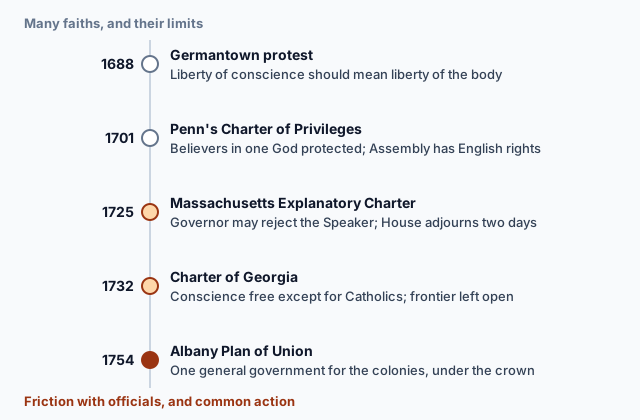
Pennsylvania shows it clearly. Penn's Charter of Privileges of 1701 opens with religion, because "no People can be truly happy, though under the greatest Enjoyment of Civil Liberties, if abridged of the Freedom of their Consciences."
Liberty had limits, and some colonists said so. In 1688 four men at Germantown, in Pennsylvania, wrote a protest "against this traffic of men-body," the trade in enslaved people. They began from a freedom the colony already had, "Here is liberty of conscience, which is right and reasonable," and argued that "here ought to be likewise liberty of the body." "In Europe there are many oppressed for conscience sake," they wrote, and in Pennsylvania people were oppressed for being Black.
Penn's charter drew lines of its own. It protected only those who "confess and acknowledge One almighty God," and only those who professed belief in Jesus Christ could serve in the government.
Sources: Charter of Privileges, 1701 (Avalon Project); Germantown protest, 1688 (Avalon Project).
Quick check · Sort it
Each card is a phrase or a rule from Pennsylvania's 1701 Charter of Privileges. Tap a card, then what it does to religious freedom.
Widens religious freedom
Draws a line around it
2b. Revival and Enlightenment
Later in the colonial era two movements of ideas crossed the Atlantic and deepened that exchange.
The first Great Awakening was a wave of Protestant revivals that spread from colony to colony. Preachers urged each listener toward a personal conversion. Protestant evangelicalism, this stress on conversion and on spreading the faith, gave colonists in different places a shared religious experience. It also gave many of them more independence in religion: they judged churches and ministers for themselves.
Decades earlier, Penn's charter had stated a similar idea in one phrase: "Almighty God being the only Lord of Conscience." If only God rules conscience, no government or church official can.
The Enlightenment was a European movement that trusted reason to explain the world and to improve government. Its ideas reached the colonies through a transatlantic print culture: books, pamphlets and newspapers that moved between Britain and the colonies and among the colonies themselves.
The two movements differ in what they trusted, faith or reason, but they traveled the same way, through preaching and print that crossed colonial borders. Together with the colonies' many churches, they left colonists with greater religious independence and diversity.
Quick check · Match
Match each scene from the colonies in the 1700s to the development it shows.
2c. Growing more English
Anglicization means becoming more English. Over time the British colonies grew more like England in law, politics and culture, even as their populations grew more varied. Trade among the colonies, a shared print culture and Protestant evangelicalism tied colonists to Britain and to one another.
Their governments followed English models but were run at home. Each colony became an autonomous political community, governing its own affairs through an elected assembly. Penn's charter let Pennsylvania's Assembly "chuse a Speaker" and "prepare Bills in order to pass into Laws" (spelling as printed), and gave it "all other Powers and Privileges of an Assembly, according to the Rights of the free-born Subjects of England."
Read that last phrase closely. The Assembly claims its power to govern locally as a right of English subjects. Becoming more English did not make colonists more willing to be ruled from London. An assembly that claimed the rights of Englishmen expected the powers that went with them.
Quick check · Fill the statement
Read the situation, then complete the sentences.
A Philadelphia merchant in the 1740s reads London newspapers, ships goods to Boston and New York, and votes for the assembly that makes his colony's laws. His reading and his trade with other colonies are part of the process called . His vote shows that his colony is built on an English model.
2d. Different goals, growing mistrust
European leaders and colonists did not always want the same things, and where their goals pulled apart, mistrust grew on both sides of the Atlantic.
The crown's own words show its goals. Georgia's charter of 1732 says a new colony would "strengthen our colonies and increase the trade, navigation and wealth of these our realms." Colonies were to serve the empire's trade and strength.
Colonists had goals of their own. In British North America they voiced dissatisfaction over four kinds of issue:
- territorial settlements: who could claim and settle which land
- frontier defense: who protected settlers on the edges of the colonies, and who paid
- self-rule: how much power their own assemblies had against royal governors
- trade: the rules the empire set for what they could buy and sell, and where
When colonists resisted imperial control, they drew on their local experience of self-government, on evolving ideas of liberty, on the political thought of the Enlightenment, on their greater religious independence and diversity, and on an ideology critical of what they saw as corruption in the imperial system.
Quick check · Sort it
Each card is a colonial complaint. Tap a card, then the kind of issue it raises.
Territorial settlements
Frontier defense
Self-rule
Trade
Part 3 Watch it done Identify the development in the Albany Plan
Watch each step, then do the last one yourself.
The Albany Plan of Union of 1754 opens: "It is proposed that humble application be made for an act of Parliament of Great Britain, by virtue of which one general government may be formed in America, including all the said colonies, within and under which government each colony may retain its present constitution." Identify the historical development the plan shows.
Predict first
Before the steps, what do you think the plan was mainly for?
Step 1 · Place it
The plan is dated 1754, at the end of this period. A note on the Avalon Project's copy credits it to Benjamin Franklin and Thomas Hutchinson. It asks for "an act of Parliament," and it lets "each colony" keep its own constitution.
Why this step?
Why look at who would approve the plan before reading what it does?
Who must approve a proposal tells you the frame it works within. A plan that asks Parliament to act accepts Parliament's authority, and every power in it should be read with that in mind.
Step 2 · Read its powers
The plan's President-General was "to be appointed and supported by the crown," and its Grand Council was "to be chosen by the representatives of the people of the several Colonies met in their respective assemblies." Together they would "hold or direct all Indian treaties," make laws "for regulating all Indian trade," and "raise and pay soldiers and build forts."
Your step · Decide and justify
Finish it. Which development does the Albany Plan most directly show?
Which evidence best supports your answer?
Part 4 Try it A quarrel in Massachusetts
In 1691 the crown gave Massachusetts Bay a new charter. It left two questions open: whether the royal governor could reject the Speaker whom the elected House of Representatives chose, and whether the House could adjourn itself. In 1725 the crown issued an Explanatory Charter. It says the gaps had caused trouble, "by means whereof divers Doubts and Controversies have Arisen within Our said Province to the Interrupcon of the Publick Business thereof and the obstruccon of Our Service" (spelling as printed). It then gave the governor power "to approve or disapprove of the Person so Elected" as Speaker, and let the House adjourn itself "for the space of two days but not for any longer time than for the space of two days without leave from the Governor."
Sources: Explanatory Charter of Massachusetts Bay, 1725 (Avalon Project); Avalon Project, 17th Century Documents (date of the 1691 charter).
Try it · Multiple choice
Which kind of colonial complaint does the 1725 charter's subject belong to?
Try it · Spot the error
A student writes a paragraph identifying the development in the 1725 charter. Which line is the first to go wrong?
Part 5 Explain it Write it like a document-based answer
Nothing you type leaves this page. Check your answer against the model and each scoring point.
Free-response practice · Question 1 style
A short practice in the shape of the document-based question: three documents instead of seven, and a thesis with one body paragraph instead of a full essay.
Evaluate the extent to which the British colonies' ties to Britain grew stronger between 1701 and 1754.
Document 1. Charter of Privileges granted by William Penn to Pennsylvania, October 28, 1701: the Assembly shall have "all other Powers and Privileges of an Assembly, according to the Rights of the free-born Subjects of England."
Document 2. Explanatory Charter of Massachusetts Bay, issued by the crown, August 26, 1725. The 1691 charter had left the Speaker and adjournment unsettled, "by means whereof divers Doubts and Controversies have Arisen within Our said Province to the Interrupcon of the Publick Business thereof and the obstruccon of Our Service" (spelling as printed). From now on the House may adjourn itself "for the space of two days but not for any longer time than for the space of two days without leave from the Governor."
Document 3. Albany Plan of Union, 1754: a President-General "to be appointed and supported by the crown," and a Grand Council "to be chosen by the representatives of the people of the several Colonies met in their respective assemblies," under a general government in which "each colony may retain its present constitution."
Write a thesis, one sentence of historical context, and one paragraph that uses at least two documents and explains the purpose, audience, point of view or situation of one of them.
Model answer
Thesis: Between 1701 and 1754 the colonies grew more tied to Britain in the models and rights they claimed, but the same English rights led colonists to defend their own assemblies, so the ties grew stronger in culture and government forms more than in obedience.
Context: Britain tried to fit its colonies into a mercantilist imperial structure, but enforcement was erratic, which left colonial assemblies room to grow.
In 1701 Pennsylvania's Assembly claimed its powers "according to the Rights of the free-born Subjects of England" (Document 1), measuring its self-government by an English standard. That standard could set colonists against royal officials. In Massachusetts, quarrels over the Speaker and adjournment produced "divers Doubts and Controversies" (Document 2). The Explanatory Charter was written by the crown, and its point of view shows: it calls the quarrel an "obstruccon of Our Service" rather than a defense of colonial rights, and it settles the matter for the governor. By 1754 the Albany Plan proposed a union with a head "appointed and supported by the crown" (Document 3), yet let "each colony" keep its constitution and gave the assemblies the choice of the Grand Council. Colonists drew closer to Britain and to one another while insisting on running their own affairs.
Score your own answer. This is a self-check, not a grade. Tick each point your answer makes.
Part 6 Check yourself Georgia's charter
The case questions use the two excerpts. The others mix the ideas from the whole lesson.
Both excerpts are from the Charter of Georgia, issued by King George II on June 9, 1732. The charter is the crown's account, written to justify founding a new colony; it names the danger and says nothing of why the Native nations fought. "Papists" was a hostile word of the time for Roman Catholics, and "savages" the charter's word for American Indians. Sources: Charter of Georgia (Avalon Project); Avalon Project, 18th Century Documents (date).
| Subject | Excerpt |
|---|---|
| Why a new colony | "our provinces in North America, have been frequently ravaged by Indian enemies, more especially that of South-Carolina, which in the late War, by the neighboring savages, was laid waste with fire and sword" |
| Religion | "there shall be a liberty of conscience allowed in the worship of God, to all persons inhabiting, or which shall inhabit or be resident within our said provinces and that all such persons, except papists, shall have a free exercise of their religion" |
Case question 1 · Multiple choice
The first excerpt shows the crown taking up which concern that colonists also raised?
Case question 2 · Multiple choice
What does the second excerpt show about religion in the British colonies?
The rest stand on their own and do not use the case.
Check yourself · Match
Match each colonial document to the development it shows.
Check yourself · Select all
A colonial assembly protests the 1725 limits on the Massachusetts House. Colonial resistance drew on local self-government, ideas of liberty, Enlightenment thought, religious independence and a critique of corruption in the imperial system. Which two arguments both protest these limits and draw on one of those roots? Select two.
Select 2 answers, then check.
Part 7 Keep it Bring back earlier ideas
This lesson stands on slavery in the British colonies from Topic 2.6 and colonial self-government from Topic 2.3.
Bring it back · Multiple choice
As chattel slavery became the main labor system in many southern colonies, new laws decided the status of children. Which rule did they set?
Bring it back · Fill the statement
Read the situation, then complete the sentences.
A traveler around 1700 visits a Massachusetts town and a Virginia county. In the town, voters gather to settle local matters and choose who will represent them, which is a . In the county, the seat in the elected assembly goes to .
In three lines
- Many European peoples and faiths made the British colonies plural, and the Great Awakening and the Enlightenment deepened their exchange of ideas.
- Trade, print and Protestant evangelicalism made the colonies more English over time, and each governed itself through an assembly on English models.
- Colonists' and imperial leaders' goals diverged over land, the frontier, self-rule and trade, and colonial resistance drew on self-government and ideas of liberty.
Exam strategy for this topic
- Section I Part A, Multiple Choice: 55 questions in 55 minutes.
- Section I Part B, Short Answer: 3 questions in 40 minutes.
- Section II, Document-Based Question and Long Essay: 2 questions in 100 minutes.
- This lesson's Explain it is shaped like free-response question 1, Document-based.
When a question asks you to identify a development, name it in the course's terms, such as pluralism, Anglicization or a dispute over self-rule, and point to the words in the source that show it.
Questions students ask
Did religious toleration in the colonies mean freedom for everyone?
No. Penn's 1701 charter protected those who believed in one God and let only Christians hold office, and Georgia's 1732 charter granted liberty of conscience to all "except papists," meaning Roman Catholics.
What was the first Great Awakening?
A wave of Protestant revivals that spread from colony to colony and stressed personal conversion. It gave colonists in different places a shared religious experience and more independence in judging churches for themselves.
If the colonies were becoming more English, why did they quarrel with Britain?
Because English models included elected assemblies with real powers, which colonists claimed as English rights. When the crown limited an assembly, as the 1725 Massachusetts charter did in the governor's favor, the dispute was over powers colonists believed were theirs as English subjects.
Why do some quotations in this lesson spell words like "chuse" or "Interrupcon"?
Every excerpt is copied exactly as the archive prints it, old spellings included, so you can check it against the source linked beside it.
Where can I read these documents in full?
Each excerpt links to its full text at the Avalon Project at Yale Law School, the primary-source collection this lesson was checked against.
Course alignment, for teachers
AP U.S. History topic 2.7, Unit 2: Period 2: 1607–1754.
- Skill 1.A: Identify a historical concept, development, or process.
This lesson maps all 4 essential knowledge statements of the topic, and the 2 learning objectives with none of their own, to the part that teaches each one: 6 are checked by a scored question. The map is in the lesson file.